
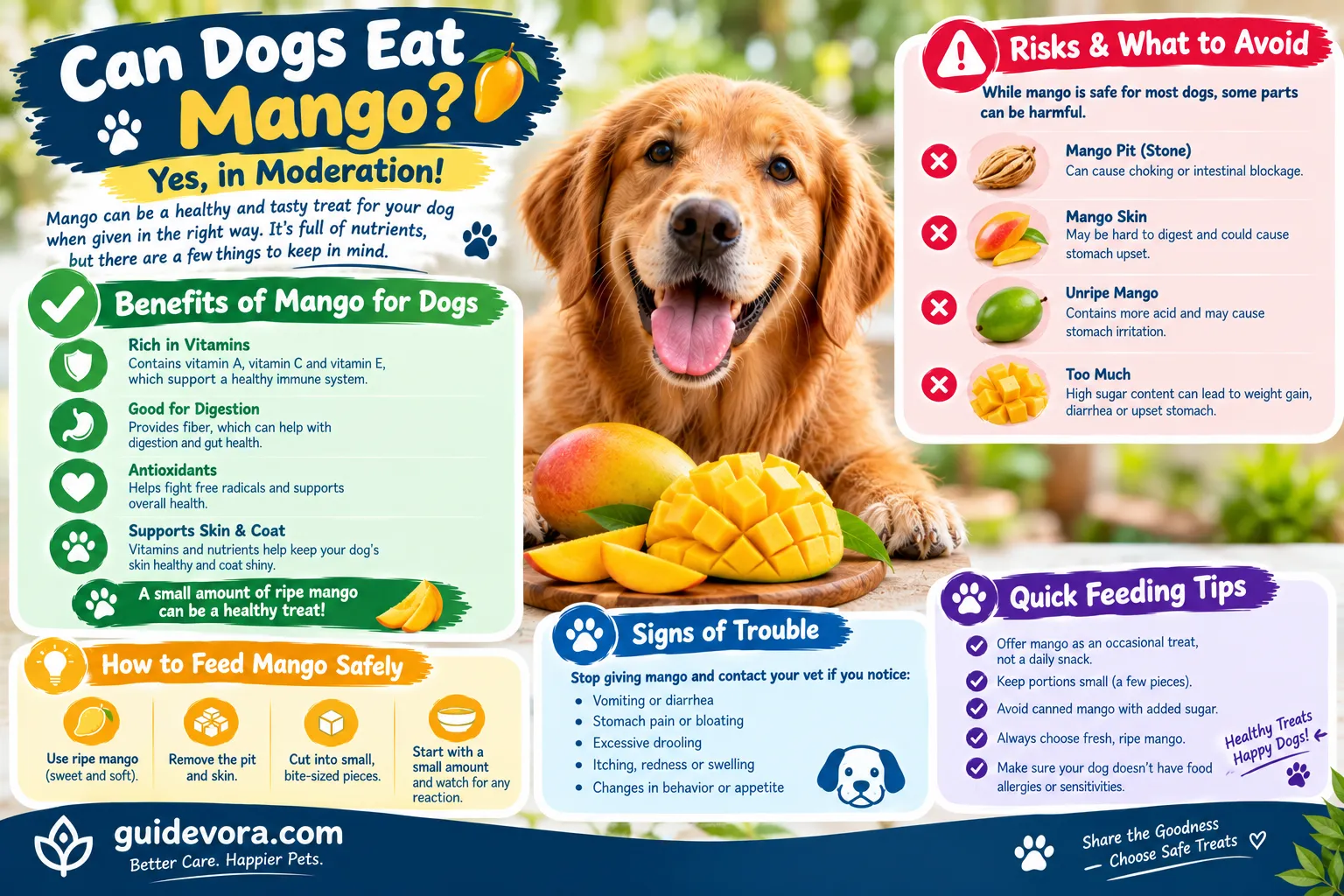
Yes — the flesh of a ripe mango is safe for dogs and even offers some real nutritional value (vitamins A, C, B6, and fiber), as long as it’s peeled, pitted, and given in moderation. The parts to actually watch out for are the skin and the pit, not the fruit itself — get those two things right and mango is a genuinely fine occasional treat.
How to Prepare Mango Safely
- Wash the mango to remove any surface pesticide residue.
- Peel off all the skin. Don’t skip this — see below for why it matters more than most fruit skins.
- Cut around the pit completely and discard it; never let your dog near it directly.
- Cut the flesh into small, bite-sized pieces — smaller for small dogs and puppies, since mango can be a choking risk in large chunks regardless of the pit.
- Serve plain — no added sugar, yogurt dips, or seasoning.
Can Dogs Eat Mango Skin?
Best avoided, even though it’s not strictly toxic. Mango skin is tough and fibrous, which makes it genuinely hard for dogs to digest and a realistic choking or minor blockage risk, especially in smaller dogs. There’s also a lesser-known detail worth knowing: mango skin contains urushiol, the same compound found in poison ivy and poison oak, which can cause skin irritation or a rash on contact in sensitive individuals. Between the digestion difficulty and this, peeling the mango fully before offering it is worth the extra minute every time.
Read More: Dog Ate a Bee? Here’s What Actually Happens
Can Dogs Eat Mango Seed (Pit)?
No — remove it every time, without exception. The pit is large, hard, and flat, making it a genuine choking hazard and a well-documented cause of intestinal blockage if swallowed. It also contains small amounts of cyanogenic compounds, though a dog would generally need to chew through and consume multiple pits for that specifically to be the primary concern — the mechanical choking/blockage risk is the more immediate and more common danger. If your dog does swallow a mango pit, contact your veterinarian right away, even if they seem fine at first — a blockage doesn’t always cause symptoms immediately.
How Much Mango Can I Give My Dog?
Follow the same general treat guideline that applies across fruits: no more than roughly 10% of your dog’s daily caloric intake, with mango specifically kept to an occasional treat rather than a regular one, since it’s notably high in natural sugar for a fruit.
- First time trying mango: offer one small piece and wait to see how your dog tolerates it before giving more.
- Small dogs and puppies: need proportionally smaller pieces and smaller total amounts than the same treat would represent for a large dog.
- Dogs with diabetes, obesity, or pancreatitis: talk to your vet before offering mango at all, given its sugar content.
Can Dogs Eat Mango Every Day?
Not recommended as a daily habit, even though an occasional piece is fine. Mango’s sugar content is the main reason — regular daily feeding adds up in calories and can contribute to weight gain over time, and it also just makes the treat less special/motivating as a training reward if it becomes routine. Save it for an occasional warm-weather treat rather than a daily addition to your dog’s diet.
Is Mango a Laxative for Dogs?
Not in the traditional sense, but it can have a similar practical effect in larger amounts. Mango is high in both fiber and natural sugar, and too much of either can lead to loose stools or diarrhea in dogs, especially if it’s a new food or given in a large quantity all at once. In small, appropriate amounts, the fiber content is generally considered a mild digestive benefit rather than a problem — it’s specifically overfeeding that tends to cause the laxative-like effect people notice.
Common Real-World Scenarios
Can dogs eat dried mango? Best avoided, or offered only very sparingly if homemade with no added sugar. Drying concentrates mango’s natural sugar significantly, and store-bought dried mango often includes added sugar or preservatives that make it a meaningfully worse choice than fresh mango. If you do offer dried mango, a small homemade piece with nothing added is the safer version — not the packaged kind from a store shelf.
Can dogs eat mango and pineapple together? Both are non-toxic to dogs individually and can be combined in small amounts as an occasional fruit treat — but combining two sugary fruits means paying closer attention to total portion size, since the 10% treat guideline applies to the combined amount, not each fruit separately.
Can dogs eat mango yogurt? Only if it’s plain, unsweetened yogurt with no added sugar, artificial sweeteners, or fruit syrup — and specifically check the label for xylitol, an artificial sweetener increasingly common in flavored and “light” yogurts that’s genuinely toxic to dogs. Most commercial mango-flavored yogurt cups aren’t a good choice; plain yogurt with a small amount of fresh mango mixed in yourself is a safer version of the same idea.
Can dogs eat mango sticky rice? Not recommended as a dish, even though none of the individual base ingredients are toxic. This popular dessert typically includes added sugar, coconut milk (high in fat), and sometimes salt — the combination is too rich and calorie-dense to be a good choice, even though a small piece is unlikely to cause acute harm. Fresh, plain mango on its own is a far better way to give your dog the same fruit.
Is mango safe for small breeds like Shih Tzus? Yes, the fruit itself isn’t more or less risky for any particular breed — but small breeds do need proportionally smaller pieces and smaller total portions, given their much lower daily caloric needs. A piece sized appropriately for a large dog can be an oversized, choking-risk portion for a small breed.
Frequently Asked Questions
Can dogs eat mango? Yes — the peeled, pitted flesh of a ripe mango is safe for dogs in moderation and offers some real nutritional value. Avoid the skin and pit, and treat it as an occasional treat rather than a daily food.
Can dogs eat mango skin? It’s best to remove it. Mango skin is tough to digest, poses a minor choking/blockage risk, and contains urushiol, the same irritant compound found in poison ivy.
Can dogs eat mango seeds (pits)? No. The pit is a genuine choking hazard and a common cause of intestinal blockage, and it contains trace cyanogenic compounds. Always cut around it and discard it before offering mango to your dog.
How much mango can I give my dog? Treat it like any other treat — no more than about 10% of daily calories, and only occasionally given mango’s sugar content. Start with one small piece the first time to check tolerance.
Is mango a laxative for dogs? Not inherently, but overfeeding mango can cause loose stools or diarrhea due to its combined fiber and sugar content. Small, appropriate portions are generally fine and don’t typically cause this effect.
Can dogs eat mango every day? It’s better as an occasional treat than a daily one — mango’s natural sugar content makes daily feeding more likely to contribute to weight gain over time compared to a less sugary treat.
What fruit can dogs not have? Grapes and raisins are the most important to avoid entirely, as they can cause acute kidney injury even in small amounts. Cherries (pit and stem), and the seeds/pits of apples, are also worth avoiding. This topic is broad enough to deserve its own full breakdown beyond this answer.
Final Thoughts
Mango is one of the more genuinely dog-friendly fruits out there — the real risk isn’t the fruit itself, it’s skipping the prep. Peel it, pit it, cut it small, and keep it occasional rather than daily, and there’s very little to worry about. Save dried mango, mango sticky rice, and flavored yogurt cups for yourself; a few fresh, plain chunks are the version your dog actually benefits from.
This article is for informational purposes and doesn’t replace veterinary guidance for a dog with existing health conditions or a specific ingestion concern.
Leave a Reply