
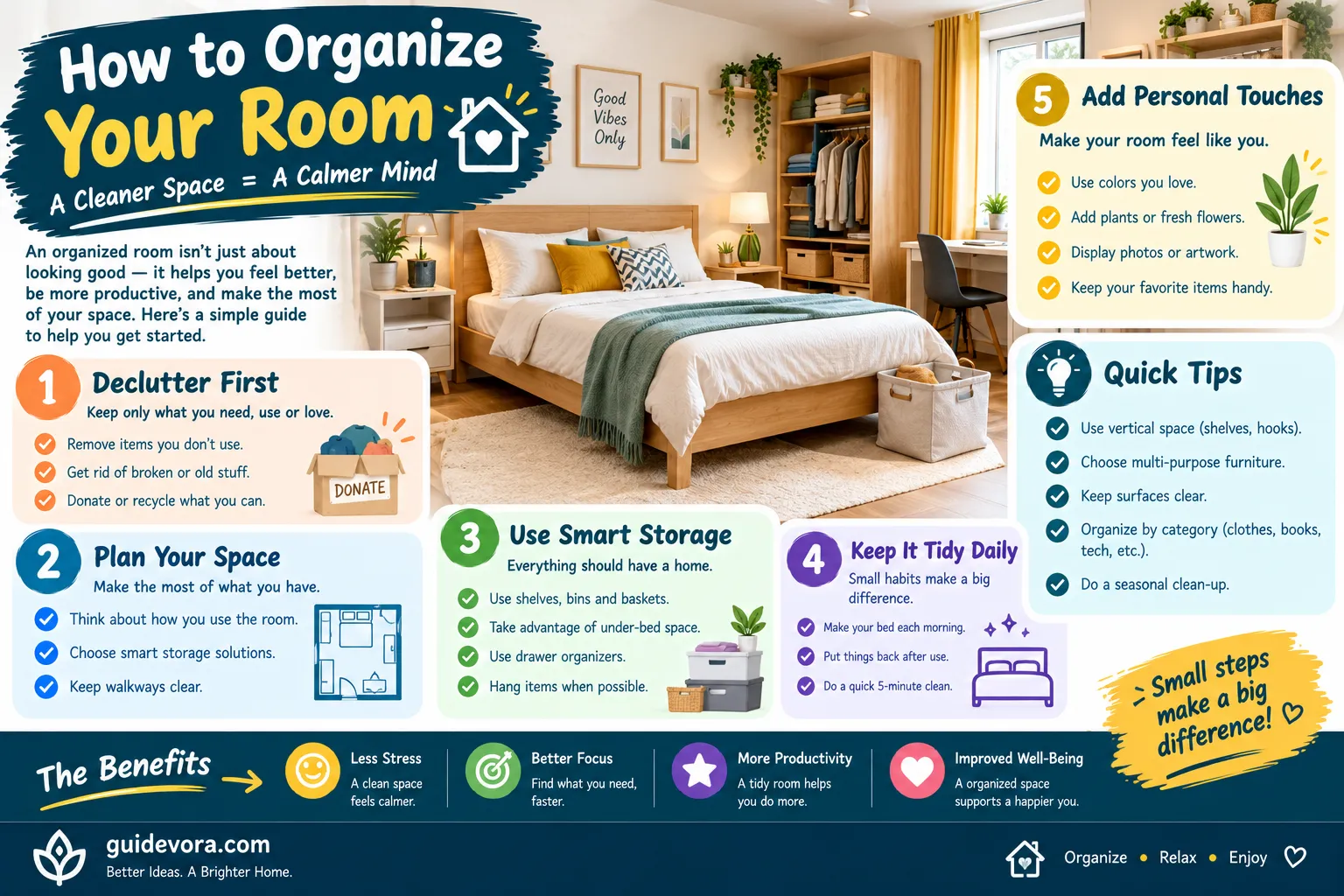
A messy room doesn’t happen overnight, and it won’t fix itself overnight either. But learning how to organize your room doesn’t require a weekend-long overhaul or a trip to the container store. It requires a system — and that’s exactly what this guide gives you.
Below, you’ll find a beginner-friendly, step-by-step method for how to organize your room, plus the two decluttering rules everyone’s asking about right now (the 3-3-3 rule and the 50% rule), tips for rooms with way too much stuff, and how to make your finished space look genuinely aesthetic — not just tidy.
Quick Answer: How to Organize Your Room in 7 Steps
- Empty and sort — pull everything out of drawers, closets, and corners
- Declutter first — decide what stays before you decide where it goes
- Deep clean the empty room — dust, vacuum, and wipe surfaces while they’re bare
- Plan your layout — map furniture placement before you move anything heavy
- Assign a “home” to every category — clothes, electronics, papers, everything
- Use vertical and under-used space — walls, the back of doors, under the bed
- Do a 10-minute daily reset — the habit that actually keeps a room organized
If you only remember one thing from this guide, remember this: decluttering and organizing are two different steps. Skipping straight to storage bins before you’ve removed what you don’t need is the #1 reason room organization projects fail.
How to Organize Your Room Step by Step
Step 1: Take Everything Out (Yes, Everything)
Before you can organize a space, you need to see it empty. Pull items out of drawers, shelves, and closets and group them into rough piles by category: clothing, books, electronics, paperwork, miscellaneous. This single step is what separates a true reset from “shuffling clutter around,” and it’s the foundation of how to organize your room step by step the right way.
Tip for small rooms: work in zones (one drawer, one shelf, one corner at a time) if clearing the whole room at once feels unmanageable.
Step 2: Declutter Using a Proven Rule
This is the step most people skip — and the step that matters most. Two decluttering methods consistently come up in organizing circles because they remove the guesswork of “should I keep this?”
What Is the 3-3-3 Rule for Decluttering?
The term “3-3-3 rule” actually refers to two different methods, so it’s worth knowing both:
- The wardrobe version (Project 333): a minimalist challenge where you wear only 33 items of clothing for 3 months, then reassess what you genuinely missed.
- The room-decluttering version: for each area of your room, pick 3 items to throw away, 3 items to donate, and 3 items to relocate to where they actually belong. Repeat this round in every zone of the room until it’s clear.
For a bedroom reset, the room-decluttering version is the faster, more practical choice — it turns an overwhelming “declutter everything” task into small, repeatable decisions.
What Is the 50% Rule for Clutter?
The 50% rule for clutter is simple: take everything out of a space (a drawer, a shelf, a closet) and allow only half of it back in. The rest is donated, sold, or thrown away.
| Rule | Best For | How It Works |
|---|---|---|
| 3-3-3 Rule | Small zones, quick decisions | 3 trash, 3 donate, 3 relocate per area |
| 50% Rule | Overstuffed closets, shelves, drawers | Remove everything, keep only half |
| 90-Second Rule | “Maybe” items you keep picking up | If you can’t decide in 90 seconds, put it in a “maybe” box with a 30-day return date |
You don’t need to pick just one — many people use the 50% rule for closets and drawers, then the 3-3-3 rule for flat surfaces like desks and nightstands.
Step 3: Clean the Empty Space
With the room cleared out, this is the easiest time to dust shelves, vacuum under furniture, wipe down windowsills, and wash bedding. Organizing a dirty room just traps dust under new storage bins — clean first, store second.
Step 4: Plan Your Layout Before You Move Furniture
This is where a room layout planner earns its keep. Before you haul a dresser across the room, sketch the layout (on paper or using a free digital tool) to check:
- Does the bed block a window, vent, or closet door?
- Is there a clear walking path from the door to the bed?
- Will large furniture (bed, desk, dresser) fit without crowding entry points?
Free room planner tools worth trying:
- IKEA Home Planner — drag-and-drop furniture to scale, free and browser-based
- Roomstyler 3D Home Planner — free 3D room planner with a large furniture library
- Sweet Home 3D — a free, downloadable room planner for more detailed layouts
- A quick “room planner” or “room layout planner free” search on your phone’s app store also works well for a fast mobile option
A good room planner takes 10 minutes and saves you from re-arranging a heavy dresser three times.
Step 5: Give Every Category a Home
This is the core of how to best organize your bedroom long-term: every type of item needs one specific, consistent place to live.
- Clothes: closet by category (tops, bottoms, outerwear), drawers by type
- Books/media: a dedicated shelf, sorted by use (currently reading vs. storage)
- Chargers & electronics: one labeled drawer or basket near an outlet
- Papers & school/work items: a tray or folder system on the desk, cleared weekly
- Sentimental items: one labeled memory box — not scattered across surfaces
Step 6: Use Vertical and Hidden Space
Floor space is usually the first thing to run out — walls and gaps rarely do.
- Install floating shelves above the desk or bed for books and décor
- Use under-bed storage bins for off-season clothing or linens
- Add a hanging organizer on the back of the closet or bedroom door
- Use drawer dividers so small items don’t become loose clutter again within a week
Step 7: Build a 10-Minute Daily Reset Habit
Organizing is a one-time project; staying organized is a habit. Spend 10 minutes before bed putting items back in their assigned homes. This single habit is the real answer to how to arrange your room perfectly and keep it that way — not just for one weekend.
How to Start Organizing a Messy Room (When You Don’t Know Where to Begin)
If the room feels too overwhelming to start, don’t try to tackle it all at once.
- Set a timer for 15–20 minutes and work in just one corner or one surface
- Start with trash — an empty trash bag is the fastest, guilt-free win
- Clear flat surfaces first (desk, nightstand, floor) before touching closets or drawers
- Use the 3-3-3 rule in that one zone, then stop and reassess before moving on
- Resist buying storage bins first — organize what you’re keeping, then shop for containers that fit
This same approach works whether you’re figuring out how to start organizing a messy room or tackling how to start organizing a messy house room by room — momentum from one finished zone makes the next one easier.
How to Organize a Room With Too Much Stuff
A room that feels impossible to organize usually has one real problem: too much volume, not too little storage. Before adding a single new bin:
- Apply the 50% rule to every closet and drawer, not just the obvious clutter spots
- Sort duplicates — most people own more chargers, pens, and towels than they realize
- Box up “maybe” items with a date; if unopened in 30–60 days, donate the box unopened
- Prioritize floor space first — a visibly emptier floor makes the whole room feel organized even before storage is finished
How to Organize Your Room on a Beginner’s Budget
You don’t need new furniture to organize a room well. Start with what’s already in the house:
- Shoeboxes and cardboard boxes as makeshift drawer dividers
- Command hooks for bags, hats, and accessories (no drilling required)
- Repurposed jars for desk supplies or jewelry
- Reused gift bags or baskets as a temporary “donate” bin
This is the most budget-friendly way to approach how to organise your room for beginners — build the system first, upgrade the containers later.
How to Organize Your Room Aesthetic (Without Sacrificing Function)
An organized room and an aesthetic room aren’t the same thing — but they can be. A few low-effort upgrades make the difference:
- Matching bins and baskets in one or two colors instantly look more curated than mismatched containers
- Hide, don’t just store — lidded boxes and closed baskets read cleaner than open bins on display
- One accent color or theme tying bedding, storage, and décor together
- Clear surfaces — even a perfectly organized drawer looks cluttered if the desk on top is covered
How to Arrange Your Room Perfectly: Layout Tips
Once your items are sorted and stored, furniture placement is what makes the room feel finished.
- Position the bed against the longest uninterrupted wall, away from direct door swing
- Keep walkways at least 2 feet wide between major furniture pieces
- Place the desk near natural light when possible, rather than facing a blank wall
- Leave breathing room around furniture — pushing everything flush to the walls often makes a small room feel more cramped, not less
Frequently Asked Questions
How do I best organize my bedroom?
Start by removing everything and sorting it into keep, donate, and trash using the 3-3-3 or 50% rule. Clean the empty room, plan furniture placement with a room planner, then assign a fixed “home” for every category of item — clothes, electronics, papers, and sentimental items.
What is the 3-3-3 rule for decluttering?
For a room, the 3-3-3 rule means choosing 3 items to throw away, 3 to donate, and 3 to relocate in each zone you tackle. (A separate version, Project 333, is a wardrobe challenge where you wear only 33 clothing items for 3 months.)
What is the 50% rule for clutter?
The 50% rule means removing everything from a space — a drawer, shelf, or closet — and only allowing half of it back in. The remaining half is donated, sold, or thrown away.
How do I start organizing a messy room if I feel overwhelmed?
Set a 15–20 minute timer and focus on one small zone, like a single drawer or the top of a desk. Clear trash first for an easy win, then apply the 3-3-3 rule before moving to the next zone.
How can I organize my room if I have too much stuff?
Apply the 50% rule to every closet and drawer before buying new storage. Sort duplicates, box up “maybe” items with a 30-day decision date, and prioritize clearing floor space first.
Is there a free room layout planner I can use?
Yes — tools like the IKEA Home Planner, Roomstyler 3D Home Planner, and Sweet Home 3D all offer free, browser-based room planning so you can test furniture placement before moving anything heavy.
Final Thoughts
Learning how to organize your room isn’t about buying the right bins — it’s about following the right order: declutter first, clean second, plan the layout third, and assign a permanent home to everything you keep. Use the 3-3-3 rule or the 50% rule to make decluttering decisions faster, lean on a free room planner before moving furniture, and finish with a 10-minute nightly reset so the work actually sticks.
Leave a Reply