
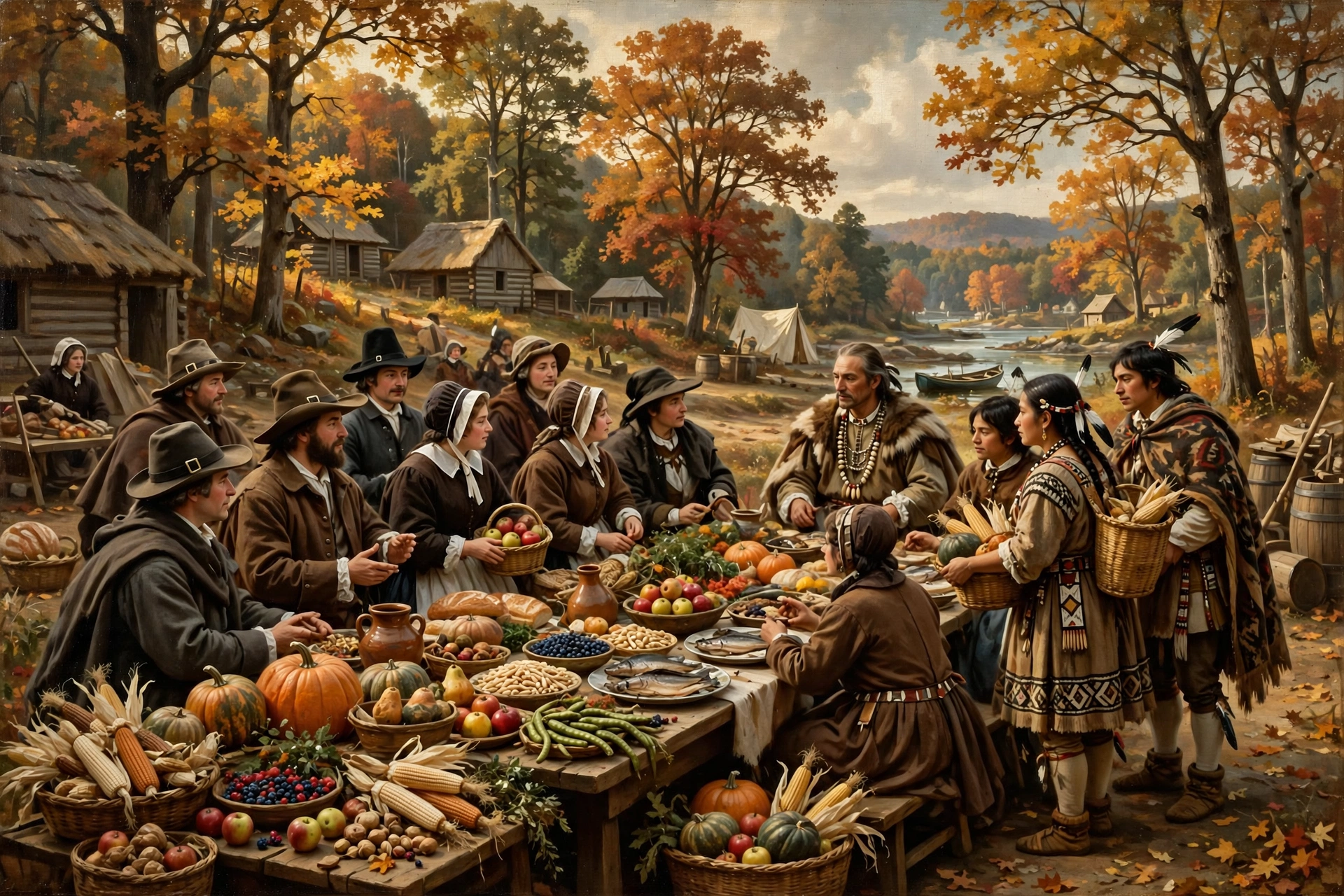
Thanksgiving has a history that stretches far beyond the familiar image of Pilgrims and Native Americans sharing a meal in 1621. The American holiday developed over centuries from Indigenous traditions of gratitude, European harvest customs, colonial religious observances, and presidential proclamations.
The event most often associated with Thanksgiving occurred in Plymouth Colony in the autumn of 1621, when English settlers and members of the Wampanoag people participated in a harvest gathering. However, that gathering did not immediately establish the national holiday celebrated today.
Thanksgiving gradually became a recognized American tradition, particularly during the nineteenth century. In 1863, President Abraham Lincoln called for an annual national observance, and in 1941, federal legislation established its modern calendar date.
Understanding the history of Thanksgiving in America requires examining these separate developments and the experiences of the Indigenous communities whose history is often missing from simplified versions of the story. If you are curious about the holiday’s deeper meaning, read our guide on why Americans celebrate Thanksgiving.
Where Did Thanksgiving Originally Come From?
The origins of Thanksgiving cannot be traced to a single meal or individual.
Long before the establishment of the United States, different communities practiced ceremonies and celebrations connected to gratitude, harvests, and seasonal changes.
Indigenous peoples across North America had their own longstanding traditions of giving thanks. These practices varied between nations and were not simply earlier versions of the modern American holiday.
European settlers also brought harvest festivities and Christian traditions of prayer and thanksgiving. In colonial New England, religious days of thanksgiving were sometimes proclaimed in response to particular events.
Over time, several distinct traditions became connected to the holiday now known as Thanksgiving.
Indigenous Traditions Before European Settlement
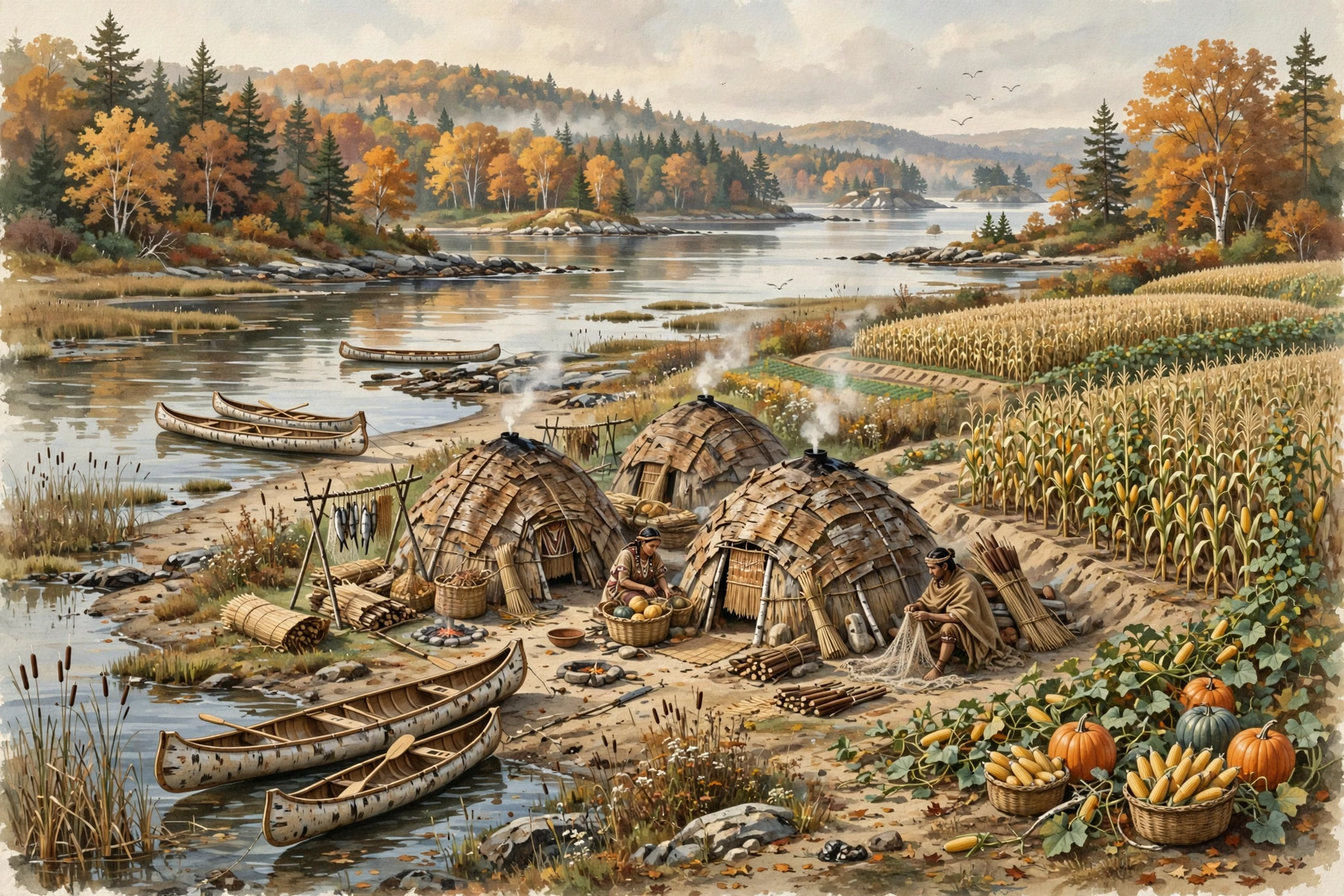
The Wampanoag people lived in the region of present-day southeastern Massachusetts and eastern Rhode Island for thousands of years before the arrival of the Mayflower.
Their communities had established agricultural practices, political relationships, spiritual traditions, and systems of trade.
Seasonal activities, including planting, harvesting, fishing, and gathering, played important roles in community life.
Gratitude and reciprocity were already meaningful parts of Wampanoag cultural traditions. The arrival of English settlers did not introduce the concept of giving thanks to the region.
The Smithsonian National Museum of the American Indian explains that archaeological evidence places Wampanoag communities in their ancestral homelands for at least 12,000 years.
This much longer history is essential for understanding why the popular phrase “the first Thanksgiving” can be misleading.
European Harvest and Religious Traditions
Harvest celebrations had existed in Europe for centuries.
Farmers and communities marked the end of agricultural seasons with meals, gatherings, and religious observances.
English Protestant settlers also recognized special days of thanksgiving through prayer and worship.
These traditions contributed to the development of later American celebrations, but the national holiday did not emerge directly from any one European custom.
What Happened Before the First Thanksgiving in 1621?
The story of the 1621 harvest gathering begins before the English settlers arrived.
During the early seventeenth century, European voyages, trade, forced captivity, and disease affected Indigenous communities throughout coastal New England.
Between approximately 1616 and 1620, devastating epidemics caused major population losses in Wampanoag communities.
The Patuxet community, whose village occupied the site where Plymouth Colony was later established, was particularly affected.
The Mayflower Arrived in 1620
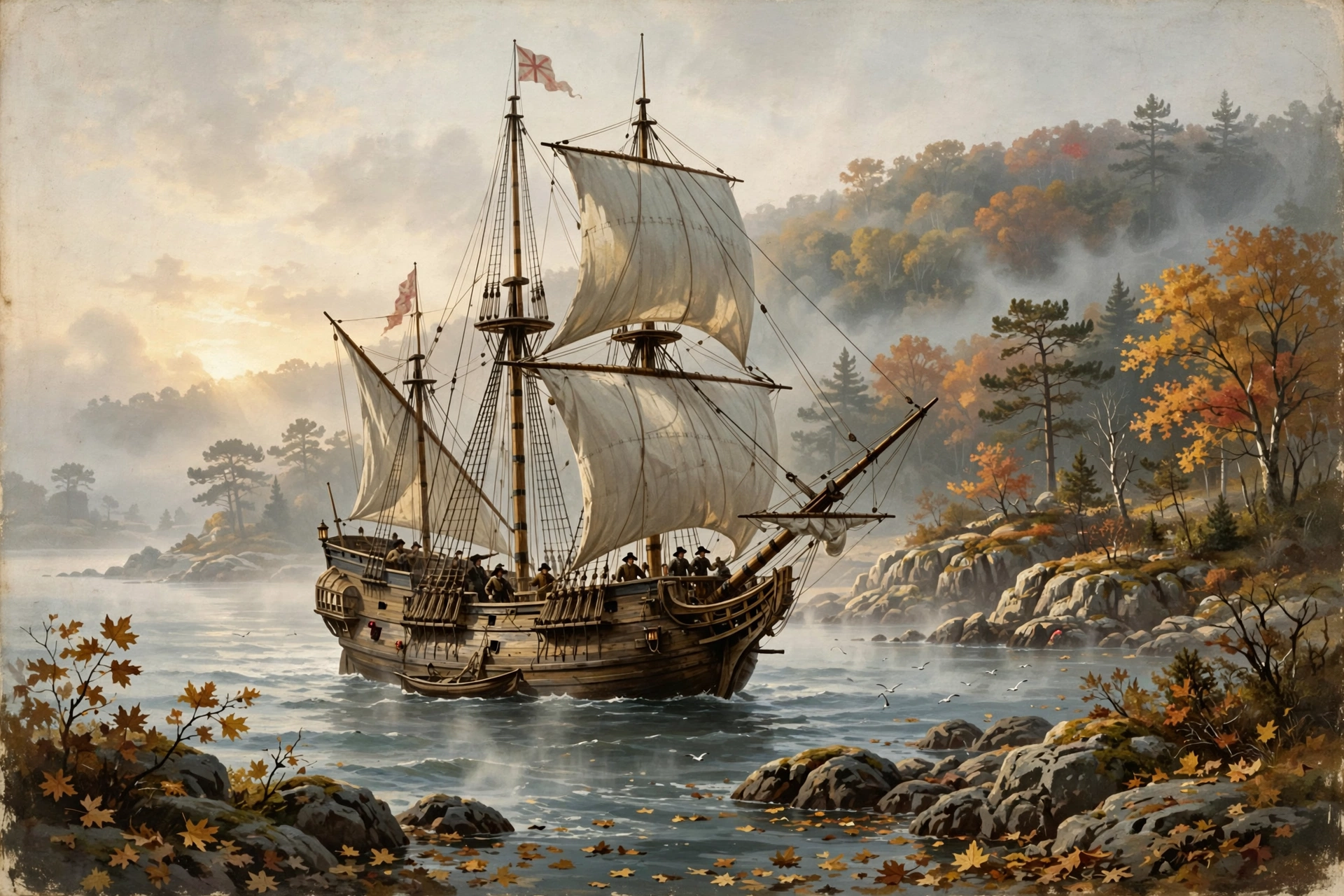
The Mayflower carried English settlers across the Atlantic in 1620.
After reaching Cape Cod, the settlers eventually established their colony at Patuxet, which they renamed Plymouth.
Their first winter was extremely difficult.
Many colonists died from illness, malnutrition, and severe conditions.
The settlers faced significant challenges in producing food and establishing a stable community.
The Wampanoag Alliance of 1621
Ousamequin, often called Massasoit in English historical accounts, was an important Wampanoag leader.
He made a strategic decision to establish diplomatic relations with the Plymouth settlers.
In March 1621, Wampanoag leaders and English colonists entered an agreement of mutual protection.
The alliance reflected political and security concerns, not simply spontaneous friendship.
Tisquantum, commonly called Squanto, had previously been kidnapped by an English ship captain and taken across the Atlantic.
After returning to his homeland, he helped communicate between the English and Wampanoag and shared knowledge useful to the colonists.
The Smithsonian emphasizes that the alliance must be understood within the Wampanoag people’s own political circumstances.
What Really Happened at the First Thanksgiving in 1621?
In the autumn of 1621, the Plymouth colonists held a harvest celebration after producing a successful crop.
The gathering lasted approximately three days and included English colonists and members of the Wampanoag community.
Ousamequin and approximately 90 men were among those who attended.
One of the most important surviving documents about the event is a letter written by Edward Winslow, who participated in the gathering.
His account was published in 1622 in Mourt’s Relation.
Winslow described English colonists obtaining wildfowl and Wampanoag participants bringing five deer.
The written account does not provide a complete list of everything eaten, nor does it tell us exactly why every participant attended.
The Smithsonian and Plimoth Patuxet Museums both emphasize that diplomacy and the relationship between the communities were important parts of the event’s historical setting.
Primary historical source: Edward Winslow’s 1621 account, Plimoth Patuxet Museums
Was the 1621 Celebration Actually Called Thanksgiving?
Not in the way the term is commonly used today.
The gathering was a harvest celebration. The participants were not establishing an annual American national holiday.
English colonial communities sometimes distinguished between harvest festivities and religious days specifically proclaimed for thanksgiving and prayer.
The connection between the 1621 Plymouth gathering and the modern national holiday became especially prominent much later.
In 1841, historian and antiquarian Alexander Young described the 1621 event as the first Thanksgiving in a footnote to his publication of early Plymouth records.
That nineteenth-century interpretation helped connect the event to a holiday tradition that was already developing in New England.
What Food Was Served at the First Thanksgiving?
The exact menu is unknown.
The surviving account identifies wildfowl and venison.
Other foods available in the region may have included corn, squash, fish, and additional seasonal ingredients, but historians cannot confirm every dish served at the gathering.
There is no reliable evidence that the participants enjoyed the complete modern Thanksgiving menu of roast turkey, mashed potatoes, cranberry sauce, and pumpkin pie.
Those familiar foods became associated with Thanksgiving over later generations.
Did the Pilgrims Invite the Wampanoag?
The precise circumstances of the Wampanoag group’s arrival are uncertain.
Historical sources confirm that Wampanoag participants attended the gathering, but they do not establish that it began as a planned invitation resembling a modern holiday dinner.
The gathering occurred in the context of a diplomatic alliance between neighboring communities.
Treating it as a simple meal between two uniformly friendly groups leaves out much of that context.
The History of Thanksgiving After 1621
The 1621 harvest gathering did not establish a lasting period of harmony between Indigenous communities and English colonists.
European settlement expanded across Native homelands during the following decades.
Disputes over territory, political authority, resources, and colonial expansion damaged relationships.
Colonial Expansion and Conflict
As English settlements grew, Wampanoag communities experienced increasing pressure on their land and political independence.
Conflicts escalated during the seventeenth century.
King Philip’s War, beginning in 1675, was particularly devastating.
The war involved Indigenous nations and English colonies in a complex regional conflict. Metacom, also known as King Philip, was a Wampanoag leader involved in resistance to colonial expansion.
The consequences included extensive deaths, displacement, destruction of communities, and enslavement.
These events are an essential part of the broader history that followed the 1621 gathering.
The popular Thanksgiving narrative often moves directly from a shared meal to modern celebration without explaining these developments.
How Thanksgiving Became an American Holiday
The transition from colonial thanksgiving observances to a national American holiday occurred gradually.
Different colonies and states observed days of thanksgiving at different times.
Religious practices, regional customs, political events, and changing national identity all influenced the holiday’s development.
George Washington’s Thanksgiving Proclamation in 1789
On October 3, 1789, President George Washington issued a proclamation recommending November 26 as a national day of thanksgiving and prayer.
The proclamation followed a request from Congress.
Washington encouraged Americans to acknowledge blessings associated with the new federal government and the nation’s circumstances.
However, his proclamation did not establish a permanent annual holiday.
Other presidents issued thanksgiving proclamations at various times, but there was not yet a single recurring national observance.
Sarah Josepha Hale and the Campaign for a National Holiday
Writer and editor Sarah Josepha Hale played an important role in promoting Thanksgiving during the nineteenth century.
Through editorials, letters, and published descriptions of holiday customs, she advocated for a common national celebration.
Hale believed that a shared holiday could help unite Americans.
She also wrote directly to President Abraham Lincoln in support of a national Thanksgiving observance.
Her campaign helped popularize the idea of Thanksgiving as an annual occasion for the entire country.
Abraham Lincoln’s Thanksgiving Proclamation in 1863
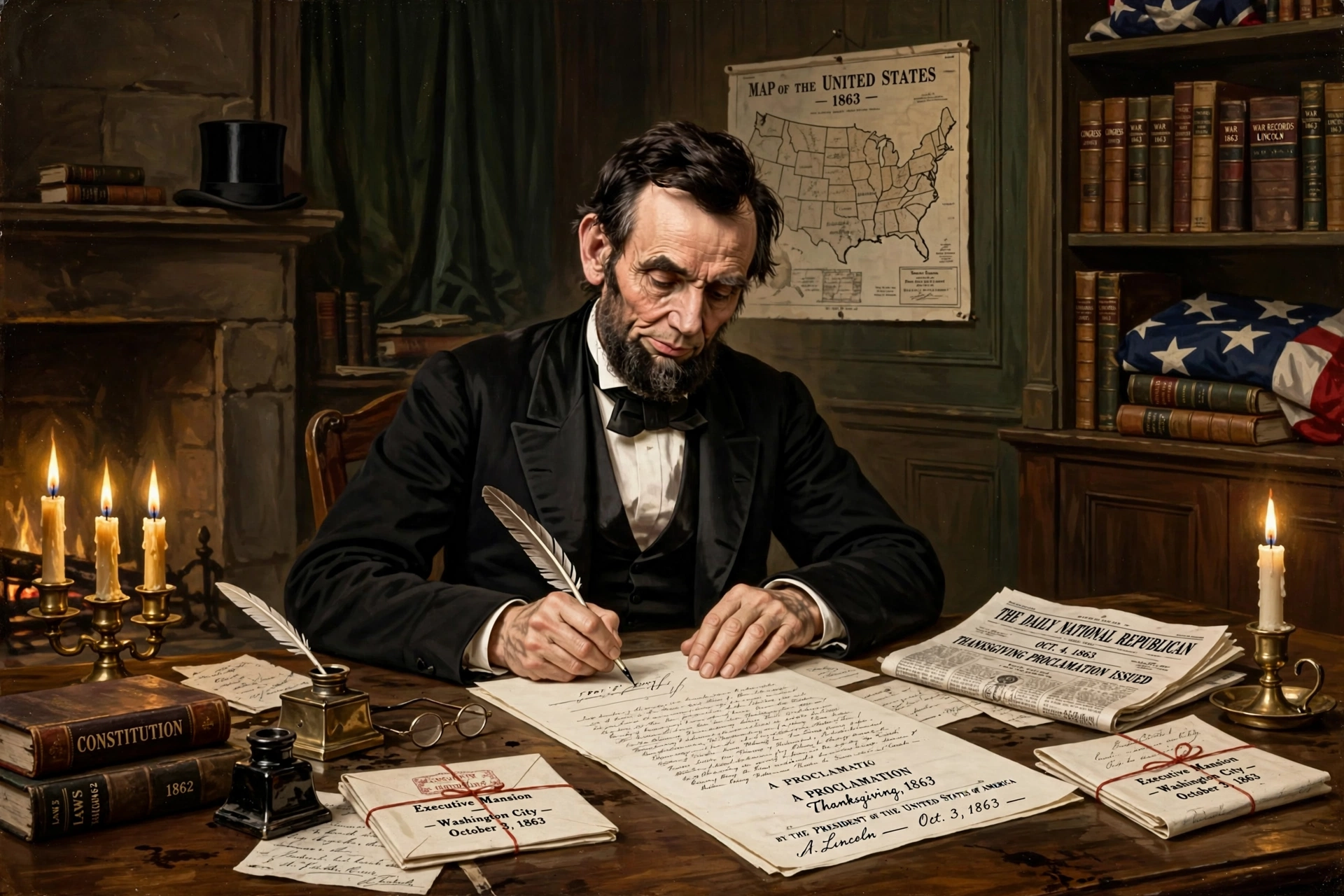
During the American Civil War, President Abraham Lincoln issued a Thanksgiving proclamation on October 3, 1863.
The proclamation called for a national day of thanksgiving and praise on the last Thursday of November.
At a time when the country was divided by war, the observance carried themes of gratitude, reflection, and national unity.
Lincoln’s proclamation became an important turning point in establishing the annual Thanksgiving tradition.
Presidents continued issuing Thanksgiving proclamations in the following years.
Franklin D. Roosevelt and the Thanksgiving Date Dispute
In 1939, President Franklin D. Roosevelt moved the observed date of Thanksgiving earlier in November.
The change was intended to create a longer holiday shopping period before Christmas.
However, the decision caused disagreement.
Some states followed the new date, while others continued observing the traditional date.
The change also disrupted established holiday arrangements, including scheduled sporting events.
The controversy demonstrated how deeply the Thanksgiving calendar had become embedded in American life.
Congress Established the Fourth Thursday in 1941
Congress eventually acted to standardize the holiday.
In December 1941, President Roosevelt signed legislation establishing Thanksgiving on the fourth Thursday of November, beginning in 1942.
This fixed the modern federal holiday schedule.
Thanksgiving has been observed on the fourth Thursday of November in the United States ever since. See when Thanksgiving falls each year for dates through 2030.
Historical references: Library of Congress: Thanksgiving History and National Archives: FDR’s Thanksgiving Experiment
Thanksgiving History Timeline: Important Events
The following timeline summarizes major developments in the history of Thanksgiving.
| Year or period | Historical event |
|---|---|
| Before European settlement | Indigenous communities maintain longstanding harvest and gratitude traditions |
| 1616–1620 | Epidemics devastate many Native communities in coastal New England |
| 1620 | Mayflower settlers arrive and establish Plymouth Colony |
| 1621 | Wampanoag leaders and English settlers establish an alliance |
| Autumn 1621 | Plymouth colonists and Wampanoag participants share a harvest gathering |
| 1675–1676 | King Philip’s War causes major losses and displacement |
| 1789 | George Washington proclaims a national day of thanksgiving |
| 1841 | Alexander Young helps popularize the connection between 1621 and the “First Thanksgiving” |
| 1863 | Abraham Lincoln calls for an annual November Thanksgiving observance |
| 1939 | Franklin D. Roosevelt moves the date earlier, creating controversy |
| 1941 | Federal legislation establishes the fourth Thursday of November |
| 1942 onward | The standardized federal Thanksgiving date takes effect |
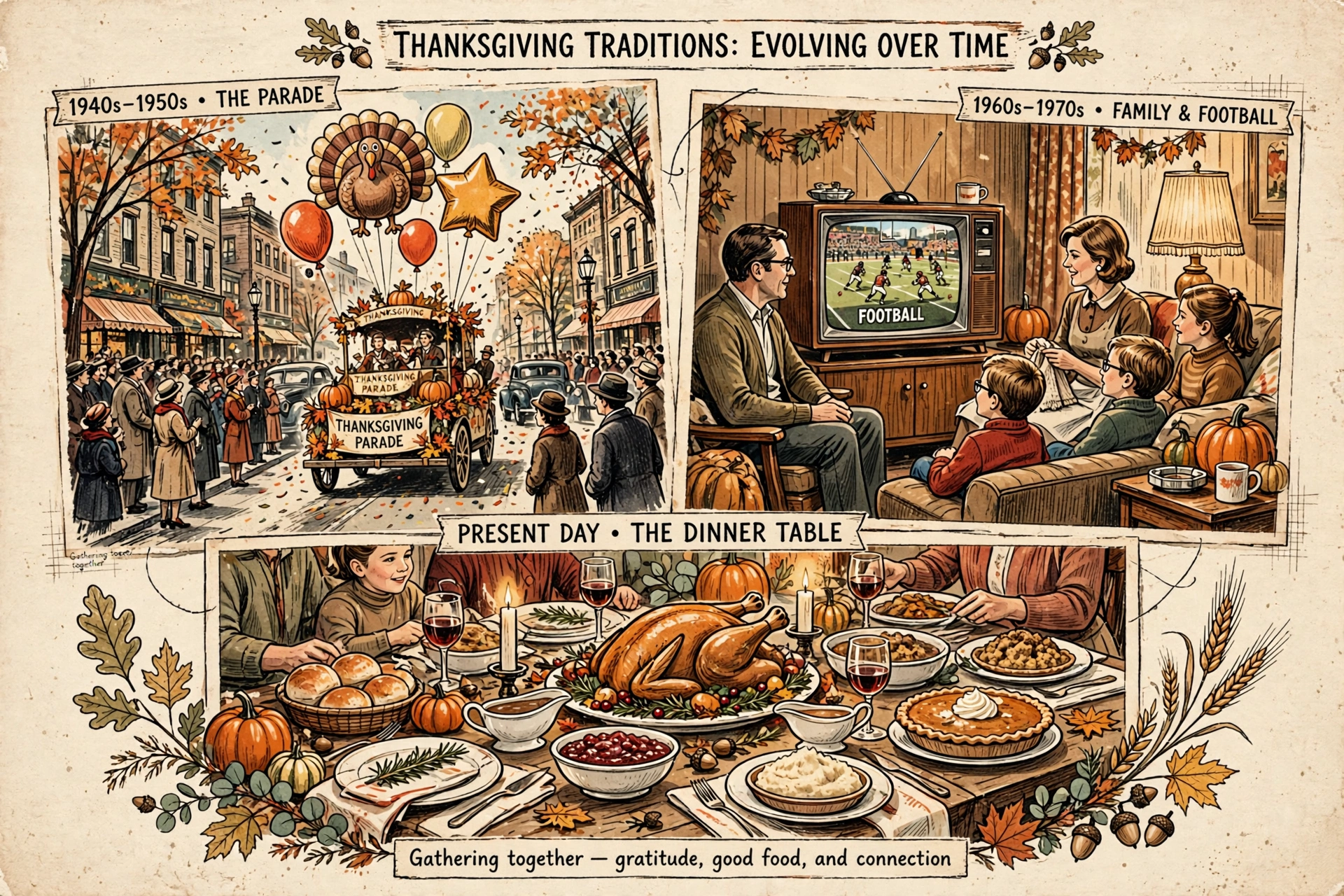
How Thanksgiving Traditions Changed Over Time
The modern Thanksgiving celebration reflects customs that developed across several centuries.
The 1621 harvest gathering did not include many of the activities now associated with the holiday.
Thanksgiving Dinner
The holiday meal became increasingly prominent in American celebrations during the nineteenth century.
Turkey, potatoes, cranberry dishes, and pies gradually became familiar menu items.
Recipes and holiday descriptions published in newspapers, magazines, and cookbooks helped reinforce these traditions.
Thanksgiving Football
American football became associated with Thanksgiving during the nineteenth century.
One notable early event was the Princeton-Yale football game played on Thanksgiving Day in 1876.
Football traditions continued developing, eventually becoming a recognizable part of the modern holiday.
Thanksgiving Parades
Public parades and celebrations grew during the twentieth century.
These events helped transform Thanksgiving into a widely shared cultural occasion beyond private family gatherings.
Television later allowed audiences around the country to participate by watching parades and holiday programming from home.
Family Gatherings and Gratitude
Thanksgiving also became closely associated with family reunions.
For many households, the holiday is now an occasion to share food, continue traditions, and express appreciation.
The customs vary depending on individual family history, religion, region, and cultural background. Families planning this year’s gathering can use our Thanksgiving dinner planning guide for a complete preparation timeline.
Native American Perspectives on Thanksgiving History
Thanksgiving has different meanings among Native Americans.
Some Indigenous families celebrate the holiday through gatherings, meals, and expressions of gratitude.
Others view the occasion as a reminder of colonization and the losses experienced by Native nations.
Since 1970, Indigenous activists and supporters have held a National Day of Mourning in Plymouth, Massachusetts, to commemorate Native history and draw attention to ongoing concerns affecting Indigenous communities.
It is important not to present Native Americans as a single group with one view of Thanksgiving.
The Wampanoag people also remain present-day communities with living cultures, governments, and traditions.
A more accurate understanding of Thanksgiving history recognizes their continuing existence and contributions rather than treating them only as figures from a colonial-era story.
Further research: Smithsonian National Museum of the American Indian: The First Thanksgiving Timeline
Common Myths About the History of Thanksgiving
Myth 1: Thanksgiving Began as an Annual Holiday in 1621
The 1621 gathering was a harvest celebration, not the beginning of an immediately established national holiday.
Myth 2: The Pilgrims Were the First People in America to Give Thanks
Indigenous nations had their own longstanding gratitude traditions before European settlement.
Myth 3: The First Thanksgiving Menu Was Identical to Today’s Dinner
The surviving account describes wildfowl and deer but does not document a complete modern Thanksgiving menu.
Myth 4: Thanksgiving Always Fell on the Fourth Thursday
The date varied historically. Congress standardized the fourth Thursday in 1941.
Myth 5: The 1621 Gathering Represents the Entire Relationship Between the Wampanoag and English Settlers
The gathering was one event within a much longer history involving diplomacy, alliances, colonization, conflict, and Indigenous resistance.
Frequently Asked Questions About Thanksgiving History
When was the first Thanksgiving?
The 1621 Plymouth harvest gathering is commonly described as the First Thanksgiving. However, earlier Indigenous harvest and gratitude traditions existed, and other thanksgiving observances occurred before the modern US holiday developed.
Who started Thanksgiving in America?
No single person created every aspect of Thanksgiving. Indigenous traditions, colonial observances, Sarah Josepha Hale’s advocacy, presidential proclamations, and federal legislation all contributed to the holiday’s development.
Did Abraham Lincoln create Thanksgiving?
Lincoln did not originate Thanksgiving celebrations, but his 1863 proclamation was an important step in establishing an annual national observance.
Why was Thanksgiving moved in 1939?
President Franklin D. Roosevelt moved the holiday earlier to extend the shopping season before Christmas. The decision caused disagreement and was eventually replaced by a standardized federal date.
Is the original Thanksgiving story historically accurate?
The 1621 harvest gathering was real, but simplified versions often omit the Wampanoag people’s political interests, the longer Indigenous history of the region, and the consequences of colonization.
When did Thanksgiving become a federal holiday?
Federal legislation enacted in 1941 established the fourth Thursday of November as Thanksgiving, with the standardized schedule taking effect in 1942.
Conclusion
The history of Thanksgiving is more complex than the familiar story of a single harvest meal.
Its development involved longstanding Indigenous traditions, European religious customs, colonial events, national political decisions, and changing American celebrations.
The 1621 gathering remains an important historical event, but it was only one part of the process through which Thanksgiving became a national holiday.
Understanding this broader timeline gives the holiday a more accurate historical context while recognizing the Wampanoag people and other Indigenous communities whose experiences are essential to the story.
Leave a Reply