
The best Christmas tree types for most homes are Fraser fir and Noble fir: both hold their needles for weeks, have strong branches for heavy ornaments, and look full and classic. Balsam fir wins on scent, Scotch pine is the budget-friendly workhorse, and Nordmann fir is the best choice if you want the longest-lasting tree.
Choosing a tree species is not just about looks. The species decides how long the tree stays green, how much it smells, whether it can hold your heaviest ornaments, and how much it costs. A spruce looks stunning on the lot and sheds its needles in a week if it dries out. A pine is cheap and cheerful but may not hold a heavy glass ornament. The best christmas tree types are the ones that match your home, your ornaments, and your patience for watering — and this guide compares the eight most popular species side by side so you can pick with confidence.

Key Facts
| Fact | Detail |
|---|---|
| Most popular real tree in the US | Fraser fir |
| Best needle retention | Fraser fir, Noble fir, Nordmann fir |
| Best scent | Balsam fir, then Douglas fir |
| Strongest branches | Noble fir, Fraser fir, Colorado blue spruce |
| Best budget pick | Scotch pine, Douglas fir |
| Best for heavy ornaments | Noble fir, Fraser fir |
| Best for allergy-sensitive homes | Nordmann fir (low scent) |
| Real trees sold in the US each year | About 25–30 million |
Best Christmas Tree Types: Comparison Table
| Type | Needle retention | Scent | Branches | Price | Best for |
|---|---|---|---|---|---|
| Fraser fir | Excellent (5–6 weeks) | Very good | Stiff, strong | $$$ | Most homes, heavy ornaments |
| Noble fir | Excellent (4–5 weeks) | Good | Very strong, well spaced | $$$ | Heavy ornaments, wreaths |
| Balsam fir | Good (3–4 weeks) | Excellent | Flexible, lighter | $$ | Scent lovers, narrow spaces |
| Douglas fir | Good (3–4 weeks) | Very good | Soft, lighter | $ | Budget, traditional look |
| Scotch pine | Very good (4–5 weeks) | Good | Stiff, strong | $ | Budget, holds needles when dry |
| White pine | Good (3–4 weeks) | Good | Flexible, light | $ | Soft needles, kids and pets |
| Colorado blue spruce | Average (3–4 weeks) | Good | Very strong | $$ | Bold color, heavy ornaments |
| Nordmann fir | Excellent (5–6 weeks) | Mild | Strong, glossy | $$$ | Longest-lasting, low scent |
Fir, Spruce and Pine: What’s the Difference?
Before the individual species, it helps to know the three families. Firs, spruces, and pines are all evergreens, but they behave differently as Christmas trees, and knowing the family tells you most of what you need to know. It is also the quickest way to narrow down the best christmas tree types for your home.
Firs have soft, flat needles with rounded tips. They do not hurt to handle, they hold their needles the longest, and they have the classic Christmas tree shape: a neat cone with room between the branches for ornaments. Fraser, Noble, Balsam, and Nordmann are all firs, and firs dominate the Christmas tree market for good reason.
Spruces have short, sharp, square needles that prick your hands when you decorate. They look dense and full, with a beautiful conical shape and a strong blue-green color. But they drop their needles faster than firs once they start to dry, so they need constant water and a shorter season.
Pines have long needles in bundles, and they are the hardiest of the three. Scotch pine holds its needles even when it dries out, which is a rare and useful trait. Pines are usually cheaper than firs, and they have a lighter, airier look with more space between branches.
If you remember one rule, make it this: firs hold their needles best, spruces look the fullest, and pines are the toughest and cheapest. Now here are the eight best christmas tree types in detail.
Fraser Fir: The All-Round Winner
Fraser fir is the most popular Christmas tree in America, and it earns that title. Its needles are dark green on top and silvery underneath, soft to the touch, about half an inch to an inch long, and they stay on the tree longer than almost any other species. With water, a Fraser fir can last five to six weeks indoors — the longest of any common Christmas tree.
The branches are stiff and strong, with good spacing between them, which makes decorating easy and lets heavy ornaments hang without drooping. The scent is pleasant and distinctly piney without being overpowering. The shape is a neat, full cone that looks good in any living room.
The only real drawback is the price. Fraser fir is usually one of the more expensive trees on the lot, especially in regions where it has to be shipped from the mountains of North Carolina, where most Fraser firs are grown. But for most families, it is worth it: the tree that lasts the longest, holds its needles best, and handles heavy ornaments is the tree you want in your living room for a month.
Pick Fraser fir if: you want the safest all-round choice, you have heavy ornaments, or you are putting the tree up early and need it to last.

Noble Fir: The Strongest Branches
Noble fir is the tree of choice for people with serious ornament collections. Its branches are the strongest of any common Christmas tree, with a distinctive layered look: the branches grow in neat tiers with space between them, so each ornament has room to shine. The needles are deep green, not too sharp, and the tree holds them well for four to five weeks.
Noble fir is also the classic wreath tree, because its sturdy branches hold their shape. As a Christmas tree, it has a more open, airy look than a Fraser fir, which some people love and others find too sparse. If you like a tree where you can see every ornament instead of losing half of them inside dense foliage, Noble fir is your tree.
It grows mainly in the Pacific Northwest, so it is most common and most affordable on the West Coast, and pricier in the East. It is also one of the more expensive species overall, but like Fraser fir, it earns its price with needle retention and branch strength.
Pick Noble fir if: you have heavy glass ornaments, you like a layered look with visible ornaments, or you want a tree that doubles as wreath material.
Balsam Fir: The Best Smell
If the smell of Christmas is the point, buy a Balsam fir. It has the strongest, most classic pine scent of any Christmas tree — a deep, resinous, woodsy fragrance that fills the house the moment you bring it inside. No other species comes close.
Balsam fir has dark green, soft, flat needles and a narrow, spire-like shape that fits well in tight spaces. Its needle retention is good, about three to four weeks with water, though not as strong as Fraser or Noble fir. Its branches are more flexible, so it is better with lighter ornaments than with heavy glass.
Balsam fir grows in the Northeast and the Great Lakes region, and it is very common and affordable there. In the South and West it is harder to find. Cornell Cooperative Extension describes Balsam fir as having a beautiful dark green color, shiny soft needles, and a pleasant scent of balsam wood, with flexible branches that may not hold heavier ornaments — a fair summary you can check in the Cornell Christmas Tree Guide.
Pick Balsam fir if: scent is your top priority, you have a narrow space, or you live in the Northeast where it is plentiful and affordable.

Douglas Fir: The Traditional Budget Pick
Douglas fir is the old-fashioned Christmas tree, the one many Americans grew up with. It is not a true fir — it is its own species — but it has soft, shiny green needles, a sweet scent, and a full, classic shape. It is also one of the cheapest trees on the lot, which makes it the go-to choice for families watching their budget.
The trade-off is branch strength and needle retention. Douglas fir branches are softer and less stiff than a true fir, so heavy ornaments can make them droop. Needle retention is good for three to four weeks with steady watering, but it drops off fast if the tree runs dry. Buy it fresh, cut the trunk, keep the stand full, and it will serve you well.
Douglas fir is widely available across the country, and it is the tree most often sold at big-box stores and pop-up lots. If you want a good-looking tree for a fair price and you are happy to use lighter ornaments, it is hard to beat.
Pick Douglas fir if: you are on a budget, you like the traditional look, or you want a soft-needled tree that is easy on small hands.
Scotch Pine: The Tough, Cheap Workhorse
Scotch pine, also called Scots pine, is the survivor of the Christmas tree world. Its needles are one to two and a half inches long, and it has a rare and valuable trait: it holds its needles even when the tree dries out. That makes it the most forgiving real tree you can buy. Forget to water it for a day, and it will not punish you with a carpet of needles.
It is also one of the cheapest trees available, and it is widely grown across the Midwest and Northeast. The branches are stiff and strong, good for heavy ornaments, and the tree has a sturdy, open shape. The scent is a pleasant pine, though milder than Balsam or Douglas fir.
The look is a little different from a fir: the needles are longer, the branches are more open, and the tree can look a bit wild. Some people love that natural, woodland feel. Others prefer the neat cone of a fir. But if you want a tree that is cheap, tough, and hard to kill, Scotch pine is the pick.
Pick Scotch pine if: you are on a budget, you worry about forgetting to water, or you like a natural, open look.
White Pine: The Softest Needles
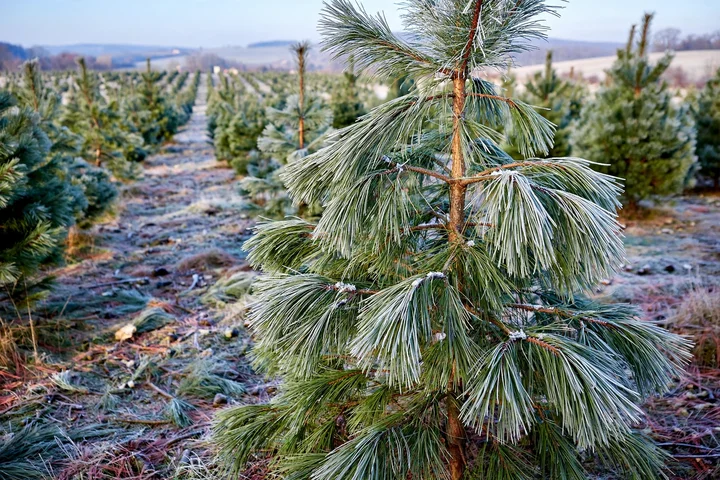
White pine has the softest needles of any Christmas tree — long, feathery, silvery-green needles in bundles of five that feel like silk. It is the gentlest tree to decorate, which makes it a favorite for families with small children and for anyone who dislikes being pricked by sharp spruce needles.
The branches are flexible, so white pine is best with lighter ornaments; heavy glass will pull the branches down. The tree has a light, airy look, and it can appear a little sparse inside, because the needles grow mostly at the ends of the branches. But when it is lit, that openness works beautifully — the lights glow through the whole tree instead of hiding inside dense foliage.
Needle retention is good, about three to four weeks with water, and the scent is a soft, foresty pine. White pine is common and affordable in the Northeast and Great Lakes, and it is the only pine native to many eastern states.
Pick White pine if: you have small children, you want the softest needles, or you love how lights glow through an open tree.
Colorado Blue Spruce: The Bold Look
Colorado blue spruce is the drama queen of Christmas trees. Its needles are a striking silvery blue, its shape is a dense pyramid, and its branches are stiff and strong enough to hold the heaviest ornaments. No other tree looks like it, and in a room full of green trees, the blue spruce is the one people notice.
The catch is the needles. They are sharp — genuinely sharp, enough to make decorating an exercise in patience and gloves. And needle retention is only average: about three to four weeks, and only if the tree never runs out of water. Let a blue spruce dry out and it will shed fast.
But for some families, the look is worth it. The blue-silver color pairs beautifully with white, silver, and blue ornaments, and the dense shape looks luxurious. The sharp needles also have a side benefit: they keep cats from climbing the tree, which is a real consideration in some households.
Pick Colorado blue spruce if: you want a bold, unusual color, you have heavy ornaments, or you want a tree your cat will leave alone.

Nordmann Fir: The Longest-Lasting Tree
Nordmann fir is the European favorite and the rising star in America. It has glossy, dark green needles with a silvery underside, a perfect symmetrical cone, and the best needle retention of any tree on this list — it can last five to six weeks indoors, matching or beating Fraser fir. It is also the lowest-scent fir, which is a plus for people who are sensitive to strong pine smells.
The branches are strong and well spaced, the needles are soft, and the tree looks almost artificial in its perfection — which is either a compliment or a criticism, depending on your taste. Nordmann fir is widely grown in Europe and increasingly available in the US, though it is usually one of the pricier trees on the lot.
If you want the tree that will still look perfect on Epiphany, six weeks after you bought it, Nordmann fir is the one. It is the best choice for an early setup and a long season.
Pick Nordmann fir if: you want the longest-lasting tree, you are putting it up early, or you prefer a mild scent.
How to Choose: Match the Tree to Your Home
With eight good options, the choice comes down to your priorities. Answer these questions and the right species will stand out:
- Heavy ornaments? Noble fir, Fraser fir, or Colorado blue spruce.
- Best scent? Balsam fir, then Douglas fir.
- Longest lasting? Fraser fir or Nordmann fir.
- Tight budget? Scotch pine or Douglas fir.
- Small children? White pine, Douglas fir, or any soft-needled fir.
- Cats that climb? Colorado blue spruce.
- Allergy-sensitive? Nordmann fir, or an artificial tree.
- Narrow space? Balsam fir, with its slim, spire-like shape.
- Early setup? Fraser fir or Nordmann fir, the two longest-lasting species.
And whatever species you choose, the care is the same: a fresh cut on the trunk, a stand full of water checked every day, and a spot away from fireplaces, radiators, and heating vents. Our guide on how to keep a real Christmas tree fresh longer covers the full routine, and if you want theme inspiration once you have picked your species, browse our Christmas tree ideas and our Christmas tree decorating ideas for the order to hang everything in.
The species is the skeleton of your Christmas. Get the tree right, and everything you hang on it — the lights, the ornaments, the memories — has a strong place to live for the whole season.

What to Check Before You Buy
Whichever of the best christmas tree types you choose, run these checks on the lot before you pay:
- The needle test: Run your hand along a branch. Fresh needles stay put; dry needles fall off.
- The bend test: Bend a needle. Fresh needles bend; dry ones snap.
- The shake test: Lift the tree a few inches and drop it gently on its base. A few brown needles falling is normal. A shower of green needles means the tree is already drying out.
- The color test: Look for rich green color, not brown or yellow, and check the underside of the needles for the silvery sheen that marks a healthy fir.
- The trunk test: Look at the cut end. It should be pale and moist, not dark and dry. Ask the lot to make a fresh cut of about half an inch before you take it home.
- The size test: Measure your ceiling and your room before you go. A tree that is six inches too tall is a problem you do not want to discover in your living room.
Buy the freshest tree you can find, get it into water within a few hours, and it will reward you with a month of green, fragrant Christmas. That is how you get the most from one of the best christmas tree types.
What is the best Christmas tree type overall?
Fraser fir is the best all-round Christmas tree type: excellent needle retention for 5 to 6 weeks, strong branches for heavy ornaments, soft needles, and a classic full shape. Noble fir is a close second for branch strength.
Which Christmas tree lasts the longest?
Fraser fir and Nordmann fir last the longest indoors, about 5 to 6 weeks with daily watering. Both hold their needles far better than spruce or pine when kept in water.
Which Christmas tree smells the best?
Balsam fir has the strongest and most classic pine scent. Douglas fir is second. Nordmann fir has the mildest scent, which suits people who are sensitive to strong smells.
Which Christmas tree is best for heavy ornaments?
Noble fir has the strongest branches, followed by Fraser fir and Colorado blue spruce. Avoid Balsam fir and white pine for heavy glass ornaments — their branches are more flexible and will droop.
What is the cheapest Christmas tree type?
Scotch pine and Douglas fir are usually the cheapest Christmas tree types, often $20 to $40 less than a Fraser or Noble fir of the same size. Both are widely available and good value.
Which Christmas tree is best for a small apartment?
Balsam fir, with its narrow spire-like shape, fits tight spaces well. For very small rooms, a tabletop tree or a slim pencil tree in any fir species works — the species matters less than the size and shape.
The best christmas tree types are not a mystery — they are a match between the tree and your home. Fraser fir and Noble fir lead the pack for most families, Balsam fir wins on scent, Scotch pine wins on price and toughness, and Nordmann fir wins on longevity. Pick the one that fits your ornaments, your budget, and your patience for watering, check it carefully on the lot, and bring home a tree that will carry your Christmas from the first ornament to the last carol.
Leave a Reply