
Small Christmas tree ideas prove that you do not need a big living room to have a real Christmas tree, because pencil trees, slim trees, half trees, tabletop trees, and wall trees all deliver full holiday magic in a fraction of the floor space. A pencil tree can stand 6 to 7 feet tall while taking up only 18 to 24 inches of width, and a half tree sits flat against the wall so it needs almost no floor space at all.
This guide covers the five best small Christmas tree ideas, a size guide that matches your ceiling height to the right tree, decorating tricks that make narrow trees look full, and renter-friendly tips that keep your deposit safe. These small Christmas tree ideas work in any home, from a studio apartment to a small family house.

Key Facts
| Fact | Detail |
|---|---|
| Pencil tree | 18 to 24 inches wide, 6 to 7 feet tall, fits in a corner |
| Slim tree | About 30 to 36 inches wide, nearly full height |
| Half tree | Flat back, sits against a wall, needs almost no floor space |
| Tabletop tree | 2 to 4 feet tall, sits on a table, shelf, or counter |
| Wall tree | Flat garland or felt tree on the wall, zero floor space |
| Christmas Day 2026 | Friday, December 25, 2026 |
| Lights rule | About 100 mini lights per foot, fewer for pencil and slim trees |
Why Small Christmas Tree Ideas Matter
More people than ever live in apartments, studios, and small houses, and a standard Christmas tree simply does not fit. A full 7 foot tree is about 55 inches wide at the base, which eats a quarter of a small living room and blocks walkways, doors, and windows. That is why small Christmas tree ideas have become one of the most searched holiday topics: renters and small-space dwellers want the tree without the takeover.
The good news is that tree makers have caught up. Pencil, slim, half, tabletop, and wall trees are now sold everywhere, in every style from classic green to snowy flocked to bright white, and most cost less than a full-size tree because they use fewer branches and fewer lights.
A small tree also has hidden advantages. It is easier to set up alone, easier to store, cheaper to decorate because you need fewer ornaments, and easier to keep away from pets and toddlers. Many people with large homes now choose a second small tree for the bedroom, the entryway, or the home office, because a small Christmas tree brings holiday cheer to a room that a big tree could never reach. The trick is picking the right type for your space and decorating it in a way that makes it look intentional, not like a compromise.
A small Christmas tree is not a compromise. Pick the right shape for your space, decorate it with intention, and it will look like it was made for that corner.
1. Pencil Trees: Tall and Narrow
A pencil tree is the best small Christmas tree idea if you want a full-height tree in a tight space. Pencil trees are 6 to 7 feet tall but only 18 to 24 inches wide, roughly the width of a floor lamp, so they slide into a corner, beside a bookshelf, or between a sofa and a wall without blocking anything. From the front, a pencil tree looks like a real tree, just slimmer; from the side, you can see how narrow it is, which is why pencil trees work best tucked into a corner where only the front is visible.
Decorating a pencil tree takes a different touch. Use fewer, larger ornaments rather than many small ones, because small ornaments get lost in the narrow branches and make the tree look busy. Hang ornaments on the outer tips where they can be seen, and use vertical ribbon cascades to draw the eye upward and make the tree look taller. Pencil trees need fewer lights, about half the standard rule, so 300 to 350 lights for a 7 foot pencil tree is plenty. A slim tree skirt or a decorative basket as a base finishes the look and hides the stand. For more on choosing lights for narrow trees, see our guide to Christmas lights ideas.

2. Slim Trees: Nearly Full, Much Narrower
A slim tree is the middle ground between a pencil tree and a full tree. Slim trees are about 30 to 36 inches wide at the base, roughly two-thirds the width of a full tree, while keeping nearly the same height and fullness. They look like a normal Christmas tree to anyone walking into the room, which makes them the best choice if you want a traditional tree look but your living room cannot spare the full 55 inches.
Slim trees suit small living rooms, dining rooms, and bedrooms. They fit beside a fireplace, in front of a window without blocking the light, and in the gap between two pieces of furniture. Decorate a slim tree almost like a full tree, but scale your ornaments down slightly and use about three-quarters of the standard light count, around 500 to 550 lights for a 7 foot slim tree. Slim trees also work well in pairs: two matching slim trees flanking a fireplace or a front door look grand without taking over the room.
3. Half Trees: Flat Against the Wall
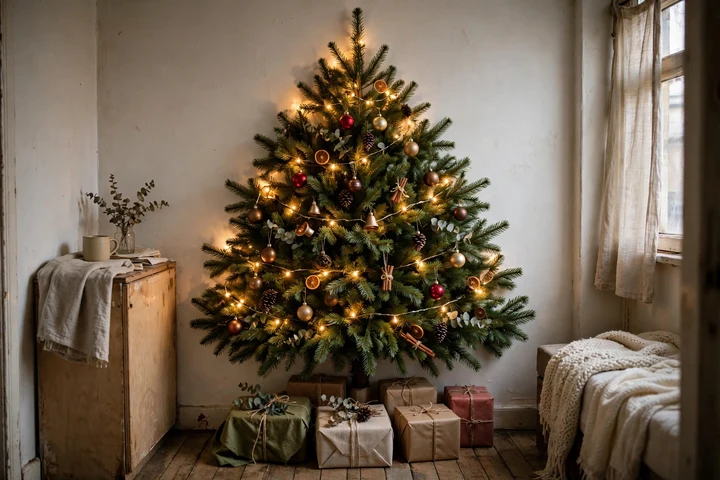
A half tree is exactly what it sounds like: a tree that is flat on the back and full on the front, designed to sit flush against a wall. Half trees are the smartest small Christmas tree idea for very tight spaces, hallways, and rooms where a round tree would block foot traffic. Because the back half is missing, a half tree needs only about half the floor space of a full tree, and you only have to decorate the front, which means half the ornaments and half the lights.
Half trees look best in a corner or flat against a wall where the missing back is invisible. They are ideal for apartments with open floor plans, because they create a Christmas focal point without creating an obstacle. The one downside is that a half tree looks wrong if you can see it from behind, so do not put one in the middle of a room or in front of a glass door. Pair a half tree with a wall-mounted stocking holder or a garland above it to complete the scene, and use a tree collar instead of a skirt, since a round skirt looks odd under a flat-backed tree.
4. Tabletop and Mini Trees: Small but Mighty
Tabletop trees are 2 to 4 feet tall and sit on a table, shelf, counter, or desk, which makes them the most flexible small Christmas tree idea of all. A 3 foot tree on a side table gives you a real tree at eye level without using any floor space. A 2 foot mini tree works on a desk, a kitchen counter, a nightstand, or a bathroom vanity. Mini trees are also the best choice for dorm rooms, kids rooms, and offices, where a floor tree is out of the question.
Decorate a tabletop tree like a full tree in miniature. Use small ornaments, 1 to 2 inches, and a short string of lights, 50 to 100 lights is enough. A tiny star or bow topper, a small tree skirt or a piece of fabric under the base, and a few wrapped gifts beside it make a tabletop tree look complete. Tabletop trees are also the easiest to move: if you want the tree in the living room during the day and the bedroom at night, just pick it up and carry it. For more small-space decorating inspiration, see our guide to small-space Christmas decor.

5. Wall Trees: Zero Floor Space
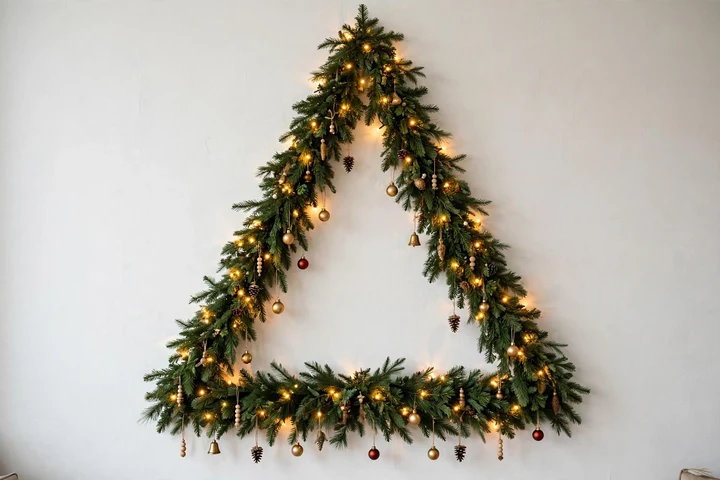
A wall tree uses no floor space at all, because it hangs flat on the wall. You can buy a felt wall tree with Velcro ornaments, which is perfect for kids and toddlers, or make your own from green garland, string lights, and a few ornaments arranged in a triangle on the wall. Wall trees are the ultimate renter-friendly option, since they hang with removable adhesive hooks and leave no holes.
A wall tree works in entryways, hallways, kitchens, and any room where a floor tree is impossible. It also works as a second tree: a wall tree in the hallway or the kids room adds holiday cheer without adding clutter. Keep the design simple, a clear triangle shape, lights outlining the edges, and ornaments spaced evenly inside, and it will read as a tree from across the room. Wall trees are also the safest option for homes with crawling babies or pets that climb, because there is nothing to pull over.
Small Christmas Tree Size Guide
Picking the right size is the most important step, and it starts with measuring. Measure your ceiling height, then subtract at least 12 inches for the tree topper and breathing room. Measure the floor space where the tree will stand, including how far it can stick out from the wall. Then match your measurements to the table below.
| Ceiling height | Tree height | Best type | Base width |
|---|---|---|---|
| 7 to 8 feet | 5 to 6 feet | Pencil or tabletop | 18 to 24 inches |
| 8 to 9 feet | 6 to 7 feet | Pencil or slim | 18 to 36 inches |
| 9 to 10 feet | 7 to 7.5 feet | Slim or half | 30 to 40 inches |
| Any ceiling | 2 to 4 feet | Tabletop | Sits on furniture |
| Any ceiling | Flat on wall | Wall tree | Zero floor space |
Always measure twice before you buy, and remember the tree stand and topper add height. A 7 foot tree in an 8 foot ceiling leaves only a few inches for a star, which looks cramped. A 6 foot tree in the same room looks balanced and gives the topper room to shine. When in doubt, go one size smaller than you think you need: a small Christmas tree that fits comfortably always looks better than a big tree squeezed into a corner.
Decorating Tricks for Narrow Trees
Narrow trees need different decorating tricks than full trees. First, use fewer, larger ornaments. On a pencil tree, six large baubles make more impact than thirty small ones, because large ornaments fill the narrow silhouette and can be seen from across the room. Second, use vertical ribbon. A ribbon cascade running from top to bottom draws the eye up and makes the tree look taller and more elegant than a ribbon wrapped horizontally, which can make a narrow tree look squat.
Third, hang ornaments on the outer branch tips rather than deep inside, because the inside of a narrow tree is barely visible and ornaments hidden there are wasted. Fourth, use lights generously but wisely: string lights in a zigzag pattern down the front of the tree rather than wrapping them all the way around, since the back of a corner tree is never seen.
Fifth, pick a statement topper that matches the tree scale: a tall, slim topper like a finial or a slim star suits a pencil tree better than a wide angel. Finally, use a basket, a galvanized bucket, or a decorative tree collar as the base instead of a traditional skirt, because these look tidy in a tight space and double as storage after Christmas.

Renter-Friendly Small Christmas Tree Ideas
Renters face extra rules: no holes in the walls, no damage to floors, and a deposit to protect. The good news is that small Christmas tree ideas are naturally renter friendly. Use a pencil or slim tree with a freestanding base, so nothing attaches to the wall. Hang a wall tree with removable adhesive hooks rated for the weight, and remove them slowly with a hair dryer to soften the adhesive when the season ends. Protect hardwood floors with a tree skirt, a mat, or a plastic tray under the tree stand, because water from a real tree or scratches from a metal stand can cost you your deposit.
If you have a real mini tree, use a waterproof tray and water it carefully with a small cup to avoid spills. Keep the tree away from radiators and heating vents, which dry it out and raise the fire risk, and never leave lights on when you leave the apartment. Battery-operated LED lights are a great renter option because they need no outlet and you can place the tree anywhere, and LEDs use about 75 percent less energy than incandescent bulbs, according to the U.S. Department of Energy’s guide to how holiday lights work.
Where to Put a Small Christmas Tree
Placement makes or breaks a small Christmas tree. The best spots are corners, because a corner hides the narrow sides of a pencil or half tree and makes it look fuller. Next to a window works well too, because daylight makes the ornaments sparkle and the tree frames the view. Beside the fireplace is classic, but keep the tree at least three feet from the firebox and any heat source. In a studio apartment, use the tree as a room divider: a pencil tree between the sleeping area and the living area adds privacy and holiday cheer at the same time.
Avoid putting a small tree in the middle of a walkway, in front of a door that swings open, or right next to a heating vent. Also avoid spots where the tree blocks the television or the main light source in the room. Before you commit, stand the undecorated tree in the spot for a day and live with it: walk past it, open the nearby doors, and check that it does not crowd the room. If it feels tight undecorated, it will feel tighter once the ornaments and gifts are added, so move it to a better spot before you decorate.
Small Christmas Tree Ideas by Room
Living Room
In the living room, a pencil or slim tree in the corner is the classic choice. Pair it with a matching garland on the mantel and a few coordinating ornaments on the coffee table to tie the room together. If your living room is very small, a half tree against the longest wall gives you the biggest visual impact for the least floor space.
Bedroom
A tabletop tree on a dresser or a slim tree in the bedroom corner turns your bedroom into a holiday retreat. Use soft, warm lights and a calm palette like white, silver, and blush, and skip the noisy ornaments. A small tree in the bedroom is also a lovely surprise for kids, who love waking up to their own tree. For more apartment-friendly holiday looks, see our guide to Christmas apartment decor.
Kitchen and Dining Room
A mini tree on the kitchen counter or a tabletop tree as a dining table centerpiece brings Christmas into the rooms where your family actually spends time. Use food-safe, shatterproof ornaments in the kitchen, and keep the tree away from the stove. A small tree on the dining table looks best with a low profile so guests can see each other over it, so skip the tall topper and use a small bow instead.
Entryway and Hallway
A half tree or a wall tree is perfect for an entryway, because it greets guests the moment they walk in without blocking the door. A pencil tree beside a console table works too, as long as it does not crowd the walkway. Add a doormat, a wreath on the door, and a few wrapped gifts under the tree to make the entryway feel festive from the first step inside.

Frequently Asked Questions
What size Christmas tree is best for a small apartment?
A 6 to 7 foot pencil tree is the best choice for most small apartments, because it gives you full height and a real tree look while taking up only 18 to 24 inches of floor width. If your apartment is very small or you want zero floor space used, a 3 foot tabletop tree or a wall tree is better. Measure your ceiling and floor space first, then pick the tree that fits with room to spare.
How many ornaments do I need for a small Christmas tree?
A small Christmas tree needs far fewer ornaments than a full tree. A 6 foot pencil tree looks full with 30 to 40 ornaments, a 7 foot slim tree needs 50 to 60, and a 3 foot tabletop tree needs only 15 to 20. Use fewer, larger ornaments on narrow trees, because large ornaments fill the silhouette better and are easier to see from across the room.
Can a small Christmas tree look just as good as a big one?
Yes, a small Christmas tree can look just as good as a big one, and sometimes better, because a well decorated small tree looks intentional and tidy while a big tree squeezed into a small room looks crowded. The keys are choosing the right tree shape for your space, using a tight color palette, and decorating with restraint so the tree shape stays visible.
Where should I put a Christmas tree in a small apartment?
Put your Christmas tree in a corner, beside a window, or flat against the longest wall. Corners are best because they hide the narrow sides of pencil and half trees and make the tree look fuller. Avoid walkways, door swings, and heating vents, and keep the tree at least three feet from fireplaces and radiators.
Are pencil Christmas trees stable?
Yes, pencil Christmas trees are stable when they are set up correctly, because they use the same weighted metal stands as full trees but carry less weight up high. Make sure the stand is tightened firmly, the tree is centered, and the base sits flat on the floor. If you have pets or toddlers, anchor the tree to the wall with a removable hook and fishing line for extra safety.
Do small Christmas trees need fewer lights?
Yes, small Christmas trees need fewer lights than full trees. A pencil tree needs about half the standard count, roughly 300 to 350 lights for a 7 foot tree, while a slim tree needs about three quarters, around 500 to 550 lights. A tabletop tree needs only 50 to 100 lights. The standard rule is about 100 lights per foot of tree height, but narrow trees need fewer because they have less branch surface to cover.
Small Christmas tree ideas are about working with your space, not against it. A pencil tree in the corner, a half tree flat on the wall, a tabletop tree on the dresser, or a wall tree in the hallway can all deliver the full Christmas feeling without taking over your home. Measure first, pick the shape that fits, decorate with fewer and larger ornaments, and let the tree shine. Your apartment may be small, but your Christmas does not have to feel small at all. With these small Christmas tree ideas, even the smallest corner can feel like Christmas.
Leave a Reply