
The best Christmas lights ideas follow one rule: pick a color temperature and commit to it. Warm white everywhere reads elegant and cohesive; mixing warm white, cool white, and multicolor on the same house reads chaotic. This guide gives you 30 Christmas lights ideas for 2026 — rooflines, yards, trees, windows, and mantels — plus the LED efficiency math and safety rules that keep your display beautiful and your electric bill sane.
Key Facts
- LEDs are the whole game: LED holiday lights use up to 90% less energy than incandescent strings and stay cool to the touch (U.S. Department of Energy guidance).
- One color temperature: warm white (~2700K) is the 2026 trend; cool white looks icy and modern; never mix both on one display.
- The 3-layer formula: roofline first, then trees and shrubs, then ground-level accents — a display with all three reads finished, one with only the first reads half-done.
- Timer everything: outdoor lights on a dusk-to-midnight timer cut energy use roughly in half versus all-night operation.
- Safety non-negotiables: outdoor-rated cords only, no more than three standard strings end-to-end, clips — never staples or nails — on shingles and gutters.

Outdoor Christmas Lights Ideas
The roofline outline is the backbone of every great display. Trace the eaves with C9 LEDs on gutter clips, keeping spacing even and lines taut. Sagging strings are the difference between “magazine” and “meh” — run a support wire first if your span is longer than 20 feet. A straight line of lights beats a sagging line of twice as many.
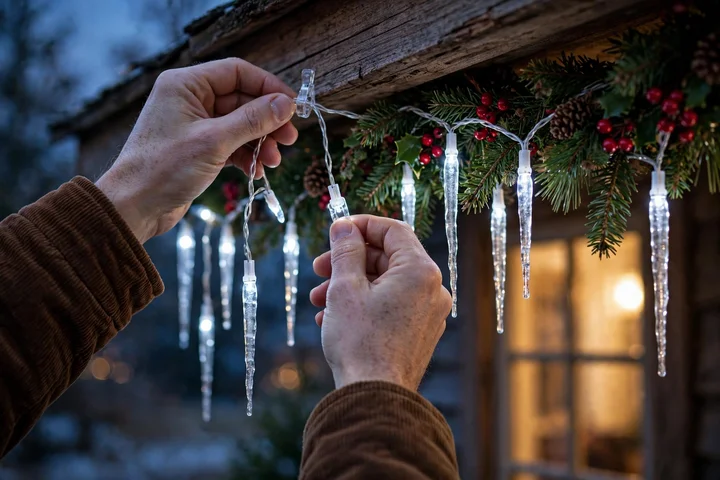
Icicle lights along the porch give instant charm with minimal effort. Hang them from the porch eave or railing so the “drips” vary in length, and back them with a simple evergreen garland so the daylight view looks finished too. Pair icicles with our outdoor Christmas decorations guide for the full yard plan.
Tree-wrapping that actually looks good follows the trunk-up method: start at the base, wrap the trunk in a spiral, then work outward along the main branches rather than circling the whole canopy. You use fewer lights and the tree glows from inside instead of looking shrink-wrapped.
The pathway runway is the cheapest high-impact move on this list. Stake lights or luminaries along both sides of the walkway at even intervals — the symmetry reads intentional from the street. Solar stakes work, but plug-in low-voltage sets stay brighter on short December days.
Window frames in lights make the house glow from within the display. Outline two or three front-facing windows with warm white mini-lights on suction-cup clips; from the curb, lit windows tie the roofline to the ground and make the whole facade read as one composition.
The single statement tree beats a yard full of small decorations. One large evergreen wrapped in 1,000+ warm white lights, visible from the street, anchors everything else. If you only buy lights for one thing, make it this.
Net lights on shrubs are the lazy genius of Christmas lights ideas — drape, plug in, done. They give hedges and bushes a full, even glow in minutes, and they store flat.
Projectors vs. strings is the 2026 debate. Laser and LED projectors cover a whole facade in minutes and use little energy, but they read flat up close. The winning move: projectors for coverage plus a few real strings near the entrance where guests actually look.
Indoor Christmas Lights Ideas
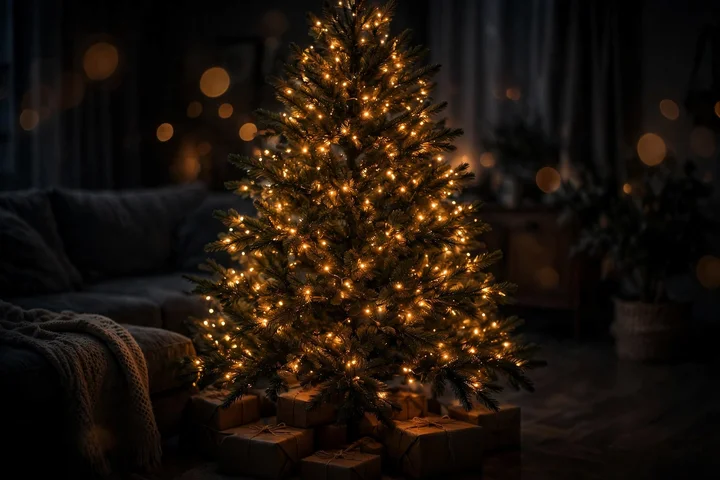
The 3-layer tree method is non-negotiable for a professional look: lights first (100 per foot of tree), then garland or ribbon, then ornaments. Weave lights in and out of the branches — not around the outside — so the tree glows from within. Our Christmas tree ideas guide has the full styling playbook.
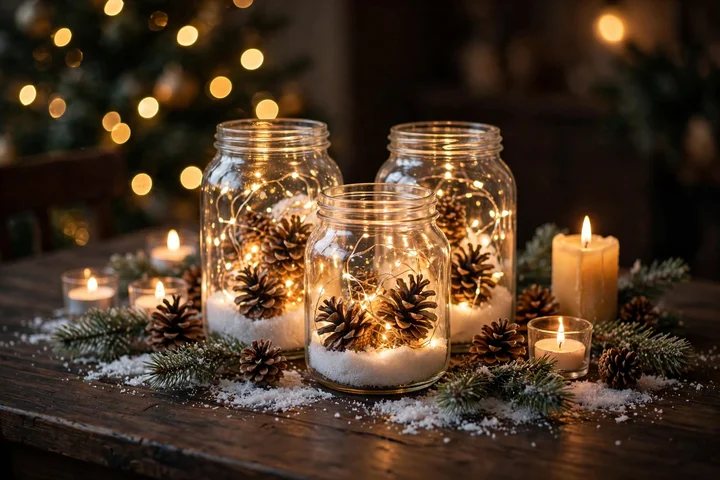
Fairy lights in glass jars are the easiest centerpiece ever made. Fill mason jars or hurricane vases with a coil of battery fairy lights, add pinecones or faux snow, and you have mantel, table, and shelf decor in ten minutes. Candlelight without the fire risk is the whole point.
The mantel glow layers three light sources: a lit garland across the mantel, fairy-light jars at each end, and flameless candles in front. The layering is what makes it look designed rather than decorated.
Staircase garland with lights turns the dullest hallway into a photo backdrop. Weave a lit garland through the banister, securing it with ribbon every two feet, and let the ends pool slightly on the newel posts.
Bedroom fairy-light canopy is the 2026 trend crossing over from dorm rooms to master bedrooms: drape warm fairy lights from the ceiling above the bed in loose swags. It costs one string of lights and makes December feel magical every night.
Window candles, done right, mean one flameless candle per window, centered, all on the same timer. The uniform glow from the street is the entire effect — mismatched candles in random windows just look like you forgot half of them.
The light-up wall tree is the small-space answer: outline a tree shape on the wall with a single string of lights and hang a few lightweight ornaments from removable hooks. All the glow, zero floor space.
Smart & Efficient Christmas Lighting
Switch to LED and stop thinking about the bill. A 25-foot LED string draws about 2–4 watts versus 100+ for the same length in incandescent — you can run your entire display for the season for less than the cost of one takeout dinner. The Department of Energy’s holiday lighting guidance backs the math.
Smart plugs beat smart lights for most people. Plug your existing strings into outdoor-rated smart plugs and you get schedules, phone control, and energy monitoring for a fraction of the cost of app-controlled light sets. Automation you already own beats features you have to buy.
The dusk-to-11pm schedule is the sweet spot: the display is on when neighbors and guests see it, off when everyone sleeps. Six hours a night instead of twelve roughly halves your energy use with zero visible difference.
Solar for accents, plug-in for anchors. Solar stakes and fairy lights are perfect for pathways and planters, but keep the roofline and the big tree on plug-in power — December’s short days leave solar displays dim by evening.
Christmas Light Safety Rules
Outdoor-rated means outdoor-rated. Indoor strings lack the insulation and sealed sockets to survive rain and snow; using them outside is the single most common cause of holiday light failures and a genuine fire risk.
Three strings max, end to end. Daisy-chaining more than three standard light strings overloads the first string’s wiring. Need more length? Run a second extension cord from the outlet instead.
Clips, not staples. Plastic gutter and shingle clips grip without piercing insulation. A staple through a wire is an invisible short circuit waiting for rain.
Keep lights off the ground in snow country. Strings lying in snowmelt wick water into sockets. Elevate connections on stakes or bricks, and keep all plugs under covered, GFCI-protected outlets.
Take them down by mid-January. UV and freeze-thaw cycles degrade insulation fast; lights left up year-round fail sooner and look worse. A display you maintain for five seasons beats one you replace every year.
Budget Christmas Lights Ideas
Buy one great thing per year. A full display bought at once is expensive; one quality roofline set this year, pathway lights next year, and a tree set the year after builds a stunning display for a fraction of the sticker shock. Our Christmas on a budget guide has 25 more ways to save.
Shop the day after Christmas for next year’s display — 50–75% off is standard on December 26. LEDs store for years, so there is no downside to buying ahead.
One color, bought in bulk, always looks more expensive than a rainbow bought on clearance. Pick warm white, buy the 10-pack, and watch your display look twice as rich.
Frequently Asked Questions
How many lights do I need for a Christmas tree?
Plan on 100 lights per foot of tree height — 700 for a 7-foot tree. Sparse or minimalist trees can go lower; dense “wow” displays go up to 150 per foot.
Are LED Christmas lights really cheaper to run?
Yes — dramatically. LEDs use up to 90% less electricity than incandescent mini-lights, stay cool to the touch, and last tens of thousands of hours. The upfront cost pays back in the first season or two.
When should I put up Christmas lights?
The weekend after Thanksgiving is the American standard, but there’s no rule — many families light up the first weekend of December. Take them down by mid-January to protect the wiring.
Can I leave outdoor Christmas lights on all night?
You can, but a timer set for dusk to 11pm gives you the full visual payoff for roughly half the energy. Smart plugs make scheduling effortless.
Should I test old lights before hanging them?
Yes — plug every strand in on the ground in November before a single clip goes up. Replace dead bulbs, toss any string with cracked insulation or loose sockets, and note what needs replacing so you can buy it in the after-Christmas sales. An hour of testing on the driveway saves a freezing evening on a ladder.
Leave a Reply