
When is Trinity Sunday 2027? It falls on Sunday, May 23, 2027, in the Western churches. It is always the first Sunday after Pentecost, which means it lands exactly one week after Pentecost Sunday — and in 2027 Pentecost is May 16, so Trinity Sunday comes on May 23, the last Sunday of the month. If you are planning the Easter season, May 23 is the date to mark, because it closes the great fifty days of Easter and opens the long green season of Ordinary Time.
Trinity Sunday is easy to miss. Easter Sunday gets the lilies, the sunrise services, and the family dinner. Pentecost gets the red vestments and the story of the rushing wind. The Sunday after Pentecost can look like an ordinary Sunday. It is not.
The question when is trinity sunday 2027 comes up every spring precisely because the date moves with Easter, and the answer this year is May 23. On this one day, the whole Church stops to adore the mystery at the center of the Christian faith: one God in three Persons — Father, Son, and Holy Spirit. It is the only feast in the calendar that celebrates a doctrine rather than an event in the life of Jesus or a saint, and it took the Church more than a thousand years to agree that it needed a day of its own.
This guide gives you the exact date, explains why it moves every year, walks through the history from the Arian crisis to Pope John XXII, explains the Athanasian Creed and Rublev’s famous icon, and answers the practical questions people ask most.

Key Facts
| Fact | Detail |
|---|---|
| When is Trinity Sunday 2027 | Sunday, May 23, 2027 (Western) |
| Eastern date 2027 | Sunday, June 20, 2027 (Pentecost Sunday in the East) |
| What it is | Solemnity of the Most Holy Trinity; first Sunday after Pentecost |
| Easter Sunday 2027 | Sunday, March 28, 2027 |
| Pentecost Sunday 2027 | Sunday, May 16, 2027 |
| Liturgical color | White |
| Readings 2027 (Year B) | Deuteronomy 4:32-34, 39-40; Romans 8:14-17; Matthew 28:16-20 |
| Established for the whole Church | Pope John XXII, 1316–1334 |
| Raised to first class | Pope Pius X, July 24, 1911 |
| Earliest possible date | May 17 (1818 and 2285) |
| Latest possible date | June 20 (1943 and 2038) |
| Federal holiday in the US | No |
| Holy day of obligation | No, beyond the normal Sunday obligation |
| Trinity Sunday 2026 | Sunday, May 31, 2026 |
| Trinity Sunday 2028 | Sunday, June 11, 2028 |
What Is Trinity Sunday?
Trinity Sunday celebrates the Christian doctrine of the Trinity: the three Persons of God — the Father, the Son, and the Holy Spirit. The doctrine says that God is one in essence and three in Persons, that each Person is fully God, and yet there are not three gods but one God. It is the most distinctive claim Christianity makes about who God is, and it is also the hardest to explain, which is why the feast is often called a feast of mystery rather than of explanation.
The feast is celebrated in all the Western liturgical churches: Roman Catholic, Anglican, Lutheran, Presbyterian, Reformed, Congregationalist, and Methodist. In the Roman Catholic Church it is officially known as the Solemnity of the Most Holy Trinity. In the Church of England it is a Principal Feast under Common Worship, and in the Episcopal Church it is one of the seven principal feast days of the year — and the only one that addresses squarely what Christians believe about God, rather than an event in salvation history.
One thing that surprises people is that the Eastern Orthodox churches do not keep Trinity Sunday as a separate feast at all. In Eastern Christianity, Pentecost Sunday itself is the feast of the Trinity, because the coming of the Holy Spirit reveals the three Persons together. That is why the Eastern date in 2027 is June 20 — Orthodox Pentecost, which is also the day the East calls Trinity Sunday. The Western date and the Eastern date are 28 days apart in 2027, because Western Easter (March 28) and Orthodox Easter (May 2) fall five weeks apart that year.
Trinity Sunday also marks a turning point in the Church year. It is the last of the great Easter-season feasts, and the day after it, Ordinary Time resumes. In the revised Roman rite, Ordinary Time actually restarts on the Monday after Pentecost, but Trinity Sunday is the hinge: everything before it belongs to the Easter cycle, and everything after it is counted forward toward Advent. In the Church of England, the Sundays that follow are still counted as Sundays after Trinity, a usage that goes back to the pre-Reformation Sarum rite.

Why Trinity Sunday Falls on May 23 in 2027
Trinity Sunday is a movable feast, which means its date is set by Easter, not by the calendar. The rule is simple: Trinity Sunday is the first Sunday after Pentecost, and Pentecost is fifty days after Easter. That puts Trinity Sunday exactly fifty-six days after Easter Sunday. In 2027 Easter is unusually early — Sunday, March 28, the earliest Easter since 2016 — so every feast that depends on it comes early too. Count forward fifty-six days from March 28 and you land on Sunday, May 23.
The chain of dates around it makes the pattern easy to follow. Easter Sunday 2027 is March 28. Ascension Day, forty days after Easter, is Thursday, May 6. Pentecost Sunday 2027 is May 16, fifty days after Easter. Trinity Sunday follows one week later, on May 23. Then Corpus Christi, the Thursday after Trinity Sunday, is May 27, and the Solemnity of the Sacred Heart of Jesus, the Friday after Corpus Christi week, is June 4. The whole stretch from Easter to the Sacred Heart covers just over nine weeks, and Trinity Sunday sits right in the middle of the closing sequence.
The range of possible dates is wide. Because Easter itself can fall anywhere from March 22 to April 25, Trinity Sunday can fall anywhere from May 17 to June 20. The earliest possible date, May 17, last occurred in 1818 and will not occur again until 2285. The latest possible date, June 20, last occurred in 1943 and will not occur again until 2038. In 2027, May 23 sits on the early side of the range, which is a direct result of the early Easter. That is the short answer to when is trinity sunday 2027: Sunday, May 23, 2027, fifty-six days after Easter.
| Year | Easter Sunday | Trinity Sunday |
|---|---|---|
| 2026 | Sunday, April 5 | Sunday, May 31 |
| 2027 | Sunday, March 28 | Sunday, May 23 |
| 2028 | Sunday, April 16 | Sunday, June 11 |
| 2029 | Sunday, April 1 | Sunday, May 27 |
| 2030 | Sunday, April 21 | Sunday, June 16 |
| 2031 | Sunday, April 13 | Sunday, June 8 |
Notice how much the date swings. In 2026 it was May 31, in 2027 it is May 23, and in 2028 it jumps to June 11. Anyone planning a church dedication, a parish patronal festival, or a family gathering around the feast should always check the year in question rather than assuming late May. That is why the question when is trinity sunday 2027 comes up every spring.
The History: From No Feast to a Solemnity
The early Church had no special day for the Holy Trinity. That sounds strange now, but it made sense at the time: the doctrine was honored every day, in the Gloria Patri — “Glory be to the Father, and to the Son, and to the Holy Spirit” — and in the sign of the cross, and in every baptism done in the name of the Father, the Son, and the Holy Spirit. Why set aside one day for something the Church celebrated daily?
The answer came from a crisis. When the Arian heresy was spreading — the teaching that the Son was a created being, not truly God — the Fathers prepared an Office with canticles, responses, a Preface, and hymns to be recited on Sundays, so that the Church’s worship would state the doctrine plainly every week. The Sacramentary of Gregory the Great already contains prayers and the Preface of the Trinity. During the Middle Ages, especially during the Carolingian period, devotion to the Blessed Trinity became a highly important feature of private devotion and inspired several liturgical expressions. Sundays, traditionally, were dedicated to the Holy Trinity.
The move toward a separate feast was slow and uneven. The Micrologies, written during the pontificate of Gregory VII, list no special Office for the Sunday after Pentecost, but add that in some places they recited the Office of the Holy Trinity composed by Bishop Stephen of Liège, who lived from 903 to 920. By others the Office was said on the Sunday before Advent. Pope Alexander II, who reigned from 1061 to 1073, refused a petition for a special feast on the grounds that such a feast was not customary in the Roman Church, which daily honored the Holy Trinity — but he did not forbid the celebration where it already existed.
England moved first. Thomas Becket was consecrated Archbishop of Canterbury on the Sunday after Whitsunday in 1162, and he ordered that the same Sunday should be kept as the Feast of Trinity in the churches under his jurisdiction. A new Office was later made by the Franciscan John Peckham, Canon of Lyons and later Archbishop of Canterbury, who died in 1292. English use ran ahead of the rest of Christendom for more than a century and a half, and Rome eventually followed.
Pope John XXII, who reigned from 1316 to 1334, ordered the feast for the entire Church on the first Sunday after Pentecost and established it as a Double of the Second Class. It was raised to the dignity of a primary of the first class on July 24, 1911, by Pope Pius X.
The placement was deliberate. As the old Catholic Encyclopedia puts it, since it was after the first great Pentecost that the doctrine of the Trinity was proclaimed to the world, the feast becomingly follows that of Pentecost. The full history of the feast, from the Arian crisis to John XXII, is set out on the Trinity Sunday page.
The Athanasian Creed
If Trinity Sunday has a text, it is the Athanasian Creed, known by its Latin opening words, Quicumque vult — “Whosoever will.” It is the most uncompromising statement of Trinitarian belief ever written for worship, and it is traditionally recited on Trinity Sunday at Prime in the traditional Divine Office. Before the reforms of 1960, it was said on all Sundays after Epiphany and Pentecost that did not fall within octaves or on which a feast of double rank or higher was celebrated; the 1960 reforms reduced it to once a year, on this Sunday.
The creed opens with a warning and then states the doctrine in a series of hammer blows:
“Whosoever will be saved, before all things it is necessary that he hold the Catholic Faith. Which Faith except every one do keep whole and undefiled, without doubt he shall perish everlastingly. And the Catholic Faith is this: That we worship one God in Trinity, and Trinity in Unity, neither confounding the Persons, nor dividing the Substance.”
It goes on, person by person: the Father is God, the Son is God, and the Holy Spirit is God, and yet there are not three gods but one God. The Father is uncreated, the Son is uncreated, and the Holy Spirit is uncreated. The Father is almighty, the Son is almighty, and the Holy Spirit is almighty — and yet there are not three almighties but one almighty.
The creed is named for Athanasius of Alexandria, the fourth-century bishop who defended the divinity of Christ against the Arians, but modern scholars mostly reject him as its author. Its language points to the West, and it was probably written in the fifth century, in Latin, for use in worship. The 1662 Book of Common Prayer prescribes it for use on certain Sundays at Morning Prayer, including Trinity Sunday, and it is found in many Anglican prayer books. The Episcopal Church’s Book of Common Prayer places it between the Catechism and the Preamble to the Constitution, although it makes no provision for its use in the liturgy today.
Most churches do not recite the Athanasian Creed every year. It is long, it is severe, and its language about who will be saved makes modern congregations uncomfortable. But on Trinity Sunday it is worth reading, because it shows what the feast is for: not to explain the Trinity, which no creed can do, but to state it plainly enough that the Church knows what it believes.
Rublev’s Icon and the Shield of the Trinity
The most famous image of the Trinity in art is not a picture of God the Father at all. It is Andrei Rublev’s icon “The Holy Trinity,” painted in the early fifteenth century, which shows three angels seated around a table with a golden cup. The scene is the Hospitality of Abraham from Genesis 18, when three visitors came to Abraham’s tent at Mamre — and the Church has long read those three visitors as a sign of the three Persons of the Trinity.

Rublev’s icon is the most famous attempt to capture the concept of the Trinity in art. It leaves the impression that God resides in an ongoing conversation of creation, redemption, and sanctification, and that we are invited to sit at God’s table and enter into the conversation. The three angels lean toward one another in a circle, their heads bowed, their hands resting on the table. The cup in the center is both the meal Abraham served and the chalice of the Eucharist. The icon is now in the Tretyakov Gallery in Moscow, and reproductions of it hang in churches, homes, and chapels around the world.
The reason Rublev painted angels rather than God himself is that the Trinity is rarely depicted directly in Byzantine art. To paint the Father as an old man, the Son as a young man, and the Spirit as a dove would make the three Persons look like three separate beings, which is exactly what the doctrine denies. The three angels solve the problem: three figures, one table, one cup, one conversation.
Medieval artists had a second tool for the same problem: the Shield of the Trinity, or Scutum Fidei. It is a diagram, not a picture. Three outer nodes read “Father,” “Son,” and “Holy Spirit.” Each is joined to a central node reading “God” by a line labeled “is.” The outer nodes are joined to each other by lines labeled “is not.” The Father is God, the Son is God, the Holy Spirit is God — and yet the Father is not the Son, the Son is not the Holy Spirit, and the Holy Spirit is not the Father. The whole doctrine, drawn in a few lines, and it still appears in stained glass, on vestments, and in prayer books.
What Happens in Church on Trinity Sunday
The liturgical color on Trinity Sunday is white, the color of Easter joy and of solemn feasts. After seven weeks of white and gold for Easter, then red for Pentecost, the white returns for one more Sunday before the green of Ordinary Time takes over. The change of color is itself a signal: the Easter season is over, and the long stretch of the year has begun.
The readings for 2027 are from Year B of the three-year lectionary cycle. The first reading is Deuteronomy 4:32-34, 39-40, Moses telling Israel that no other nation has heard the voice of God speaking from the fire and lived, and that the Lord is God in heaven above and on earth below. The second reading is Romans 8:14-17, Paul’s passage about the Spirit of adoption, by which we cry “Abba, Father.”
The Gospel is Matthew 28:16-20, the Great Commission, in which the risen Jesus sends the eleven to baptize “in the name of the Father and of the Son and of the Holy Spirit.” It is the only passage in the New Testament that names the three Persons together in a single formula, and it is the reason the Gospel is read on this day.
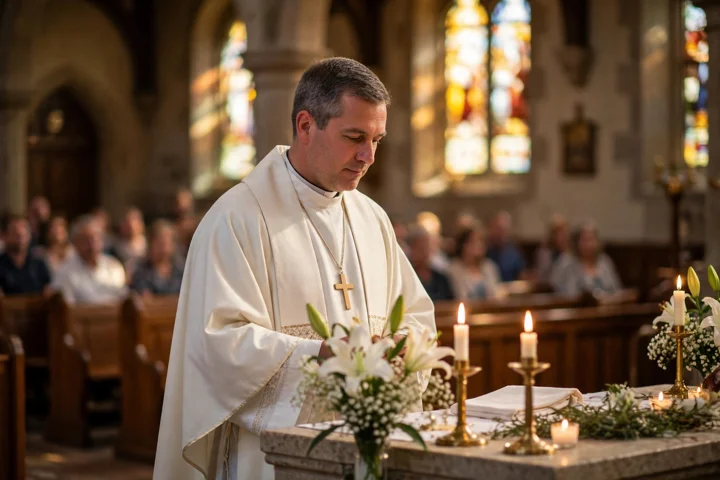
In the Church of England, the Sundays that follow are counted as Sundays after Trinity — the First Sunday after Trinity is May 30, 2027, and the counting runs all the way to Advent. In the Roman rite, the Sundays are counted as Sundays in Ordinary Time instead, and Ordinary Time resumes on the Monday after Pentecost, which means the Sundays that would otherwise fall on Pentecost and Trinity Sunday are omitted from the numbering that year. The difference is a matter of custom, not doctrine, but it is a visible reminder that Trinity Sunday once stood at the head of the second half of the Church year.
Before the reforms of the Second Vatican Council, Trinity Sunday also marked the end of a three-week period when church weddings were forbidden. The period began on Rogation Sunday, the fifth Sunday after Easter, and ran through Ascension and Pentecost to Trinity Sunday. The rule is gone now, but it explains why older parish registers show a rush of weddings in the week after Trinity Sunday. If you are still asking when is trinity sunday 2027, mark Sunday, May 23, 2027, and expect white vestments and the Great Commission Gospel.
For churches dedicated to the Holy Trinity, the day is the patronal festival — the feast of the church’s title, kept at the rank of a Festival or higher. Dedications to the Trinity are among the commonest in England: Frances Arnold-Forster counted over six hundred in 1899, with an ancient one in nearly every county, more than two hundred of them medieval and more than two hundred and thirty added between 1800 and 1850. A parish called Holy Trinity keeps Trinity Sunday the way a parish called St. Mary keeps the Assumption: it is the church’s own day.
Is Trinity Sunday a Public Holiday? Open or Closed?
Trinity Sunday is not a federal holiday in the United States, and it is not a public holiday anywhere in the English-speaking world. It is not listed in 5 U.S.C. 6103, the statute that defines federal holidays, and it is not a holy day of obligation beyond the normal Sunday obligation. Churches hold their usual Sunday services, and businesses, shops, and offices follow regular Sunday opening hours. In the United States, most businesses follow regular Sunday hours on May 23, 2027, and there is no special closure to plan around.
That is worth knowing because the feasts around it are different. Corpus Christi 2027 is a public holiday in about twenty-five countries, including Germany, Poland, Austria, Portugal, and Brazil, and the Easter Sunday 2027 weekend reshapes travel and shopping across the Christian world. Trinity Sunday itself is quieter: a church feast, not a civil one. The one exception is for people planning a visit to a Holy Trinity church — the patronal festival often means a special service, a parish lunch, or a fete, and it is worth checking the parish notice sheet in advance.

If you are traveling on May 23, 2027, expect a normal Sunday. Public transport runs on Sunday schedules, restaurants and attractions are open as usual, and the only crowds you are likely to meet are the ones at the church door after Mass. For anyone checking when is trinity sunday 2027 to plan travel, the answer is simple: it is a normal Sunday, so plan as you would for any Sunday in late May.

Frequently Asked Questions
When is Trinity Sunday 2027?
Trinity Sunday 2027 is Sunday, May 23, 2027, in the Western churches. It is always the first Sunday after Pentecost, which falls on May 16, 2027. In the Eastern churches, Trinity Sunday is June 20, 2027, the same day as Orthodox Pentecost.
Why does Trinity Sunday move every year?
Trinity Sunday is a movable feast set by Easter. It falls exactly fifty-six days after Easter Sunday — fifty days to Pentecost, plus seven more days. Because Easter moves with the lunar calendar, Trinity Sunday moves with it, anywhere from May 17 to June 20.
Is Trinity Sunday a holy day of obligation?
No. Trinity Sunday is not a holy day of obligation beyond the normal Sunday obligation. Catholics are obliged to attend Mass on Sundays, and Trinity Sunday is a Sunday, but there is no additional obligation attached to the feast itself.
What is the difference between Trinity Sunday and Pentecost?
Pentecost celebrates the coming of the Holy Spirit on the apostles, fifty days after Easter. Trinity Sunday, one week later, celebrates the doctrine of the Trinity itself — one God in three Persons. Pentecost is an event; Trinity Sunday is the doctrine the event reveals. In the East, the two are the same day.
What are the readings for Trinity Sunday 2027?
The readings for 2027 are from Year B: Deuteronomy 4:32-34, 39-40; Romans 8:14-17; and Matthew 28:16-20, the Great Commission, in which Jesus commands baptism “in the name of the Father and of the Son and of the Holy Spirit.” The liturgical color is white.
What comes after Trinity Sunday in 2027?
Corpus Christi follows on Thursday, May 27, 2027 (observed on Sunday, May 30, in the United States), and the Solemnity of the Sacred Heart of Jesus follows on Friday, June 4, 2027. After Trinity Sunday, Ordinary Time resumes, and the Sundays are counted as Sundays after Trinity in the Anglican tradition or Sundays in Ordinary Time in the Roman rite. So the short answer to when is trinity sunday 2027 is Sunday, May 23, 2027.
Leave a Reply