
If you are asking when is corpus christi 2027, the answer is Thursday, May 27, 2027, in most of the world — and Sunday, May 30, 2027, in the United States. The feast is always the Thursday after Trinity Sunday, exactly 60 days after Easter. In the United States the celebration moves to the following Sunday, because Corpus Christi is not a holy day of obligation there. This guide gives you both dates, explains the 60-day rule, tells the story of the 13th-century nun and the pope who created the feast, and covers the street processions, the public holidays, and what is open and closed.
Key Facts
| Fact | Detail |
|---|---|
| When is Corpus Christi 2027 (universal date) | Thursday, May 27, 2027 |
| When is Corpus Christi 2027 (United States) | Sunday, May 30, 2027 |
| Full name | Solemnity of the Most Holy Body and Blood of Christ |
| Also called | Corpus Domini, Fronleichnam (Germany), Boże Ciało (Poland) |
| Days after Easter | 60 days after Easter Sunday |
| Western Easter 2027 | Sunday, March 28, 2027 |
| Trinity Sunday 2027 | Sunday, May 23, 2027 |
| Feast of the Sacred Heart 2027 | Friday, June 4, 2027 |
| Meaning | The real presence of Christ in the Eucharist |
| Liturgical color | White |
| Established | 1264, by Pope Urban IV |
| Created after the vision of | St. Juliana of Liège |
| Hymns written for the feast | Pange Lingua, Tantum Ergo, Lauda Sion Salvatorem (St. Thomas Aquinas) |
| Public holiday in | About 25 countries, including Poland, Austria, Portugal, Brazil, Colombia, and parts of Germany, Spain, and Switzerland |
| Is it a federal holiday in the US | No — it is not in 5 U.S.C. 6103 |
| Corpus Christi 2026 | Thursday, June 4, 2026 |
| Corpus Christi 2028 | Thursday, June 15, 2028 |
Why Are There Two Dates in 2027?
The two dates are not a disagreement about the feast itself. Both dates celebrate the same solemnity, and both are counted the same way. The difference is a rule about holy days of obligation. The feast is set on the Thursday after Trinity Sunday, which in 2027 is Thursday, May 27. In countries where Corpus Christi is a holy day of obligation — a day when Catholics are required to attend Mass — the feast stays on that Thursday. Germany, Poland, Austria, Portugal, and much of Latin America keep the Thursday.
Where the feast is not a holy day of obligation, the church moves it to the following Sunday so more people can take part. The United States is one of those places. The United States Conference of Catholic Bishops lists the Most Holy Body and Blood of Christ on Sunday, May 30, 2027, in its liturgical calendar for 2027. England and Wales made the same move in 2006 and reaffirmed it in 2017, so Catholics there also keep the feast on Sunday, May 30, 2027. The same Sunday transfer applies in several other countries.
So when is corpus christi 2027 for you? If you live in the United States, England, or Wales, mark Sunday, May 30, 2027. If you live in Germany, Poland, Austria, Portugal, Brazil, or Colombia, mark Thursday, May 27, 2027. If you are traveling that week, check the local calendar, because the Thursday and the Sunday are both real celebrations of the same feast, and the country you are in decides which one you will find.
When is corpus christi 2027? It falls on Thursday, May 27, 2027, in most of the world, and on Sunday, May 30, 2027, in the United States.
How the Date Is Calculated
Corpus Christi is a moveable feast, which means it has no fixed date on the calendar. It is always a Thursday, always the Thursday after Trinity Sunday, and always 60 days after Easter Sunday. The counting is simple once Easter is known. When Is Easter 2027 falls on Sunday, March 28, 2027, the earliest Easter since 2016. Count forward 60 days from Easter Sunday and you land on Thursday, May 27, 2027.
The rule that answers when is corpus christi 2027 also explains why the date swings so widely from year to year. Easter itself moves, because it follows the moon, and Corpus Christi moves with it. Western Easter can fall anywhere from March 22 to April 25, so Corpus Christi can fall anywhere from May 21 to June 24.
The earliest possible date is May 21, which last happened in 1818 and will not happen again until 2285. The latest possible date is June 24, which last happened in 1943 and will happen again in 2038. In 2027 the feast sits on the early side of that range, because Easter itself is unusually early. May 27 is only six days after the earliest possible date.
The feast sits at the end of the Easter season, and it is the last of the great spring feasts to be dated from Easter. The whole 2027 Easter cycle runs like this: Ash Wednesday on February 10, Easter Sunday on March 28, Ascension Day on Thursday, May 6, Pentecost on Sunday, May 16, Trinity Sunday on Sunday, May 23, and Corpus Christi on Thursday, May 27. Eight days after Corpus Christi comes the Feast of the Sacred Heart, on Friday, June 4, 2027. After that, Ordinary Time resumes, and the church year runs on until Advent begins on Sunday, November 28, 2027.
If you are still wondering when is corpus christi 2027, count 60 days forward from Easter Sunday, March 28, 2027, and you will reach Thursday, May 27, 2027.
Corpus Christi Dates 2026–2031
| Year | Thursday date | Sunday observance (US) |
|---|---|---|
| 2026 | Thursday, June 4, 2026 | Sunday, June 7, 2026 |
| 2027 | Thursday, May 27, 2027 | Sunday, May 30, 2027 |
| 2028 | Thursday, June 15, 2028 | Sunday, June 18, 2028 |
| 2029 | Thursday, May 31, 2029 | Sunday, June 3, 2029 |
| 2030 | Thursday, June 20, 2030 | Sunday, June 23, 2030 |
| 2031 | Thursday, June 12, 2031 | Sunday, June 15, 2031 |
If you are planning ahead, when is corpus christi 2027 is only the first date you need. The 2028 feast falls on Thursday, June 15, which is near the late end of the range, and the 2029 feast falls on Thursday, May 31. The date jumps around because Easter jumps around, and the jump is the whole point of a moveable feast: the church follows the moon, not the calendar on the wall.
The Story Behind the Feast
Corpus Christi is one of the youngest great feasts in the church calendar, and its origin is unusually well documented. It began with a woman, a vision, and a pope who had once been her neighbor.
St. Juliana of Liège was born in 1191 or 1192 in Liège, in what is now Belgium. She was orphaned at five and raised by Augustinian nuns at the convent and leprosarium of Mont-Cornillon, where she developed a deep devotion to the Blessed Sacrament. From 1208 onward she reported a recurring vision: the church appeared to her as a full moon with one dark spot on it. The spot, she was told, meant that the calendar was missing a feast — a feast devoted entirely to the Eucharist. She kept the vision secret for twenty years before telling her confessor, who told the bishop.
The bishop of Liège, Robert of Thourotte, ordered a celebration of Corpus Christi in his diocese in 1246, and the first such celebration took place that year at St. Martin’s Church in Liège. The feast spread slowly. Cardinal-Legate Hugh of St-Cher reinstated it in 1251 and extended it to his whole jurisdiction — Germany, Dacia, Bohemia, and Moravia — in 1252. Then, in 1264, Pope Urban IV made it a feast for the entire Latin Church by the papal bull Transiturus de hoc mundo.
Urban IV was no stranger to the story. Before becoming pope he had been Jacques Pantaléon, Archdeacon of Liège under Bishop Robert, and he had been won over to the cause of the feast during his ministry there. He was also moved by the Eucharistic Miracle of Bolsena, reported in 1263, when a priest named Peter of Prague and his congregation were said to have seen a consecrated host bleed during Mass. Scholars have questioned the dating of the miracle, but there is no doubt about what followed: the pope asked St. Thomas Aquinas, then living at Orvieto, to write the office for the new feast.
Aquinas wrote some of the most famous hymns in the church’s history for Corpus Christi. Pange Lingua, sung at Vespers, gives us its last two verses as Tantum Ergo, the hymn still sung at Benediction of the Blessed Sacrament today. Lauda Sion Salvatorem is the sequence for the Mass, and O Salutaris Hostia is sung at Benediction as well.
The readings for the Mass come from Paul’s First Letter to the Corinthians and from the Gospel of John. It was the first feast ever imposed by a pope on the whole Latin Church, and yet it took half a century to become truly universal.
The bull of Urban IV was included in the collection of laws known as the Clementines, compiled under Pope Clement V and promulgated by his successor, Pope John XXII, in 1317. Only then did the feast take hold everywhere.
The reason for the feast is stated in the bull itself, and it is worth hearing. Maundy Thursday already celebrates the institution of the Eucharist at the Last Supper, but that day is crowded: the washing of the feet, the institution of the priesthood, and the agony in the garden all share the same liturgy, and the mood is somber, with Good Friday only a day away. The principal event was almost lost sight of.
Corpus Christi was created to give the Eucharist a feast of its own, in joyful Ordinary Time, outside Lent, where nothing else competes with it. That is the whole idea of the day: a feast focused solely on the Holy Eucharist, as St. Thomas Aquinas put it, on the Body and Blood, Soul and Divinity of Jesus Christ.
What Happens on Corpus Christi
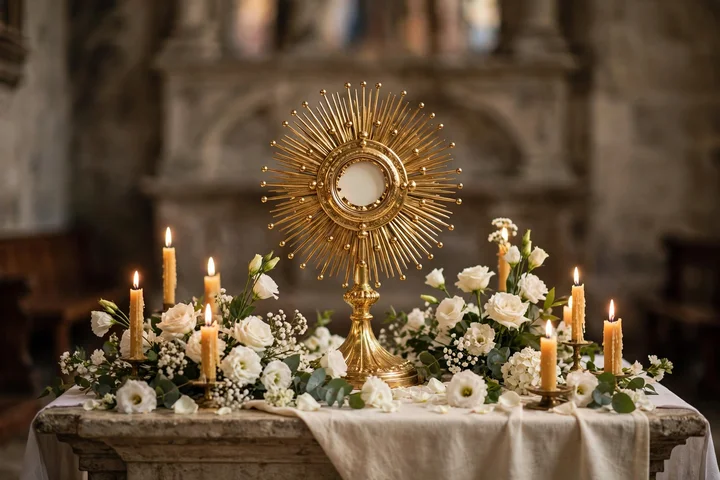
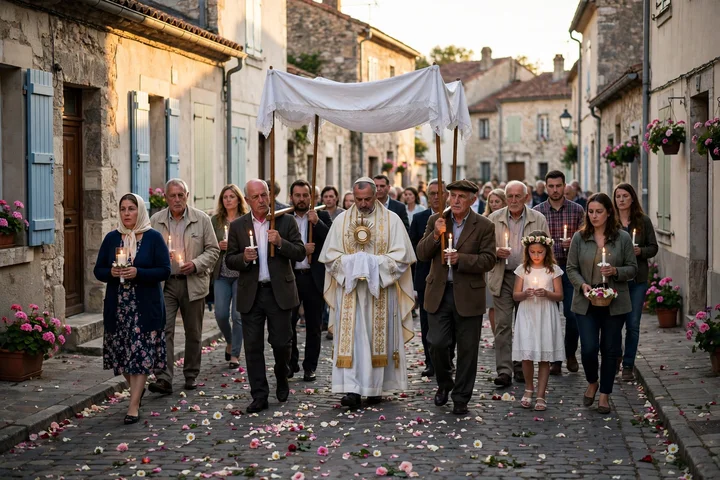
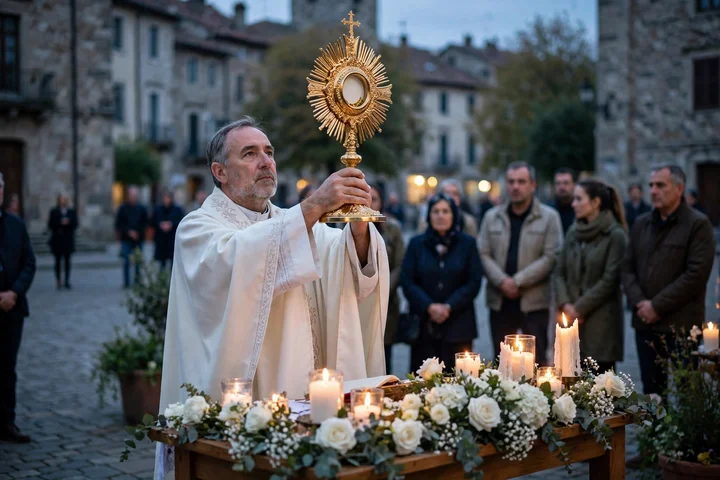
The celebration has a shape that has barely changed in 750 years. Mass is celebrated in the morning, and at the end of Mass there is a procession of the Blessed Sacrament through the streets. The consecrated host is displayed in a monstrance — a vessel of gold or silver-gilt, often shaped like a sunburst — and carried aloft by a member of the clergy, usually under a canopy. The procession stops at outdoor altars along the route, where prayers are said and hymns are sung, and it ends with Benediction of the Blessed Sacrament.
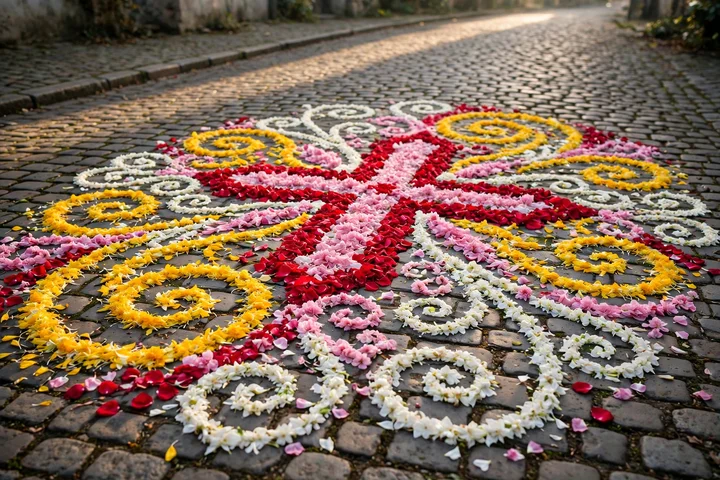
The procession is the heart of the day, and it is what makes Corpus Christi different from every other feast. Most feasts happen inside a church. This one takes the Sacrament out into the streets, past houses and shops, so that the whole town can take part. Corpus Christi wreaths made of flowers are hung on doors and windows, and in many places the route is covered with flower carpets — intricate patterns of colored petals laid out on the pavement, sometimes running for hundreds of yards. The carpets are a work of art that lasts a few hours and is walked over by the procession itself.
Some processions are famous around the world. In Rome the pope presides over a procession that begins at the Archbasilica of St. John Lateran and ends at the Basilica of Saint Mary Major. In Toledo, Spain, the procession carries a silver-gilt monstrance that is one of the great treasures of Spanish goldsmithing.
In Cusco, Peru, fifteen statues of saints are carried through the streets alongside the Sacrament. In Manila, in the Philippines, the Archbishop kneels before the Blessed Sacrament for the entire route. In Germany the day is called Fronleichnam, and the processions pass through villages decorated with birch branches and flower garlands. In Poland the processions stop at four outdoor altars, one for each Gospel, and children in white scatter flower petals ahead of the monstrance.
The feast is also a day of first Communions in many parishes, and of confirmations in some. Children who have just made their First Communion often walk in the procession in their white clothes, carrying baskets of petals. The white of the liturgical color, the white of the altar cloths, and the white of the children’s clothes all point to the same thing: the feast is a celebration, not a fast, and joy is the right mood for it.

Where It Is a Public Holiday
Corpus Christi is a public holiday in about 25 countries, and in parts of several more. The list is a map of the Catholic world, and it is worth knowing if you are traveling in late May or June.
In Europe the day is a public holiday in Austria, Croatia, Liechtenstein, Monaco, Poland, Portugal, and San Marino, and in parts of Germany, Spain, and Switzerland. In Germany the holiday covers Baden-Württemberg, Bavaria, Hesse, North Rhine-Westphalia, Rhineland-Palatinate, and Saarland, and parts of Saxony and Thuringia. In Spain it is a regional holiday in places such as Toledo and Granada. In Switzerland it is a holiday in the Catholic cantons. In Latin America the day is a public holiday in Bolivia, Brazil, Colombia, the Dominican Republic, Haiti, Mexico, Panama, Peru, and Trinidad and Tobago, among others. It is also a public holiday in East Timor, Equatorial Guinea, Grenada, Saint Lucia, and the Seychelles.
The holiday matters most for travel planning in Germany and Poland, where the Thursday closes schools, government offices, and many businesses, and creates a four-day weekend when people take the Friday off. In Germany the day is a quiet religious holiday in the Catholic-majority states, with village processions and flower-decorated streets, and it sits in the most holiday-rich stretch of the German spring, between Ascension Day and Pentecost. In Poland the day is called Boże Ciało, the Body of God, and it is one of the most widely observed holidays in the country.

Corpus Christi in the United States
In the United States, Corpus Christi is a church feast, not a public holiday. It is not a federal holiday, and it is not a holy day of obligation. Federal offices, post offices, banks, and the New York Stock Exchange all follow their regular schedules on Thursday, May 27, 2027, and schools and businesses are open as usual. The celebration happens on Sunday, May 30, 2027, when parishes hold their Masses and processions after the regular Sunday liturgy.
That Sunday has its own character. Because the feast falls on a Sunday, the procession often follows the main Mass, and the whole parish takes part — families, children, and the choir, walking together through the neighborhood around the church. In parishes with large Hispanic communities the day can be especially colorful, with flower carpets, traditional music, and processions that draw on the customs of Mexico, Peru, and other Latin American countries. The Feast of the Sacred Heart follows on Friday, June 4, 2027, so the week after Corpus Christi Sunday is a week of Eucharistic devotion in many parishes, with adoration and Benediction on the days between.
If you are planning travel around the feast, the practical point is simple. In the United States nothing closes for Corpus Christi, and the only date that matters is Sunday, May 30, 2027. If you are traveling to Germany, Poland, Austria, Portugal, or Brazil that week, plan around Thursday, May 27, 2027, when the holiday closes much of the country and the processions fill the streets. Either way, the feast is worth seeing once: there is nothing else in the church year quite like a monstrance carried through a town square, with a crowd walking behind it in silence.
Corpus Christi in Other Traditions
The feast belongs to the Western tradition, and the other Christian churches relate to it in different ways. The Church of England keeps the day as the Day of Thanksgiving for the Institution of Holy Communion. It was abolished in 1548 as the English Reformation progressed and later reintroduced, and some Anglican churches now observe Corpus Christi under its old name. Lutheran churches have a mixed history with the feast. Martin Luther was hostile to the processions, calling them play-acting, and most Lutheran churches dropped the feast at the Reformation — but some Evangelical-Lutheran churches kept it, and Sweden and Prussia historically marked it as a public holiday.
The Eastern Orthodox churches do not observe Corpus Christi. There is no Orthodox Corpus Christi date in 2027, and the feast has no place in the Orthodox calendar, because the Orthodox tradition never developed a separate feast for the Eucharist outside the Divine Liturgy itself.
The closest Orthodox parallel is the way the gifts are carried in procession during the Liturgy, and the great feasts of the Easter cycle — Pascha on May 2, Ascension on June 10, and Pentecost on June 20 in 2027 — fill the same season. The difference is a reminder that the feast is a Western creation, born in Liège and spread by a pope, and that its history is tied to the Latin Church in a way that no other spring feast is.
For more on the history of the feast, including the full account of St. Juliana’s vision and the bull of Urban IV, see the Feast of Corpus Christi on Wikipedia.
Frequently Asked Questions
When is Corpus Christi 2027?
Corpus Christi 2027 falls on Thursday, May 27, 2027, in most of the world. In the United States, and in England and Wales, the feast is transferred to Sunday, May 30, 2027, because it is not a holy day of obligation there. Both dates celebrate the same solemnity, the Most Holy Body and Blood of Christ.
Why does Corpus Christi fall on a Thursday?
Corpus Christi always falls on the Thursday after Trinity Sunday, which is 60 days after Easter Sunday. In 2027 Easter falls on Sunday, March 28, Trinity Sunday falls on Sunday, May 23, and the Thursday after that is May 27. The Thursday was chosen because the Last Supper, when the Eucharist was instituted, took place on a Thursday, and the feast gives the Eucharist a joyful celebration outside Lent.
Is Corpus Christi a public holiday in 2027?
It is a public holiday in about 25 countries, including Poland, Austria, Portugal, Brazil, Colombia, and parts of Germany, Spain, and Switzerland. In Germany it is a holiday in Baden-Württemberg, Bavaria, Hesse, North Rhine-Westphalia, Rhineland-Palatinate, and Saarland. It is not a public holiday in the United States or the United Kingdom, and it is not a federal holiday in the US.
What is the difference between Corpus Christi and the Feast of the Sacred Heart?
Corpus Christi, on Thursday, May 27, 2027, celebrates the real presence of Christ in the Eucharist, the Body and Blood given at the Last Supper. The Feast of the Sacred Heart, on Friday, June 4, 2027, celebrates the love of Christ symbolized by his heart. The two feasts are eight days apart, and together they close the Easter season with a week of Eucharistic devotion.
Who created the Feast of Corpus Christi?
The feast grew out of the visions of St. Juliana of Liège, a 13th-century nun who saw the church as a full moon with a dark spot, meaning a feast was missing from the calendar. The Bishop of Liège ordered the first celebration in 1246, and Pope Urban IV made it a feast for the whole Latin Church in 1264 by the bull Transiturus de hoc mundo. St. Thomas Aquinas wrote the hymns for the feast, including Pange Lingua and Lauda Sion Salvatorem.
When is Corpus Christi 2028?
Corpus Christi 2028 falls on Thursday, June 15, 2028, with the Sunday observance in the United States on Sunday, June 18, 2028. Easter 2028 falls on Sunday, April 16, which is one of the rare years when Western and Orthodox Easter fall on the same day, so there is a single Ascension Day and a single Pentecost in 2028 as well.
Leave a Reply