
A Thanksgiving scavenger hunt turns the longest, laziest part of the holiday — the stretch between dinner and dessert — into the most memorable hour of the day. Players follow a trail of clues through the house, the yard, or the neighborhood, hunting for hidden items, solving riddles, and racing the clock. It works for toddlers with picture cards, for teens with photo challenges, and for competitive adults who will absolutely cheat if you let them.
Key Facts: Thanksgiving Scavenger Hunt
- What it is: A clue-based search game where players find hidden objects or complete photo challenges around the house or outdoors.
- Best timing: The 1–2 hour gap between the main meal and dessert, when energy dips and kids get restless.
- Group size: Works for 4 to 40 players — split into teams of 3–5 for larger gatherings.
- Prep time: 20–30 minutes to hide items and write clues; almost zero cost using household objects.
- Age range: Toddlers hunt with picture cards, kids 5–9 solve simple riddles, tweens do photo challenges, adults get the gratitude twist.
- Why it works: It burns off dinner energy, gets everyone moving, and creates the candid photos you will actually keep.

Why a Scavenger Hunt Is the Perfect Thanksgiving Game
Every Thanksgiving has a dead zone. Dinner ends, the dishes pile up, and the kids start bouncing off the walls while the adults sink into the couch. A Thanksgiving scavenger hunt fills that gap better than any other game: it gets bodies moving after a huge meal, mixes age groups, and sends everyone home with a story.
Unlike board games, nobody has to learn rules for twenty minutes. Unlike trivia, nobody feels dumb for not knowing an answer. And because players move through the actual house and yard, the game doubles as a tour for guests who have never visited.
Research summarized by the Children & Nature Network shows that nature-based scavenger hunts sharpen children’s observation skills and deepen their engagement with the outdoors.
How to Set Up Your Thanksgiving Scavenger Hunt in 30 Minutes
1. Choose your hunting ground. Indoors for bad weather or small kids; outdoors for bigger kids and bigger energy; both for the full experience.
2. Pick your hunt style. Classic clue-chain builds suspense but bottlenecks with big groups. Checklist style (find any 12 of 20 items, in any order) scales beautifully.
3. Hide the items. Use what you have: pinecones, mini pumpkins, wooden spoons, holiday ornaments, wrapped candies.
4. Write the clues. Ten minutes with a pen. Rhyming couplets for charm, straightforward directions for little kids, cryptic riddles for teens and adults.
5. Set the rules and the prize. Time limit (30–45 minutes), boundaries, and whether phones are allowed. The prize can be as simple as first pick of the dessert table.
Indoor Thanksgiving Scavenger Hunt Clues
Ready-to-use indoor clue ideas:
The cold oven: “I cook your turkey but I’m taking the day off — check inside me for what’s hidden.” (Only when completely cold.)
The coat closet: “Guests shed their layers here; something extra is hanging among them.”
Behind the curtains: “I hide the sunshine so you can nap after pie — but today I’m hiding something better.”
The bookshelf: “Find the book about being thankful, and look behind it.”
Under the couch cushions: “The most dangerous territory in the house. Reach in bravely.”
Taped under the dining table: “You have eaten above this spot all day without knowing its secret.”
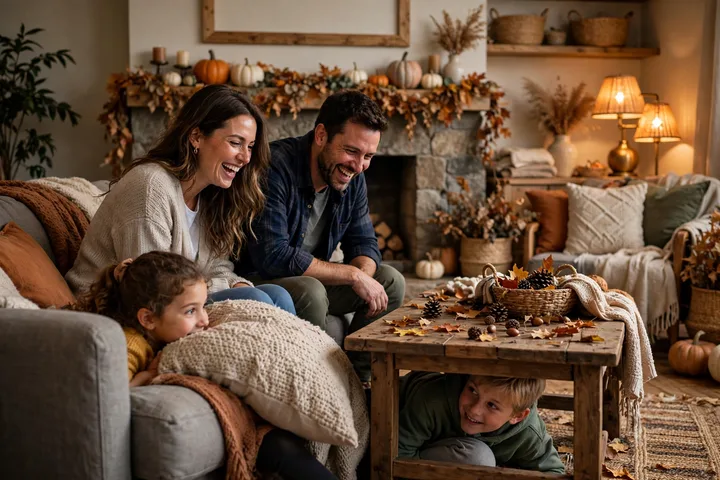
If you are pairing the hunt with other indoor fun, our Thanksgiving family games guide has card and dice games that run perfectly while the hunt teams regroup.
Outdoor Thanksgiving Scavenger Hunt Ideas
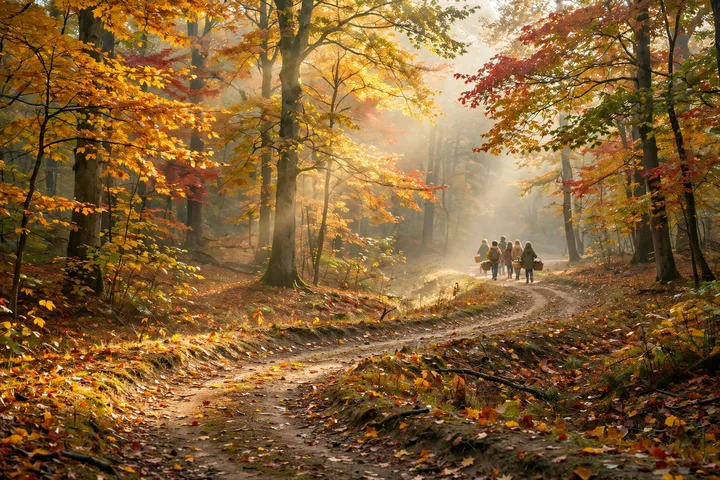
Nature checklist items: a red leaf, a pinecone bigger than your fist, something smooth, something rough, a feather, an acorn, a stick shaped like a letter, three different seed types.
Hidden-object spots: tucked in the mailbox, under the porch mat, hanging from a low branch in a mesh bag, taped beneath the patio table.
Photo challenges for tweens and teens: a team selfie with the biggest tree, the funniest leaf face, everyone mid-jump with the house behind them. Photo challenges are the great equalizer.
Boundary rules matter outdoors: define the hunting area clearly, set a buddy rule for small kids, and do a headcount when time is called. Start outdoor hunts no later than mid-afternoon — dusk comes early in late November.
Thanksgiving Scavenger Hunt by Age
Toddlers and preschoolers (ages 2–4): picture cards
Give little ones a card with simple drawings — a pumpkin, a leaf, a ball — and let them match each picture to the real object hidden in plain sight. An adult “hunt buddy” shadows each toddler.
Kids (ages 5–9): simple riddles
Short rhyming clues with obvious answers build reading confidence. Keep the search area small and the hiding spots visible-ish.
Tweens and teens (ages 10–15): teams and photo missions
Split them into competing teams, add a time limit, and include photo and video challenges. Let them use phones; the content they create becomes the family’s favorite footage.
Adults: the gratitude twist
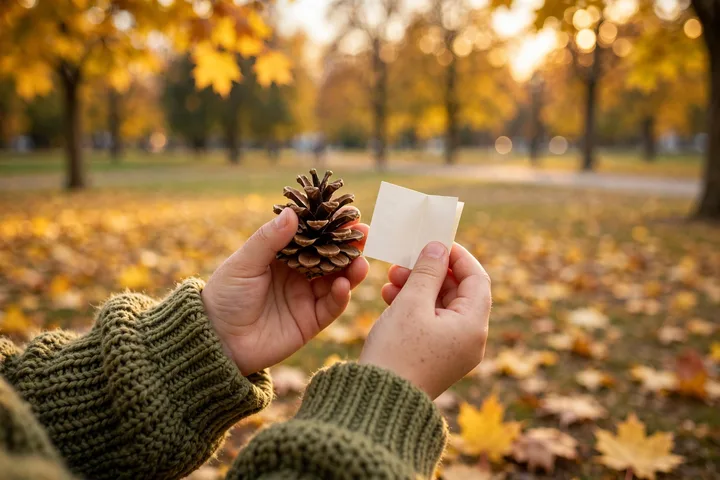
Each clue location holds a slip where they write one thing they are grateful for. Collect the slips and read them aloud at dessert.
For more age-organized ideas, our Thanksgiving activities for kids guide sorts 25+ crafts and games by age band.
Printable Checklist: Make Your Own in 10 Minutes
Take a sheet of paper, draw two columns, and list 12–15 items with a checkbox beside each. For toddlers, sketch simple shapes or cut pictures from a grocery flyer.
Pro formatting tips: big checkboxes little hands can mark, group items by location, and add one “bonus” item worth double points. Laminate the sheet if the hunt goes outdoors.
Want a second game when the hunt ends? Our Thanksgiving trivia questions run perfectly as a sit-down follow-up while the pie cools.
Hosting Tips: Teams, Timing, and Prizes
Team them up. Mixed-age teams of 3–5 work best — every team gets a reader, a runner, and a navigator.
Time it tight. Thirty to forty-five minutes is the sweet spot.
Prize the experience, not the stuff. First pick of desserts, control of the music for an hour, the “Golden Turkey” trophy they must defend next year.
Photograph the chaos. Designate one adult as the hunt photographer — mid-hunt action shots beat posed photos every time.
Frequently Asked Questions About Thanksgiving Scavenger Hunts
How long should a Thanksgiving scavenger hunt last? Plan 30–45 minutes of hunting plus 15 minutes of setup explanation.
What do you hide in a Thanksgiving scavenger hunt? Pinecones, mini pumpkins, wrapped candies, ornaments, wooden spoons, or printed clue cards.
Can toddlers do a scavenger hunt? Yes, with picture cards instead of written clues and an adult buddy.
Indoor or outdoor — which is better? Outdoors for energy-burning and bigger groups; indoors for bad weather and small kids.
How do you keep teens interested? Teams, a time limit, rivalries, and photo/video challenges they can post.
What is a good prize? First pick of the dessert table, the Golden Turkey trophy, or control of the evening’s music.
The Hunt Becomes the Tradition
The first year it is a clever way to fill an hour. The second year the kids ask about it in October. By the third year it has rules, rivalries, a trophy, and a disputed finish someone will bring up every holiday for a decade. That is not a game anymore — that is a tradition.
Leave a Reply