
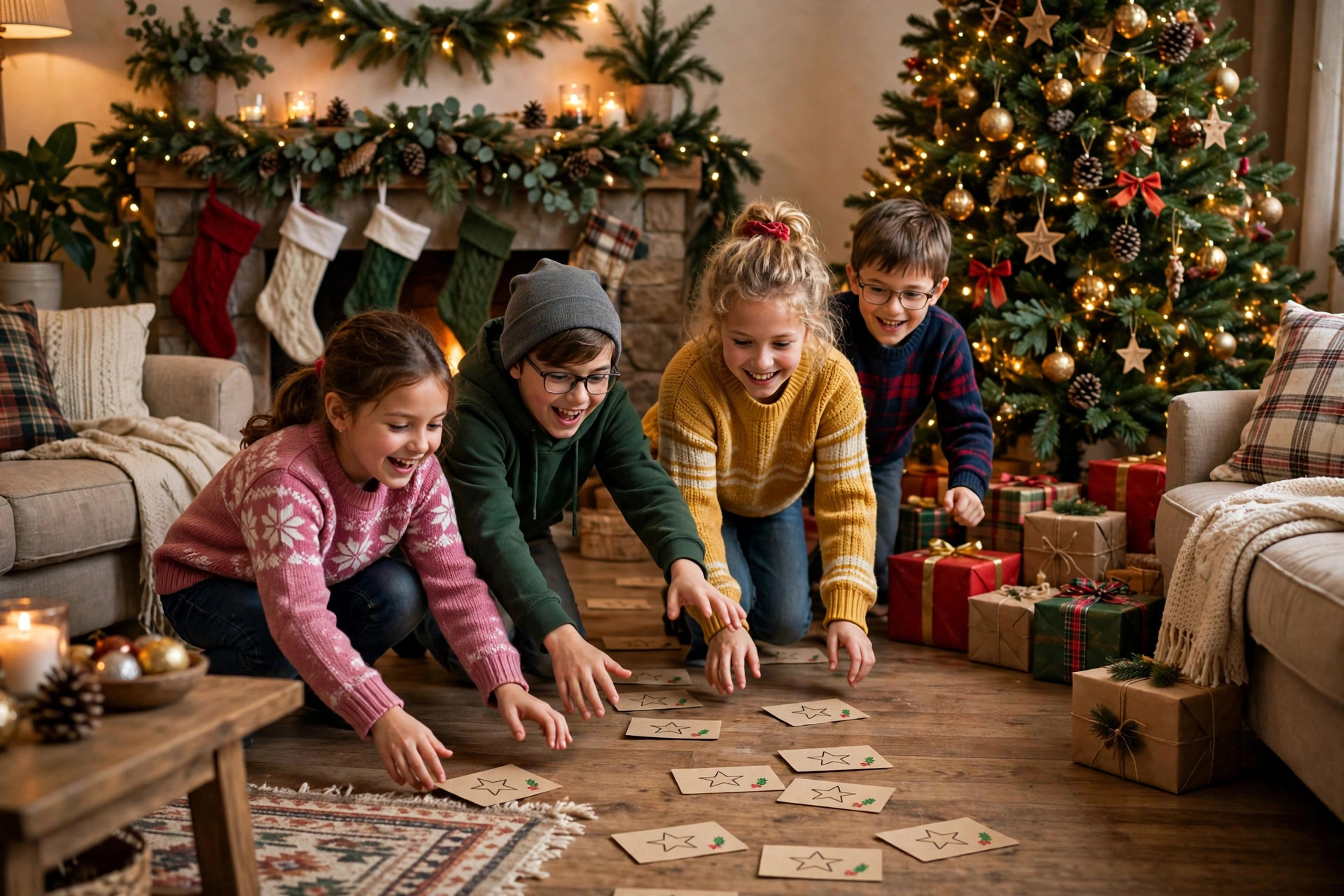
A Christmas scavenger hunt for kids is one of the easiest ways to keep children happy, busy and excited during the holidays — and it costs almost nothing to set up. Children follow a trail of clues around the house or garden, finding small hidden objects or solving riddles until they reach a final prize. In this guide you will find ready-to-use clue ideas, indoor and outdoor hunt plans, tips for different ages, and prize ideas, so you can set up a festive hunt in under an hour.
Key Facts
- A scavenger hunt is a trail of clues that leads children from one hidden spot to the next.
- Ten to twelve clues is a good length for most children.
- Picture clues work for children who cannot read yet.
- The final prize can be small: a chocolate, a small toy, a Christmas book or a craft kit.
- Hide clues in safe, reachable spots, away from hot, sharp or fragile items.
- A scavenger hunt works indoors, outdoors, or as a mix of both.
How a Christmas Scavenger Hunt Works
The idea is simple. You hide a series of clues around your home or garden, and each clue points to the next hiding place. The first clue is handed to the children at the start, and the last clue leads to a prize. Run it as a single trail everyone follows together, or as a race between two teams with separate trails.
There are two main styles. In a clue hunt, children solve a riddle to find the next clue. In a find-it hunt, children get a list of Christmas items to find — a candy cane, a red bauble, a pine cone, a star — and tick them off as they go. Clue hunts suit older children who enjoy puzzles, while find-it hunts suit younger children and large groups. Our guide to Christmas party games has more ideas to fill the afternoon.
Planning Your Hunt: Age by Age
The right hunt depends on the children’s ages. For ages four to six, keep it simple and visual: use picture clues — a drawing of a fridge, a sofa or a Christmas tree — and hide them in obvious, easy-to-reach places. Walk with them, read the clues aloud, and celebrate each find. Six to eight clues is plenty.
For ages seven to nine, rhyming riddles work well — a clue such as “I keep your milk cold and your ice cream frozen, look inside me for your next token” is fun to solve and not too hard. Hide clues in slightly trickier spots, such as inside a shoe, behind a curtain or under a cushion. Ten to twelve clues is a good length.
For ages ten and over, make the clues harder: word puzzles, anagrams, simple codes, or clues that need a little general knowledge. Add a time limit or a points system, and let them hunt in teams. With a mixed-age group, pair younger children with older ones, or run two trails at once — a picture trail for the little ones and a riddle trail for the older children.
Indoor Christmas Scavenger Hunt Ideas
An indoor hunt is the easiest option, especially in cold or wet weather. Classic hiding places include the fridge, a bookshelf, behind the sofa cushions, under the Christmas tree, inside a shoe, and behind a door. Choose spots the children can reach safely.
Here are some ready-to-use indoor clue ideas:
- “I keep your food cold, my light comes on when you open the door.” (Fridge)
- “I sparkle and shine, with baubles and lights — find your next clue where I stand so bright.” (Christmas tree)
- “You wear me on your feet, I come in a pair — your next clue is hiding there.” (Shoes)
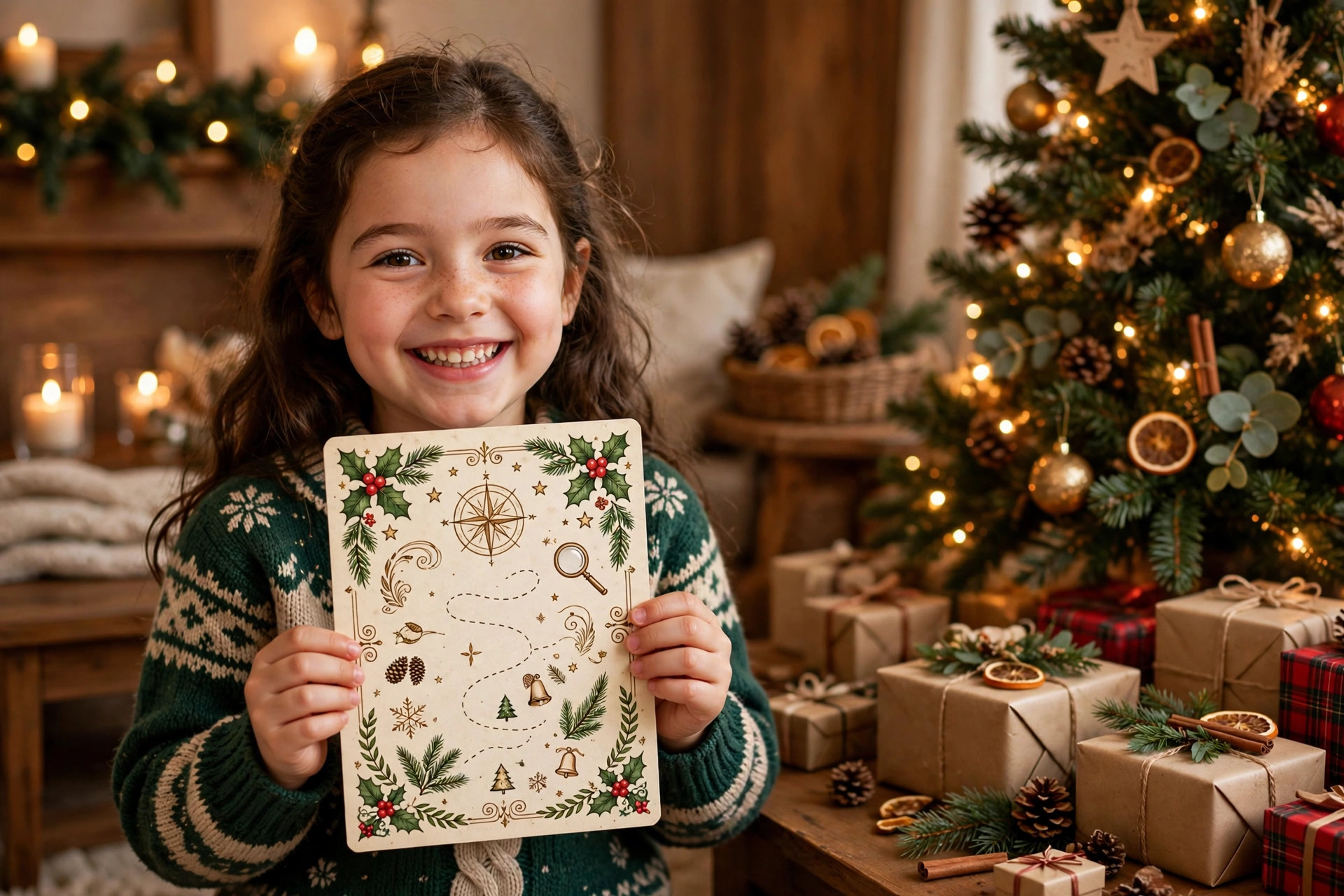
Write each clue on a card, decorate it with a small Christmas drawing, and number the cards so you remember the order. For younger children, draw the hiding place instead of writing a riddle.
Outdoor and Garden Hunt Ideas
If the weather allows, an outdoor hunt adds excitement and gives children room to run. Hide clues around the garden, the porch or the front yard: under a flowerpot, behind a tree, inside a mailbox, taped to a fence, or tucked into a bush. Use waterproof bags so the clues survive damp grass.
Set clear boundaries before the hunt starts, and make sure an adult is outside with the children at all times, especially near a road or driveway. If you enjoyed planning a hunt for another holiday, our Thanksgiving scavenger hunt uses the same format with autumn clues, and it is easy to adapt for Christmas.
Christmas Scavenger Hunt Clue Ideas by Theme
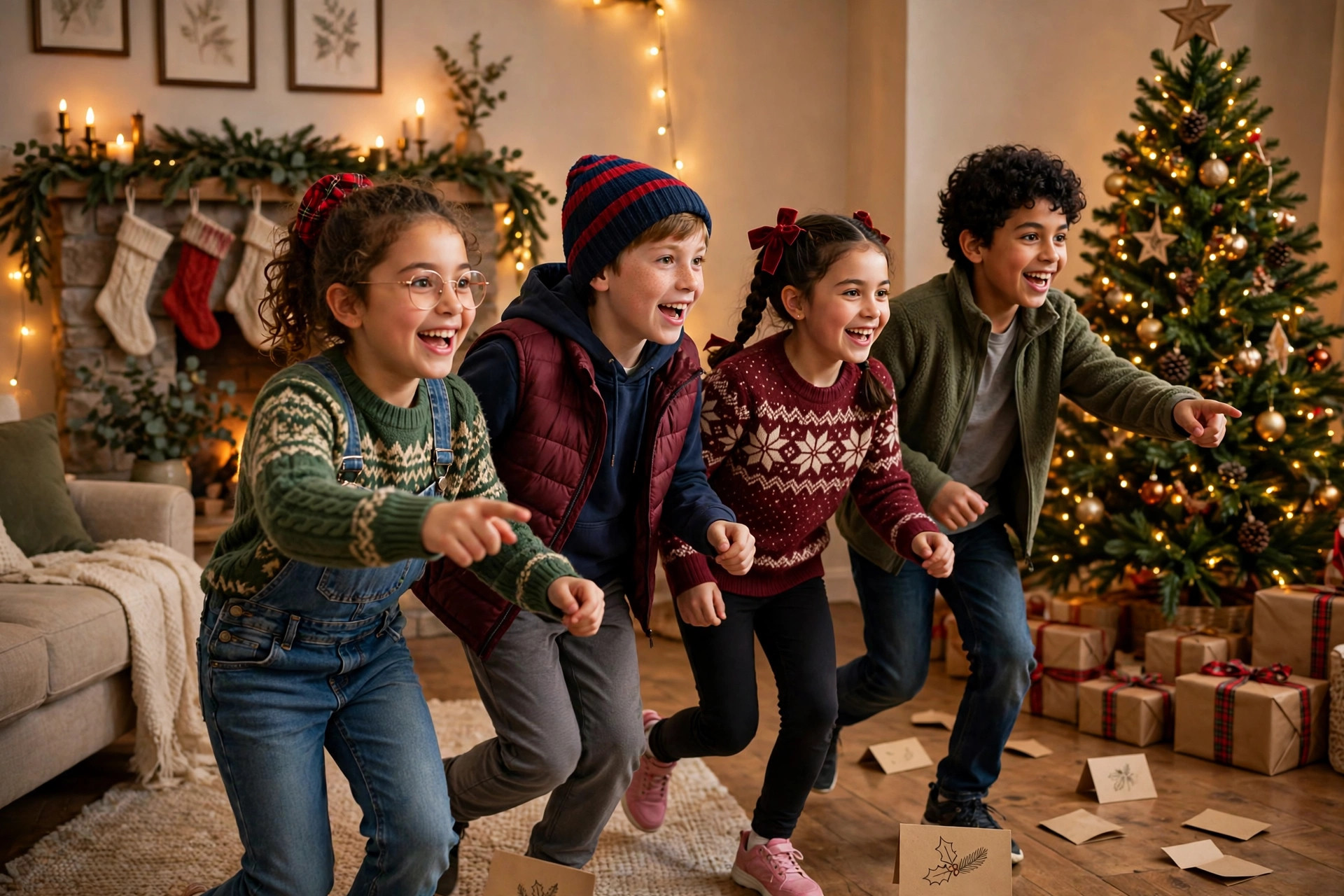
A theme makes the hunt feel special. A Santa theme uses clues about the North Pole, reindeer, chimneys and presents, while a reindeer theme sends children looking for antlers, carrots and sleigh bells. A nativity or star theme works well for a church or school group.
Here are a few more themed clues you can use as they are:
- “Rudolph’s nose is bright and red, find your clue under the bed.”
- “I jingle when I shake, and I hang on the tree — your next clue is waiting on me.” (Bell ornament)
- “I am sweet, striped and shaped like a cane — find me where the sweets are kept.” (Candy cane in a jar)
You can also build a hunt around a story: the children are Santa’s helpers, and they must find the missing presents before Christmas Eve. Give each child a small “helper badge” at the start and a certificate at the end.
Prizes and Treats for the Final Find
The final prize does not need to be expensive — the fun is in the hunt itself. Good prizes for younger children include a chocolate Santa, a small soft toy, a Christmas sticker book, or a bag of candy canes. Older children might prefer a small craft kit, a Christmas puzzle, or a book.
If you are buying toys as prizes, check the CPSC recalls and product safety warnings first to make sure the toy has not been recalled for a safety hazard.
You can also make the prize an experience rather than an object: the winner chooses the Christmas film for the evening, picks the first present to open, or hangs the star on the tree. Experience prizes cost nothing and are often the ones children remember. If the hunt is part of a bigger party, small prizes along the way — a sticker or a sweet at each clue — keep the energy up.
Making It a Craft: Clue Cards and Decorations
Turn the preparation into an activity of its own. Children can help make the clue cards, decorating each one with drawings, glitter and stickers, or make a treasure map — or a small treasure chest from a decorated shoebox to hold the final prize.
After the hunt, the fun can continue with a craft session. Our guide to Christmas crafts for kids has simple ideas — paper snowflakes, salt-dough ornaments, handprint reindeer — for a calm activity once the excitement has worn off.
Safety Tips for a Christmas Scavenger Hunt
A scavenger hunt is safe when it is planned with a little care. Hide clues only in places children can reach without climbing, and avoid the kitchen stove, the bathroom cabinet, and anywhere with cleaning products, medicines or sharp objects. Keep clues away from Christmas lights and lit candles.
If the hunt goes outdoors, check the garden first for hazards, and keep an adult outside with the children at all times. Finally, think about allergies when choosing edible prizes, and offer a non-food prize as well, so every child can enjoy the final find.
Frequently Asked Questions
How many clues should a Christmas scavenger hunt have?
Ten to twelve clues is a good length for most children. Younger children do better with six to eight shorter clues, while older children can handle twelve or more.
What age is a Christmas scavenger hunt suitable for?
Children from about four can enjoy a hunt with picture clues and adult help. Children aged seven to twelve usually enjoy it most, since they can solve riddles on their own. Teenagers can enjoy a harder version with codes and a time limit.
Can I do a Christmas scavenger hunt indoors?
Yes, an indoor hunt works very well and is the easiest option in cold weather. Use rooms the children know well, and hide clues in safe, reachable places such as the fridge, a bookshelf or under the tree.
What should the final prize be?
The prize can be small — a chocolate, a small toy, a Christmas book or a craft kit. Experience prizes, such as choosing the Christmas film or hanging the star, are free and often the most memorable.
How long does a Christmas scavenger hunt take?
Most hunts take 20 to 40 minutes, depending on the number of clues and the children’s ages. Allow extra time for younger children, and keep it shorter if it is part of a larger party.
Can I run a scavenger hunt for a classroom or large group?
Yes. Split the children into teams with colour-coded trails, so teams do not follow each other. Keep the clues in the same area, set a time limit, and give every team a small prize so nobody goes home empty-handed.
Leave a Reply