
The real vs artificial Christmas tree debate comes down to this: a real tree gives you the smell, the tradition, and a fresh tree every year for $60 to $100, while an artificial tree costs $150 to $500 once and lasts 7 to 10 years, breaking even after about 10 years. Most American households now choose artificial, but the real tree still wins on scent and tradition.
Every December, millions of families make the same choice, and most of them make it the same way every year without ever questioning it. If you grew up with a real tree, you probably buy a real tree. If your parents had a plastic one in a box in the attic, you probably do too.
But the choice is worth a fresh look, because the costs, the safety issues, and the environmental picture have all changed in recent years. A fair comparison of real vs artificial christmas tree options is not about which one is “better” in the abstract — it is about which one fits your home, your budget, and your life. This real vs artificial christmas tree guide lays out the costs, the smell, the safety, and the environmental picture side by side.
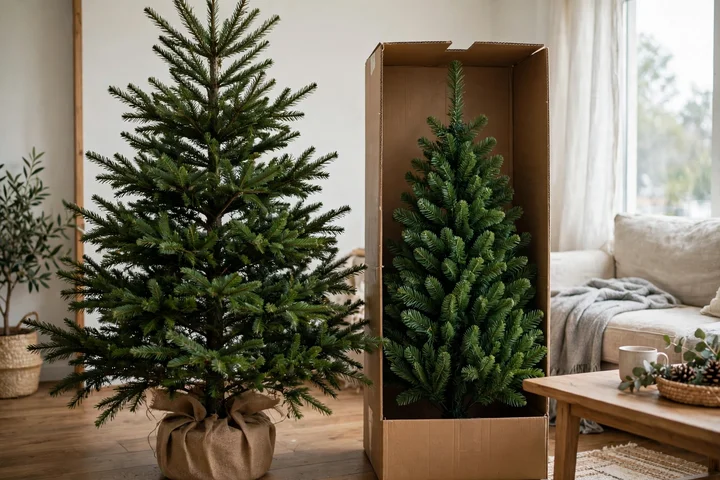
Key Facts
| Fact | Detail |
|---|---|
| Real trees sold in the US each year | About 25–30 million |
| Households that decorate a tree | About 80% use artificial, about 20% use real |
| Real tree cost per year | About $60–$100, plus stand and water |
| Artificial tree cost | About $150–$500 once, lasting 7–10 years |
| Break-even point | About 10 years of use for the artificial tree |
| Real tree lifespan indoors | About 3–4 weeks with water |
| Main safety issue | Dry real trees are a fire risk; artificial trees must be flame resistant |
Real vs Artificial Christmas Tree: The Full Comparison
| Factor | Real tree | Artificial tree |
|---|---|---|
| Cost per year | $60–$100 every year | $150–$500 once, then free for 7–10 years |
| Smell | Wonderful fresh pine scent | No scent unless you add scented ornaments |
| Maintenance | Daily watering, needle cleanup | None — set it up and forget it |
| Lifespan | 3–4 weeks indoors | 7–10 years, sometimes longer |
| Safety | Fire risk if it dries out; keep 3 ft from heat | Must be labeled flame resistant; no drying risk |
| Environment | Renewable, recyclable, grown on farms | Plastic and metal; lasts years but ends in landfill |
| Convenience | Annual trip to the lot, hauling, disposal | Stored in a box; setup in under an hour |
| Appearance | Unique shape, natural variation | Perfectly even, identical every year |
| Allergies | Can carry pollen and mold spores | Hypoallergenic, dust it before setup |
| Tradition | The classic experience, cutting your own tree | The modern, practical choice |
The Cost Math: Which Tree Is Cheaper?
The money question is the one most people ask first, and the answer is less obvious than it looks. A real tree feels cheap because you pay a small amount each year. An artificial tree feels expensive because you pay a large amount once. Over a decade, the picture flips.
A real tree costs about $60 to $100 a year. That is the tree itself, at a lot or a farm. Add a stand if you do not own one, and a tree bag for disposal, and the first year costs a little more. Over ten years, a real-tree family spends roughly $600 to $1,000, and the spending never stops. Every December, there is another tree to buy.
An artificial tree costs about $150 to $500 once. A basic six-foot tree is at the low end; a tall, pre-lit, realistic tree is at the high end. A good artificial tree lasts seven to ten years, and many last longer. Over ten years, the artificial-tree family spends $150 to $500 total — half or less of what the real-tree family spends.
The break-even point lands at about ten years. That is the number most experts cite: you need to use an artificial tree for roughly a decade before it clearly beats a real tree on cost, and on the environmental side too. If you buy a cheap artificial tree and replace it every three years, you save nothing. If you buy a good one and keep it for a decade, you save hundreds of dollars.
There is one more cost to count: your time. A real tree costs an afternoon at the lot, an hour of setup, daily watering, needle cleanup, and a disposal trip in January. An artificial tree costs an hour of setup and an hour of takedown. For a busy family, that time is worth something too. Our Christmas on a budget guide has more ways to keep the whole season affordable, whatever tree you choose.
The Smell Test: Real Wins, and It Is Not Close
Ask a real-tree lover why they will never switch, and the answer is almost always the same word: smell. A fresh fir fills the house with a pine scent that no candle or air freshener has ever matched. It is the smell of the lot, the smell of the forest, and the smell of Christmas itself. For many families, that scent is the season.

An artificial tree has no scent at all. You can buy scented ornaments, pine-scented sprays, or a wreath made of real branches to hang nearby, and those help, but they are an imitation of the thing, not the thing itself. If the smell of a real tree is the core of Christmas for you, no cost saving will make an artificial tree feel right.
That said, the smell cuts both ways. A real tree can also bring pollen, mold spores, and sap into the house, and some people are allergic to it. If someone in your family sneezes every December and feels better in January, the tree may be the cause. An artificial tree is hypoallergenic — just dust it off before you set it up, and it will not trigger allergies at all.
Maintenance: Watering vs. Unfolding
A real tree is a living thing, even after it is cut, and it needs care every day. It can drink a gallon of water or more in its first week indoors, and if the stand runs dry, the cut end seals with sap and the tree can never drink again. From that point it dries out fast, sheds needles, and becomes a fire risk. You need to check the water every morning, keep the tree away from fireplaces and heating vents, and vacuum up needles every day.
An artificial tree needs nothing. You unfold it, fluff the branches, plug in the lights if it is pre-lit, and you are done. There is no watering, no needle cleanup, and no daily check. When the season ends, you fold it back into its bag and put it in the attic.

That difference matters most for busy families, for older people who find hauling a tree difficult, and for anyone who travels over the holidays. A real tree left alone for a week while you visit family will come home to a dry stand and a shedding tree. An artificial tree does not care if you are home or not.
If you do go real, the care is not hard — it is just daily. Our guide on how to keep a real Christmas tree fresh longer covers watering, placement, and the fresh cut that keeps a tree drinking all season.
Safety: Two Different Risks
Both kinds of tree can be a fire risk, but in different ways, and the rules are different for each.
A real tree becomes dangerous when it dries out. The National Fire Protection Association warns that dry Christmas trees are a serious fire hazard: the thin needles are easily ignited, and a fire that spreads to a tree can grow large very quickly. The NFPA’s guidance says a tree showing signs of dryness, such as brittle needles that come off easily, must be removed. Keep a real tree watered, keep it at least three feet from heat sources, and take it down the moment it goes dry.

An artificial tree does not dry out, so it does not carry that risk. But it is made of plastic and metal, and it must be labeled flame resistant. When you buy an artificial tree, check for a flame-resistant label from a recognized testing laboratory. Cheap, unlabeled trees are not worth the saving. And whatever tree you have, use lights that are listed by a recognized testing lab, replace any strand with worn cords, never use lit candles on a tree, and always turn the lights off before bed or when you leave the house.
One more safety point: both kinds of tree should be placed so they do not block an exit, and lights should never be connected in more than three incandescent strands end to end. Those rules apply to every tree, real or artificial.
The Environment: It Depends How You Count
The environmental question is the one people argue about most, and the honest answer is that it depends on how long you keep the artificial tree.
A real tree is a farm crop. About 25 to 30 million real trees are sold in the United States each year, grown on farms that plant one to three seedlings for every tree harvested. The trees absorb carbon dioxide while they grow, and after Christmas they can be recycled into mulch, which keeps them out of landfills. The Real Christmas Tree Board, the industry group for American tree growers, notes that real trees are a renewable, recyclable resource — and you can read more about the industry at realchristmastreeboard.org.
An artificial tree is made of plastic and metal, mostly PVC, and most are manufactured overseas and shipped long distances. Making one uses energy and creates waste, and at the end of its life it goes to a landfill, where it does not break down. The environmental case for an artificial tree rests entirely on reuse: if you use it for ten years or more, its footprint per Christmas drops below that of buying a new real tree every year. If you replace it every few years because it looks dated or the lights fail, the environmental case collapses.
So the green choice is not a type of tree — it is a habit. Buy a real tree and recycle it in January, or buy a good artificial tree and keep it for a decade. Either one beats buying a cheap artificial tree every three years, or a real tree that ends up in the trash.
Who Should Pick Which Tree?
Choose a real tree if: you love the smell and the tradition, you enjoy the annual trip to the lot or the farm, you have a cool spot in the house away from heat, you are home every day to water it, and you do not mind the needle cleanup. A real tree is also the better choice if you want a unique shape — no two real trees are alike, and part of the fun is finding the one that is yours.

Choose an artificial tree if: you want to set it up once and forget it, you travel over the holidays, someone in the family has allergies, you have small children or pets and want a tree that can take a beating, you live in an apartment where hauling a real tree is a hassle, or you want to save money over the long run. An artificial tree is also the practical choice for very tall trees — a nine-foot real tree is heavy, expensive, and hard to move, while a nine-foot artificial tree is just a bigger box. If space is tight, our small space Christmas decor ideas can help you fit a tree into any room.
Consider a hybrid: some families buy a small real tree for the smell and a larger artificial tree for the main display, or put a real wreath on the door and an artificial tree in the living room. There is no rule that says you must pick one and only one.

The best Christmas tree is not the real one or the artificial one — it is the one your family gathers around, the one with the ornaments that carry your stories, and the one that makes your living room feel like Christmas.
A Note on Timing
The real vs artificial christmas tree choice also decides when it goes up. A real tree should wait until the first week of December, because it only lasts three to four weeks indoors. An artificial tree can go up any time, even early November. If you want the full calendar of dates and traditions, our guide on when to put up the tree covers Advent Sunday, Thanksgiving weekend, and the best week for a real tree.
Is a real or artificial Christmas tree cheaper?
An artificial tree is cheaper over ten years: $150 to $500 once, versus $60 to $100 every year for a real tree. The artificial tree breaks even after about 10 years of use.
Do artificial Christmas trees look real?
Modern artificial trees look very convincing, especially the higher-end ones with molded PE tips that copy real branches. From a few feet away, a good artificial tree is hard to tell from a real one — but it has no pine scent.
Are artificial Christmas trees safe?
Yes, if they are labeled flame resistant. Buy from a reputable brand, check for a flame-resistant label, use listed lights, and turn the lights off when you leave the house or go to bed.
Are real Christmas trees bad for the environment?
No. Real trees are a farm crop, with one to three seedlings planted for every tree cut, and they can be recycled into mulch after Christmas. The environmental cost is the annual cutting and transport, which is small compared with manufacturing a plastic tree.
How long does an artificial Christmas tree last?
A good artificial tree lasts 7 to 10 years, and many last longer with careful storage. Keep it in a cool, dry place in a bag or box, and avoid crushing the branches.
Which tree is better for allergies?
An artificial tree is better for allergies. Real trees can carry pollen, mold spores, and dust into the house. If someone in your family sneezes every December, try an artificial tree — just dust it before setup.
The real vs artificial christmas tree decision is personal, and the right answer is the one that fits your home. If the smell of fresh pine is the heart of Christmas for you, buy a real tree, water it every day, and enjoy it. If you want a tree that goes up in an hour, stays perfect all season, and costs nothing next year, buy a good artificial tree and keep it for a decade. Either way, the tree is not the point — the people gathered around it are. Whatever you decide in the real vs artificial christmas tree debate, the best tree is the one that brings your family together.
Leave a Reply