
When is Maundy Thursday 2027? It falls on Thursday, March 25, 2027. The day opens the Paschal Triduum, the three-day heart of the Christian year, and it remembers the Last Supper, the washing of the feet, and the institution of the Eucharist. If you are planning around church services or a Holy Week trip, March 25 is the date to mark first, because the evening Mass that night sets the whole Triduum in motion.
Maundy Thursday is one of the most quietly powerful days of the Christian year. It is not a public holiday in the United States, and it carries no parade or shopping rush, yet churches fill in the evening for a service that ends in silence, with the altar stripped bare and the lights dimmed. This guide gives you the exact date, explains why it moves every year, walks through the full Holy Week calendar, and answers the practical questions people ask most: what happens at the service, whether schools and offices close, and why 2027 holds a rare collision with another feast on the very same day.

Key Facts
| Fact | Detail |
|---|---|
| When is Maundy Thursday 2027 | Thursday, March 25, 2027 |
| What it is | Fifth day of Holy Week; commemorates the Last Supper, the washing of the feet, and the institution of the Eucharist |
| Also called | Holy Thursday, Great and Holy Thursday, Covenant Thursday, Thursday of Mysteries |
| Easter Sunday 2027 | Sunday, March 28, 2027 |
| Days before Easter | 3 days (Easter minus 3) |
| Orthodox date 2027 | Thursday, April 29, 2027 (Great and Holy Thursday) |
| Opens | The Paschal Triduum |
| Lent ends | Evening of Maundy Thursday, March 25, 2027 |
| Annunciation 2027 | Transferred to Monday, April 5, 2027 |
| Federal holiday | No |
| Holy Day of Obligation | No |
| Name origin | Latin mandatum, “commandment” (John 13:34) |
What Is Maundy Thursday?
Maundy Thursday is the Christian feast held on the Thursday of Holy Week, the week that leads to Easter. It marks the beginning of the Paschal Triduum, the three-day period that commemorates the passion, death, and resurrection of Jesus, and it remembers three connected events from the night before the Crucifixion: the Last Supper, the washing of the feet, and the institution of the Eucharist.

It is the fifth day of Holy Week, preceded by Holy Wednesday, often called Spy Wednesday, and followed by Good Friday. The day is observed by Catholics, Eastern Orthodox, Anglicans, Lutherans, Methodists, and many other Protestant churches, though the depth of ritual varies from one tradition to another.
The name is the part people ask about most. “Maundy” comes from the Latin word mandatum, meaning “commandment.” It traces to the words Jesus spoke in John 13:34, after washing his disciples’ feet at the Last Supper: “A new commandment I give to you, that you love one another, as I have loved you.” In Latin the sentence begins Mandatum novum do vobis, and the first word gave the day its English name. The word has no connection to “Monday,” despite the similar sound, and the two words share no root at all.
The day has carried other names across the centuries. The Roman Rite calls it Holy Thursday. The Byzantine Rite calls it Great and Holy Thursday. The Coptic Orthodox Church calls it Covenant Thursday. In England it was once known as Shere Thursday, from the old word shere, meaning “clean” or “bright,” perhaps because churches switched their colors from the dark tones of Lent, or because it was customary to shear the beard that day. In Germany it is Gründonnerstag, or Green Thursday, linked to the tradition of eating green vegetables that day.
Why Maundy Thursday Falls on March 25 in 2027
The short answer to when is maundy thursday 2027 is simple math: count back three days from Easter. Easter Sunday 2027 falls on March 28, which is unusually early, the earliest Easter since 2016. Count back three days from March 28 and you land on Thursday, March 25.
Easter itself moves because it is tied to the moon. By the rule set at the Council of Nicaea in 325, Easter is the first Sunday after the first full moon on or after March 21, the spring equinox. In 2027 the full moon falls on Saturday, March 27, so Easter is the next day, Sunday, March 28. Maundy Thursday follows Easter wherever it goes, which is why the date swings by more than a month from year to year.
The range is wide. Maundy Thursday can fall no earlier than March 19, when Easter falls on its earliest possible date of March 22, and no later than April 22, when Easter falls on its latest possible date of April 25. In 2027 the day sits only six days after the earliest possible date, which is why the whole of Holy Week fits inside a single month. The Maundy Thursday page at Wikipedia lists the same 2027 dates, March 25 for the Western churches and April 29 for the Orthodox churches.
| Year | Maundy Thursday (Western) | Easter Sunday |
|---|---|---|
| 2026 | Thursday, April 2 | Sunday, April 5 |
| 2027 | Thursday, March 25 | Sunday, March 28 |
| 2028 | Thursday, April 13 | Sunday, April 16 |
| 2029 | Thursday, March 29 | Sunday, April 1 |
| 2030 | Thursday, April 18 | Sunday, April 21 |
| 2031 | Thursday, April 10 | Sunday, April 13 |
The Annunciation Collision: Two Feasts on One Day in 2027
The most unusual fact about Maundy Thursday in 2027 is not the date itself but what shares it. The Solemnity of the Annunciation, the feast that marks the angel Gabriel’s announcement to Mary, is fixed to March 25 every year. In 2027, March 25 falls on Maundy Thursday, so the two feasts collide on the same day.

The church does not celebrate both at once. When March 25 falls anywhere inside Holy Week, the Annunciation is transferred to the Monday after the Second Sunday of Easter. For 2027 that places the transferred observance on Monday, April 5, 2027, the day after Divine Mercy Sunday, which falls on April 4. The Catholic Church and the Church of England both move it to that Monday.
The collision is rare because it needs two things to line up: Easter must fall early enough that Holy Week reaches back to March 25, and that happens only in years when Easter falls between March 22 and March 28. The last time the whole of Holy Week fell entirely in March was 2024, and the calendar repeats the exact pattern of 1948, according to the Santiago de Compostela Holy Week guide. In 2027 the overlap adds a second layer: Holy Week also falls inside a Compostela Holy Year, with the Holy Door open all year.
That collision is the reason when is maundy thursday 2027 is a date worth marking twice on a church calendar: once for the Last Supper, and once as a reminder that the Annunciation has moved to April 5.
The Last Supper and the Institution of the Eucharist
The evening Mass of the Lord’s Supper is the center of Maundy Thursday. It remembers the meal at which Jesus, according to the Synoptic Gospels and 1 Corinthians 11:23–26, shared bread and wine with his twelve apostles and told them to repeat the act in his memory. Roman Catholic teaching identifies this meal as the institution of the Eucharist, one of the seven sacraments, and every Christian tradition that observes the day celebrates Holy Communion at this service.

The Mass begins as usual, but it carries details found on no other night of the year. The Gloria is sung with the ringing of church bells, and then the bells fall silent until the Easter Vigil on Saturday night. In Anglo-Saxon England those three days of silence were known as the still days, and many churches still keep the custom, using wooden clappers instead of bells until the Vigil.
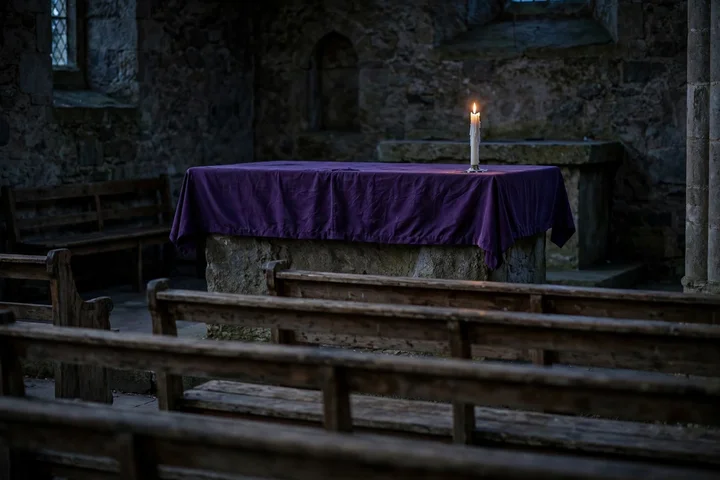
After the homily comes the washing of the feet, and after the Mass the Blessed Sacrament is carried in procession to an altar of repose, a side chapel decorated with flowers and candles, where it remains for adoration through the night. The main altar is then stripped bare, along with every other altar in the church except the altar of repose, and the stripping represents the abandonment of Jesus by his disciples and the stripping of Jesus by the soldiers before his crucifixion. In the Roman Rite the stripping was once done ceremonially to the accompaniment of Psalms 21 and 22, a practice that continues in Lutheran and some Anglican churches.
The service ends without a blessing and without a dismissal. The congregation leaves in silence, and the church stays dark and bare until Good Friday. That silence is deliberate: the Triduum is treated as a single unbroken service spread across three calendar days, and it does not close until Evening Prayer on Easter Sunday.
The Washing of the Feet: What “Maundy” Means in Practice
The Gospel of John tells the foot-washing story instead of the institution narrative. In John 13:1–15, Jesus rises from the table, pours water into a basin, and washes his disciples’ feet, an act of service that a master would never perform for his followers. When he finishes, he explains the meaning himself: “I give you a new commandment, that you love one another as I have loved you.”

In the service, a priest or bishop, representing Christ, ceremonially washes the feet of twelve people, chosen as a cross-section of the community. The number twelve recalls the apostles, but the people chosen are meant to stand for the whole congregation, not for a particular group. In 2016 the Roman Missal was revised to allow women to take part among the twelve; before that, only men were chosen.
The rite is called the Mandatum, from the same Latin word that gives the day its name, and the phrase Mandatum novum do vobis is sung as an antiphon during the ceremony. The act is practiced across many traditions, including Anglican, Lutheran, Methodist, Presbyterian, Roman Catholic, Armenian, Ethiopian, and Mennonite churches, and in the Schwarzenau Brethren and German Baptist communities.
The foot-washing is the most human moment of Holy Week. It turns the day from a history lesson into a command: the service is not something to watch, but something to copy. That is why the day’s name is a commandment, not a date.
The Chrism Mass: The Morning Service
Maundy Thursday holds a second, quieter service that most people never see: the Chrism Mass. It is celebrated in each diocese, usually in the cathedral, on the morning of Maundy Thursday, though some dioceses move it to another day in Holy Week. The Mass celebrates the institution of the priesthood, and it is one of the principal expressions of the bishop’s ministry.

During the Mass, the bishop blesses the holy oils used in the sacraments through the coming year and consecrates the chrism. There are three oils. Chrism, a mixture of olive oil and balsam, is used in Baptism, Confirmation, and Holy Orders, and for the consecration of altars and the dedication of churches. The oil of catechumens is used in Baptism. The oil of the sick is used in the Anointing of the Sick. The oils are then given to priests to take back to their parishes.
The priests and deacons present also renew the promises they made at ordination, and the congregation renews its baptismal promises. The rite is a restoration from 1967, when Pope Paul VI renewed a ceremony recorded in the early 200s by the historian Hippolytus, who described a service at the Easter Vigil at which two holy oils were blessed and one was consecrated. For many dioceses, the Chrism Mass is the one day of the year when the whole presbyterate gathers in one place.
Royal Maundy: The King’s Coins
In the United Kingdom, Maundy Thursday carries a ceremony found nowhere else: the Royal Maundy service. The monarch offers alms to deserving senior citizens, one man and one woman for each year of the sovereign’s age, in a custom that dates back to King Edward I.
The coins, known as Maundy money or Royal Maundy, are distributed in two purses. The red purse contains regular currency and is given in place of the food and clothing that were once handed out. The white purse holds specially minted Maundy coins, in denominations of one, two, three, and four pence, with one penny for each year of the sovereign’s age. The coins have been specially minted since 1822, and they remain legal tender.
Until the death of King James II, the monarch would also wash the feet of the selected poor people, just as the Maundy ceremony requires. A miniature painting attributed to Levina Teerlinc, An Elizabethan Maundy, from around 1560, shows Queen Elizabeth I washing people’s feet during the ceremony. Today the service rotates around English and Welsh cathedrals, and in 2008 it took place for the first time in Northern Ireland, at Armagh Cathedral.
The recipients are nominated by their local dioceses for service to their church and community, and the service is one of the few occasions when the monarch’s religious role is visible in an ordinary parish setting rather than a state occasion.
Holy Week 2027: The Full Calendar
Maundy Thursday sits in the middle of a week that moves fast, opening with Palm Sunday on March 21 and closing with Easter Sunday on March 28. The table below answers when is maundy thursday 2027 at a glance, with every day of Western Holy Week beside it, so you can plan the whole week from one place.
| Day | Date in 2027 | What it remembers |
|---|---|---|
| Palm Sunday | Sunday, March 21 | Entry of Jesus into Jerusalem |
| Holy Monday | Monday, March 22 | Cleansing of the Temple (traditional reading) |
| Holy Tuesday | Tuesday, March 23 | The Olivet Discourse (traditional reading) |
| Spy Wednesday | Wednesday, March 24 | Judas agrees to betray Jesus |
| Maundy Thursday | Thursday, March 25 | Last Supper, foot-washing, Eucharist |
| Good Friday | Friday, March 26 | Crucifixion and death of Jesus |
| Holy Saturday | Saturday, March 27 | Christ’s body in the tomb; Easter Vigil after sunset |
| Easter Sunday | Sunday, March 28 | Resurrection of Jesus Christ |
| Easter Monday | Monday, March 29 | Second day of Eastertide |
The Orthodox calendar runs five weeks later in 2027. Orthodox Palm Sunday falls on Sunday, April 25, Great and Holy Thursday on Thursday, April 29, and Pascha, or Orthodox Easter, on Sunday, May 2. The gap is the widest the two calendars can produce, and it comes from the different ways the two traditions calculate the spring full moon.
Lent itself ends on the evening of Maundy Thursday, just before the evening Mass begins. The Triduum then runs from that evening through Good Friday and Holy Saturday, closing with Evening Prayer on Easter Sunday. In the Catholic calendar, the season of Easter runs for fifty days after that, ending at Pentecost on Sunday, May 16, 2027.
Traditions Around the World
Maundy Thursday looks different from place to place, but the same three threads run through every tradition: a shared meal, a washing of feet, and a night of watching.
In Spain and Latin America, the day is the center of Holy Week processions. In Malaga, brotherhoods carry their floats through the streets from Thursday evening into the early hours of Good Friday, and the final timetables and routes are published each year by the Association of Holy Week Brotherhoods. In Seville, the night processions known as the Madrugada begin on Maundy Thursday and run until dawn. In the Philippines, where the day is a public holiday, families visit seven churches in a single evening, a practice called Visita Iglesia, and churches stay open late for the vigil.
In Santiago de Compostela, Holy Week 2027 runs from March 21 to March 28 inside a Holy Year, and the city expects very high occupancy all week, because the whole week falls inside the closure of the Napoleon route over the Pyrenees. The Pilgrim Office publishes Compostela figures month by month, and the 2027 dates repeat the exact calendar of 1948.
In many European towns, the day keeps its old food customs. In Germany, Gründonnerstag is the day for green vegetables, especially spinach and green herb soup. In the Czech Republic, the day is called Green Thursday too, and spinach and green beer appear on the table. In the United Kingdom, the day is marked by hot cross buns in some regions, though those are more often tied to Good Friday.
In the United States, the day is quieter. Most churches hold a single evening service, often starting between 6 and 7 p.m., and many parishes keep a vigil at the altar of repose until midnight, with people signing up for half-hour watches. The practice recalls the Garden of Gethsemane, where Jesus asked his disciples to watch with him for one hour.
Is Maundy Thursday a Public Holiday? What Is Open and Closed
Maundy Thursday is not a federal holiday in the United States, and it is not a Holy Day of Obligation, so there is no requirement to attend Mass. Federal offices, the post office, banks, and most businesses stay open on their normal schedules, and the New York Stock Exchange trades as usual.
Schools are a mixed picture. Public schools do not close for Maundy Thursday, though some close for spring break that week, and the New York City public schools are on spring recess from Thursday, April 22 to Friday, April 30, 2027, which does not cover Maundy Thursday. Catholic schools often close or dismiss early, and many parochial schools hold no classes from Maundy Thursday through Easter Monday.
In the United Kingdom, Maundy Thursday is not a bank holiday; Good Friday is the bank holiday. In Spain, the day is a public holiday in most regions, and in the Philippines it is a regular holiday, with banks and government offices closed. In Germany, the day is a normal working day, though many shops close early in some states. In Latin America, most countries treat Maundy Thursday as a public holiday, and in Colombia, Peru, and Venezuela, government offices and schools close from Thursday through the Easter weekend.
If you are traveling, the practical rule is simple: in the United States, plan for a normal working day with an evening service, and abroad, check the local Holy Week calendar, because Thursday is a holiday in much of the Catholic world. That is why so many people search for when is Maundy Thursday 2027 before they book spring travel.
How to Observe Maundy Thursday in 2027
The evening service is the heart of the day, and it is worth arriving early, because churches fill up and the service runs longer than a normal Mass, often ninety minutes or more. The service begins with the Gloria and the bells, moves through the foot-washing, and ends in silence, so plan to stay through the stripping of the altar rather than slipping out at Communion. If you are still asking when is Maundy Thursday 2027, the answer is Thursday, March 25, 2027, so keep that evening free.
If your parish keeps a vigil at the altar of repose, sign up for a half-hour watch. The vigil recalls the Garden of Gethsemane, and it is the quietest hour of the Christian year, with the church lit only by candles. Many parishes provide a booklet of readings for the watch, and some keep the chapel open until midnight.
The day is also a good one for a shared meal at home. A simple supper of bread, wine, and lamb or fish, eaten slowly and without hurry, echoes the Last Supper, and many families read John 13 together before the meal. The point is not the menu but the pace: the meal is the last unhurried moment before the Triduum begins.
For families with children, the foot-washing is the easiest part of the day to explain. A basin of warm water, a towel, and a parent washing a child’s feet turns the day’s name into something a child can touch. The commandment behind the day is not complicated: love one another as I have loved you, and start with the people at your own table.
Frequently Asked Questions
When is Maundy Thursday 2027?
Maundy Thursday 2027 falls on Thursday, March 25, 2027, three days before Easter Sunday on March 28. The Orthodox date is Thursday, April 29, 2027, five weeks later. The day is always Easter Sunday minus three days, so it moves with Easter every year.
What is Maundy Thursday?
Maundy Thursday is the Christian feast on the Thursday of Holy Week that commemorates the Last Supper, the washing of the feet, and the institution of the Eucharist. It opens the Paschal Triduum, the three-day period that runs through Good Friday and Holy Saturday and ends on Easter Sunday. The name comes from the Latin mandatum, meaning “commandment,” from John 13:34.
Is Maundy Thursday a public holiday?
No, not in the United States. Maundy Thursday is not a federal holiday, and federal offices, banks, schools, and the post office stay open on their normal schedules. It is a public holiday in Spain, the Philippines, and most of Latin America, where Holy Week is a national observance.
Why is it called Maundy Thursday?
The name comes from the Latin word mandatum, meaning “commandment.” After washing his disciples’ feet at the Last Supper, Jesus said, “A new commandment I give to you, that you love one another, as I have loved you” (John 13:34). The first word of that sentence in Latin, Mandatum novum do vobis, gave the day its English name.
What happens at a Maundy Thursday service?
The evening Mass of the Lord’s Supper includes the Gloria sung with bells, the washing of the feet of twelve people, and the celebration of the Eucharist. After the Mass, the Blessed Sacrament is carried to an altar of repose for adoration, the main altar is stripped bare, and the congregation leaves in silence. The Chrism Mass is held earlier in the day, in the cathedral, where the bishop blesses the holy oils for the coming year.
What is the difference between Maundy Thursday and Holy Thursday?
There is no difference. Maundy Thursday and Holy Thursday are two names for the same day. The Roman Rite uses “Holy Thursday” in its modern liturgical books, while the Church of England and many Protestant churches use “Maundy Thursday.” The Orthodox Church calls it Great and Holy Thursday, and the Coptic Church calls it Covenant Thursday.
Leave a Reply