
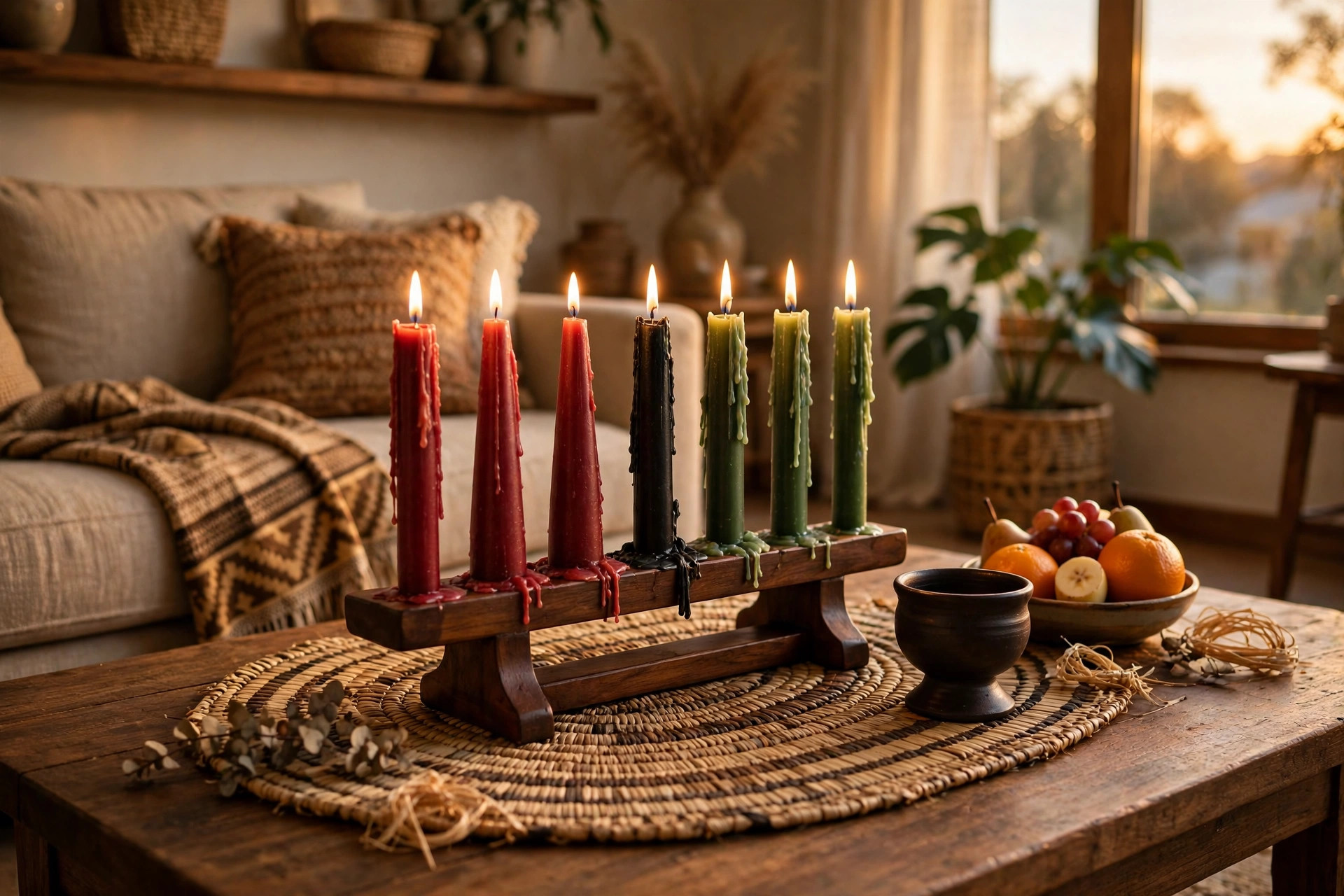
What is Kwanzaa? Kwanzaa is a week-long celebration of African heritage and culture, observed each year from 26 December to 1 January. It is not a religious holiday, but a cultural one, built around seven principles known as the Nguzo Saba, and it gives families a structured, joyful way to reflect on community, identity and shared values as one year ends and another begins. Created in the United States in 1966, Kwanzaa is now celebrated by millions of people of African descent around the world, as well as by many others who appreciate its emphasis on family, creativity and collective responsibility.
If you have ever seen a kinara with seven candles in a window at the end of December, this guide explains where Kwanzaa came from, what its seven days stand for, which symbols matter most, and how it is celebrated.
Key Facts
- Kwanzaa runs from 26 December to 1 January each year, ending on New Year’s Day.
- In 2026–27, Kwanzaa runs from Saturday 26 December 2026 to Friday 1 January 2027.
- Kwanzaa was created in 1966 by Dr Maulana Karenga, an academic and activist in the United States.
- The name comes from the Swahili phrase “matunda ya kwanza”, meaning “first fruits”.
- Kwanzaa is a cultural celebration of African heritage, not a religious festival, and people of any faith can observe it.
- Each of the seven days is dedicated to one of the Nguzo Saba, the seven principles.
- The kinara holds seven candles: three red, one black and three green.
- The Karamu feast, a large communal meal, is held on 31 December.
- Gifts, known as zawadi, are usually handmade or educational, and are often given on the final day.
The Origins of Kwanzaa
Kwanzaa was created in 1966 by Dr Maulana Karenga, a professor and activist who wanted African Americans to have a holiday rooted in African history and values rather than borrowed from another tradition. The 1960s were a period of intense cultural and political change in the United States, and many people were searching for ways to reconnect with African identity, community pride and shared history. Karenga drew inspiration from African harvest festivals, in which communities gathered to give thanks for the harvest, honour their ancestors and renew their bonds with one another.
The name comes from “matunda ya kwanza”, Swahili for “first fruits”. Swahili was chosen because it is widely spoken across East Africa and not tied to one ethnic group. An extra “a” gives the word seven letters, matching the seven days and principles. From the beginning, Kwanzaa was designed to be inclusive: it does not replace Christmas, Hanukkah or any other observance, and many families celebrate it alongside Christmas or New Year.
The Seven Principles: Nguzo Saba
At the heart of Kwanzaa are the Nguzo Saba, seven principles that give each day of the celebration its theme. They were drawn from African communal values and are intended to guide not only the holiday week, but everyday life throughout the year. The principles are Umoja (unity), Kujichagulia (self-determination), Ujima (collective work and responsibility), Ujamaa (cooperative economics), Nia (purpose), Kuumba (creativity) and Imani (faith).
Each evening, families gather to reflect on that day’s principle through discussion, stories, songs or readings. Children take part, and the conversations are deliberately practical: what does unity look like in our family or street? How can we support one another’s goals? Each principle offers a question to carry into the new year.
The Symbols of Kwanzaa
Kwanzaa has a set of distinctive symbols, each displayed on or around a woven mat called the mkeka. Together, they tell the story of the celebration in objects, and setting them out is one of the first things many families do when the holiday begins.
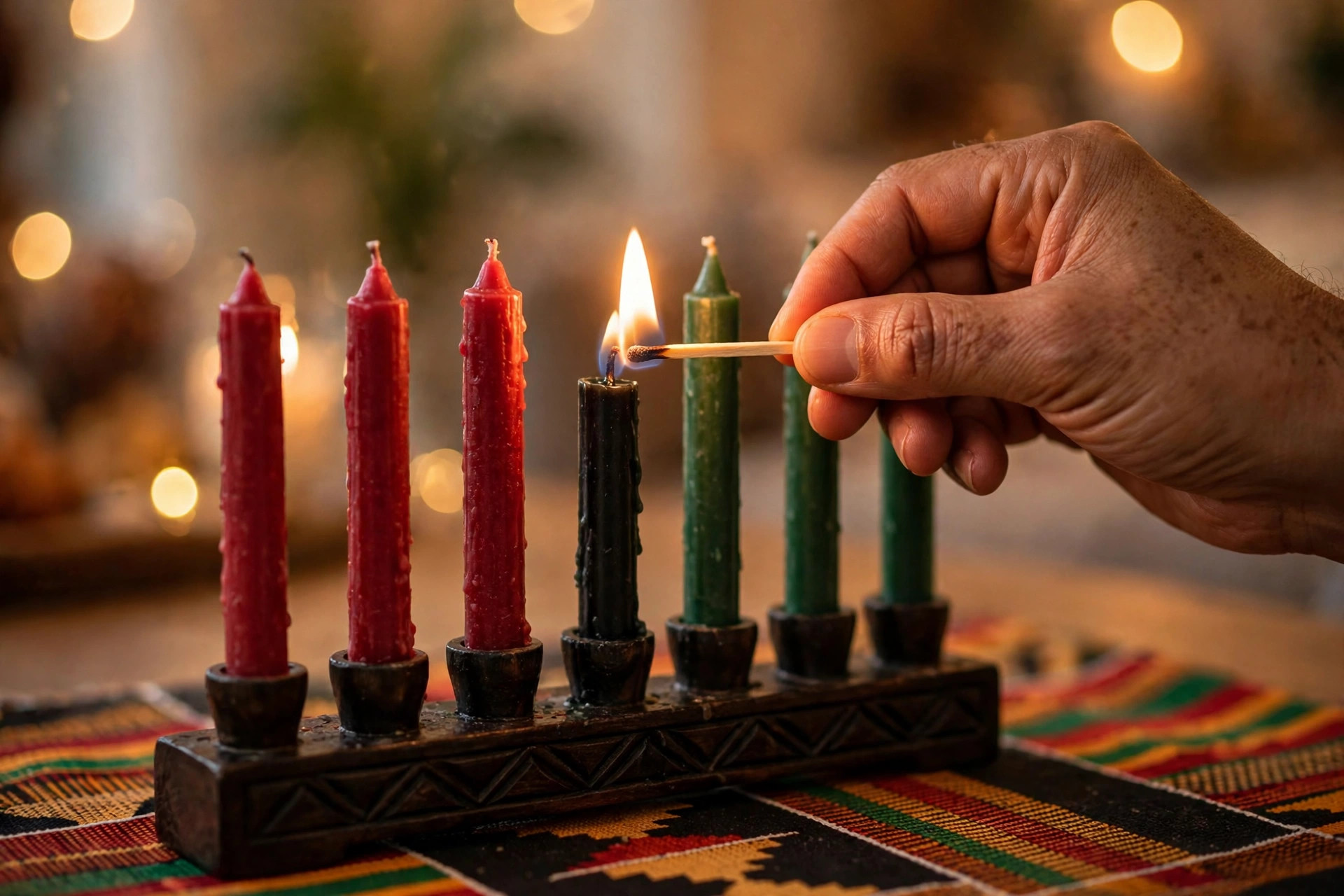
The kinara is the candle holder at the centre of the display. It holds seven candles, called mishumaa saba: three red candles on the left, one black candle in the centre and three green candles on the right. The black candle represents the people, the red candles represent struggle, and the green candles represent hope and the future. A new candle is lit each evening, beginning with the black candle on 26 December, then alternating red and green on the following days.
Other symbols include mazao (fruit and vegetables, representing the harvest), muhindi (ears of corn, representing children), and the kikombe cha umoja (unity cup, used for a libation honouring ancestors). Zawadi, or gifts, are traditionally handmade or educational rather than extravagant.
How Kwanzaa Is Celebrated
A typical Kwanzaa celebration is warm, structured and deliberately unhurried. Each evening, the family gathers around the kinara. The previous days’ candles are relit, the new candle for that day is lit, and the principle of the day is announced and discussed. Someone may read a passage, tell a story from African or African diaspora history, or share a personal reflection. Music and dance often follow, and children may perform poems or songs they have prepared.
Food plays a central role. Throughout the week, families cook dishes inspired by African and African diaspora cuisines, from West African stews and jollof rice to soul food classics such as collard greens, black-eyed peas and sweet potato pie. Meals are shared generously, and neighbours and friends are often invited, because hospitality and community are themselves part of the celebration.
People also greet one another with “Habari gani?” (“What is the news?”), answered with that day’s principle — “Umoja” on day one, and so on through the week.
The Karamu Feast on 31 December
The high point of the week is the Karamu feast, held on 31 December, the sixth day of Kwanzaa. Karamu is a large communal meal that brings together family, friends and the wider community. It is a time for celebration rather than solemnity, with abundant food, music, dancing and storytelling. The feast often begins with a welcome, a remembrance of ancestors, and a libation poured from the unity cup, before everyone sits down to eat together.
Falling on New Year’s Eve, the Karamu also invites reflection on the year ending and hopes for the year ahead. Our guide to New Year’s Eve party ideas offers practical inspiration for a similar gathering.
Gifts, Decorations and the Final Day
Gifts, or zawadi, are traditionally given on 1 January, the final day of Kwanzaa, which is dedicated to Imani, or faith. The emphasis is on thoughtful, meaningful gifts rather than expensive ones. Handmade presents are especially valued, as are books and educational gifts that encourage growth. For children, a gift might be a book about African history, an art set, or something made by a family member. The point is not the price tag, but the thought and the message behind it.
Homes are decorated in red, black and green, with African fabrics, art and crafts around the kinara display — simpler and more personal than the commercial rush of other December holidays.
Is Kwanzaa a Religious Holiday?
One of the most common questions about Kwanzaa is whether it is a religious holiday. The answer is no. Kwanzaa is a cultural celebration, and it was deliberately designed to be open to people of all faiths and none. The seventh principle, Imani, refers to faith in a broad sense — faith in the community, in the goodness of people and in the possibility of progress — rather than to any particular religious belief.
This is why many families combine Kwanzaa with other observances, celebrating Christmas on 25 December and beginning Kwanzaa the next day, or observing Hanukkah and Kwanzaa in the same household. Our comparison of Hanukkah and Christmas and our guide to Christmas traditions around the world place Kwanzaa in that wider seasonal context.

Kwanzaa Today
Today, Kwanzaa is celebrated across the United States and in many other countries, including Canada, the Caribbean and parts of Africa, in schools, libraries, museums and community centres, with exhibitions, music, storytelling and children’s workshops.
Yet its core has remained unchanged since 1966: seven days, seven principles, and a focus on family, community and heritage. In a season that can easily become dominated by shopping and rushing, Kwanzaa offers a pause, a set of values to discuss, and a way to end the year with intention.
Frequently Asked Questions
What is Kwanzaa in simple terms?
Kwanzaa is a week-long cultural celebration of African heritage, from 26 December to 1 January, built around seven principles, with a candle lit each evening and a communal feast on 31 December.
When is Kwanzaa in 2026?
Kwanzaa in 2026–27 runs from Saturday 26 December 2026 to Friday 1 January 2027, beginning the day after Christmas Day and ending on New Year’s Day.
Who celebrates Kwanzaa?
Kwanzaa is mainly celebrated by people of African descent, particularly in the United States, but it is open to anyone of any faith.
Is Kwanzaa a religious holiday?
No. Kwanzaa is not tied to any religion; its seventh principle, Imani, means faith in community and a better future in a broad sense.
What do the seven candles mean?
The candles represent the seven principles: black for the people, red for struggle, and green for hope and the future.
What happens at the Karamu feast?
The Karamu is a large communal feast on 31 December, with food, music, dancing, remembrance of ancestors, and reflection on the year ahead.
Leave a Reply