

Table of Contents
Small kitchen organization is not about buying more containers. It is about making a small room work the way you actually cook in it, so you can reach what you need, put it away without thinking, and keep the counter clear enough to chop an onion without moving five other things first. If your kitchen feels cramped, the problem is rarely that you own too much. It is usually that things live where they fit, rather than where they are used.
I learned this in a rental kitchen with one drawer that worked properly and a counter barely wide enough for a cutting board. I spent a weekend moving things around, not buying anything, and the kitchen felt twice as big by Sunday night. The knives moved next to the prep counter, the pots moved next to the stove, and the coffee things moved to one tray instead of spreading across every surface. Nothing was renovated. The room just stopped fighting me.
This guide stays strictly inside the kitchen. It covers zones, cabinets, drawers, countertops, the space under the sink, the fridge, and the small appliances that eat counter space. It does not wander into other rooms, because the site already has general small-space guides and room-by-room organization posts. If you want the whole-house version, our guide on home organization ideas for small spaces covers that ground. Here, we stay in the kitchen and go deep on it.
Start With Zones, Not Containers
Professional kitchens run on zones, and the same idea rescues a small home kitchen. A zone is a stretch of counter plus the storage nearest to it, dedicated to one job. North Dakota State University Extension describes the same idea as kitchen centers: a food storage and preparation center around the fridge, a cooking and serving center around the stove, and a cleanup center around the sink. When each item lives in the zone where it is first reached for, you stop walking back and forth across a small room for every step of a meal.
Most small kitchens need five zones, and they can overlap in a tiny room without causing trouble. The prep zone is your largest clear counter, ideally between the sink and the stove. The cooking zone is the counter and cabinet space around the stove. The cleanup zone is around the sink and dishwasher. The food storage zone is the fridge and the cabinet or shelf where dry food lives. The daily essentials zone is the easiest-to-reach cabinet, where mugs, plates, and glasses you use every day belong.
To set your zones, stand in your kitchen and point to where you do each job: chopping, cooking, washing up, storing food, and grabbing breakfast. Write each zone on a sticky note and stick it on the cabinet or wall for three days before you buy anything. If a zone feels wrong after three days of real cooking, move the note. That test saves you from buying organizers for a layout that never worked.
Small Kitchen Organization for Cabinets
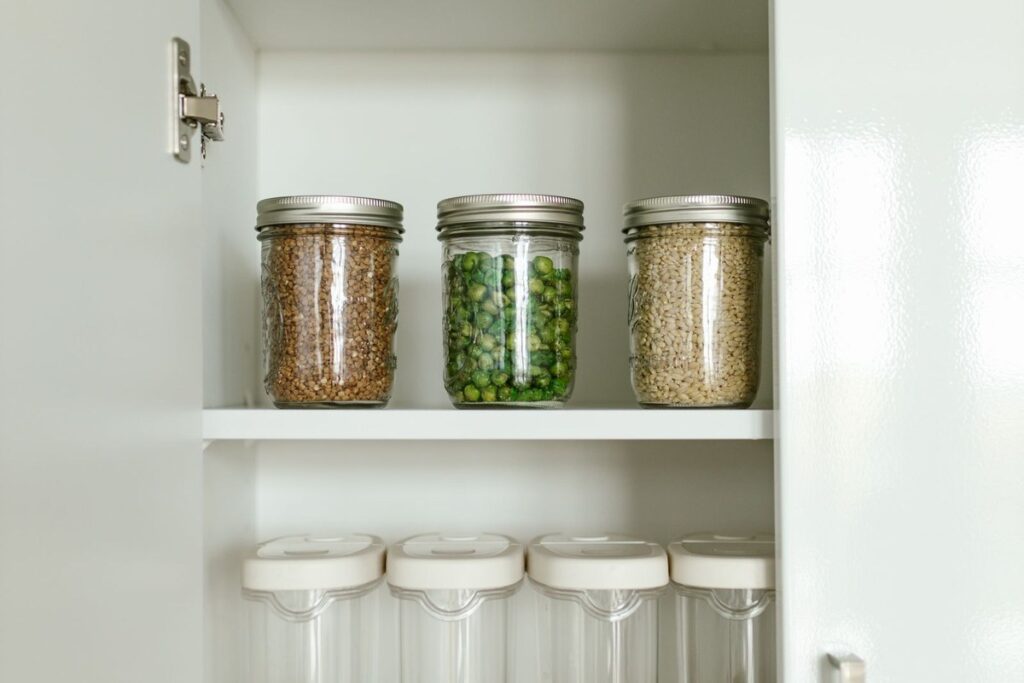
Cabinets are where small kitchens hide their biggest waste, because deep shelves and high shelves both encourage stacking things you cannot see or reach. Fix the inside of the cabinet before you worry about how it looks from outside.
Use the Full Height, Not Just the Bottom
Most cabinets waste the space above plates and bowls. A stackable shelf riser inside a cabinet lets you store two layers instead of one, so bowls sit on the riser and plates sit below, or mugs sit on top and bowls below. Measure the inside height of your cabinet before you buy a riser, because a riser that is too tall for the shelf gap is useless, and one that is too short wastes the gain.
For corner cabinets, a turntable is the simplest fix. Corner cabinets are where things go to be forgotten, and a turntable brings the back of the cabinet to you. Use one for oils, sauces, and canned food, and keep the turntable to one layer of items so nothing topples when it spins.

Put Daily Items Between Knee and Shoulder Height
Daily plates, bowls, mugs, and glasses belong on the easiest shelf to reach. Heavy items, like a cast iron pan or a large pot, belong low, where lifting them is safe. Light, rarely used items, like a holiday baking tin or a large serving platter, belong up high or out of the kitchen entirely. If you have to climb onto a chair to get a mug you use every morning, the mug is in the wrong place, and no organizer will fix that.

Use Cabinet Doors
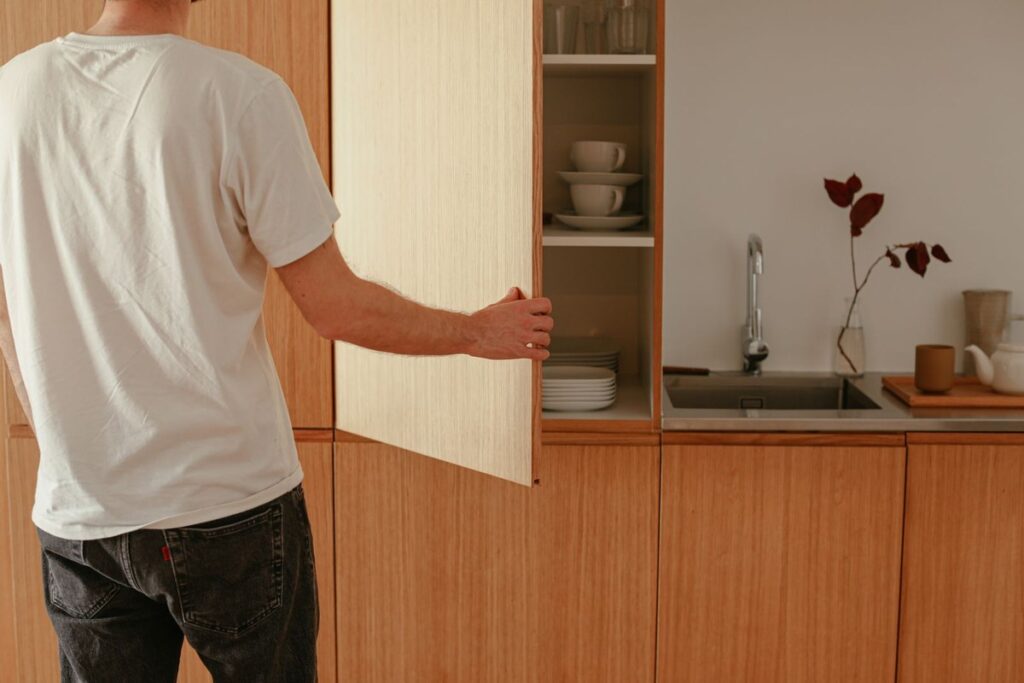
The inside of a cabinet door is free storage. A slim rack on the inside of a door holds lids, foil, wraps, measuring spoons, or cleaning supplies, as long as the rack is light and the door still closes fully. Under-sink cabinet doors are especially useful for spray bottles, because they keep bottles upright and visible instead of piled on the floor of the cabinet around the pipes.
Small Kitchen Organization for Countertops
Counter space is the most valuable space in a small kitchen, because it is where you actually work. Every item that lives on the counter permanently is space you cannot chop, mix, or plate on.
Keep Only Daily Items Out
Run a one-week test. For a week, put anything on the counter that you did not touch that day into a box. At the end of the week, what is still in the box gets a home in a cabinet. What usually survives the test is a kettle or coffee maker, a knife block or magnetic strip, a cutting board, and a small tray for oil and salt near the stove. Everything else, including appliances you use once a week, can live in a cabinet and come out when needed.

Group What Stays Out
Loose bottles and jars spread across a counter look messy even when they are useful. A single tray or a small turntable turns five loose bottles into one object you can lift to wipe underneath. Keep the tray near the stove for cooking oil, salt, pepper, and a spoon rest, and keep a separate small tray for coffee or tea things if you have a beverage corner. Two trays with clear jobs beat one large tray that collects everything.
Win Back the Sink and the Stove Edges
An over-the-sink cutting board or a roll-up drying rack turns the sink into extra counter when you need it, and disappears when you do not. A board that fits over the sink gives you a second prep surface in a kitchen with almost no counter, which is worth more than any new gadget. Around the stove, keep the counter beside the burners clear except for the cooking tray, because that is where hot pans land and where you need space to work safely.
Drawers, Utensils, and Small Tools
A small kitchen usually has one or two drawers that matter, and they tend to become junk drawers by default. Give each drawer one job, and use dividers to keep that job intact.
The utensil drawer should hold only cooking utensils: spatulas, tongs, ladles, and wooden spoons, sorted by type with dividers or small containers. The prep drawer, if you have one, holds knives, peelers, measuring cups, and small tools. If you only have one drawer, put the daily utensils in it and move the rest to a wall rail or a magnetic strip.
A wall-mounted magnetic knife strip frees an entire drawer or a chunk of counter that a knife block would take, and it keeps knives visible and easy to grab. Mount it securely with screws rather than adhesive strips, especially for heavy knives, and mount it above a counter where a falling knife cannot land on someone’s foot. A wall rail with hooks does the same job for ladles, measuring cups, and mugs, and it turns a blank wall into storage without taking any counter.

Under the Sink, the Fridge, and the Gaps
The cabinet under the sink is awkward because of the pipes, but it is still prime storage for cleaning supplies. Use a small caddy that you can lift out, so you are not reaching around pipes for a spray bottle. Keep dish soap, sponges, and trash bags in the caddy, and keep anything that could leak in a small tray at the bottom of the cabinet. Do not store food under the sink, and do not store anything you would be upset about getting damp.
The fridge deserves the same zone thinking as the cabinets. Keep daily items at eye level, group condiments together, and keep leftovers in clear containers at the front so they get eaten instead of discovered weeks later. A small fridge benefits from one-in-one-out discipline: when a new condiment comes in, an old one goes out, or the door shelf becomes a museum.
Finally, look for gaps. The narrow gap between the fridge and the wall often fits a slim rolling cart for bottles and cans. The space above the fridge, if you can reach it safely with a step stool, holds rarely used items like a large stockpot or a holiday baking tin. The side of the fridge, with a magnetic rack, holds spices or small tools. None of these gaps add square footage, but together they can free a whole cabinet.
Small Appliances: The Counter Space Thieves
Small appliances are the quiet reason many small kitchens feel full. A toaster, a blender, a coffee maker, a stand mixer, and a food processor can eat every inch of counter between them, even in a kitchen that is otherwise well organized.
Be honest about frequency. An appliance you use daily earns counter space. An appliance you use weekly earns a cabinet shelf near its zone. An appliance you use a few times a year earns a high shelf or a spot outside the kitchen. If you love baking but bake once a month, the stand mixer does not need to live on the counter all month. It needs a shelf you can reach without a struggle, and a clear spot to work when it comes out.
When you do bring an appliance out, put it back the same day. That one habit, more than any organizer, keeps a small kitchen clear. Appliances left out after use are how a clean kitchen slowly refills itself by Thursday.
A One-Weekend Small Kitchen Reset
If you want to do this properly, give it a weekend, one zone at a time, and do not buy anything until the second day.
- Day one, morning: empty one zone completely, clean it, and sort everything into keep, relocate, and let go.
- Day one, afternoon: put back only what belongs in that zone, in the order you reach for it, and move everything else to its proper zone or out of the kitchen.
- Day two, morning: repeat for the next zone, and note what organizers would actually help, with measurements.
- Day two, afternoon: buy only the organizers on that measured list, install them, and label the spots that tend to drift.
- Every evening after: spend two minutes putting things back in their zones. A small kitchen stays organized through small daily resets, not through big monthly overhauls.
The same small-space thinking that helps a kitchen also helps other small rooms, though the details are different in each one. For a small bathroom, see our guide on small bathroom decor ideas on a budget, and for bedroom storage in a small space, see bedroom decor ideas. The principle is the same in every room: store things where they are used, keep daily items within easy reach, and let the rest go.
For the extension guidance behind the zone approach, see NDSU Extension: Conquering Kitchen Clutter Takes Self-discipline.
Frequently Asked Questions
What is the best way to organize a small kitchen with no pantry?
Treat one cabinet or one shelf as your food storage zone, and use clear containers so you can see what you have. Keep daily food at eye level, backstock behind or above it, and use the first-in-first-out rule so older food gets used before it expires.
How do I keep small kitchen countertops clear?
Keep only daily items out, group them on one or two trays, and run the one-week test for anything you are unsure about. If you did not touch it in a week, it belongs in a cabinet, not on the counter.
Where should pots and pans go in a small kitchen?
Next to the stove, in the lowest cabinet you can reach comfortably, with lids stored separately on a door rack or a vertical divider. Stacking pans with a protector between them saves space, but nesting lids on top of pans wastes it.
Can renters organize a small kitchen without drilling?
Yes. Use adhesive hooks only for light items, and rely on freestanding solutions for the rest: stackable shelf risers, turntables, over-the-sink boards, rolling carts, and countertop trays. A magnetic knife strip needs screws for safety, so if drilling is not allowed, use a countertop knife block or a drawer insert instead.
How often should I reorganize a small kitchen?
Do a full zone check twice a year, and a two-minute reset every evening. Small kitchens drift fast because every item that lands in the wrong zone is immediately in the way, so the daily reset matters more than the big overhaul.
Leave a Reply