
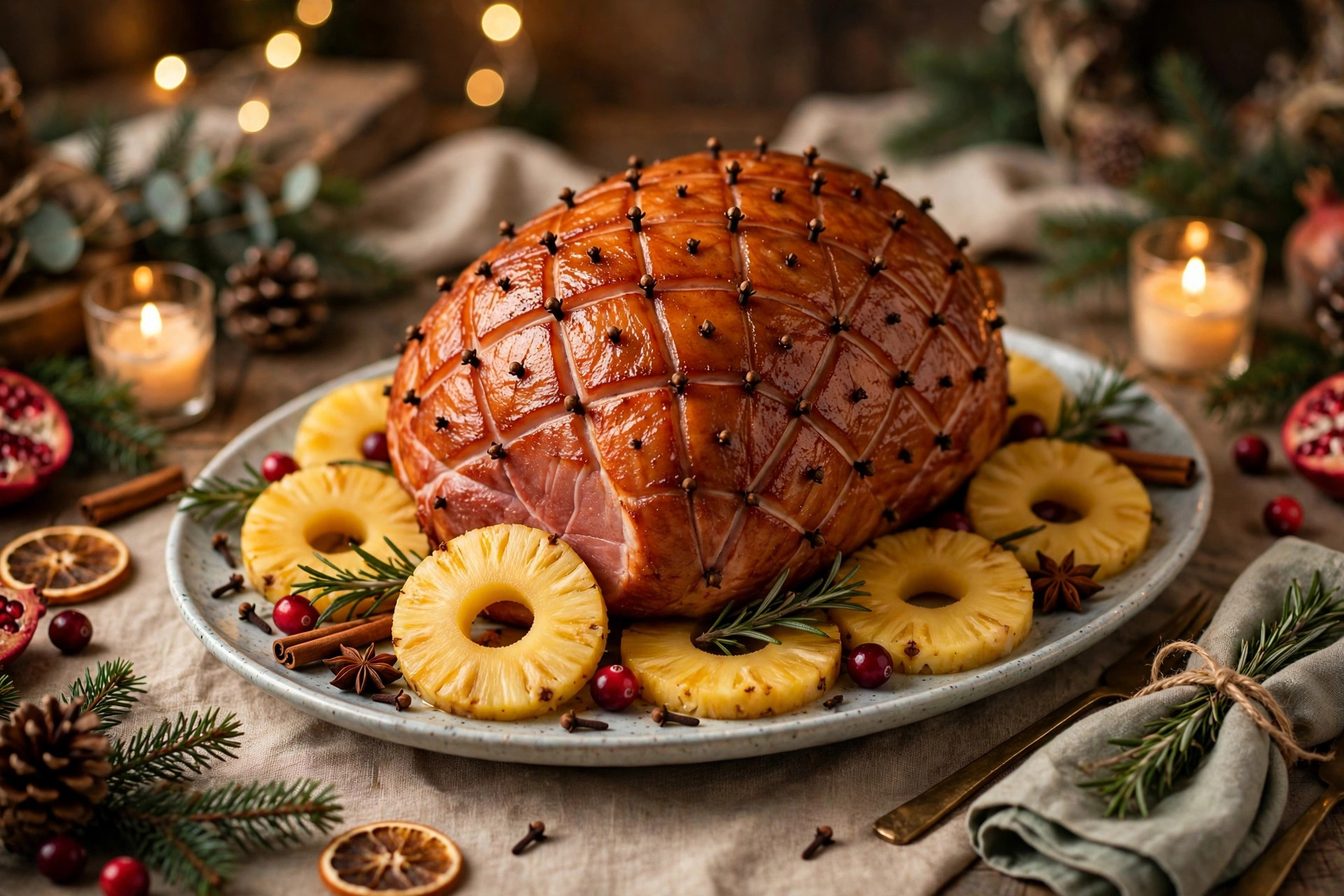
This christmas ham recipe gives you a juicy, tender ham with a sticky, golden glaze — a centrepiece that makes the whole table go quiet for a moment. A good glazed ham looks impressive, feeds a crowd, and is easier to cook than most people expect. With the right ham, a simple glaze and a meat thermometer, you can serve perfect slices. This guide covers choosing your ham, cooking times, glaze ideas, carving tips and leftovers.
Key Facts
- Christmas Day 2026 falls on Friday 25 December.
- A fully cooked ham only needs reheating; a fresh, uncooked ham must be cooked all the way through.
- Plan on about 225 to 340 grams (half to three-quarters of a pound) of bone-in ham per person.
- Glaze the ham during the last 30 minutes of cooking so the sugars caramelise instead of burning.
- Let the ham rest for 15 minutes before carving so the juices settle.
- Always check the internal temperature with a meat thermometer before serving.
Choosing the Right Ham
Choosing the right ham is simpler than the supermarket aisle makes it look. Most Christmas hams are sold fully cooked and smoked, so you are really just reheating them gently and adding a glaze. Look for a bone-in, spiral-cut ham for easy serving, since the slices are already cut and pull apart neatly at the table. A bone-in ham also stays juicier than a boneless one, and the bone can go into soup stock afterwards.
Check the label before you buy. A ham labelled “ham” or “ham with natural juices” has more real meat and less added water than one labelled “ham, water added” or “ham and water product”. City hams are wet-cured and mildly flavoured, suiting most families, while country hams are dry-cured, saltier and more intense. If your guests include children or anyone who prefers mild flavours, choose a city ham. Buy from a butcher or a trusted brand when you can, and order early in December, since the best hams sell out before Christmas.
A whole bone-in ham usually weighs between 7 and 9 kilograms and feeds 20 or more people, while a half ham of 3 to 5 kilograms is plenty for a family gathering of 8 to 12. Plan on about 225 to 340 grams per person, and buy a little more if you want generous leftovers.
Preparing the Ham for the Oven
Take the ham out of the fridge about an hour before cooking, and heat the oven to 160°C (325°F). Remove the packaging and any plastic disc on the bone, then place the ham cut-side down in a roasting pan. Pour about a cup of water, stock or apple juice into the pan — this keeps the oven steamy and stops the ham drying out. Cover the pan tightly with foil so the moisture stays in.
Score the fat in a diamond pattern if your ham is not spiral-cut, cutting just through the fat without slicing into the meat. This helps the glaze seep in and gives the finished ham its classic look. Push whole cloves into the corners of the diamonds if you like the traditional flavour, but keep them in the fat only. For a spiral ham, leave the slices together in the pan so the ham keeps its shape while it heats.
Timing is straightforward. A fully cooked ham needs about 15 to 18 minutes per 450 grams at 160°C, while a fresh uncooked ham needs about 20 to 25 minutes per 450 grams. A 4-kilogram fully cooked ham therefore takes roughly two to two and a half hours. Use a meat thermometer to be sure: check the safe cooking temperatures for ham published by FoodSafety.gov, and heat a fully cooked ham to at least 60°C (140°F) throughout, or 63°C (145°F) for a fresh ham with a short rest. Never guess with a centrepiece this size.

Glaze Ideas for a Golden, Sticky Finish
The glaze turns a good ham into a great one, and you only need a few pantry ingredients. A classic brown sugar and mustard glaze is hard to beat: brown sugar, Dijon mustard, a little honey and apple cider vinegar. A honey and orange glaze — honey, orange juice and zest, and a pinch of cinnamon — gives a brighter, citrus flavour. For something richer, try a maple and bourbon glaze with maple syrup, brown sugar and a little bourbon or apple juice.
Brush the glaze on during the last 30 minutes of cooking, not at the start — glaze too early and the sugars burn and turn bitter before the ham is hot. Remove the foil, brush a generous layer over the scored fat, and return the ham to the oven. Brush on a second layer after 15 minutes for a thick, sticky coating. Turn the oven up to 200°C (400°F) for the final 10 minutes for a deeper caramel colour, but watch it closely — a glaze can go from golden to burnt in minutes.
You can also decorate the ham once it comes out of the oven. Stud it with pineapple rings and maraschino cherries for the retro look many families remember from childhood, or keep it simple with orange slices and fresh herbs. Either way, spoon some of the pan juices over the ham before you bring it to the table.
Carving, Serving and Sides
Let the ham rest for 15 minutes after it leaves the oven, so the juices settle back into the meat and the slices stay moist. If you carve too soon, the juices spill out and the meat tastes dry. Tent the ham loosely with foil while it rests, and use the time to finish your side dishes.
Carving a spiral ham is easy: simply run a knife along the bone and let the pre-cut slices fall away. For a whole, unscored ham, carve thin slices from the outside, cutting parallel to the bone, then cut along the bone to free the slices. Serve the ham on a warm platter, spooning over some of the pan juices and glaze.
The right sides turn the ham into a full Christmas dinner. Roast potatoes, honey-glazed carrots, green beans with almonds and a creamy cauliflower cheese all work beautifully, and a sharp cranberry sauce cuts through the richness of the ham. For a complete plan, see our Christmas dinner menu and the full list of Christmas dinner menu ideas to match your table. Warm bread rolls and a simple green salad round out the meal without adding much work.

Leftovers and Storing Your Ham
Christmas ham is famous for its leftovers, and a little planning means you can enjoy them safely for days. Carve the leftover ham off the bone within two hours of serving, and store it in shallow, covered containers in the fridge. Use refrigerated leftover ham within three to four days, and freeze anything you will not eat by then. Ham freezes well for two to three months if wrapped tightly to prevent freezer burn.
Leftover ham is wonderfully versatile: use it in sandwiches with mustard and pickles, dice it into omelettes and fried rice, or simmer the bone with beans or split peas for a hearty soup. Our Thanksgiving dinner menu 2026 also has leftover ideas that work just as well after Christmas.
Frequently Asked Questions
How long do I cook a Christmas ham?
A fully cooked ham needs about 15 to 18 minutes per 450 grams at 160°C, while a fresh ham needs 20 to 25 minutes per 450 grams. Always check the internal temperature with a thermometer rather than relying on time alone.
Should I glaze the ham at the start of cooking?
No. Brush the glaze on during the last 30 minutes of cooking so the sugars caramelise instead of burning. Add a second layer after 15 minutes for a thicker coating.
What temperature should ham reach before serving?
Heat a fully cooked ham to at least 60°C (140°F) throughout, and cook a fresh ham to 63°C (145°F) with a short rest. Check the temperature in the thickest part with a meat thermometer.
Can I cook a Christmas ham the day before?
Yes. Cook and glaze the ham, let it cool, then refrigerate it whole or sliced. Reheat gently, covered, at 160°C until hot through, and brush with a little extra glaze before serving.
How much ham do I need per person?
Plan on about 225 to 340 grams of bone-in ham per person. Buy a little extra if you want leftovers for sandwiches and soups.
How long does leftover ham last in the fridge?
Use refrigerated leftover ham within three to four days. Freeze anything you will not eat by then, and use frozen ham within two to three months.
Leave a Reply