
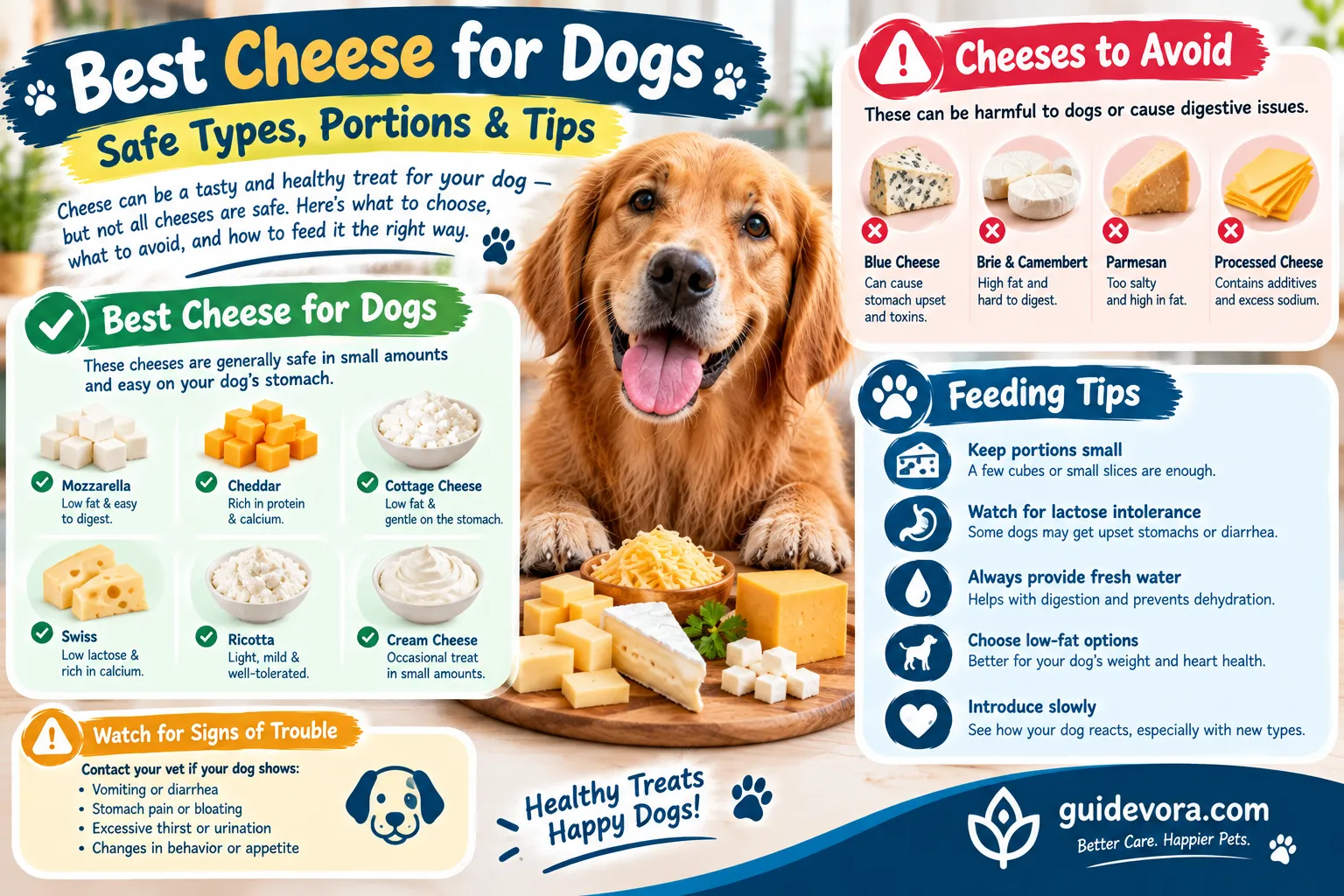
Once you know cheese is fine for your dog in moderation, the next question is which one actually makes sense to keep on hand. The right pick depends less on which cheese is “healthiest” in the abstract and more on what you’re using it for — a fast-disappearing training treat has different requirements than something you’re using to hide a pill twice a day. Here’s how the common options stack up.
Quick Comparison
| Cheese | Lactose | Fat | Sodium | Best For |
|---|---|---|---|---|
| Mozzarella | Low | Low | Low | All-around best default choice |
| Cottage cheese | Moderate | Low | Low–Moderate | Meal topper, higher protein |
| Swiss | Low | Moderate | Low–Moderate | Sensitive-stomach dogs |
| Plain cheddar (aged) | Low | Moderate–High | Moderate–High | Training treats (strong smell/taste) |
| Ricotta | Moderate | Moderate | Low | Small spoon-fed treat |
| Plain cream cheese | Low–Moderate | High | Low–Moderate | Hiding pills |
| Plain provolone (aged) | Low | Moderate–High | High | Occasional treat only |
1. Mozzarella — The Best All-Around Default
If you only keep one dog-safe cheese on hand, this is the one. Mozzarella is naturally lower in fat and sodium than most cheeses, and low-moisture varieties are also lower in lactose. It’s mild enough that most dogs happily eat it, and it’s easy to cut into small, consistent training-treat sizes.
Best for: general everyday use, dogs new to cheese, or as a default answer when you’re not optimizing for anything specific.
2. Cottage Cheese — Best for a Meal Topper
Cottage cheese brings real protein value along with its lower fat content, which makes it a reasonable option to mix into a meal rather than hand-feed as a single treat. It still contains some lactose, so introduce it gradually and watch for any digestive response the first few times.
Best for: adding to a meal for extra protein, or as a change-of-pace treat that’s less calorie-dense than a fattier cheese.
3. Swiss — Best for Sensitive Stomachs
Swiss cheese is naturally low in lactose as part of how it’s made, which makes it one of the more consistently well-tolerated options for dogs with mild dairy sensitivity. It’s higher in fat than mozzarella, so portion size still matters.
Best for: dogs who’ve shown mild stomach upset with other cheeses but you still want to offer an occasional dairy treat.
4. Plain Aged Cheddar — Best for Training
Cheddar’s strong smell and flavor make it genuinely effective as a high-value training treat — the kind of reward that gets a dog’s attention even in a distracting environment. Aging reduces its lactose content, but it runs higher in fat and sodium than mozzarella, so this is a “smaller pieces, more often” cheese rather than a “handful at once” one.
Best for: training sessions where you need a strong-smelling, high-motivation reward, cut into small pea-sized pieces.
5. Ricotta — Best as a Small Spoon-Fed Treat
Similar in profile to cottage cheese, ricotta is mild and generally well tolerated in small amounts. It’s easy to serve as a small spoonful rather than a cut piece, which some owners find convenient for very small dogs.
Best for: small dogs, or as a lick-friendly treat inside a puzzle toy or lick mat.
6. Plain Cream Cheese — Best for Hiding Pills
Plain, unflavored cream cheese is one of the most commonly recommended options specifically for wrapping medication, since its texture holds a pill well and most dogs find it appealing enough to eat without hesitation. It’s higher in fat than most options on this list, so it’s better suited to this specific job than as a general daily treat.
Best for: medication time — this is the use case it’s genuinely best suited for, more than as an everyday snack.
7. Plain Provolone — Occasional Treat Only
Provolone is low in lactose as an aged cheese, but it tends to run higher in sodium and fat than the other options here. It’s fine occasionally but isn’t the cheese to reach for regularly, and smoked or seasoned varieties should be avoided entirely.
Best for: an occasional variety treat, not a regular rotation choice.
What to Skip, Regardless of Use Case
- Blue cheese (Roquefort, Gorgonzola, Stilton) — genuinely toxic to dogs; not a “worse option,” an “avoid entirely” one
- Any flavored or seasoned cheese — garlic, onion, and chive seasoning are common in flavored cheese products and are toxic to dogs independent of the cheese itself
- Heavily processed cheese products (spray cheese, cheese singles) — not dangerous in a small amount, but nutritionally the weakest choice on any list
- Smoked cheeses — often higher in sodium and sometimes seasoned in ways that aren’t dog-friendly
How Much of Any of These Is Actually Okay?
Regardless of which cheese you pick, the same portion principle applies: treats should stay under roughly 10% of your dog’s daily calories, and cheese specifically works best as an occasional addition rather than a daily habit, given its fat and calorie density. Smaller dogs need proportionally smaller pieces than larger dogs for the same relative dose.
Frequently Asked Questions
What is the best cheese for dogs overall? Mozzarella is the most commonly recommended default — it’s naturally lower in fat, sodium, and lactose than most other cheeses, and mild enough that most dogs tolerate it well.
What cheese is best for training treats? Aged cheddar is a popular choice for training specifically because of its strong smell and flavor, which makes it a high-value reward. Cut it into small pea-sized pieces to manage the higher fat and sodium content.
What’s the best cheese for hiding a dog’s pills? Plain cream cheese is the most commonly recommended option — its texture holds a pill well and most dogs eat it readily without noticing the medication inside.
What’s the lowest-lactose cheese for dogs? Aged, firm cheeses — cheddar, Swiss, and provolone — are generally lower in lactose than fresh, soft cheeses, since aging reduces lactose content. Mozzarella is also comparatively low, particularly low-moisture varieties.
Is cottage cheese good for dogs? Yes, in moderation — it’s higher in protein and lower in fat than many cheeses, making it a reasonable meal topper, though it still contains some lactose and should be introduced gradually.
Final Thoughts
There’s no single “best” cheese for every situation — mozzarella is the safest general default, cheddar earns its place for training specifically, and cream cheese is the practical choice for pills. Whichever you choose, keep portions small and occasional, and skip blue cheese and anything flavored with garlic or onion entirely, regardless of which “best” cheese you’re reaching for.
For the full breakdown of cheese safety, lactose intolerance, and what to avoid, see our companion guide, Can Dogs Eat Cheese?
Leave a Reply