
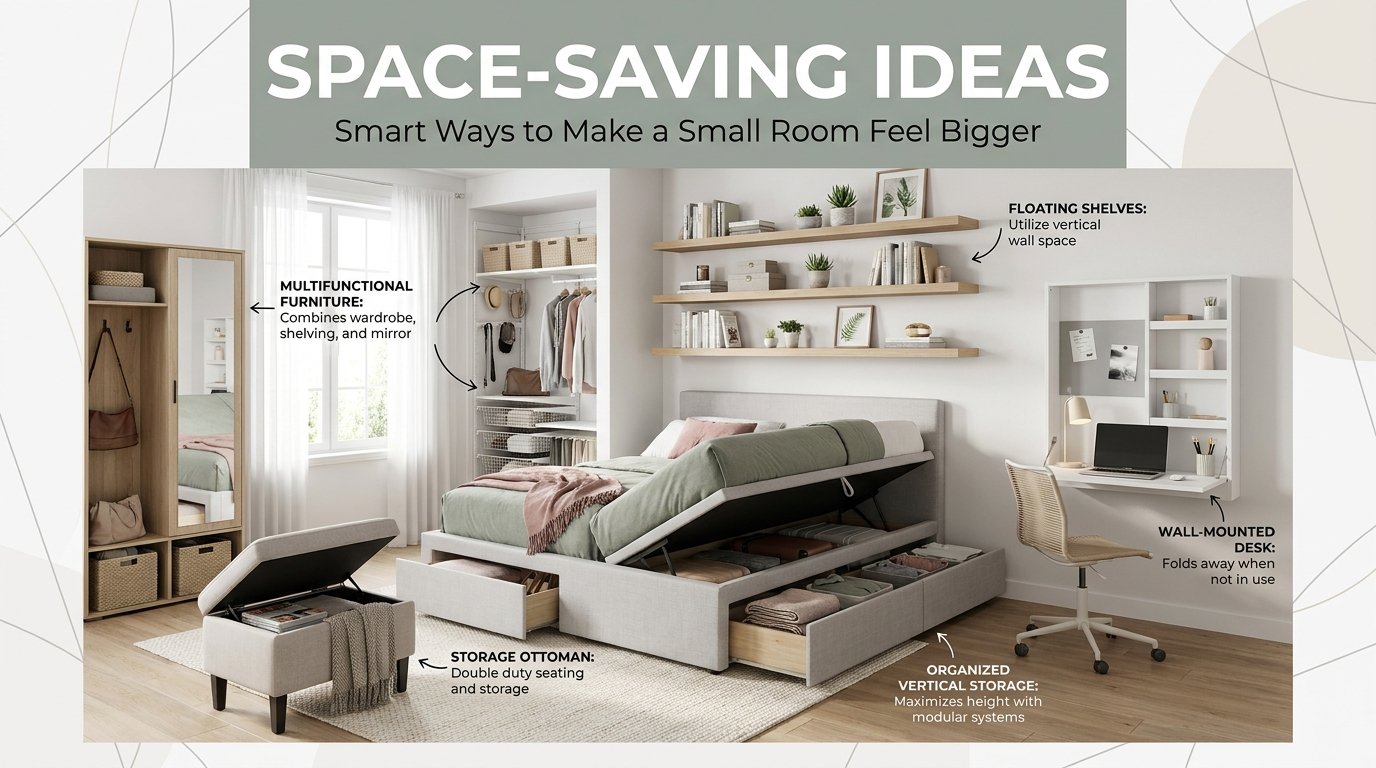
The best space-saving ideas for small rooms do more than make a room appear larger. They reduce how much usable space your furniture and possessions require.
Start by removing unnecessary furniture, moving storage vertically, using empty areas under or behind existing furniture, and replacing single-purpose pieces with furniture that can perform more than one useful job.
A small room does not necessarily need more storage.
Sometimes it needs fewer things competing for the same floor space.
What Actually Counts as a Space-Saving Idea?
A storage basket is not automatically a space-saving product.
Neither is a smaller table.
Before adding anything to a compact room, ask whether the change does at least one of these:
Replace
Does it eliminate another piece?
A storage ottoman can replace a separate footrest and storage container.
Relocate
Does it move possessions into space that was previously unused?
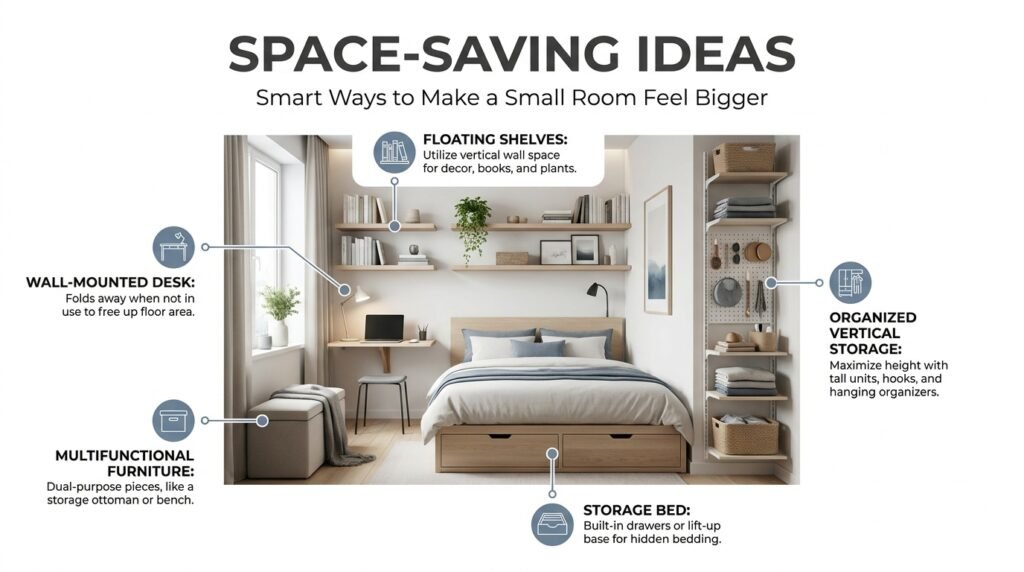
Floating shelves can move books from the floor to an empty wall.
Collapse
Can it become smaller when you are not using it?
Drop-leaf tables, nesting tables, folding chairs, and wall-mounted desks can return space to the room between uses.
Consolidate
Can one footprint handle several functions?
A storage bed combines sleeping and storage. A sleeper sofa can combine everyday seating with occasional guest accommodation.
If a new product does none of these things, it may simply be another object in an already small room.
Audit These Four Areas Before Buying Anything
Walk through the room and examine four types of space.
1. Floor space
Identify furniture that occupies the most floor area.
Ask:
- Is it used regularly?
- Could a narrower piece perform the same job?
- Can another item absorb its function?
- Does it block a door, closet, window, or useful wall?
Large items deserve scrutiny first because changing one can have more impact than adding several small organizers.
2. Vertical space
Look above:
Many rooms have crowded floors but largely unused walls.
3. Hidden space
Check:
- Under the bed
- Under benches
- Inside ottomans
- Behind doors
- Inside deep cabinets
- Above closet rods
These areas can store possessions without claiming additional visible floor space.
4. Transition space
Look at the areas people need for:
- Walking
- Opening drawers
- Opening doors
- Pulling out chairs
- Reaching closets
- Using convertible furniture
A room is not efficiently arranged if everything technically fits but nothing can be used comfortably.
1. Remove Furniture That Does Not Earn Its Footprint
The cheapest space-saving strategy is often subtraction.
Small rooms accumulate pieces that seem normal in isolation:
- Two nightstands
- An accent chair
- A floor lamp
- A separate bookshelf
- A coffee table
- A desk
- A dresser
The problem is not that any one of them is inappropriate. The problem is that every piece demands its own footprint.
Start with furniture that has low actual use.
A bedroom chair that functions primarily as a place to leave clothes may be less valuable than the floor space it consumes.
A second nightstand may be unnecessary for one occupant.
A conventional coffee table may be expendable if compact side tables can provide the surfaces you actually use.
Best for: Any room that feels crowded even after organizing.
Cost: Free.
2. Use the Full Height of the Room
When horizontal space is scarce, vertical storage becomes more valuable.
Options include:
- Tall bookcases
- Floating shelves
- Wall cabinets
- Modular shelving
- Pegboards
- Wall rails
- Hooks
- Storage above existing furniture
Put frequently used items within easy reach and reserve high storage for things you need less often.
One caution matters here.
Tall furniture can create a tip-over hazard. The U.S. Consumer Product Safety Commission continues to issue warnings about unstable clothing-storage furniture and advises consumers to secure affected furniture appropriately. Some products are subject to the mandatory stability requirements associated with the STURDY Act.
Follow the manufacturer’s installation instructions and use an anchoring method appropriate for the furniture and wall construction.
Best for: Bedrooms, offices, living rooms, closets.
3. Turn the Bed Into Storage
A bed is usually difficult to eliminate, which makes the space around and beneath it particularly valuable.
Options include:
- Bed frames with drawers
- Lift-up storage beds
- Rolling under-bed containers
- Low-profile boxes
- Headboards with shelves
- Built-in storage surrounding the bed
The best option depends on how often you need the stored items.
Under-bed storage works particularly well for:
- Extra bedding
- Seasonal clothing
- Shoes
- Bags
- Occasional-use items
Avoid simply pushing miscellaneous belongings underneath. Categorized storage is easier to retrieve and less likely to become permanent clutter.
If you already need to replace your bed, a storage model can make more sense than purchasing a conventional bed plus another dresser.
Best for: Small bedrooms and studio apartments.
4. Replace Floor-Standing Pieces With Wall-Mounted Alternatives
The wall can perform jobs that would otherwise require furniture legs and floor area.
Examples include:
- Floating nightstands
- Wall-mounted desks
- Floating shelves
- Wall-mounted lighting
- Pegboards
- Wall hooks
- Wall-mounted media consoles
A wall sconce can eliminate the need for a large lamp on a small nightstand.
A floating nightstand can provide enough room for a phone, book, and water without requiring a conventional bedside cabinet.
A fold-down wall desk can disappear after work.
Renters should check their lease and mounting restrictions before drilling into walls.
Best for: Bedrooms, home offices, entry areas.
5. Choose Furniture That Replaces Two or More Pieces
Multifunctional furniture is useful only when the second function eliminates something else.
Strong examples include:
| Furniture | Functions it can combine |
| Storage ottoman | Footrest + seating + storage |
| Storage bed | Bed + dresser/storage |
| Sleeper sofa | Sofa + guest bed |
| Lift-top coffee table | Table + temporary workstation |
| Storage bench | Seating + storage |
| Desk with shelving | Workspace + book/storage unit |
| Murphy bed system | Bed + usable daytime floor area |
Do not pay extra for functionality you will never use.
A convertible table that remains permanently extended is effectively just a normal table with more hardware.
Best for: Multipurpose rooms and studios.
6. Use Folding and Nesting Furniture
Some functions are necessary only occasionally.
They should not always receive permanent floor space.
Consider:
- Drop-leaf dining tables
- Folding desks
- Folding chairs
- Nesting side tables
- Stackable stools
- Extendable tables
- Mobile furniture that can be repositioned
A household that normally seats two people does not necessarily need a six-person table occupying the room every day.
Buy for everyday use first, then accommodate occasional needs with flexible pieces.
Best for: Dining areas, studios, guest spaces.
7. Recover the Back of the Door
Doors create vertical surfaces that many rooms barely use.
Depending on the room, an over-door system can hold:
- Shoes
- Towels
- Accessories
- Cleaning products
- Craft supplies
- Small toiletries
- Bags
Hooks may be enough if you do not need a complete organizer.
Check that anything attached to the door does not prevent it from opening, closing, or latching properly.
Best for: Renters, closets, bathrooms, bedrooms.
8. Make Closets Work Vertically
Many closets contain a single hanging rod with significant unused space above or below it.
Depending on your wardrobe, improvements may include:
- A second hanging rod
- Adjustable shelving
- Shelf dividers
- Stackable drawers
- Hanging organizers
- Hooks
- Shoe storage
- Upper shelves for occasional items
Do not organize the closet around a generic storage system.
Organize it around what you actually own.
Someone with mostly folded clothes needs a different configuration from someone who owns many full-length garments.
Best for: Bedrooms and entry closets.
9. Use Narrow and Awkward Spaces Deliberately
Standard furniture often leaves small gaps unused.
Potential locations include:
- Beside a refrigerator
- Between a bed and wall
- Between furniture and a corner
- Behind an open door
- At the end of a wardrobe
- In an alcove
Possible solutions include:
- Narrow shelving
- Rolling carts
- Shallow book ledges
- Corner shelves
- A compact desk
- Hooks
Measure carefully.
A storage unit that fits the width of a gap but prevents an adjacent drawer or door from opening has solved the wrong problem.
Best for: Older homes, apartments, irregular rooms.
10. Consolidate Storage Onto One Wall
Scattering small storage units around every wall can fragment an already compact room.
In some spaces, one concentrated storage wall works better.
For example:
- A desk can sit between tall shelves.
- A television can become part of a media-storage wall.
- A bed can sit beneath overhead cabinets.
- A window can be combined with a storage bench.
This approach leaves other parts of the room less interrupted.
It can be achieved with custom built-ins, but custom construction is not essential. Modular systems can create a similar layout.
Best for: Living rooms, bedrooms, home offices.
11. Protect the Center of the Room
Small rooms become difficult to use when permanent furniture occupies every central area.
When possible, keep bulky storage against walls and use flexible pieces toward the center.
Instead of a large fixed coffee table, consider:
- Nesting tables
- Small movable side tables
- A storage ottoman
- A compact lift-top table
Furniture should also be positioned based on how the room is actually used, not simply pushed against walls by default.
Current small-space design coverage increasingly emphasizes layout and intentional furniture placement rather than assuming every compact room needs uniformly tiny furniture.
Best for: Living rooms and multipurpose spaces.
12. Put Occasional Items in Less Convenient Storage
Prime storage should go to prime possessions.
Think of storage in three levels.
Daily
Keep these easiest to reach.
Examples:
- Everyday clothing
- Chargers
- Work equipment
- Toiletries
Occasional
These can go higher, lower, or deeper.
Examples:
- Extra bedding
- Guest supplies
- Hobby equipment
Seasonal or rarely used
These are suitable for the least convenient areas.
Examples:
- Holiday decorations
- Off-season clothing
- Luggage
This prevents frequently used objects from ending up on countertops simply because rarely used possessions occupy the most accessible storage.
Best for: Every small room.
13. Combine Open and Closed Storage
Open shelving is useful, but turning every wall into exposed storage can make a compact room visually busy.
Open storage works well for:
- Books
- Frequently accessed items
- A limited number of decorative objects
Closed storage is often better for:
- Cables
- Paperwork
- Toiletries
- Small accessories
- Cleaning supplies
- Spare linens
The goal is not minimalism for its own sake.
It is reducing the number of small objects competing for attention while keeping necessary possessions accessible.
Best for: Living rooms, bedrooms, offices.
14. Use Mirrors and Visual Tricks After Fixing the Layout
Making a room look bigger and creating more usable space are different problems.
Mirrors, continuous colors, lighter visual furniture, and carefully placed lighting can make a room feel more open, but they cannot compensate for a blocked walkway or an oversized dresser.
Use visual techniques after the functional layout is working.
A mirror can be especially useful where it reflects natural light or extends a sight line, but it does not create storage or square footage.
This distinction is important because many small-space articles mix visual enlargement with actual space-saving tactics. Current design coverage often recommends both, but they solve different problems.
Best for: Rooms that function well but still feel enclosed.
15. Leave Some Space Empty
Not every available wall, corner, or shelf needs to be filled.
Empty floor area has a function: movement.
Empty wall area has a function: visual separation.
An empty section of a tabletop has a function: temporary use.
A small room often becomes less useful when every theoretically available inch is converted into permanent storage.
Before adding another organizer, ask:
What problem will this solve?
If the only answer is “there is an empty spot,” leave the spot alone.
What is the best way to save space in a small room?
Start by removing unnecessary furniture and using unused vertical or hidden areas. Then consider multifunctional or folding furniture that can replace separate pieces rather than adding more storage units.
How can I add storage without taking up more floor space?
Use wall shelving, tall storage units, over-door organizers, under-bed containers, wall-mounted furniture, and unused closet height. Install heavy furniture and wall storage safely according to manufacturer requirements.
Is multifunctional furniture worth buying for a small room?
It can be, but only if you regularly use both functions and the piece replaces something else. A storage ottoman that replaces a footrest and storage bin is more useful than a complicated convertible product whose second function is rarely used.
How do I make a small room look bigger?
First improve the physical layout. After that, mirrors, better lighting, clearer sight lines, visually lighter furniture, and less exposed clutter can make the room feel more open.
What should I remove from a small bedroom?
Start with furniture that is rarely used, such as unnecessary seating, oversized bedside tables, redundant storage units, or furniture serving functions that another piece can absorb.
Are tall shelves good for small rooms?
They can be highly space-efficient because they use vertical rather than additional floor space. Tall furniture should be stable and installed or secured as appropriate, especially where tip-over could pose a hazard.
Leave a Reply