
How many lights for a Christmas tree? The standard rule is about 100 mini lights per foot of tree height, which means a 6 foot tree needs around 600 lights and a 7 foot tree needs around 700 lights. That rule comes from Balsam Hill and Home Depot, and it works well for full-size trees, but the real answer depends on your tree shape, your bulb type, and how bright you want the tree to look.
Slim trees need about three quarters of the standard count, pencil trees need about half, and LED lights need fewer bulbs than incandescent to look just as bright. This guide gives you the exact counts by height and shape, the strand math, and the safety rules that keep your tree glowing safely all season.
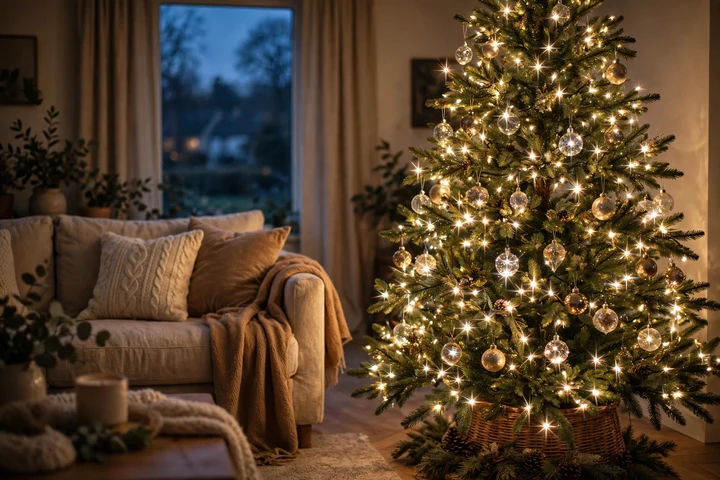
Key Facts
| Fact | Detail |
|---|---|
| Standard rule | About 100 mini lights per foot of tree height |
| 7 foot full tree | About 700 lights |
| 7 foot slim tree | About 550 lights |
| 7 foot pencil tree | About 350 lights |
| LED lights | 50 per foot is enough, LEDs look brighter per bulb |
| CPSC safety rule | Never connect more than 3 incandescent sets end to end |
| Christmas Day 2026 | Friday, December 25, 2026 |
The 100 Lights Per Foot Rule
The 100 lights per foot rule is the starting point every tree and lighting guide uses, and it is the answer most people need. Balsam Hill, one of the largest artificial tree makers, recommends 100 mini lights per foot of tree height for a classic, well-lit look. Home Depot gives the same guidance, with a range: 50 lights per foot for a sparse, subtle glow, 100 per foot for a standard look, and 150 to 200 per foot for a bright, showpiece tree.
Some heavily decorated trees go up to 350 lights per foot, but that is a specialty look that needs very dense branches to hide the wires. For most homes, that rule alone settles how many lights for a Christmas tree you need.
The rule is simple to use. Multiply your tree height in feet by 100. A 5 foot tree needs 500 lights. A 6 foot tree needs 600. A 7 foot tree needs 700. A 7.5 foot tree needs 750. An 8 foot tree needs 800. A 9 foot tree needs 900. These numbers assume a full-width tree with standard mini lights, and they answer the question of how many lights for a Christmas tree in most homes. If your tree is slim or pencil shaped, or if you are using LED lights, adjust down, which the next sections explain.
Why does the rule work? A Christmas tree is roughly cone shaped, and the number of branches grows with height, so the light count scales naturally with the height. A tree that is twice as tall has roughly twice the branch surface to cover, so it needs roughly twice the lights. The rule breaks down only at the extremes: very small tabletop trees and very large trees over 10 feet, where you should count by branch coverage rather than by height alone.

The 100 lights per foot rule is your starting point, not your final answer. Tree shape, bulb type, and how bright you like your tree all change the real number.
How Many Lights by Tree Height and Shape
Tree shape matters as much as height. A full tree is wide and bushy, with lots of branch surface that needs lights. A slim tree is narrower, so it needs fewer lights to look just as full. A pencil tree is very narrow, so it needs far fewer. The table below gives the standard count for each height and shape, based on the 100 per foot rule adjusted for width: slim trees use about three quarters of the full count, and pencil trees use about half.
| Tree height | Full tree | Slim tree (~3/4) | Pencil tree (~1/2) |
|---|---|---|---|
| 4 feet | 400 lights | 300 lights | 200 lights |
| 5 feet | 500 lights | 375 lights | 250 lights |
| 6 feet | 600 lights | 450 lights | 300 lights |
| 7 feet | 700 lights | 525 lights | 350 lights |
| 7.5 feet | 750 lights | 550 lights | 375 lights |
| 8 feet | 800 lights | 600 lights | 400 lights |
| 9 feet | 900 lights | 675 lights | 450 lights |
Use these numbers as a shopping guide. If you are buying lights for a 7.5 foot full tree, you need about 750 lights, which is three strands of 250 or five strands of 150. For a 7.5 foot slim tree, about 550 lights is right, and for a 7.5 foot pencil tree, about 350 lights will look full without overcrowding the narrow branches. If your tree is pre-lit, check the light count on the box: a pre-lit 7.5 foot tree with 750 lights is well lit, while one with only 400 lights will look sparse and need an extra strand.
Remember that these counts are for mini lights. If you use larger C6 or C7 bulbs, which are bigger and brighter, you need fewer of them, roughly 50 to 70 per foot for a full tree. If you use wide-angle LED lights, which spread light more broadly, you can also use fewer. The goal is even coverage with no dark patches, not a specific number on a box.

LED vs Incandescent: How Bulb Type Changes the Count
LED and incandescent lights are not interchangeable when you count bulbs, because LEDs are brighter and more efficient per bulb. With incandescent mini lights, the 100 per foot rule is exact: you need the full count to get a classic glow. With LED mini lights, 50 lights per foot is often enough for the same look, because LED bulbs are brighter, they spread light more evenly, and they do not dim as the strand warms up. Many decorators use 70 to 100 LED lights per foot for a bright tree, but 50 per foot is the right starting point if you are switching from incandescent and want to save money.
LED lights have other advantages that matter for a Christmas tree. They use about 75 percent less energy than incandescent lights and last up to 25 times longer, according to the U.S. Department of Energy. The Department of Energy also notes that it costs only 27 cents to light a 6 foot tree with LEDs for 12 hours a day for 40 days, compared with 10 dollars for incandescent lights.
LEDs also run cool to the touch, which is safer around dry branches, and you can connect many more LED strands end to end without overloading the circuit. Switching to LEDs also helps keep holiday spending down, as we explain in our guide to Christmas on a budget. To learn more about how LED holiday lights work and why they save energy, read the Department of Energy guide to how holiday lights work.
Incandescent lights still have fans, because many people prefer their warm, soft glow and the way they fade gently. If you use incandescent lights, stick to the full 100 per foot rule and follow the safety limits below strictly, because incandescent strands get hot and draw more power. If you are buying new lights this year, LED is the better choice for most households: brighter, cooler, cheaper to run, and longer lasting.

Strand Math: How Many Strands Do You Need?
Light strands are sold by bulb count, and the most common sizes are 50, 100, 150, 200, and 300 bulbs per strand. Once you know how many lights for a Christmas tree you need, divide your total light count by the bulbs per strand and round up. Here are the worked examples for the most common tree sizes, using standard 100-bulb strands.
A 6 foot full tree needs 600 lights, which is 6 strands of 100. A 7 foot full tree needs 700 lights, which is 7 strands of 100. A 7.5 foot full tree needs 750 lights, which is 8 strands of 100 if you round up, or 3 strands of 250. A 7 foot slim tree needs about 550 lights, which is 6 strands of 100. A 7 foot pencil tree needs about 350 lights, which is 4 strands of 100. A 3 foot tabletop tree needs 150 to 300 lights, which is 2 to 3 strands of 100 or 1 to 2 strands of 150.
Buy one extra strand beyond your calculation. Strands sometimes have a dead bulb or a short section that will not light, and having a spare means you do not have to run back to the store mid-decorating. Keep all your strands the same brand and color temperature if you can, because mixing brands can give you slightly different shades of white that look uneven on the tree. Check the box for the strand length too: a 100-bulb strand is usually 20 to 25 feet long, so 7 strands gives you 140 to 175 feet of lights to wrap around your tree.

How to String Lights on a Christmas Tree
The order matters: lights go on first, before ornaments, ribbon, or the topper. Start by testing every strand on the floor. Plug each one in, check that all the bulbs light, and replace any dead bulbs or blown fuses before you start. A strand that fails halfway up the tree is frustrating to remove and restring.
Work from the inside out and from the bottom up. Start at the base of the tree, near the trunk, and weave the lights in and out of the branches, going deeper near the trunk and coming out toward the tips. This inside-out method creates depth, because lights glow from within the tree instead of sitting only on the surface. Move upward in horizontal bands, spacing each pass about 6 to 8 inches above the last, and step back every strand to check for dark patches. Tuck the wire into the branches so it disappears, and leave a little slack rather than pulling the strand tight, because tight wires snap when the branches settle.
For a pre-lit tree, you still need to check the lights before decorating, but you skip the stringing step entirely. Fluff the branches first, then plug the tree in and check for dark sections. If a section is out, check the fuse in the plug and the connections between tree sections before you assume the lights are dead. For more on the decorating order, lights first, then ribbon and garland, then ornaments, then the topper, see our guide to Christmas tree decorating ideas.
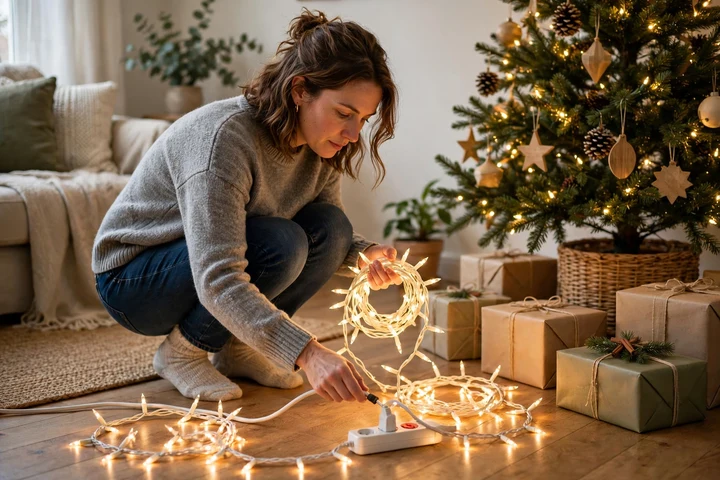
Christmas Tree Light Safety Rules
Christmas lights are safe when you use them correctly, but they are the leading cause of holiday decoration fires, so the safety rules matter. The U.S. Consumer Product Safety Commission warns that you should never connect more than three incandescent light sets end to end, because each additional set adds load to the wire and can overheat the first strand in the chain. LED strands have a much higher limit, often 20 or more sets, but always check the limit printed on the box and never exceed it.
Follow these safety rules every year. Inspect every strand before you use it: throw away any strand with cracked bulbs, frayed wires, exposed copper, or a loose plug, because damaged strands are the most common fire cause. Use only indoor-rated lights indoors and outdoor-rated lights outdoors, and never use indoor lights outside where rain can reach them. Keep lights away from open flames, candles, and heating vents, and keep your tree watered if it is real, because a dry tree catches fire far faster than a watered one.
Turn lights off when you leave the house or go to bed, or use a timer that shuts them off automatically after 6 to 8 hours. Never run light cords under rugs or through doorways where they can be pinched, and never overload a single outlet with multiple extension cords. A good rule is one high-quality power strip with surge protection per tree, and nothing else plugged into that strip.
If a fuse blows, replace it with the exact fuse size printed on the plug, never with a higher-rated fuse or a piece of foil. If a strand feels hot to the touch after an hour, unplug it and replace it: a healthy strand should feel barely warm. Store lights loosely coiled in a box or on a reel after Christmas, not tangled in a knot, because kinks and crushed wires create weak spots that fail next year.
How Bright Should Your Tree Be?
Brightness is personal, and the right light count depends on the look you want. When people ask how many lights for a Christmas tree they need for a bright, showpiece look, the answer is 150 to 200 per foot. A sparse tree, 50 lights per foot, gives a soft, elegant glow that suits minimalist and farmhouse styles, where the ornaments and the tree shape do most of the work. A standard tree, 100 lights per foot, gives the classic Christmas look that most people picture: bright, cheerful, and evenly lit. A bright tree, 150 to 200 lights per foot, gives a showpiece glow that suits large rooms, dark corners, and trees with lots of dark ornaments that absorb light.
Consider your room too. A tree in a bright room with white walls needs fewer lights, because the walls reflect light back onto the tree. A tree in a dark room with dark furniture needs more lights to stand out. A tree with mostly clear glass ornaments needs fewer lights, because the glass catches and reflects every bulb. A tree with mostly matte or dark ornaments needs more lights, because matte surfaces absorb light instead of reflecting it.
Start with the standard count for your tree shape, plug the lights in, and step back. If the tree looks flat or has dark patches, add one more strand. If the wires are visible and the tree looks cluttered, you have enough.
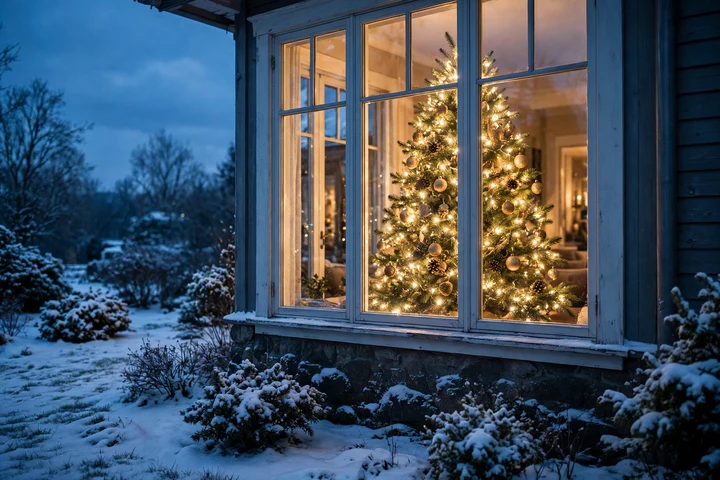
Common Light Count Mistakes
The most common mistake is buying too few lights. People buy two strands for a 7 foot tree, string them on, and wonder why the tree looks bare. Two strands of 100 is only 200 lights, less than a third of what a 7 foot full tree needs. The second mistake is the opposite: buying far too many lights and wrapping them so densely that the wires show and the tree looks like a glowing ball instead of a tree. If you can see more wire than branch, you have too many lights. Both mistakes come from guessing instead of counting how many lights for a Christmas tree you actually need.
The third mistake is mixing color temperatures. Warm white and cool white lights look different side by side, and a tree with both will look uneven even if the count is right. Pick one color temperature, warm white at 2700K for a cozy glow or cool white at 5000K for a crisp winter look, and use it for every strand. The fourth mistake is forgetting the top of the tree: many people string lights up to the top third and run out, leaving the top dark. Start at the bottom with a full strand and work up, so the top gets its fair share. For more ideas on lighting styles and themes, browse our Christmas lights ideas.
Frequently Asked Questions
How many lights do I need for a 7 foot Christmas tree?
A 7 foot full Christmas tree needs about 700 mini lights, based on the standard rule of 100 lights per foot. That is the short answer to how many lights for a Christmas tree of this size. A 7 foot slim tree needs about 525 lights, and a 7 foot pencil tree needs about 350 lights. If you use LED lights, you can use fewer, around 50 to 70 LED lights per foot, and still get a bright look.
How many lights do I need for a 6 foot Christmas tree?
A 6 foot full Christmas tree needs about 600 mini lights, which is 6 strands of 100 lights. A 6 foot slim tree needs about 450 lights, and a 6 foot pencil tree needs about 300 lights. With LED lights, 300 to 400 LEDs is usually enough for a 6 foot tree.
How many strands of lights for a 7.5 foot tree?
A 7.5 foot full tree needs about 750 lights, which is 8 strands of 100 lights, 5 strands of 150 lights, or 3 strands of 250 lights. A 7.5 foot slim tree needs about 550 lights, which is 6 strands of 100, and a 7.5 foot pencil tree needs about 375 lights, which is 4 strands of 100. Buy one spare strand beyond your calculation.
Can you put too many lights on a Christmas tree?
Yes, you can put too many lights on a Christmas tree. Beyond about 200 lights per foot, the wires become visible, the tree looks cluttered, and the extra strands add heat and electrical load without improving the look. If your tree already glows evenly with no dark patches, adding more lights will not make it prettier, it will just make it brighter and harder to see the ornaments.
How many lights per foot for LED Christmas lights?
For LED Christmas lights, 50 lights per foot is enough for a soft, elegant look, and 70 to 100 LED lights per foot gives a bright, classic look. LEDs are brighter per bulb than incandescent lights and use about 75 percent less energy, so you need fewer of them to light the same tree.
Is it safe to connect Christmas lights end to end?
It is safe to connect Christmas lights end to end only within the limit printed on the box. For incandescent lights, the U.S. Consumer Product Safety Commission says never to connect more than three sets end to end. For LED lights, the limit is much higher, often 20 or more sets, because LEDs draw far less power. Always check the box and never exceed the printed limit.
How many lights for a Christmas tree comes down to one simple rule and a few smart adjustments: start with 100 lights per foot, use fewer for slim and pencil trees, use fewer still for LEDs, and always check your strands before you hang them. A 7 foot full tree wants 700 lights, a slim one wants about 550, and a pencil tree is happy with 350. Count your strands before you shop, test them before you hang them, and follow the safety rules, and your tree will glow beautifully all season long.
Leave a Reply