
The best Thanksgiving worksheets turn holiday excitement into real learning: word scrambles, mazes, simple math sheets, gratitude writing prompts, and vocabulary games that keep kids ages 3 to 14 happily busy while dinner cooks. Unlike coloring pages, which are pure art, Thanksgiving worksheets build reading, math, and thinking skills — and this guide organizes 20 of them by age and grade so you can pick the right one in seconds.
Key Facts: Thanksgiving Worksheets at a Glance
- What they are: Educational printables — word scrambles, mazes, math sheets, vocabulary games, and gratitude writing prompts — built around Thanksgiving themes.
- How they differ from coloring pages: Coloring pages are art; Thanksgiving worksheets are learning. The two work best together, not as substitutes.
- Best by age: Preschoolers do tracing and matching; grades K–2 do mazes and simple scrambles; grades 3–5 handle vocabulary and math word problems; grades 6–8 take on gratitude essays and crosswords.
- When to use them: At home during cooking hours and holiday travel, or in the classroom during the school week before Thanksgiving.
- The golden rule: Match the worksheet to the child’s actual skill level, not their age — one page done well beats five done with frustration.

What Are Thanksgiving Worksheets?
Thanksgiving worksheets are printable learning pages that use the holiday as a theme for real school skills. A word scramble spells “turkey” instead of a random word. A math sheet counts pumpkins instead of plain dots. A writing prompt asks what the child is grateful for instead of a generic topic. The Thanksgiving wrapping is not decoration — it is motivation. Kids who would groan at a plain spelling list will happily unscramble “gratitude” when there is a turkey waiting at the end of the page.
That is the core difference between these worksheets and the holiday’s other paper activities. Coloring pages develop creativity and fine motor control, and they absolutely have their place on the kids’ table. But these learning pages develop literacy and numeracy: phonics, vocabulary, spelling, number sense, problem-solving, and written expression. A good Thanksgiving worksheet feels like play and teaches like school — which is exactly why parents reach for them during the long cooking hours and why teachers build them into November lesson plans.
The format matters less than the fit. A worksheet that is too easy bores a child in three minutes; one that is too hard creates tears before the turkey is even in the oven. The sections below organize everything by age and grade band, so you can hand a child a page that hits their sweet spot on the first try.
Thanksgiving Worksheets by Age and Grade
Not every Thanksgiving worksheet suits every child. A maze that delights a six-year-old will frustrate a four-year-old, and a crossword that challenges a ten-year-old will bore a thirteen-year-old. Use these bands as a starting point, then adjust to the individual child — the golden rule from the Key Facts box always wins.
Preschool (Ages 3–5): Tracing, Matching, and Counting
Preschool worksheets should be short, visual, and forgiving. Dotted-line tracing pages — trace the outline of a turkey, a pumpkin, or a cornucopia — build the hand strength and pencil control that writing depends on later. Matching worksheets (“draw a line from each pumpkin to its shadow”) teach visual discrimination without requiring any reading. Count-and-circle pages (“how many turkeys do you see? circle the right number”) introduce one-to-one correspondence, the foundation of all math. Keep every page to five minutes or less, sit with the child, and treat wrong answers as interesting rather than wrong.
Kindergarten to Grade 2 (Ages 5–8): Mazes, Word Scrambles, and Picture Math
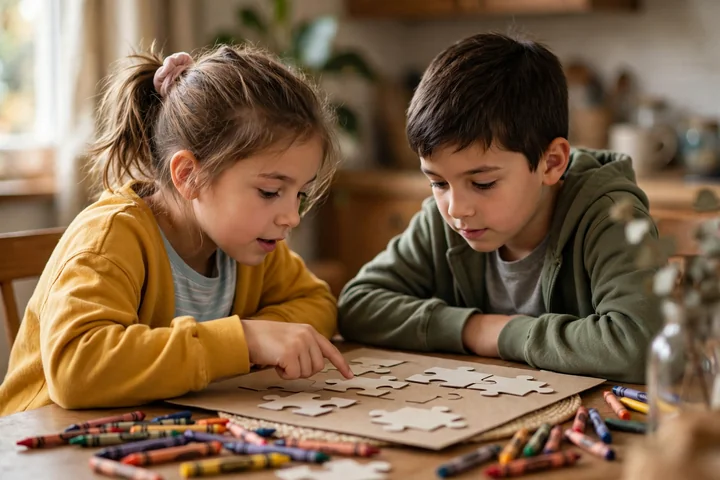
This is the sweet spot for classic holiday worksheets. Simple mazes — help the turkey find the cornfield, help the Pilgrim find the feast — build problem-solving and pencil control at once. Four- and five-letter word scrambles (kteyur becomes turkey, eip becomes pie) turn spelling practice into a game; add a word bank for younger kids and remove it for older ones. Picture math uses holiday images before abstract numbers: three pumpkins plus two pumpkins, then the same problem written as 3 + 2. Worksheets at this level work beautifully as morning work in classrooms and as quiet-time pages at home while the adults cook.
Grades 3–5 (Ages 8–11): Vocabulary, Reading, and Math Word Problems
Upper-elementary worksheets can carry real academic weight. Vocabulary pages introduce words like harvest, gratitude, feast, tradition, and bountiful — words kids will actually meet in November reading. A short nonfiction passage about the 1621 harvest meal followed by three or four comprehension questions doubles as a history lesson. Math word problems use the holiday as cover for multi-step thinking: if 24 guests are coming and each person eats two dinner rolls, how many dozen rolls do you need? These fit naturally into the week before the break, when attention spans are short and themed work keeps the class engaged.
Grades 6–8 (Ages 11–14): Essays, Crosswords, and Research
Middle schoolers will see through babyish worksheets instantly, so worksheets for this band need genuine challenge. Gratitude essay prompts (“Write about a tradition your family should start, and argue why it matters”) practice persuasive writing with a personal hook. A proper crossword with clever clues rewards real vocabulary knowledge. A mini-research page — find five verified facts about the first Thanksgiving and cite your sources — teaches research skills through a topic they already care about. At this level, the best ones respect the student’s intelligence while still feeling seasonal.
20 Thanksgiving Worksheet Ideas You’ll Actually Use
Below are twenty Thanksgiving worksheet ideas organized into four groups of five. Mix and match across groups to build a packet that fits your child or your class — one page from each group makes a well-rounded 30-minute session.
Word and Vocabulary Thanksgiving Worksheets (1–5)
1. Thanksgiving word scramble. Unscramble ten holiday words, from easy (pie, corn) to tricky (gratitude, harvest). Include a word bank for younger kids; drop it for a real challenge.
2. Vocabulary match-up. Draw lines connecting words like feast, gratitude, tradition, harvest, and bountiful to their definitions. This is one of the most versatile worksheets because it works from grade 2 through grade 6 just by changing the word list.
3. THANKFUL acrostic poem. Write one line for each letter of the word THANKFUL. It looks like a poetry worksheet and secretly practices vocabulary and creative thinking.
4. Thanksgiving crossword. Clues about holiday foods, history, and traditions, with a word bank for support. Crosswords are endlessly reusable — change the clues each year and the same grid feels new.
5. Synonym harvest. For each Thanksgiving word, find a synonym: thankful becomes grateful, big feast becomes banquet. A quiet vocabulary builder that feels like a game.
Math Thanksgiving Worksheets (6–10)
6. Count the harvest. Count the pumpkins, turkeys, and corn stalks in the picture and write the numbers. The simplest of all these worksheets, and perfect for preschool and kindergarten.
7. Pumpkin addition and subtraction. Picture problems first (four pumpkins plus three pumpkins), then the same facts as bare numbers. The pictures scaffold the abstraction.
8. Feast word problems. Real multi-step problems in holiday dress: seating charts, grocery math, cooking times. These prove that math lives inside the holiday, not beside it.
9. Fraction pies. Shade one-half of the pumpkin pie, one-quarter of the apple pie. Few worksheets make fractions this delicious to learn.
10. Favorite-foods bar graph. Survey the family on their favorite Thanksgiving dish, tally the results, and build a bar graph. It practices data skills and starts a genuinely fun dinner-table debate.

Writing and Gratitude Thanksgiving Worksheets (11–15)
11. Gratitude journal prompts. “Name three things you are thankful for and explain why each one matters.” Simple, powerful, and the worksheet kids remember longest.
12. “I am thankful for…” sentence starters. Half-written sentences for young writers to complete: “I am thankful for ___ because ___.” It removes the blank-page fear that stops early writers cold.
13. Thanksgiving story starter. “The turkey escaped on Thanksgiving morning. What happens next?” Creative writing pages like this one produce the funniest read-aloud moments of the holiday.
14. Thank-you letter template. A guided letter to the holiday cook — greeting, two things you loved about the meal, a closing. Manners and writing practice in a single page.
15. Five-senses poem. Describe Thanksgiving dinner using sight, sound, smell, taste, and touch. It turns the meal itself into a writing lesson.
Puzzle and Logic Thanksgiving Worksheets (16–20)
16. Turkey maze. Help the turkey find its way through the corn maze to the farmhouse. Mazes are the gateway activity — every age loves them, and they build planning and persistence.
17. Thanksgiving word ladder. Change one letter at a time to climb from PIE to YAM to HAM. A compact logic puzzle that rewards careful thinking.
18. First Thanksgiving sequencing. Cut out the events of the 1621 harvest celebration and glue them in order. History and reading comprehension disguised as a puzzle.
19. Spot the difference. Two nearly identical harvest scenes with ten differences to circle. Sharp eyes and patience required — excellent quiet-time pages.
20. Gratitude cryptogram. Decode the secret Thanksgiving message using the letter key. Kids who finish early always ask for another one, so keep a spare.
Using Thanksgiving Worksheets in the Classroom
Thanksgiving worksheets earn their place in November lesson plans because they solve a real teaching problem: the week before Thanksgiving break is the hardest week of the fall to keep students focused. Themed worksheets channel that holiday energy into standards-aligned work instead of fighting it. Use them as morning bell-ringers, as a station rotation during literacy or math blocks, or as the core of an early-finisher folder that runs all month.
A simple structure works well: one word-work page on Monday, one math page on Tuesday, one writing prompt on Wednesday, and a puzzle page on Thursday as the week’s reward. For differentiation, keep two difficulty levels of the same worksheets on hand — the content stays unified while the challenge adjusts. And pair the paper work with hands-on options so the week feels festive, not just busy. Teachers looking for crafts and printable projects to run alongside these pages will find them in our Thanksgiving classroom activities guide, which organizes crafts, gratitude lessons, and minimal-prep printables by age band.

Using Thanksgiving Worksheets at Home
At home, Thanksgiving worksheets are a parent’s secret weapon for the two hardest stretches of the holiday: the cooking hours and the travel. Print a small packet — three to five pages matched to each child’s level — and keep it in a folder with crayons and a pencil. During cooking, set kids up at the kitchen table where they can work within sight; during travel, the same packet turns backseat restlessness into quiet focus. The rule is simple: worksheets are an invitation, not an assignment. If a child finishes one page and wants to go play, that is a win.
For families with kids of different ages, worksheets are easier to manage than most activities because everyone can work side by side on their own level. A four-year-old traces turkeys while a nine-year-old tackles the crossword, and nobody has to wait for anyone else. When the pages are done, switch to movement — and for ideas beyond paper, our Thanksgiving activities for kids guide has 25+ crafts, games, and gratitude activities organized by age to fill the rest of the day.
Thanksgiving Worksheets vs Coloring Pages: What’s the Difference?
Parents often ask whether Thanksgiving worksheets and coloring pages are the same thing. They are not — and understanding the difference helps you use each at the right moment. Coloring pages are art: open-ended, creative, calming, and wonderful for fine motor development and quiet time. These worksheets are learning: structured, skill-targeted, and designed to practice reading, writing, math, or logic. Neither is better; they do different jobs.
The practical move is to use both. Start a quiet session with these learning pages while focus is fresh, then transition to Thanksgiving coloring pages as a creative wind-down. In classrooms, the same pairing works: worksheets for the lesson block, coloring pages for early finishers. And if you want more professionally designed literacy printables to supplement your own, the ReadWriteThink classroom resources from the National Council of Teachers of English offer free, research-backed lesson materials that pair well with any holiday worksheet packet.
7 Tips for Getting the Most Out of Thanksgiving Worksheets
1. Match the skill, not the age. A struggling third-grader will get more from a second-grade maze than from a fourth-grade crossword done in tears. Worksheets only work when the challenge fits the child.
2. One page at a time. Handing a child a ten-page packet feels like homework; handing them one page feels like an activity. Refill as they finish.
3. Keep sessions short. Ten to twenty minutes is the sweet spot for most ages. End while it is still fun and they will ask for more tomorrow.
4. Mix the types. A word scramble followed by a maze followed by a gratitude prompt keeps the brain engaged. Five math pages in a row is a recipe for groans.
5. Praise effort over answers. “You stuck with that tricky scramble” builds more learning than “you got them all right.” They should build confidence, not just scores.
6. Do the first one together. A two-minute demo removes all confusion about instructions and turns the page into a shared activity instead of a solo chore.
7. End with something fun. Finish every worksheet session with a puzzle, a joke page, or a coloring sheet. The last feeling is the one they remember.
Frequently Asked Questions About Thanksgiving Worksheets
What ages are Thanksgiving worksheets for? Thanksgiving worksheets work for ages 3 to 14. Preschoolers do tracing, matching, and counting; elementary kids do mazes, scrambles, and math; middle schoolers take on essays, crosswords, and research prompts. Always match the difficulty to the child’s skill level rather than their exact age.
Are Thanksgiving worksheets the same as coloring pages? No. Coloring pages are open-ended art activities; Thanksgiving worksheets are structured learning pages that practice reading, writing, math, or logic skills with a holiday theme. They complement each other well in the same session.
How many Thanksgiving worksheets should kids do in one sitting? One to three pages, or about 10 to 20 minutes, is plenty for most children. Quality beats quantity — a single page completed thoughtfully teaches more than five rushed ones.
Can teachers use Thanksgiving worksheets in the classroom? Absolutely. They work as bell-ringers, literacy or math stations, early-finisher activities, and homework during the week before Thanksgiving break. Keep two difficulty levels on hand for easy differentiation.
Where can I find free Thanksgiving worksheets? Many teacher resource sites, educational marketplaces, and library sites offer free printable Thanksgiving worksheets. The ReadWriteThink classroom resources linked above are a reliable, research-backed starting point for literacy materials.
Make This Thanksgiving a Learning Celebration
These worksheets prove that learning does not take a holiday — it just puts on a pilgrim hat. Twenty well-chosen pages can carry a child through the cooking hours, the car ride, and the classroom week before break, building real skills under the cover of holiday fun. Print a few, match them to the child in front of you, and watch a regular Thursday turn into the most productive quiet time of the season. The turkey gets all the attention, but the worksheets might just be the smartest thing on the table.
Leave a Reply