
If you are asking when is holi 2027, the answer is Monday, March 22, 2027. The festival begins the night before, on Sunday, March 21, 2027, with Holika Dahan, the bonfire that opens the celebration. Holi is the Hindu festival of colors, the joyful spring festival where people throw bright gulal powder, splash colored water, and set aside old grudges for a day. This guide covers the exact 2027 dates, why some calendars list March 23 instead, the full Braj Holi calendar, the history behind the festival, how it is celebrated in the United States, the food and safety basics, and what is open and closed.
Key Facts

| Fact | Detail |
|---|---|
| When is Holi 2027 | Monday, March 22, 2027 |
| Holika Dahan 2027 | Sunday, March 21, 2027 (evening) |
| Holika Dahan muhurat, New Delhi | 6:33–8:55 p.m. IST, March 21 |
| Rang Panchami 2027 | Saturday, March 27, 2027 |
| What it celebrates | The arrival of spring and the triumph of good over evil |
| Lunar basis | Full moon (Purnima) of Phalguna |
| Other names | Festival of Colors, Rangwali Holi, Dhulandi, Phagwah |
| Holi 2026 | Tuesday, March 3, 2026 |
| Holi 2028 | Saturday, March 11, 2028 |
| Holi 2029 | Wednesday, February 28, 2029 |
| Holi 2030 | Tuesday, March 19, 2030 |
| Holi 2031 | Saturday, March 8, 2031 |
| Is Holi a federal holiday in the US | No — it is not in 5 U.S.C. 6103 |
| Status in India | Gazetted public holiday |
| Braj Holi season | About March 13–22, 2027 |
| Main colors | Gulal powder and colored water |
What Day Is Holi in 2027?
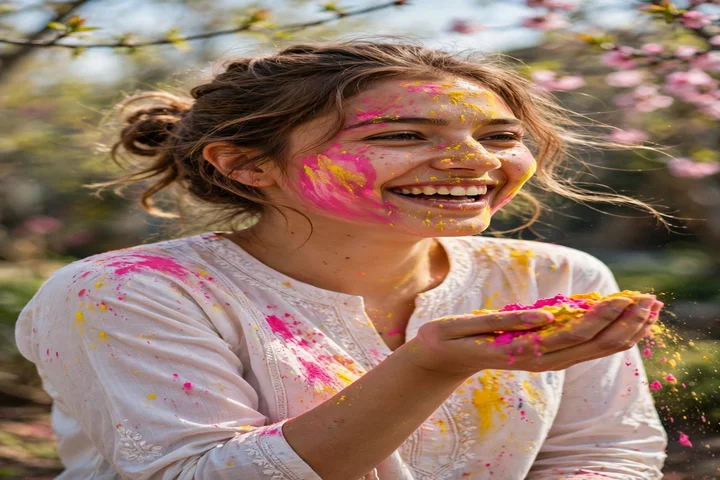
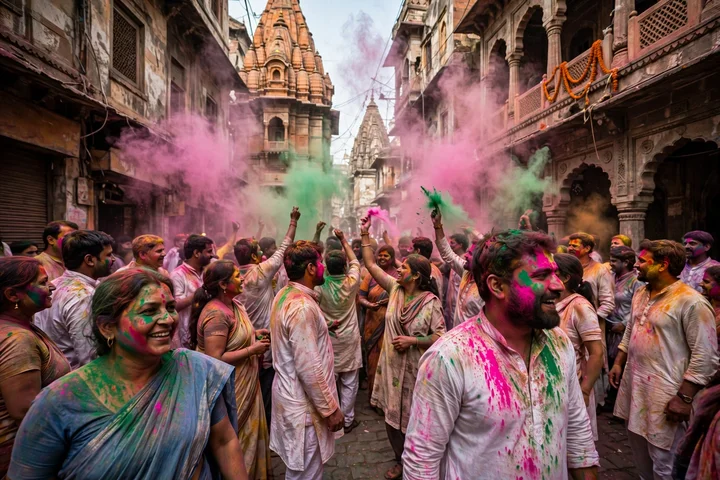
Holi 2027 falls on Monday, March 22, 2027. That is the day of Rangwali Holi, also called Dhulandi, when the color play happens: streets fill with people in white clothes that do not stay white for long, clouds of pink, yellow, green, and blue powder rise into the air, and water guns and balloons soak everyone in reach. The celebration starts the evening before, on Sunday, March 21, 2027, when families gather around the Holika Dahan bonfire. If you are planning around the festival, block out both days, because the bonfire night and the color day are two halves of one festival.
The date comes from the Hindu lunisolar calendar. Holi falls on the full moon, or Purnima, of the month of Phalguna, which lands between late February and late March on the Gregorian calendar. Because the lunar year is shorter than the solar year, the date moves from year to year, usually by about eleven days. In 2027 the full moon falls late in March, so Holi lands on March 22, almost three weeks later than Holi 2026, which fell on March 3. Anyone searching for when is holi 2027 will find March 22 in most panchangs and most major Indian media, and that is the date to plan around. Families who ask when is holi 2027 while booking flights usually aim to arrive by Sunday, March 21, so they catch both the bonfire and the color day.
There is one wrinkle worth knowing before you book travel. A minority of calendars list the main day of Holi 2027 as Tuesday, March 23, 2027. The reason is the Purnima tithi, the lunar day, which spans two Gregorian days in 2027. Different panchang traditions resolve that overlap differently, so Holika Dahan and the color day each shift by a day in some local calendars. The same split happened in 2026, when most panchangs gave March 3 and some major outlets gave March 4. The standard reference, Drik Panchang, places Holi 2027 on Monday, March 22, and that is the date used in this guide. If you are traveling to a specific town or temple, check with the local temple or your hosts, because Braj towns in particular follow their own temple calendars.
That is the date to use if you are still asking when is holi 2027.
The Two Days of Holi, Explained

Holi is really two festivals back to back, and each day has its own mood. The first evening is solemn and symbolic. The second day is loud, messy, and joyful. Knowing the difference helps you plan, and it helps you avoid showing up in your best clothes on the wrong day.
Holika Dahan, also called Chhoti Holi, is the bonfire night. On Sunday, March 21, 2027, after sunset, communities light a large bonfire in an open space. Families gather around it, offer prayers, and sometimes circle the fire with water, flowers, and grains. The fire marks the burning of the demoness Holika and the survival of the child devotee Prahlada, the story at the heart of the festival. In New Delhi the recommended muhurat, or auspicious window, for lighting the fire runs from 6:33 p.m. to 8:55 p.m. on March 21. The bonfire is a neighborhood event, not a private one, and in most Indian towns the whole street turns out for it.
Rangwali Holi, or Dhulandi, is the main day, Monday, March 22, 2027. This is the day of color. People smear gulal, the bright colored powder, on each other’s faces, throw it into the air in clouds, and spray colored water from pichkaris, the traditional water guns. Music plays from speakers and drums, groups dance in the street, and the usual rules of who can touch whom are suspended for a few hours. The phrase you will hear everywhere is “Bura na mano, Holi hai,” which means “Do not mind, it is Holi.” It is permission, and it is also a warning: if you go outside on Holi morning, you will come back colored.
The festival does not end on Monday in every place. In parts of Maharashtra, Rang Panchami is observed five days later, on Saturday, March 27, 2027, with a second round of color play. In the Braj region, the celebrations run for about ten days before the main day, so the season is longer than the two days most people know. If you are in India in mid-March 2027, the color starts well before March 22.
Braj Holi 2027: The Ten-Day Calendar
The towns of Mathura, Vrindavan, Barsana, Nandgaon, and Gokul form the Braj region, the birthplace of Krishna and the spiritual heart of Holi. Here the festival is not a two-day event. It is a season of about ten days, and each day has its own theme, its own temple, and its own version of the celebration. Travelers plan whole trips around it, and the crowds are enormous, so the calendar matters.
| Date | Day | Event | Place |
|---|---|---|---|
| March 16 | Tuesday | Laddu Holi | Radha Rani Temple, Barsana |
| March 17 | Wednesday | Lathmar Holi | Barsana |
| March 18 | Thursday | Lathmar Holi | Nandgaon |
| March 18 | Thursday | Rangbhari Ekadashi and Masan Ki Holi, Day 1 | Kashi Vishwanath Temple and Harishchandra Ghat, Varanasi |
| March 19 | Friday | Masan Ki Holi, main day | Manikarnika Ghat, Varanasi |
| March 21 | Sunday | Holika Dahan | All of Braj and across India |
| March 22 | Monday | Rangwali Holi, the main day | Mathura, Vrindavan, and all of India |
| March 27 | Saturday | Rang Panchami | Maharashtra and parts of Braj |
Lathmar Holi is the most famous of the Braj events. In Barsana, women playfully beat men from the neighboring village of Nandgaon with lathis, or long sticks, while the men shield themselves. The tradition reenacts the stories of Krishna teasing Radha and her friends, and it draws thousands of spectators. In Varanasi, Masan Ki Holi is played at the cremation grounds with ash instead of color, a stark and moving version of the festival tied to Shiva. These are not the gentle color throws of a city park. They are intense, crowded, and deeply traditional, and they reward visitors who arrive early and follow local guidance.
Why Holi Is Celebrated: The Stories
Holi carries two great stories, and both are told every year at the bonfire and in the color play. The first story is the one the bonfire reenacts. The demon king Hiranyakashipu demanded that everyone worship him, but his young son Prahlada refused and kept his devotion to Vishnu. The king tried to kill the boy again and again, and finally asked his sister Holika, who had a cloak that protected her from fire, to sit in a burning pyre with Prahlada on her lap. The cloak flew off Holika and covered Prahlada instead. Holika burned, and Prahlada walked out of the fire unharmed. The bonfire of Holika Dahan remembers that moment, and the festival’s oldest message is that good outlasts evil, even when evil holds all the power.
The second story belongs to the color day. Krishna, who grew up in Braj, loved to play with Radha and the gopis, and the color throwing began as their springtime game. The powder, the water, the music, and the dancing all trace back to those stories, and that is why Braj celebrates longer and harder than anywhere else. The two stories together give Holi its shape: one night of fire and memory, then one day of color and joy. Britannica’s Holi overview traces the same two roots, the Prahlad legend and the Krishna traditions, and it is a good place to check the festival’s background in one place, at Britannica’s Holi page.
There is also a seasonal meaning that needs no story. Holi marks the end of winter and the arrival of spring, and in farming regions it is tied to the ripening of the winter harvest. The colors themselves are part of that: the powders were once made from flowers, turmeric, and other natural materials, and the festival was a way to welcome the new season with the brightest things at hand. That is why the festival feels less like a religious observance and more like a release, a day when the whole town steps outside together.
Holi Dates Through 2031
Because Holi follows the moon, the date moves every year, and the long view shows just how much. The table below uses the Drik Panchang convention, the same one used for the 2027 date in this guide. Note that in the split years, 2029 and 2030, some calendars list the following day.
| Year | Holi (Rangwali Holi) | Day of the week |
|---|---|---|
| 2026 | March 3 | Tuesday |
| 2027 | March 22 | Monday |
| 2028 | March 11 | Saturday |
| 2029 | February 28 | Wednesday |
| 2030 | March 19 | Tuesday |
| 2031 | March 8 | Saturday |
The pattern is worth a look. Holi 2028 falls on a Saturday, March 11, which makes it a natural long weekend in India and a big weekend for US events. Holi 2029 is the earliest in this stretch, Wednesday, February 28, the only one of the six that falls in February. Holi 2031 falls on Saturday, March 8, another weekend date. If you are planning travel or a big family gathering, the Saturday years, 2028 and 2031, are the ones to circle first, because the color day lands on a day when nobody needs to take leave.
Holi in the United States
Holi has grown far beyond India, and the United States now has one of the largest Holi scenes outside South Asia. The Indian diaspora, about 5 million people, celebrates in temples, parks, rooftops, and beaches, and the events have become multicultural: in most American cities, the crowd is a mix of Indian families, students, and neighbors who simply love a color festival. The dates follow the same lunar calendar, so the main day in the US is also Monday, March 22, 2027, but most public events are held on the weekends around it, because that is when the crowds can come.
New York City hosts some of the biggest American Holi events. In 2026 the season included Rang De New York at the 230 Fifth Rooftop, a daytime rooftop carnival with dhol players, DJs, and organic colors; Holi In The City, a large open-air color party in Brooklyn; several Holi cruises on the Hudson, including the Holi Haiii cruise from Pier 36; and a free family festival at the Seaport with the South Street Seaport Museum. Queens also holds the annual Phagwah parade on Liberty Avenue in Richmond Hill, the Indo-Caribbean name for Holi, which marked its 38th year in 2026 and draws thousands. Most New York events fall on the Saturdays around the festival, so expect the 2027 season to cluster on March 20 and March 27.
Los Angeles has its own signature event, Holi and the Beach at Seaside Lagoon, often called the Coachella of Holi, which draws thousands to a beachside color festival. Dallas has the week-long celebration at the Radha Krishna Temple in Allen, with a Holi mela, temple ceremonies, and a Phoolon Ki Holi, a flower version of the festival. Chicago hosts a Holi rave on a rooftop, Houston and Atlanta run large temple and park events, and the San Francisco Bay Area has several temple festivals. The pattern is the same everywhere: the religious date is Monday, March 22, 2027, and the public parties land on the nearest weekends.
If you are going to a US event for the first time, a few practical notes help. Wear white clothes you do not mind ruining, and wear shoes you can wash, because the powder gets everywhere. Put coconut oil or moisturizer on your skin and hair before the color goes on, because it makes the powder wash off more easily. Bring sunglasses or clear safety glasses, because gulal in the eyes stings. Keep your phone in a sealed plastic bag. And check the age rules: many rooftop and cruise events are 21 and over, while temple and park events are family friendly. Tickets for the big New York and Los Angeles events sell out, so book when the 2027 dates are announced, usually in January or February.
Food, Music, and the Day Itself

Food is a large part of Holi, and the festival has its own menu. Gujiya, the crescent-shaped pastry filled with sweet khoya and nuts, is the signature sweet, made in huge batches in the days before the festival. Thandai, a cold milk drink flavored with almonds, cardamom, saffron, and rose, is served everywhere, and in some gatherings it is mixed with bhang, a preparation of cannabis that is traditional at Holi in parts of India. Bhang is legal in India only in limited, regulated forms and is illegal in the United States, so visitors should know what they are drinking and where they are. Other festival foods include dahi bhalla, puran poli, malpua, and namak para, and most families cook a large lunch after the color play ends in the early afternoon.
The music of Holi is as recognizable as the color. Traditional Holi songs, the dhol drum, and Bollywood’s Holi anthems, above all “Rang Barse” and “Balam Pichkari,” play from speakers in every street and park. The dancing is informal and communal: groups form circles, strangers are pulled in, and the line between performer and audience disappears. In Braj, the music is devotional, with temple songs and folk bands; in the cities, it is a mix of Bollywood, bhangra, and electronic dance music. The sound is part of the festival’s identity, and it is one of the reasons the color day feels like a street party rather than a ceremony.
The rhythm of the day is worth knowing. The color play usually starts mid-morning and runs until early afternoon, when people go home, wash off, and change into fresh clothes. The afternoon is for family visits and food, and the evening is quieter. If you are a visitor, the morning is the time to be outside. By mid-afternoon the streets are mostly empty again, and the festival has moved indoors to kitchens and living rooms.
Is Holi a Holiday? What Is Open and Closed

Holi is not a federal holiday in the United States. It is not in 5 U.S.C. 6103, the law that lists the federal holidays, so federal offices, banks, and schools stay open on Monday, March 22, 2027. There is no observed day and no long weekend attached to it in the US. Private employers do not give the day off, and the stock market trades normally. If you want the day off to celebrate, you will need to take leave.
In India, the picture is different. Holi is a gazetted public holiday, and government offices, banks, and most schools close on the main day. Anyone checking when is holi 2027 to request time off in the US should ask for Monday, March 22, 2027, since no leave is granted automatically. The Delhi High Court’s 2027 holiday calendar lists Holi on Tuesday, March 23, 2027, following the minority panchang convention noted earlier, which is a reminder that the official holiday date can differ from the festival date by a day in some institutions. In Nepal, Holi is also a public holiday, celebrated over two days in different regions. In the Caribbean, where the festival is called Phagwah, it is a public holiday in Guyana and Suriname, and a major community event in Trinidad and Tobago.
For travelers, the practical effect is simple. If you are in the US on March 22, 2027, everything runs normally, and the celebrations happen in the evenings and on the surrounding weekends. If you are in India, expect closures on the main day and heavy crowds at temples, markets, and transport hubs for several days around it. Book trains and hotels in Braj well in advance, because the ten-day season fills up fast.
Holi and the Spring of 2027
Holi 2027 sits in a crowded stretch of the spring calendar, and the overlaps are part of its charm. Nowruz, the Persian New Year, falls on Saturday, March 20, 2027, the day of the spring equinox, so the weekend of March 20 to 22 holds two major spring festivals back to back. Palm Sunday falls on Sunday, March 21, 2027, the same day as Holika Dahan, and Good Friday 2027 follows on Friday, March 26, with Easter Sunday on March 28.
Ramadan 2027 runs from Monday, February 8 to Monday, March 8, 2027, so the fasting month ends two weeks before Holi, and Eid al-Fitr falls on Tuesday, March 9. Anyone searching for when is holi 2027 alongside those dates is planning a spring that is unusually full, and the clustering is worth noting for travel: the last two weeks of March 2027 hold Holi, Palm Sunday, Good Friday, and Easter in a single eight-day stretch.
The spring festival season does not end there. Pentecost falls on Sunday, May 16, 2027, and Eid al-Adha follows the same day, while Mother’s Day is Sunday, May 9, 2027. For readers who like to plan the whole year at once, the guide to Diwali 2027 covers the autumn festival of lights, which falls on Friday, October 29, 2027. Holi is the spring bookend to Diwali’s autumn, and together the two festivals frame the Hindu festival year.
Planning Checklist for Holi 2027
A little planning goes a long way with Holi, because the festival is messy by design. If you are celebrating in India, book travel and hotels early, especially in Mathura and Vrindavan, where the ten-day season draws large crowds. Decide whether you want the big public color play or a smaller family celebration, because the two are very different experiences. Buy your gulal from a reputable shop and look for natural, skin-safe colors, because cheap synthetic powders can irritate skin and eyes. Wear old white clothes, oil your skin and hair, and carry a small bag with water, a towel, and a change of clothes.
If you are celebrating in the United States, the planning is simpler but the timing matters more. The main day is Monday, March 22, 2027, but the public events are on the weekends, so watch for announcements in January and February and buy tickets early for the big rooftop and cruise events. Temple events are usually free or low cost and are the best choice for families with small children. If you are hosting at home, buy gulal online well in advance, because the good organic brands sell out in March, and lay down old sheets or tarps if you are playing in a yard. A simple plan, made a month early, is the difference between a joyful day and a scramble.
Anyone asking when is holi 2027 should plan for that Monday in March.
Frequently Asked Questions

When is Holi 2027?
Holi 2027 is on Monday, March 22, 2027. Holika Dahan, the bonfire night, is on Sunday, March 21, 2027. The dates come from Drik Panchang, the standard Hindu almanac. A few calendars list Tuesday, March 23, 2027, because the full-moon tithi spans two days, but March 22 is the date most panchangs and most Indian media use.
Is Holi 2027 on March 22 or March 23?
Most panchangs, including Drik Panchang, place Rangwali Holi on Monday, March 22, 2027. A minority of calendars, including some date-countdown sites and the Delhi High Court holiday list, give Tuesday, March 23, 2027. The difference comes from the Purnima tithi spanning two Gregorian days. Check with your local temple if you are traveling, because Braj towns follow their own temple calendars.
What is the difference between Holika Dahan and Holi?
Holika Dahan is the bonfire night on the evening before Holi, Sunday, March 21, 2027. It commemorates the burning of the demoness Holika and the survival of the child devotee Prahlada. Holi, or Rangwali Holi, is the color day on Monday, March 22, 2027, when people throw gulal powder and colored water. The bonfire is solemn and symbolic, and the color day is joyful and messy.
Is Holi a public holiday in the United States?
No. Holi is not a federal holiday in the United States and is not listed in 5 U.S.C. 6103, so federal offices, banks, and schools stay open on Monday, March 22, 2027. In India, Holi is a gazetted public holiday, and government offices and banks close on the main day. US celebrations are held in the evenings and on the weekends around the festival date.
How long does Holi last?
The core festival lasts two days: Holika Dahan on the evening of March 21, 2027, and Rangwali Holi on March 22, 2027. In the Braj region of Mathura and Vrindavan, the celebrations run for about ten days, from around March 13 to March 22, with a different event each day. In parts of Maharashtra, a second color day, Rang Panchami, is observed on Saturday, March 27, 2027.
How is Holi celebrated in the US?
US celebrations follow the same date, Monday, March 22, 2027, but most public events are held on the surrounding weekends. New York City hosts rooftop parties, open-air color festivals, Holi cruises, and the Phagwah parade in Queens. Los Angeles has a large beach festival, Dallas has a week-long temple celebration, and Chicago, Houston, and Atlanta run temple and park events. Temple events are family friendly, while many rooftop and cruise parties are 21 and over. For the fasting month that ends just before Holi, see the guide to Ramadan 2027.
Leave a Reply