
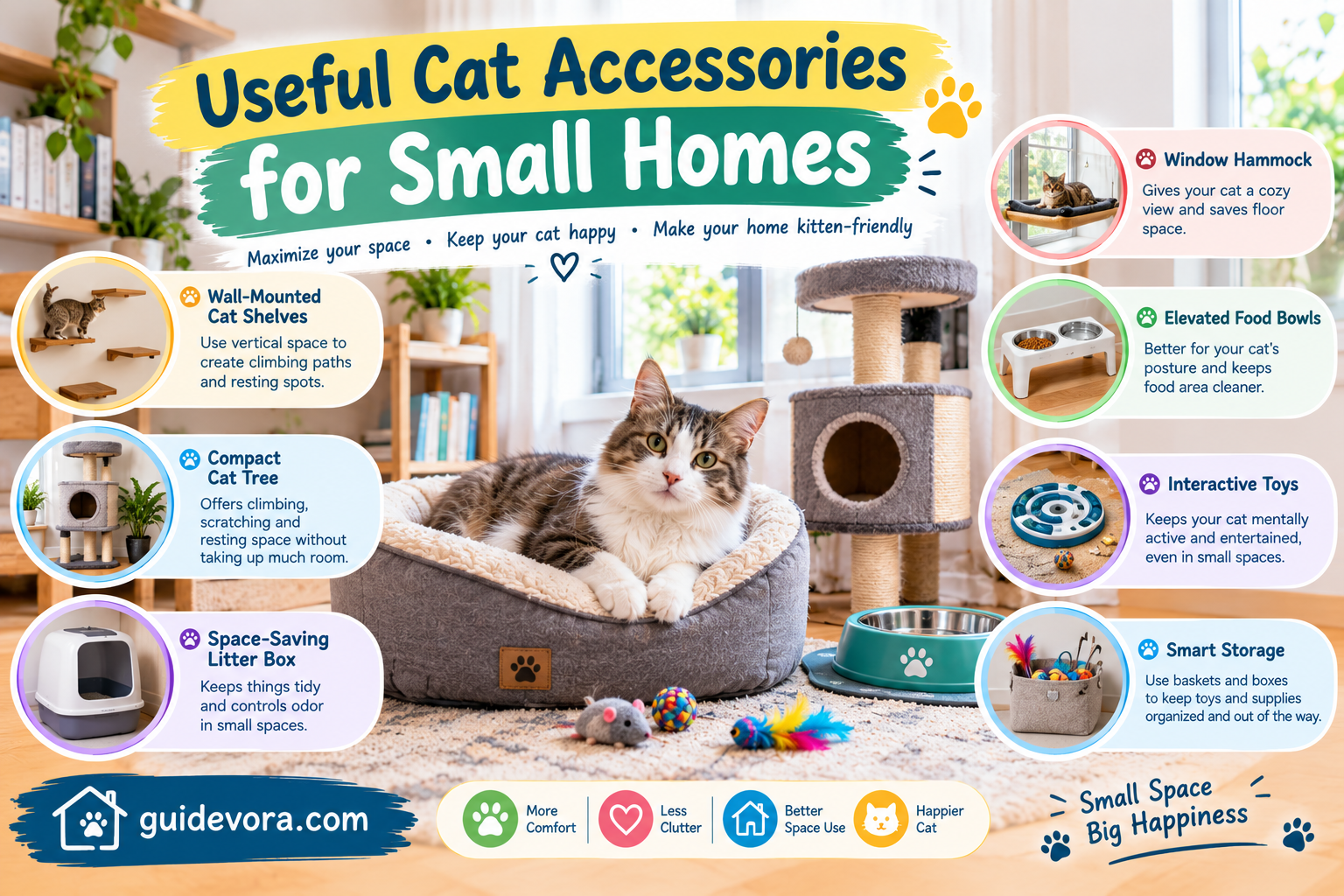
The biggest mistake small-space cat owners make is buying a large, carpeted cat tree. A tree tall enough to matter usually needs a base of 24–36 inches on each side — and in a 500–700 sq ft apartment, that footprint always lands somewhere you actually needed.
The fix isn’t less cat furniture. It’s understanding that cats measure their territory vertically, not by floor area. A wall of connected shelves gives a cat far more usable space than a bulky tower, while using square footage that was doing nothing anyway. Here are the accessories that actually work in a small home, and what to look for in each.
Why Vertical Space Matters More Than Floor Space
Cats feel safest when they can observe their environment from above — it’s a survival instinct, not a preference. In a small home, that instinct is exactly what you can exploit:
- Height creates territory. A single wall with three shelves can add more usable cat territory than a five-foot tree occupying prime floor space.
- Elevated perches reduce conflict in multi-cat homes, since cats can share a room without sharing the same level.
- Without vertical outlets, climbing and scratching instincts redirect onto furniture, curtains, and countertops.
1. Wall-Mounted Cat Shelves
From an enrichment-per-square-foot standpoint, wall shelving is the most efficient cat furniture available for a small home — it creates territory across an entire wall while occupying zero floor space.
What to look for:
- Connected paths, not isolated shelves — arrange them so your cat can move continuously from one side of a room to another. A single stranded shelf gets ignored.
- Spacing of roughly 12–18 inches vertically between levels, so the jumps are comfortable rather than strenuous
- A weight rating of at least 15–20 lbs per shelf, and anchoring into studs rather than drywall alone
- Non-slip surfaces — bare polished wood is slippery for landing paws
2. Window Perches
A suction-cup window perch (typical size around 12 x 23 inches) mounts directly to the glass and delivers the thing cats want most — a sunny observation post — using no floor or wall space at all.
- Check that the perch uses industrial-strength suction cups and confirm your cat’s weight is within the rated limit.
- Mount it on a window with actual outdoor activity to watch; a perch facing a blank wall gets abandoned quickly.
- Clean the glass and cups monthly — suction weakens as residue builds up.
3. Slim or Corner Cat Trees
If you want a tree, buy for footprint efficiency rather than height alone.
- Corner-designed trees tuck into dead space most rooms already waste.
- Vertical, narrow multi-level towers deliver climbing value without a wide base.
- Compact condos that combine sleeping, scratching, and perching in one unit can occupy under 4 sq ft of floor space while providing 20+ sq ft of usable vertical territory — that consolidation is the whole point in a small home.
- Avoid carpet-covered surfaces if your cat is a heavy scratcher; carpet shreds and makes a mess fast. Sisal holds up far better.
4. Tension-Mounted Poles and Over-the-Door Climbers
These are the best options for renters who can’t drill into walls.
- Floor-to-ceiling tension poles wrapped in sisal provide climbing and scratching in a footprint of roughly one square foot.
- Over-the-door cat condos and climbers slide over a standard interior door edge with no drilling, adhesive, or permanent modification.
5. Multifunctional Furniture That Hides the Ugly Stuff
This is where small-space cat ownership and interior design overlap.
- Litter box enclosures that double as end tables, benches, or cabinets — the single most useful purchase for keeping a small apartment from looking like a pet store.
- Cat trees with storage drawers in the base for food, treats, and supplies.
- Look for neutral finishes and clean lines so pieces read as intentional furniture rather than pet equipment.
6. How to Handle the Litter Box in a Small Apartment
- Place it in a low-traffic, ventilated spot — bathroom corners and closets with the door propped work well; avoid kitchens and directly beside food stations.
- Use an enclosure or furniture-style cabinet rather than an open pan in a visible corner.
- Scoop daily — in a small home, odor management isn’t optional, and cats avoid dirty boxes, which leads to accidents elsewhere.
- Multi-cat households generally need one box per cat plus one, which is genuinely difficult in a small space; two cats in a studio may do better with two boxes in separate rooms than one large box.
7. Space-Efficient Toys
- Telescopic wand toys deliver the highest interactive play value of any cat toy and store completely inside a drawer.
- Over-the-door bungee toys hang from any interior door and provide self-resetting solo play with no floor footprint — the elastic rebound mimics prey escaping, which is what actually triggers a cat’s hunting response, unlike a static toy on the floor.
- Treat puzzle feeders replace toy sprawl with mealtime enrichment.
- Rotate a small toy collection every 1–2 weeks rather than accumulating more — cats habituate quickly, so novelty matters more than quantity.
8. Scratching Solutions That Don’t Take Floor Space
- Wall-mounted or door-mounted sisal scratching panels save floor space and let cats stretch fully upright, which is what they actually want from a vertical scratch.
- Flat scratching mats slide under couches when not in use.
- Place scratchers near the furniture your cat currently targets, not in an out-of-the-way corner — location is what makes a scratcher get used.
Quick-Reference: What to Buy First
| Priority | Accessory | Why First |
|---|---|---|
| 1 | Window perch | Cheapest, zero footprint, immediate payoff |
| 2 | Wall shelves or tension pole | Creates real vertical territory |
| 3 | Litter box enclosure | Biggest visual and odor improvement |
| 4 | Wall-mounted sisal scratcher | Protects your furniture |
| 5 | Telescopic wand toy | Best play value, stores in a drawer |
Frequently Asked Questions
What are the most useful cat accessories for a small home? Wall-mounted shelves, a suction-cup window perch, a tension-mounted climbing pole, a litter box enclosure that doubles as furniture, and a telescopic wand toy — all deliver high value with minimal or zero floor footprint.
Is a cat tree worth it in a small apartment? Only if it’s designed for efficiency — a corner or narrow vertical model, ideally a condo that combines sleeping, scratching, and perching in one unit. Standard wide-base trees waste too much floor space for what they provide.
How do I hide a litter box in a small apartment? Use a furniture-style enclosure — a bench, cabinet, or end table designed to house the box — and place it in a low-traffic, ventilated area away from food and water stations. Daily scooping is essential in small spaces.
Do cats really need vertical space? Yes. Cats feel safest observing their surroundings from above, and vertical territory is how they measure space. Without climbing outlets, that instinct typically redirects onto furniture, shelves, and countertops.
What cat furniture works for renters who can’t drill? Tension-mounted floor-to-ceiling poles, over-the-door climbers and condos, and suction-cup window perches all install without drilling or permanent modification.
Final Thoughts
Small-home cat ownership works when you stop thinking in floor space and start thinking in height, connection, and dual-purpose furniture. Start with a window perch and one wall of connected shelves, add a litter box enclosure to reclaim the look of your space, and keep toys minimal but rotated. Done right, a 500 sq ft apartment can offer a cat more usable territory than a large home that’s all floor and no vertical access.
Leave a Reply