
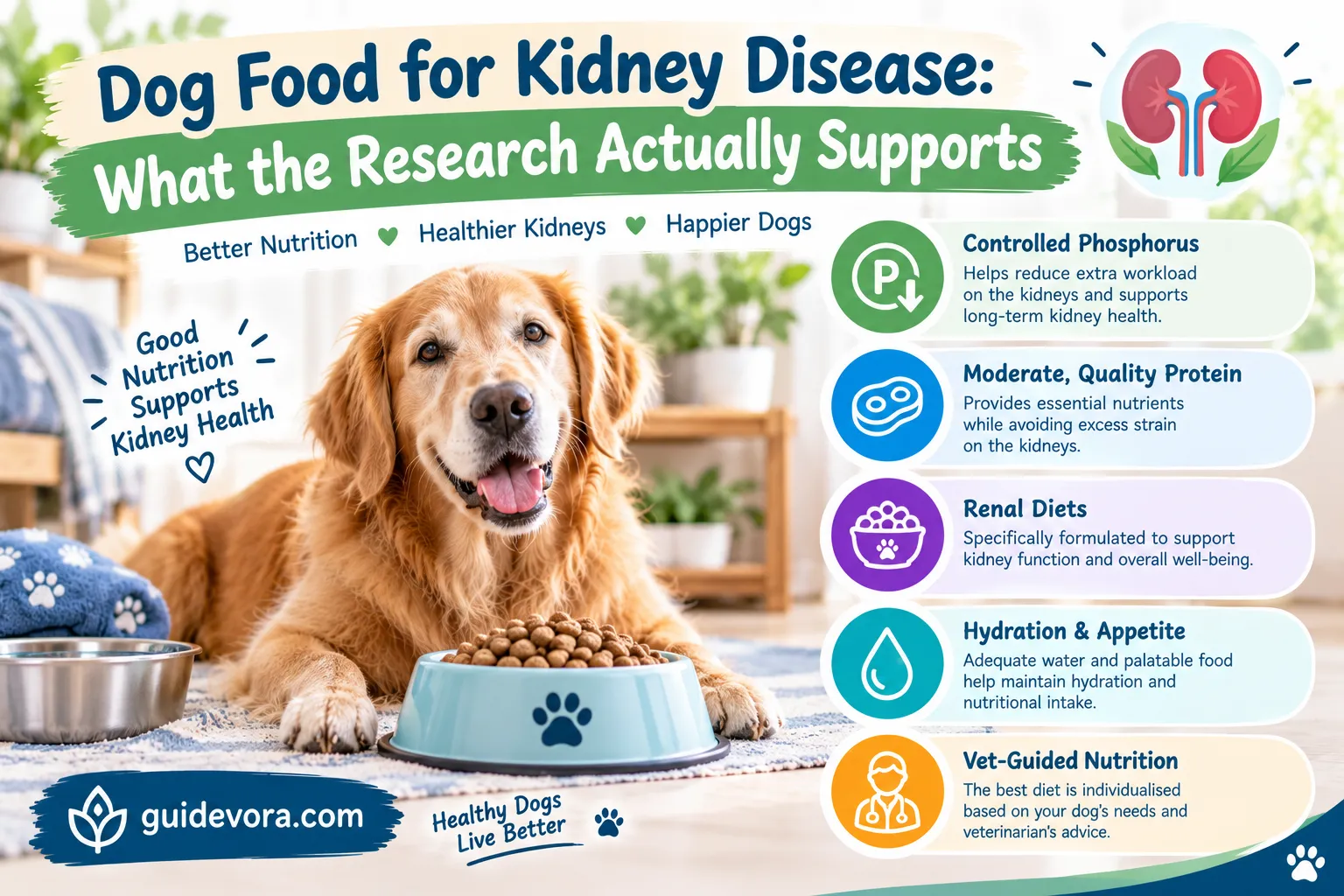
Chronic kidney disease (CKD) is one of the few conditions in veterinary medicine where diet alone has been shown to meaningfully extend life. In one controlled study, dogs with induced kidney disease fed a phosphorus-restricted diet had a 75% survival rate over two years, compared to 33% in dogs fed a phosphorus-replete diet at the same protein level. That’s not a marginal difference — it’s the reason vets treat diet as a primary treatment for CKD, not a supplement to it.
This guide explains what actually changes in a kidney diet, why phosphorus restriction matters more than anything else on the label, and how to handle the appetite-loss problem that derails more kidney diets than any ingredient choice does.
Why Kidney Disease Changes What a Dog Should Eat
Healthy kidneys filter waste and excess minerals out of the blood. As kidney function declines, the kidneys lose the ability to clear phosphorus efficiently, and it builds up in the bloodstream — a condition called hyperphosphatemia. That buildup is directly linked to faster disease progression, so nearly everything about a renal diet exists to control it.
A properly formulated renal diet differs from standard dog food in five ways:
- Restricted phosphorus — the single most important change; this is what the research most consistently links to slower progression and longer survival
- Moderately reduced protein — controversial in degree, but reducing protein lowers phosphorus intake since most protein sources are also high in phosphorus
- Reduced sodium — intended to help manage blood pressure, though dog-specific evidence for this benefit is less robust than for phosphorus
- Increased potassium — CKD can cause abnormal potassium levels in either direction, so this is monitored and adjusted, not just added
- Added omega-3 fatty acids — shown in dog studies to help reduce the inflammatory and pressure-related effects of CKD on the kidneys
Read More: How to Keep Your Pet’s Feeding Area Clean
Why “Formulated to Meet AAFCO Standards” Isn’t Enough
This is the detail most pet owners miss, and it’s genuinely useful to understand. AAFCO’s minimum phosphorus standard for adult dog maintenance is 1.4 g/Mcal — but therapeutic renal diets typically run between 0.48 and 1.0 g/Mcal, roughly half the AAFCO minimum or less. That means nearly every over-the-counter food labeled “complete and balanced” — including premium and grain-free lines — contains more phosphorus than is appropriate for a dog with anything beyond the earliest stage of kidney disease, simply by design. A bag calling itself “healthy” or “senior” is not the same claim as “formulated for renal support,” and the two shouldn’t be treated interchangeably.
This is why a genuine veterinary renal diet (prescription-labeled, such as Hill’s Prescription Diet k/d, Royal Canin Renal Support, or Purina Pro Plan Veterinary Diets NF Kidney Function) is formulated differently at the category level, not just marketed differently.
Diet Changes by Disease Stage
Veterinarians stage CKD using the IRIS (International Renal Interest Society) system, Stage 1 through 4, and diet recommendations shift with stage:
| IRIS Stage | Typical Dietary Approach |
|---|---|
| Stage 1 (early, often no symptoms) | Diet change often not yet necessary; monitoring is key |
| Stage 2 | Phosphorus restriction typically begins here |
| Stage 3 | More significant phosphorus and protein restriction |
| Stage 4 (advanced) | Most restricted diets; phosphate binders often added |
This is exactly why “best dog food for kidney disease” doesn’t have a single universal answer — a diet appropriate for Stage 2 can be genuinely wrong for Stage 4, and vice versa. Bloodwork, not a product label, determines which is correct for your dog.
Can You Home-Cook for a Dog With Kidney Disease?
Yes, but not by improvising. Renal diets are deliberately nutrient-restricted, which means an unbalanced home-cooked version can create new deficiencies faster than it fixes the original problem. The consistent veterinary guidance is to get a custom recipe from a board-certified veterinary nutritionist, typically through a veterinary teaching hospital’s nutrition service, rather than adapting a generic online recipe. Phosphorus content in home ingredients varies widely and isn’t something you can estimate reliably without professional formulation and, usually, periodic bloodwork to confirm the diet is working.
The Real Obstacle: Getting a Dog With Kidney Disease to Eat
This is the part most articles skip, and it’s often the actual problem owners are searching for help with. CKD frequently causes nausea and reduced appetite, and a picky eater on a restricted diet is a genuine risk — inadequate calorie intake can do more short-term harm than a slightly imperfect diet.
- Warm the food slightly to increase aroma, which often matters more than flavor for appetite.
- Offer canned/wet renal food alongside or instead of kibble — the higher moisture content also supports hydration, which matters separately, since CKD reduces the kidneys’ ability to concentrate urine.
- Transition gradually, mixing old and new food over 7–10 days; a fast switch during a period of nausea often causes a dog to reject the new food entirely, sometimes permanently.
- Ask your vet about anti-nausea or appetite-stimulant medication if reduced eating persists — this is a common and manageable part of CKD management, not a sign the diet has failed.
- Never withhold food to force acceptance of a new diet; for a dog with CKD, inconsistent eating is a bigger short-term risk than a temporary mixed diet.
Supporting Hydration
Because CKD impairs the kidneys’ ability to concentrate urine, dogs with kidney disease often need more water intake support, not less:
- Change water multiple times a day and wash the bowl daily.
- Add a canned renal food to the routine even if the dog primarily eats kibble — moisture content matters here independent of the nutrient profile.
- Multiple water stations around the house can increase overall intake for dogs who don’t like walking far for water.
What to Avoid
- Don’t assume “senior” or “light” formulas are renal diets. Some happen to be lower in phosphorus, but this isn’t guaranteed or labeled — verify with the manufacturer or your vet rather than assuming.
- Don’t add generic calcium or mineral supplements on your own. Mineral balance in CKD is precise and individualized; over-supplementing without bloodwork can cause harm.
- Don’t switch diets without veterinary input, even between two different renal products — protein and phosphorus levels vary meaningfully between brands and formulations.
Frequently Asked Questions
What is the best dog food for kidney disease? There’s no single best option — the right diet depends on your dog’s IRIS stage and bloodwork. In general, veterinary therapeutic renal diets (prescription-labeled, such as Hill’s k/d, Royal Canin Renal Support, or Purina NF) are formulated with substantially lower phosphorus than standard commercial food, which is the change most consistently linked to slower disease progression.
Why is phosphorus restricted in kidney diets for dogs? Failing kidneys can’t clear phosphorus efficiently, so it builds up in the blood (hyperphosphatemia), which accelerates kidney damage. Research has shown restricting dietary phosphorus significantly improves survival compared to normal-phosphorus diets at the same protein level.
Can I make homemade food for a dog with kidney disease? Yes, but it should be formulated by a board-certified veterinary nutritionist rather than adapted from a general recipe, since renal diets are deliberately nutrient-restricted and an unbalanced version can cause new problems.
Why won’t my dog eat their kidney disease food? Nausea from CKD itself is a common cause of appetite loss, separate from the food’s palatability. Warming food, offering canned varieties, transitioning gradually, and discussing anti-nausea or appetite medication with your vet all help — never withhold food to force acceptance.
Is a “senior” or “healthy joints” dog food the same as a kidney diet? No. Only a therapeutic renal diet is formulated to the phosphorus and protein levels appropriate for CKD. Standard commercial foods, including senior and premium lines, are typically formulated to AAFCO maintenance minimums, which are roughly double or more the phosphorus level found in renal diets.
Final Thoughts
Diet is genuinely one of the most effective tools for managing kidney disease in dogs — but it works because of specific, deliberate nutrient restriction, not because a bag says “healthy” or “natural.” If your dog has been diagnosed with CKD, the next step is a conversation with your veterinarian about IRIS stage and bloodwork, not a product comparison. This guide is meant to help you understand why your vet is recommending what they’re recommending — not to replace that conversation.
Leave a Reply