
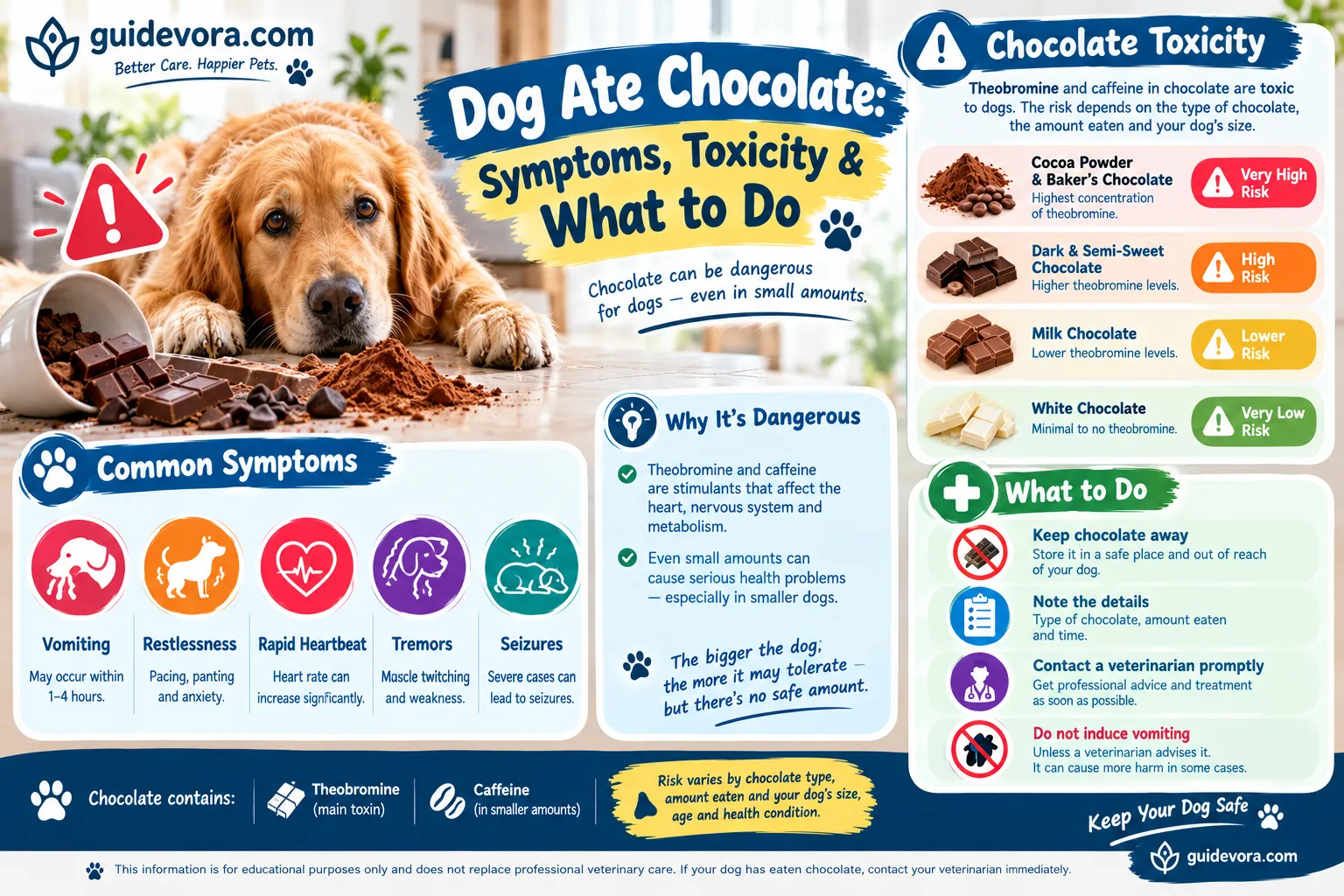
Your dog got into chocolate, and you need a plan, not a lecture. Here’s the sequence, in order.
The Next 10 Minutes
- Remove all remaining chocolate from reach immediately, and separate other pets from the area.
- Gather evidence before you clean up. Photograph the wrapper or packaging — it tells your vet the chocolate type and cocoa content, which matters more than almost anything else. Estimate how much is missing.
- Check the ingredient list for other hazards. Chocolate-covered raisins, trail mix, baked goods, and some candies can also contain raisins, macadamia nuts, or xylitol — each separately toxic to dogs, and each changes what your vet needs to know.
- Note the time of ingestion as precisely as you can, even an estimate — this determines whether inducing vomiting is still a viable option.
- Call your vet, an emergency animal hospital, or a poison control hotline now — don’t wait to see if symptoms appear first:
- ASPCA Animal Poison Control Center: 888-426-4435 (consultation fee applies)
- Pet Poison Helpline: 855-764-7661 (consultation fee applies)
Should You Go to the Vet, or Just Monitor at Home?
This is the actual question behind most searches on this topic, and the honest answer depends on type, amount, and your dog’s size — which is exactly what a quick call resolves in a few minutes. As a general guide:
Go to an emergency hospital immediately if:
- Your dog ate dark chocolate, baking chocolate, or cocoa powder in any meaningful amount
- Your dog is already showing symptoms — vomiting, tremors, wobbliness, a racing heart
- Symptoms appear more than 4 hours after ingestion, which can indicate a more significant dose
- Your dog had seizures or collapsed
A same-day (not overnight-wait) vet call or urgent visit is appropriate if:
- Your dog ate a small-to-moderate amount of milk chocolate and shows no symptoms yet
- You’re unsure of the amount but know it wasn’t a large quantity
- The product also contained xylitol, raisins, or macadamia nuts — these warrant a call regardless of the chocolate amount
Home monitoring may be reasonable only if your vet or poison control specifically tells you it is — after calculating the dose against your dog’s weight. This isn’t a decision to make alone based on how your dog “seems,” since symptoms can take 2 to 12 hours to appear, and severe cardiac signs can develop up to 24 hours later due to theobromine’s long half-life.
Relevent :Cat Not Peeing: Causes and Emergency Care
Common Real-World Scenarios
“My dog ate a chocolate chip cookie.” Cookies are typically low in actual chocolate relative to the dog’s likely body weight, but butter and sugar content can still cause GI upset, and if your dog is small, don’t assume it’s automatically fine — call and give the estimated cookie count.
“My dog ate a chocolate cake / brownies.” Baked goods made with baking chocolate or a high cocoa-content recipe carry real risk, and cake or brownies are often eaten in larger quantities than a single square of chocolate — treat this with the same urgency as baking chocolate itself.
“My dog ate chocolate-covered raisins or trail mix.” This is a dual-toxin situation — raisins carry their own, separate risk of acute kidney injury in dogs, unrelated to the chocolate. Call your vet regardless of how much chocolate was involved.
“My dog seems totally fine, it’s been a few hours.” Don’t take this as confirmation nothing will happen — the 2-to-12-hour symptom window means “fine so far” isn’t the same as “in the clear,” especially for darker or more concentrated chocolate.
What Happens If You Go In
- Decontamination, if within the window where it’s still useful — this may include inducing vomiting (done by the vet, not typically recommended as a DIY step) and/or activated charcoal to bind remaining theobromine in the gut.
- Baseline bloodwork, checking liver enzymes (ALT, ALP), kidney function markers (BUN, creatinine), and heart rhythm via ECG if there’s any cardiac concern.
- IV fluids, both to support the kidneys in clearing theobromine and to manage a dog who’s vomited significantly.
- Monitoring, sometimes overnight, since symptoms and heart effects can develop or worsen over the following 12–24 hours.
- Follow-up bloodwork in more serious cases — kidney markers like BUN typically normalize within 48–72 hours with proper fluid support if no lasting damage occurred.
What This Actually Costs
There’s real variation, but industry claims data gives a useful anchor: average chocolate-related insurance claims have landed in the roughly $814–$1,100 range, with total costs climbing well beyond that — commonly cited up to $3,000+ — for cases requiring overnight hospitalization, ICU monitoring, or complications. The single biggest driver of cost is whether your dog needs to stay overnight. This is worth knowing upfront so cost doesn’t become a reason to delay a call that could otherwise be a simple, inexpensive phone triage.
Why Not Just Induce Vomiting at Home?
Several DIY guides describe a hydrogen-peroxide method for inducing vomiting at home. This guide deliberately doesn’t provide those dosing details, for three reasons a vet would raise: timing (it’s only effective in roughly the first 1–2 hours, and by the time most owners realize what happened, that window may already be closed), breed-specific risk (flat-faced breeds like French Bulldogs and Pugs face a real aspiration risk when vomiting is induced), and dosing risk (getting the amount wrong can cause additional harm without reliably solving the original problem). If your vet or poison control specifically instructs you to induce vomiting at home, they’ll walk you through it directly and correctly for your specific dog — that’s the safer path than following a generic online dose.
How Long Do You Need to Monitor?
Because theobromine has a long half-life in dogs, monitoring — whether at home under a vet’s guidance or in hospital — typically covers the full 24-hour window after ingestion, even if early hours look uneventful. Watch specifically for: repeated vomiting, tremors or muscle twitching, a noticeably fast or irregular heartbeat, restlessness that doesn’t settle, or any seizure activity — and call back immediately if any of these appear, even after an initial “looks okay” assessment.
Frequently Asked Questions
My dog ate chocolate but has no symptoms — do I still need to call the vet? Yes. Symptoms typically take 2–12 hours to appear, and severe signs can develop up to 24 hours later. “No symptoms yet” doesn’t rule out a problem, and a quick call with the chocolate type, amount, and your dog’s weight will tell you whether monitoring at home is genuinely appropriate.
How much does it cost to treat a dog for eating chocolate? Reported average insurance claims fall around $814–$1,100, though costs can reach $3,000 or more for cases requiring overnight hospitalization or ICU-level care. The biggest cost driver is whether your dog needs to stay for observation.
Should I make my dog throw up if they ate chocolate? Only if directed to by a veterinarian or poison control, and ideally performed by a professional. Inducing vomiting is only effective in roughly the first 1–2 hours, carries aspiration risk in flat-faced breeds, and getting the method wrong can cause additional harm.
My dog ate a chocolate chip cookie — is that dangerous? Usually lower risk than eating chocolate directly, since cookies contain relatively little actual chocolate, but it still depends on your dog’s size and how many cookies were involved. When in doubt, call and give the estimated amount rather than assuming it’s fine.
How long should I watch my dog after they eat chocolate? Plan on monitoring for a full 24 hours, since theobromine clears slowly and symptoms or cardiac effects can develop later than expected. Watch specifically for vomiting, tremors, a racing or irregular heartbeat, and seizures.
What if the chocolate also had raisins or macadamia nuts in it? Treat this as a separate, additional concern — raisins can cause acute kidney injury and macadamia nuts cause their own toxic reaction in dogs, independent of the chocolate risk. Mention every ingredient to your vet, not just the chocolate.
Final Thoughts
The sequence that actually matters: remove access, gather the details (type, amount, time, other ingredients), and call — now, not after watching and waiting. Most dogs who get prompt veterinary guidance, whether that means a monitored at-home wait or an in-clinic visit, do well. The decision that most affects outcome isn’t which home remedy you try — it’s how quickly you get an accurate assessment from someone who can calculate the actual dose against your dog’s weight.
This article is for informational purposes and doesn’t replace immediate veterinary or poison-control guidance in an actual incident.
Leave a Reply