
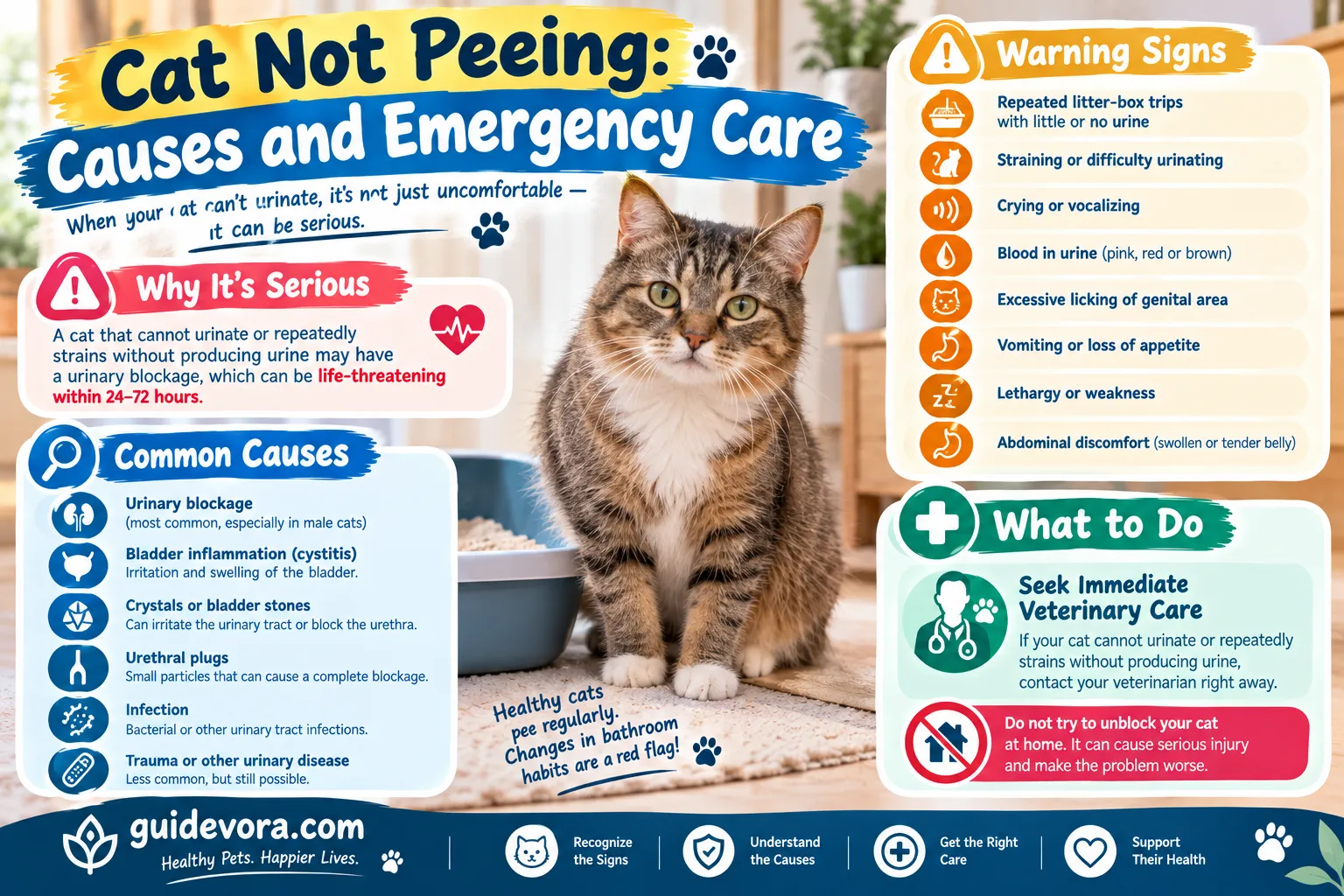
If your cat is straining in the litter box and producing little or no urine, this is a medical emergency — go to a veterinarian or emergency animal hospital now, not tomorrow. A complete urinary blockage can become fatal within 24 to 48 hours as toxins build up in the bloodstream. This is especially true for male cats, whose narrower urethras make them far more prone to complete obstruction.
If you’re reading this while watching your cat repeatedly visit the litter box with nothing coming out, stop reading after this section and go — the explanation can wait.
Emergency Signs — Go to a Vet Immediately
- Repeated trips to the litter box with little or no urine produced
- Straining or crying out while attempting to urinate
- A firm, painful, swollen abdomen
- Excessive licking of the genital area
- Vomiting, lethargy, hiding, or loss of appetite alongside any of the above
- Urinating outside the litter box in small amounts
Even small amounts of urine don’t rule out a blockage — a partial blockage can still allow a little urine through and can progress to a full blockage quickly. Treat any combination of straining and reduced output as urgent, not “wait and see.”
Read More: Useful Cat Accessories for Small Homes
Cat Not Peeing vs. Constipation — Know the Difference
These get confused because both involve a cat crouching in the litter box for a long time, but they are not the same problem:
- Constipation affects stool. Your cat may strain, but urine output is usually normal.
- Urinary blockage stops urine flow specifically. Your cat strains with little or nothing coming out, and, left untreated, this is always dangerous — constipation generally isn’t.
If you’re not sure which one you’re looking at, treat it as a urinary emergency and let a vet make the distinction — the cost of being wrong about constipation is low; the cost of being wrong about a blockage is not.
Why This Happens, and Why Male Cats Are at Higher Risk
Urine travels from the kidneys through the bladder and out through the urethra. A blockage occurs when something obstructs that path — most commonly urethral plugs (a combination of crystals and mucus) or, less often, bladder stones or severe inflammation.
Male cats are affected far more often than females because their urethra is longer and significantly narrower, making it much easier for a small plug or crystal to cause a complete obstruction. Female cats can still develop urinary tract disease and painful straining, but complete blockage is comparatively rare in females due to their wider, shorter urethra.
Risk factors consistently linked to urinary blockage and lower urinary tract disease include:
- Being an overweight, neutered male cat between roughly 2–6 years old
- A diet that produces more alkaline urine, which favors struvite crystal formation
- Chronic stress or a significant change in environment/routine
- Low water intake, often tied to a mostly dry-kibble diet
What Happens at the Vet
Understanding the process can help you know what to expect and why speed matters:
- Physical exam and bloodwork to check for electrolyte imbalances — a blocked cat’s potassium often rises dangerously (hyperkalemia), which is what makes this specifically life-threatening rather than just painful.
- Stabilization first. Cats with significant electrolyte abnormalities are stabilized with IV fluids and medication before the obstruction itself is addressed, since correcting the blockage too fast in an unstable cat carries its own risk.
- Catheterization, typically under heavy sedation or general anesthesia, to relieve the obstruction and flush the bladder.
- Hospitalization, often for 24–72 hours, to monitor the kidneys and confirm the cat is urinating normally before discharge.
This is genuinely intensive, urgent care — not something manageable at home, and not something that resolves on its own.
How Long Can a Cat Go Without Peeing Before It’s an Emergency?
There’s no safe waiting period once straining-with-no-output is present — veterinary sources are consistent that this can turn fatal within 24 to 48 hours, and some describe deterioration within as little as 12–24 hours in severe cases. The honest guidance is: the moment you notice the pattern, that’s the time to call, not a number of hours to wait out first.
Prevention: Lowering the Risk of Future Blockages
For cats who’ve had a blockage before, or who show risk factors, these consistently reduce recurrence risk:
- Increase water intake — wet food over dry kibble, multiple water stations, and pet fountains all help.
- Manage weight, since overweight neutered males are the highest-risk group.
- Reduce environmental stress — stable routines, adequate litter boxes (generally one per cat plus one), and minimizing sudden changes.
- Follow a vet-recommended urinary-support diet if your cat has a history of crystals, rather than guessing at an over-the-counter option.
- Don’t skip regular veterinary checkups — recurring FLUTD (feline lower urinary tract disease) episodes are common, and catching a pattern early changes management.
Frequently Asked Questions
My cat is straining in the litter box but nothing is coming out — what do I do? Go to a veterinarian or emergency animal hospital immediately. This is one of the clearest signs of a urinary blockage, which can become life-threatening within 24–48 hours if untreated.
How can I tell if my cat is constipated or has a urinary blockage? Constipation affects stool, and urine output is usually normal. A urinary blockage stops urine specifically — your cat strains with little or no urine produced. If you’re unsure which you’re seeing, treat it as a urinary emergency, since that’s the one that can’t wait.
Why are male cats more likely to get blocked than female cats? Male cats have a narrower, longer urethra, which makes it much easier for crystals, mucus plugs, or small stones to cause a complete obstruction. Female cats can develop urinary tract disease and pain but are far less likely to become completely blocked.
My cat is peeing small amounts frequently — is that still an emergency? Yes, treat it as urgent. A partial blockage can still let small amounts of urine through and can progress to a complete blockage quickly. Frequent small-volume trips to the litter box, especially with straining, warrant same-day veterinary attention.
Can a blocked cat get better on its own without treatment? No. A urinary blockage does not resolve without medical intervention and can become fatal within 24–48 hours as toxins build up in the bloodstream. This always requires emergency veterinary care.
How can I prevent my cat from getting blocked again? Increase water intake (wet food, multiple water sources), manage weight, reduce environmental stress, follow any vet-recommended urinary diet, and keep up with regular veterinary checkups, since cats with one blockage are at elevated risk for another.
Final Thoughts
A cat straining in the litter box with little or no urine is one of the few truly time-critical emergencies in cat ownership, and the single most important thing to know is this: don’t wait to see if it resolves. If you’re seeing these signs right now, the article is done — go to your vet or an emergency animal hospital. If your cat is currently fine, understanding the risk factors and building better water intake into their routine is the most effective thing you can do to keep it that way.
Leave a Reply