
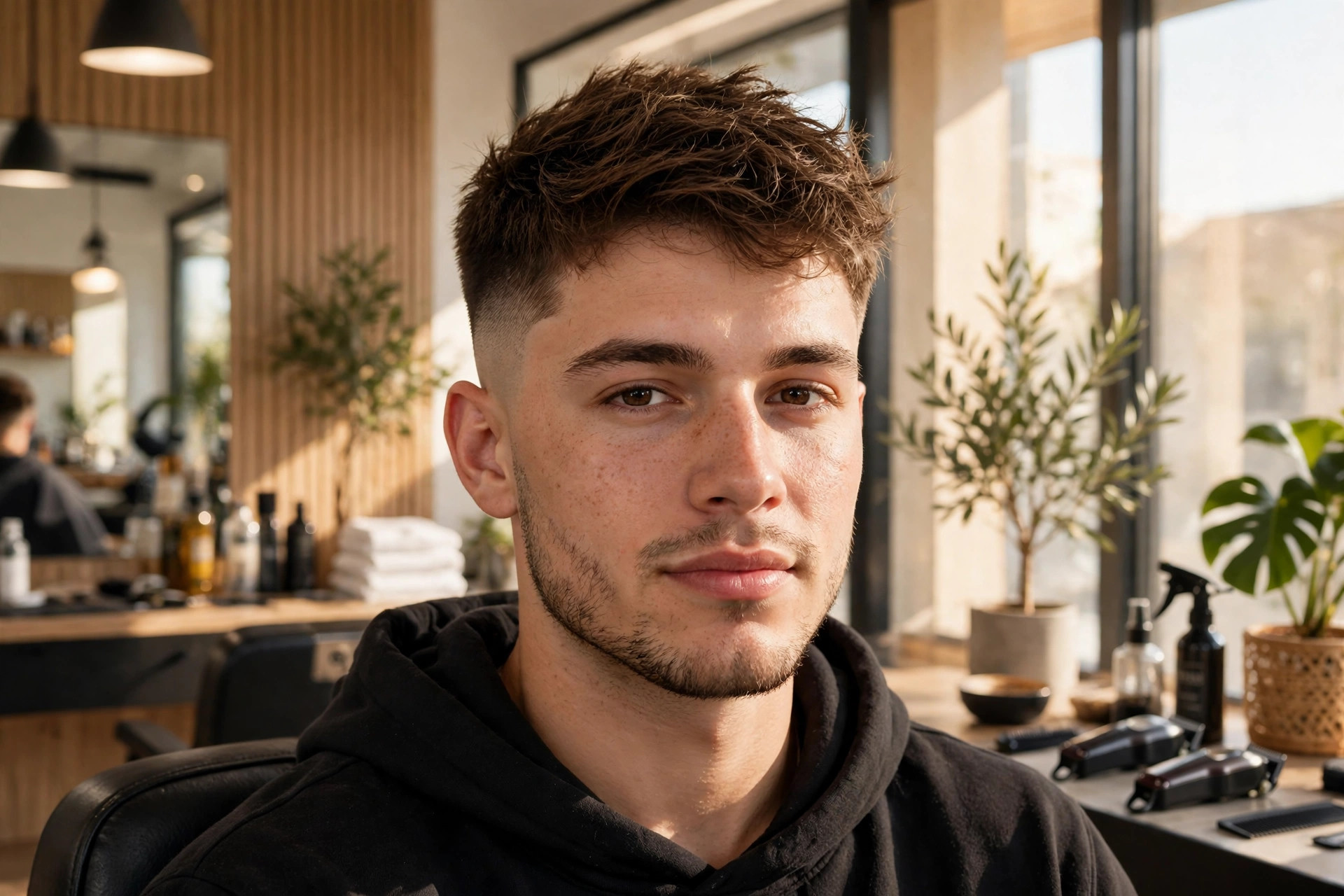
The mid fade haircut is one of the most popular men’s cuts for a simple reason: it looks sharp without trying too hard. The fade starts around the middle of the sides and back, blending smoothly from very short hair near the ears up into longer hair on top. That balance makes it clean enough for the office, relaxed enough for the weekend, and flexible enough for almost any style on top.
If you have ever struggled to describe what you want in the barber’s chair, the mid fade is a safe, stylish answer. It works on straight, wavy and curly hair, suits most face shapes, and grows out gracefully.
Key Facts
- A mid fade starts around temple level, halfway between the top of the ear and the crown.
- It blends from skin or very short hair at the bottom into longer hair above, with no harsh line.
- It suits straight, wavy, curly and coily hair, and most face shapes.
- A mid fade usually needs a tidy-up every 2 to 3 weeks to keep the blend sharp.
- It pairs well with textured crops, quiffs, pompadours, buzz cuts and curly tops.
What Is a Mid Fade Haircut?
A fade is a gradual transition from short hair at the bottom to longer hair at the top, and “mid” tells your barber where it begins. In a mid fade, the shortest point sits around the middle of the head, roughly level with the temples, and the hair gets progressively longer as it moves upward to meet the longer top.
The result is a clean outline around the ears and neckline, with a smooth blend rather than a sudden step. The top can be left short or long enough to sweep back, which is why the mid fade works as a base for so many styles.
Mid Fade vs Low Fade vs High Fade
The main difference between the three fades is where the shortest hair begins. A low fade starts just above the ears and keeps most of the sides longer, giving a subtle, classic finish. A high fade starts near the top of the head, close to the crown, creating a strong contrast between the very short sides and the longer top. The mid fade sits between the two, starting around temple height.
A low fade is the safest choice for a conservative look or a strict dress code. A high fade makes a bigger statement with sharp contrast. The mid fade gives you the best of both: noticeable definition without the drama of a high fade, and more edge than a low taper — a good starting point if you are trying a fade for the first time.
Who Does a Mid Fade Suit?
The mid fade is one of the most forgiving men’s haircuts. It suits round, oval, square and oblong faces because the clean sides slim the face while the length on top adds height. Volume on top can make a round face look longer, while tidy sides highlight a square jaw without looking harsh.
Hair type matters less than you might think. On straight hair it looks crisp and precise; on wavy hair it adds structure while the natural texture shows on top; on curly hair the short sides control volume while the curls become the feature. Thick hair benefits because the fade removes bulk, while finer hair looks fuller against the clean sides. It works at any age, with textured tops for younger men and neater finishes, like a side part, for older men.

The Best Mid Fade Styles for Men
Textured crop. The most popular partner for a mid fade right now. The top is cut short with choppy layers and pushed slightly forward, while the faded sides keep the look clean. It is low maintenance, dries quickly, and suits straight and wavy hair. A little matte clay is all you need.
Pompadour. If you like a classic look with volume, pair a mid fade with a pompadour. The top is left longer and swept up and back, creating height at the front. A pompadour haircut for men works beautifully with a mid fade because the tidy sides make the volume on top stand out even more. A blow dryer and medium-hold pomade keep the shape in place.
Quiff. The quiff is similar to the pompadour but less formal, with the front swept up and slightly to one side. It suits thicker hair and adds height without looking overdone; ask your barber to keep the front longer than the crown.
Buzz cut. For the simplest option, combine a mid fade with a short buzz on top. The fade adds shape to an otherwise uniform cut, and the result is sharp and almost zero maintenance — ideal for summer.
Curly top. Men with curly hair often find that a mid fade is the easiest way to manage their curls. The sides stay short and neat, while the curls on top are left long enough to show their natural shape. Ask your barber to cut the curls with minimal tension so they do not spring up too short.
Prefer a sharp disconnect instead of a blend? An undercut haircut for men keeps the sides one uniform length with a visible line, while a burst fade haircut curves around the ear and pairs well with a mohawk.
How to Ask Your Barber for a Mid Fade
Start by saying “mid fade”, then add three details: how short you want the bottom (skin or taper), how much length you want on top, and what style you want on top — for example, “a mid skin fade with about two inches left on top, textured and pushed forward.”
Bring a photo: barbers work visually, and a reference picture removes guesswork. Save two or three photos of cuts you like, ideally on someone with a similar hair type. If you are unsure, ask your barber — they will look at your hair type, head shape and growth pattern and suggest adjustments, such as a taper rather than a skin fade if your hair grows quickly.
How to Style a Mid Fade at Home
Start with clean, towel-dried hair. For volume, blow dry the top while brushing it in the direction you want it to sit. Use a small amount of product — a pea-sized amount of matte clay for a textured crop, or a medium-hold pomade for a pompadour or quiff. Warm it between your palms, work it through the top, and shape the front into place. Less is more: too much product weighs the hair down and makes it look greasy.
When choosing products, check what is in them: the U.S. Food and Drug Administration’s cosmetics pages explain how hair products are regulated and what to look for on labels, which helps if you have sensitive skin. A textured crop needs almost nothing — a dab of clay and thirty seconds — while a quiff or pompadour takes about five minutes with a dryer.
How to Maintain a Mid Fade
A mid fade looks its best for about two weeks, after which the blend grows out and the sharp line around the ears softens. Most men book a tidy-up every 2 to 3 weeks. Between visits, keep the neckline tidy with a trimmer, but do not touch the blend — one wrong pass can ruin the gradient. Wash your hair 2 to 3 times a week rather than daily, as overwashing can dry out the hair and scalp.

Frequently Asked Questions
How long does a mid fade haircut last?
A mid fade looks sharp for about 2 weeks and stays presentable for 3 to 4 weeks, after which the blend grows out. Most men get a tidy-up every 2 to 3 weeks.
Is a mid fade good for a job interview?
Yes. A mid fade with a neat top, such as a side part or a short textured crop, looks professional and tidy — just avoid a dramatic skin fade if your workplace is conservative.
Does a mid fade suit curly hair?
Yes — one of the best. The short sides remove bulk and keep the shape tidy, while the curls on top show their natural pattern. Ask your barber to cut the curls with minimal tension.
What is the difference between a mid fade and a mid taper?
A mid fade blends from very short or skin at the bottom up into longer hair. A mid taper is more subtle: the shortest point is longer, the transition gentler, and the look more classic.
Can I get a mid fade with thin or fine hair?
Yes. The clean sides create contrast that makes fine hair look fuller. Ask your barber to keep a little extra length on top and add texture, and avoid heavy, oily products.
How do I ask for a mid fade if it is my first time?
Say “mid fade”, then describe the finish and the top — for example, “a mid taper fade with a short textured top.” Bring a photo, and ask your barber to confirm the fade height before they start.
Leave a Reply