
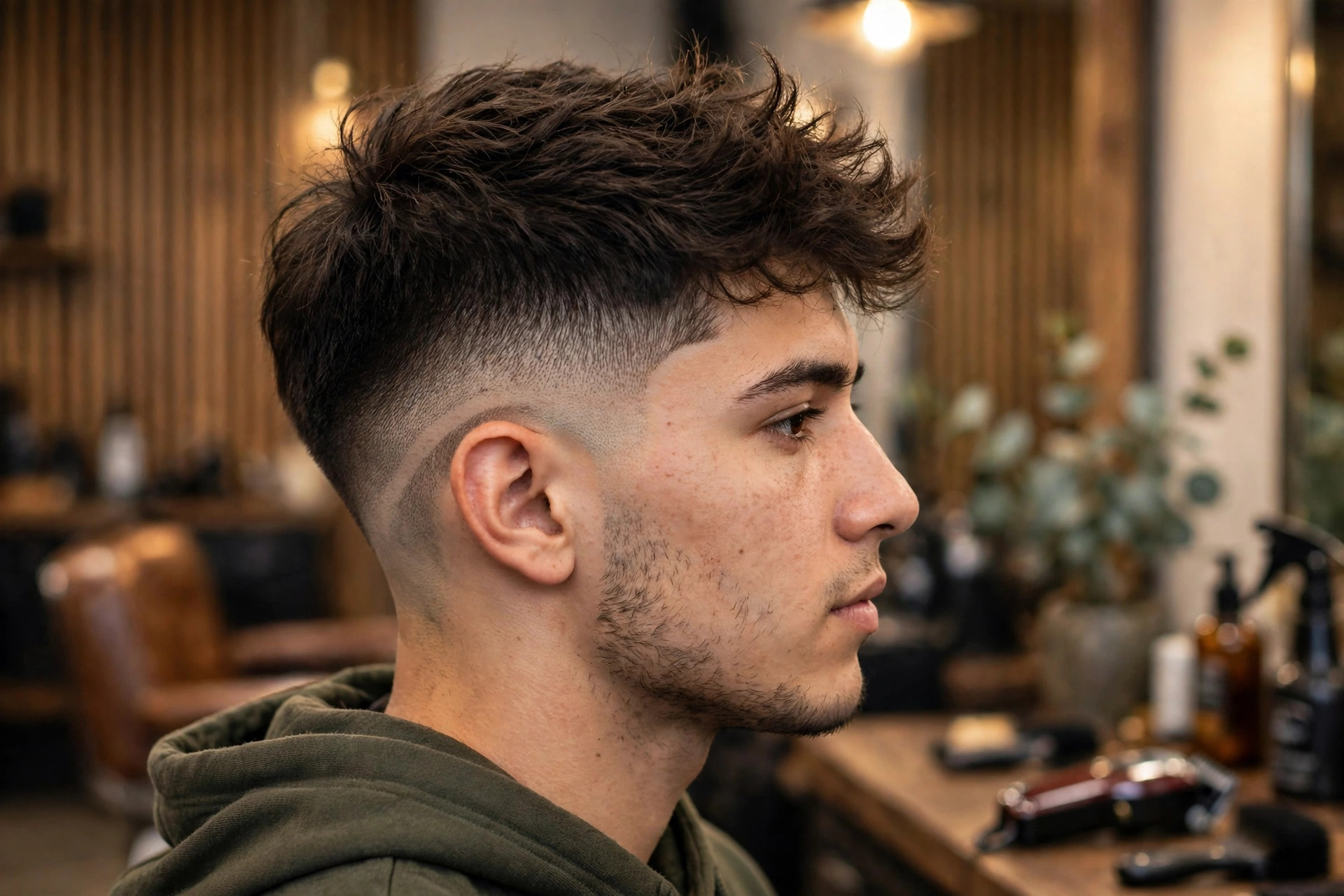
A burst fade haircut is a fade that curves around the ear in a semicircle — the hair “bursts” outwards from behind the ear, fading down at the sides while leaving the length at the back of the head longer than a standard fade. It is one of the most distinctive modern fades: sharper and more shaped than a taper fade, less dramatic than a full mohawk fade. The burst fade is famous as the base of the modern mohawk and the South-of-France style, but it also works under curly tops, straight textured hair and even longer flows. This guide explains exactly what a burst fade is, how it differs from a taper fade and a drop fade, who it suits, the best ways to wear it on top, and what to ask your barber.
Key Facts
- A burst fade curves in a semicircle around the ear, rather than running in a straight line like a normal fade.
- The back of the head keeps more length than a standard fade — the fade is concentrated around the ears.
- It is the classic base for mohawks, curly tops and the South-of-France haircut.
- A burst fade differs from a drop fade: a drop fade follows the head’s curve down at the back, while a burst fade wraps around the ear.
- It suits most hair types, especially curly and thick hair that needs the sides controlled.
- Expect a tidy-up every two to three weeks to keep the curve crisp.
What Is a Burst Fade Haircut?
Picture the fade as a sunburst centred on the ear. The hair is taken down shortest — often to skin — in a curved arc just behind and around the ear, then gradually blends into longer hair above, in front and behind. Because the shortest point sits around the ear rather than across the whole side, the back of the head keeps noticeable length, which is why a burst fade pairs so naturally with a mohawk or a mullet-leaning shape. The curve can be subtle, just softening the sideburn area, or bold, with a wide, high arc that takes the fade almost to the temple. Your barber controls that arc, so showing a photo is genuinely useful here.
Burst Fade vs Taper Fade vs Drop Fade
These three are confused constantly, but the shapes are different. A taper fade only shortens the hair at the very edges — around the sideburns and the neckline — leaving most of the sides full. It is the softest, most conservative option; see our taper fade guide for the full picture, and the mid taper fade if you want that softness carried a little higher.
A drop fade runs around the whole head but dips down in an arc behind the ear towards the neckline, following the natural curve of the head. The whole perimeter is faded, including the back.
A burst fade is faded only around the ears. The back is left longer, which is the key difference: from behind, a burst fade head still has hair length at the nape, while a drop fade is faded to the neckline. If you want a faded finish that also reaches the skin around the whole head, a mid taper skin fade style sits at the sharper end of the spectrum.
Who Does a Burst Fade Suit?
A burst fade suits men who want a shaped, modern cut without committing to fully faded sides all the way round. It is excellent for curly and thick hair, because it removes the bulky “mushroom” weight around the ears while keeping the top’s volume intact. It also flatters round and oval faces: keeping length at the back and height on top lengthens the overall silhouette. Men growing their hair out on top often choose a burst fade as a tidy middle step, since it cleans up the sides without touching the length they are growing. It is less ideal if you want a strictly classic, office-conservative cut — the arc is a visible design feature — and it does demand a barber comfortable with freehand curved work.
The Best Styles to Wear on Top
Burst Fade With a Mohawk
The classic pairing. The burst fade isolates a strip of longer hair down the centre, which can be worn spiked, textured or pushed up. Modern versions keep the strip wider and the top shorter than the punk original, making it wearable day to day.
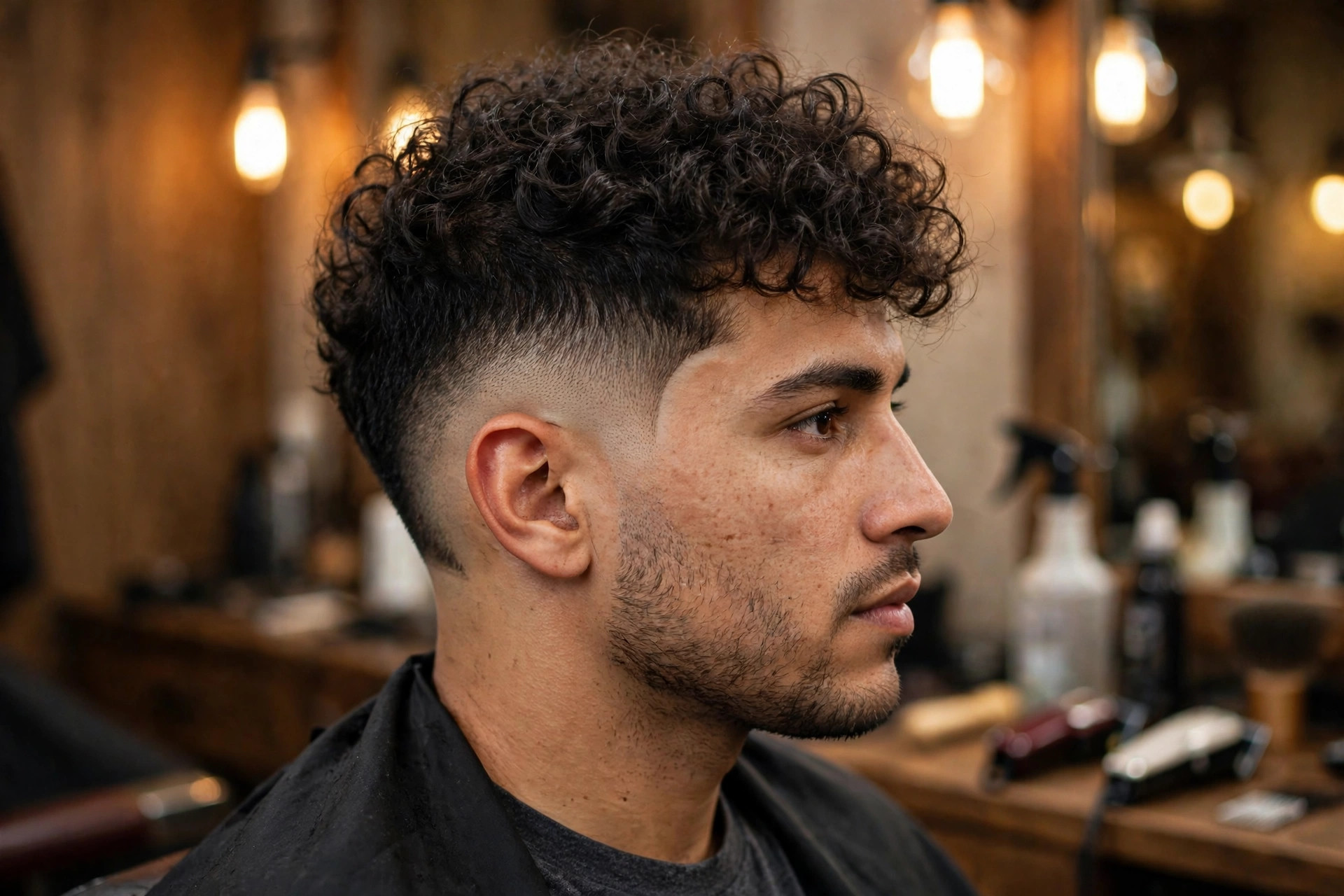
Burst Fade With Curly Hair
Curly hair on top with a burst fade is one of the most popular combinations in barbershops right now. The fade tames the sides where curls puff out most, and the curls on top keep their natural texture and height. Ask for the top to be cut to sit forward or naturally up, and keep the edges around the hairline clean.
Burst Fade With Straight or Textured Hair
Straight hair works too: a textured crop, a messy fringe or a short quiff above a burst fade gives a clean, athletic look. Because straight hair shows fade lines more clearly, the blend has to be precise — another reason to pick an experienced barber.
Burst Fade With Longer Hair at the Back
Leave the back longer still and you get a modern mullet or South-of-France shape, where the burst fade is what keeps it looking like a haircut rather than a grow-out. This version suits oval and longer faces best.
What to Ask Your Barber
Say “burst fade” clearly, then specify three things: how low or high you want the arc (low and subtle, or high and bold), whether you want it taken down to skin at its shortest point or kept as a shadow, and what is happening on top and at the back. Mention explicitly that you want the back left longer than a normal fade — that single sentence prevents the most common mistake, which is the barber blending the back down like a drop fade. Bring a photo of the exact arc you like; curved fades are genuinely hard to describe in words alone.

Maintenance and Growing It Out
A burst fade is a shape, and shapes blur as they grow. Plan on a tidy-up every two to three weeks to keep the arc crisp; the shortest area around the ear grows out fastest visually. Between visits, keep the top styled so the contrast with the faded sides stays deliberate. The good news: growing out a burst fade is easier than growing out most fades, because the back already has length — your barber can blend it into a taper as it grows if you decide to change styles.
Hygiene is part of maintenance too: official salon infection control guidelines, such as Connecticut’s, require clippers and other electric tools to be cleaned and disinfected after every client — a standard worth expecting from any barbershop.
Frequently Asked Questions
What is the difference between a burst fade and a drop fade?
A drop fade dips around the whole head and fades the back down to the neckline. A burst fade is concentrated around the ears in a semicircle and leaves the back of the head longer.
Does a burst fade suit curly hair?
Yes — it is one of the best fades for curly hair. It removes bulk around the ears where curls widen, while leaving the natural volume and texture on top untouched.
How long does a burst fade last?
The crisp shape lasts about two to three weeks. After that the arc softens as the shortest areas grow out, and the cut starts to look like a general short style rather than a shaped burst fade.
Can I get a burst fade with a mohawk?
Absolutely — the burst fade is the standard base for a modern mohawk. The fade isolates the central strip of hair so it stands out, and keeping length at the back completes the classic mohawk silhouette.
Is a burst fade high maintenance?
Moderately. It needs no daily styling beyond what your top requires, but it does need regular barber visits every two to three weeks to keep the curved fade sharp.
What should I tell my barber for a burst fade?
Ask for a burst fade, state how high and wide you want the arc, whether the shortest point should reach skin, and — most importantly — that the back should stay longer than a standard fade. A reference photo helps a lot.
Leave a Reply