
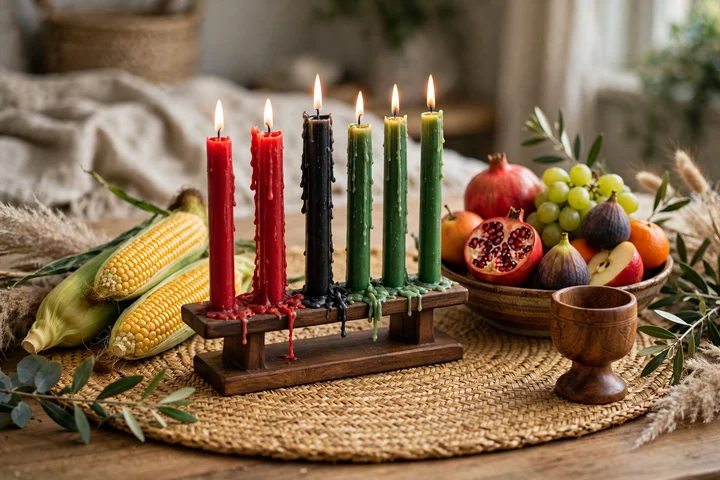
To set up a kinara, place the candle holder on a woven mat (mkeka), put the single black candle in the center slot, the three red candles in the left slots, and the three green candles in the right slots. Arrange the corn, fruit, and unity cup around it. Then light one more candle each night from December 26 to January 1: black first, then alternating red and green from the outside in. The whole setup takes about 20 minutes.
Key Facts
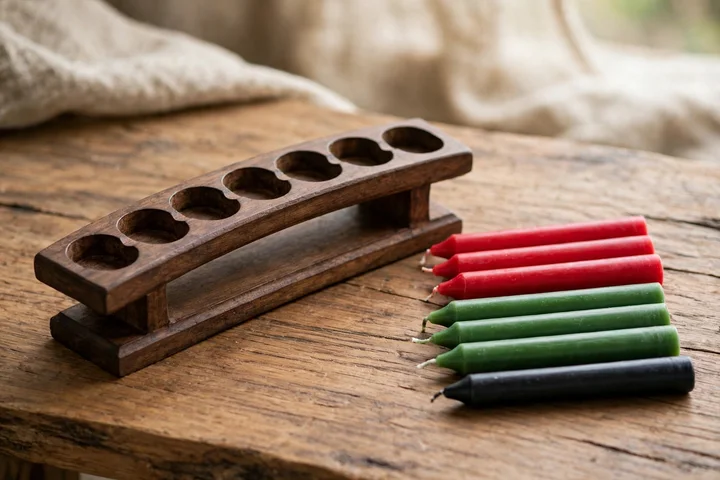
- The kinara holds seven candles (mishumaa saba) — 1 black (center), 3 red (left), 3 green (right).
- Candle meanings: black = the people, red = the struggle, green = hope and the future (the Pan-African flag colors).
- Lighting order: Dec 26 — black; Dec 27 — black + far-left red; Dec 28 — + far-right green; Dec 29 — + 2nd-from-left red; Dec 30 — + 2nd-from-right green; Dec 31 — + innermost-left red; Jan 1 — + innermost-right green.
- The base: everything sits on the mkeka (woven mat), symbolizing tradition and history.
- Timing: set it up any time before the first evening gathering on December 26.
Quotable: “Seven candles, seven principles, seven nights — the kinara is Kwanzaa’s calendar, its flag, and its philosophy in one object.”
What You Need
- Kinara — the candle holder itself. Wooden kinaras are traditional; metal and ceramic versions are common too.
- Mishumaa saba — seven taper candles: 1 black, 3 red, 3 green. Standard 10-inch tapers fit most kinaras.
- Mkeka — a woven mat, traditionally straw, as the foundation.
- Mazao — a bowl of fruits and vegetables (the crops).
- Muhindi — ears of corn, one for each child (a single decorative ear works if there are no children).
- Kikombe cha umoja — the Unity Cup, for the shared drink ritual.
- Zawadi — gifts, placed nearby for January 1.
- Red, black, and green fabric for the table (optional).
Don’t have the exact pieces? Improvise without guilt: a placemat works as a mkeka, plain candles work until you find the colors, and a favorite mug works as a unity cup. The symbols carry the meaning, not the shopping list. If you’re starting from zero, our beginner’s celebration guide has a full buying checklist with budget ranges.
Budget-wise, a full display is more affordable than most people expect. A basic wooden kinara and a set of seven tapers usually run $30–60 together; add a straw mat, a bag of fruit, and a few ears of corn, and most families put the whole display together for under $100. Secondhand shops and community Kwanzaa markets are worth a look too — kinaras are sturdy, and a used one works just as well as a new one. If money is tight, prioritize the candles and the mat: the kinara itself can be borrowed, improvised from a candle holder you already own, or built from a scrap board, and the fruit bowl can be filled from the kitchen. The display is about meaning, not money, and no one at the gathering will be checking receipts.
Choosing a Kinara
Kinaras come in wood, metal, and ceramic. Wooden ones are traditional and affordable (often $20–40); metal kinaras are sturdier and easier to clean; ceramic and hand-carved artisan pieces run higher but double as year-round art. Check two things before buying: that standard 10-inch taper candles fit snugly in the cups (wobbly candles are a fire risk), and that the base is wide and level enough not to tip when all seven candles are in.
Where you buy matters less than fit and stability. Black-owned shops, African import stores, and craft marketplaces usually carry the widest selection, and many sell the kinara and the seven candles as a matched set — the simplest option if you are starting from scratch. Online, read the measurements before you order: kinaras range from compact tabletop pieces about 10 inches wide to larger statement holders over 18 inches across. A bigger kinara looks impressive, but it needs a bigger table and a wider mat, so measure your display spot first.
If you are handy, you can also build one. A simple wooden kinara is a board with seven candle cups drilled or glued in a row, finished with wood stain or paint in the Kwanzaa colors. Families who make their own often say the project becomes part of the tradition itself — children sand the wood one year and help place the candles the next. Whatever route you take, test the fit at home before December 26: slide each taper into its cup and give the holder a gentle nudge. A candle that leans or rocks needs a snugger cup or a wrap of foil around its base.
Step-by-Step: Setting Up the Kinara
Step 1 — Choose the spot. A central table or shelf where the family gathers — living room or dining room. Keep it away from curtains, drafts, and small hands’ reach (candles will be lit nightly). The display should be visible from where everyone sits for the evening gathering, not tucked in a corner — the kinara is the focal point of each night’s discussion, so give it the best seat in the room.
Step 2 — Lay the mkeka. The woven mat goes down first. Everything in the display rests on it — it symbolizes the foundation of tradition and history.
Step 3 — Place the kinara. Center the candle holder on the mat.
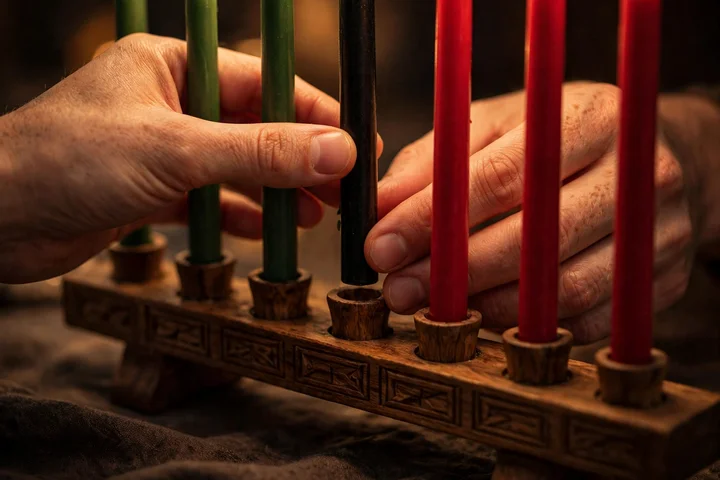
Step 4 — Insert the candles. Black candle in the center slot. Three red candles in the three left slots. Three green candles in the three right slots. Stand back and check: black in the middle, red on the left, green on the right — the Pan-African flag in candle form. Press each candle down firmly so it sits straight — a taper that leans will drip wax down one side and burn unevenly all week. If a cup is too loose, wrap a small strip of aluminum foil around the base of the candle until it grips.
Step 5 — Arrange the symbols. Bowl of fruit (mazao) to one side, ears of corn (muhindi) to the other, unity cup (kikombe cha umoja) in front. Gifts (zawadi) can sit beside the display or be brought out on January 1.
Step 6 — Drape the colors (optional). A runner or cloth in red, black, and green under or behind the display ties the whole thing together.
The Seven Symbols Around the Kinara
The kinara is the centerpiece, but it is one of seven symbols in the display, and each one earns its place on the mat. Knowing what each item means helps you arrange the display with confidence instead of guessing where things go.
Mkeka (the mat). The woven straw mat is the foundation — it represents tradition and history, the ground everything else stands on. Lay it flat first; every other symbol rests on it or beside it, never directly on the bare table.
Kinara (the candle holder). The holder itself stands for the continental African roots of the people. It sits in the center of the mat, and its seven cups hold the week’s light.
Mishumaa saba (the seven candles). The candles embody the seven principles, one per night. Black in the center for the people, red on the left for the struggle, green on the right for hope and the future.
Mazao (the crops). A bowl of fruits and vegetables — apples, oranges, bananas, squash, leafy greens — represents the harvest and the rewards of collective work. Set the bowl to one side of the kinara.
Muhindi (the corn). Ears of corn stand for the children and the future they represent. Place one ear per child on the mat; a single decorative ear works when there are no children in the family.
Kikombe cha umoja (the Unity Cup). The shared cup holds the drink — water, juice, or wine — poured and passed during the nightly libation. Keep it in front of the kinara, where everyone can reach it.
Zawadi (the gifts). Small handmade or educational gifts sit beside the display and are opened on January 1, the last day. Keeping them visible all week builds anticipation, especially for children.
Arranged together, the seven symbols tell the whole story of the holiday at a glance: roots, people, struggle, hope, harvest, children, unity, and the gifts of learning. That is why the display matters — it is not decoration, it is the teaching tool the whole week gathers around. For the full background on each symbol, the official Kwanzaa website carries the history and the official descriptions.
Getting the Whole Family Involved
Setting up the kinara works best as a family job, not a solo chore — and giving everyone a role makes the first night feel like it belongs to the whole household. Children can place the corn on the mat (one ear per child), arrange the fruit in the bowl, and help lay the cloth under the display. Older kids can read the candle order out loud while an adult places each taper, turning the setup itself into the first lesson of the week.
If grandparents or elders are visiting, invite them to tell the story of their first Kwanzaa while the display goes up — the setup hour is one of the best times for those stories, before the formal nights begin. And take a photo of the finished display before the first candle is lit: families who keep a yearly photo of the kinara end up with a small archive of how the tradition grew, which candles were replaced, and who placed what in which year. The setup is not just preparation for the holiday; for many families, it is already the holiday.
The Lighting Order, Night by Night
Each evening, you relight the previous nights’ candles and add one new one — so by January 1, all seven are burning. The order:

| Night | Date (2026–27) | Principle | Light these |
|---|---|---|---|
| 1 | Sat, Dec 26 | Umoja | Black (center) |
| 2 | Sun, Dec 27 | Kujichagulia | Black + far-left red |
| 3 | Mon, Dec 28 | Ujima | + far-right green |
| 4 | Tue, Dec 29 | Ujamaa | + 2nd-from-left red |
| 5 | Wed, Dec 30 | Nia | + 2nd-from-right green |
| 6 | Thu, Dec 31 | Kuumba | + 3rd-from-left (inner) red |
| 7 | Fri, Jan 1 | Imani | + 3rd-from-right (inner) green |
The pattern: black first, then alternate red (left side) and green (right side), working from the outside in. Each candle corresponds to that day’s principle — see the seven principles explained for the full list.
A note for first-timers: families vary slightly in the exact left-right pattern (some go inside-out). What matters is the alternation and the meaning — don’t let the geometry stress you out.
Common Setup Mistakes to Avoid
First-time setups usually go well, but a few mistakes show up every year — and all of them are easy to prevent.
Mixing up the candle colors. The most common error is placing red on the right and green on the left, or putting a colored candle in the center. Check twice before the first night: black in the middle, red on the left, green on the right. If you light the wrong candle on night one, simply swap the candles before night two — no ceremony is ruined.
Lighting all seven on the first night. The point is the slow build: one candle per night, so the light grows through the week. Lighting everything at once turns a seven-night ritual into a single evening of candles. If children are impatient, let them help place the unlit candles in their slots — they still get to touch the display every night.
Skipping the mat. Setting the kinara straight on a table is not just a missed symbol — the mat also catches dripping wax and protects the table surface. A placemat, a woven runner, or even a folded cloth works if you do not own a traditional mkeka.
Forgetting candle height. Taper candles burn down a little each night, and a candle that starts too short may not last through all seven evenings. Start with full 10-inch tapers, and keep a spare set in the same colors in case one burns too fast or snaps.
Putting the display in a draft. A hallway, a spot near a window, or a table under a ceiling fan will make flames flicker, smoke, and burn unevenly. Pick the calmest corner of the room you gather in.

Candle Safety
The kinara burns for seven nights, so treat it like any open flame: never leave lit candles unattended, keep them clear of anything flammable, and make sure the holder sits level and stable. LED taper candles are a fine substitute if you have small children or pets — the ritual and the symbolism are what count.
Trim each wick to about a quarter inch before lighting — a long wick makes a tall, smoky flame that drips wax everywhere. Keep a candle snuffer or a small metal lid nearby to put flames out cleanly; blowing them out spatters hot wax and fills the room with smoke. Never move a kinara while its candles are lit, and wait until the wax has cooled before rearranging anything on the mat. If you use real candles, keep a small fire extinguisher or a heavy damp towel within reach, not as a worry but as a habit — seven nights of open flame deserves the same respect you would give any fireplace. And if the evening gathering moves to another room, the candles stay where they are: carry the conversation, not the fire.

Decorating Around the Display
The kinara display is the centerpiece; the room around it is the frame. Red, black, and green garlands, African-print fabrics, framed art, and harvest decorations (gourds, dried corn, nuts) extend the theme through the whole space. Our Kwanzaa decoration ideas has 15 ways to dress the room around your kinara.

Frequently Asked Questions
What order do the kinara candles go in?
Black in the center, three red on the left, three green on the right. Light the black candle first (Dec 26), then alternate red and green from the outside in, one new candle per night.
What do the kinara candle colors mean?
Black represents the people, red represents the struggle for freedom, and green represents hope and the future — the colors of the Pan-African flag.
Which candle do you light first on Kwanzaa?
The black candle in the center, on December 26 (Umoja/Unity). It’s lit first every night afterward, followed by that night’s new candle.
Do you light all the candles every night?
Yes — each night you relight the previous nights’ candles and add one more, so the light grows through the week until all seven burn on January 1.
Can I use different colored candles?
The red-black-green set is traditional and meaningful (Pan-African flag colors). If you can’t find them, plain candles work — but the traditional colors are worth seeking out for the symbolism.
Where should the kinara go?
On the mkeka (woven mat) in a central gathering spot, with the other symbols arranged around it. Keep lit candles away from curtains, drafts, and children’s reach.
Can I make my own kinara?
Yes — a simple wooden board with seven candle cups is a classic family project. Drill or glue seven cups in a row, sand and stain the wood, and test that standard 10-inch tapers fit snugly before December 26. Handmade kinaras often become keepsakes that come out year after year.
How long do the candles burn each night?
Most families light the candles for the evening gathering — usually one to three hours — then snuff them out before bed. The candles are not meant to burn all night. Full 10-inch tapers should last the whole week at that pace, but keep a spare set on hand just in case.
What do I do with the kinara after Kwanzaa ends?
On January 1, after the last candle is lit and the gifts are opened, let the candles burn down for the evening, then snuff them out. Clean the wax from the cups, store the kinara and the mat somewhere safe, and keep the display intact in storage — many families bring the same set out every year, adding a new handmade piece when they can.
Leave a Reply