
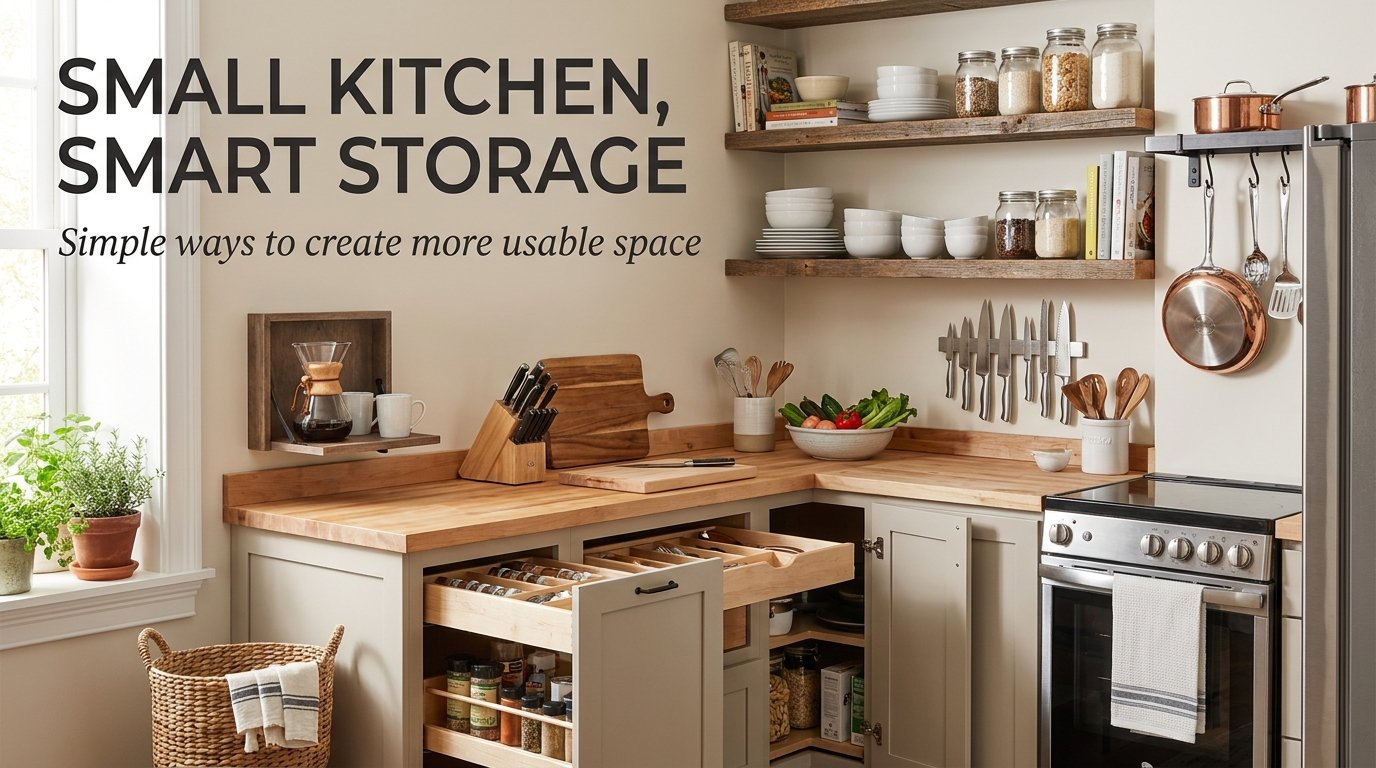
To organize a small kitchen effectively, stop trying to make every item equally accessible.
Give your easiest storage locations to the things you use most often, place tools close to the task they support, keep enough countertop space open to prepare food, and move occasional items into less convenient storage.
The goal is not to fit the maximum number of possessions into the kitchen.
It is to make the kitchen faster and easier to use.
The Small-Kitchen Rule That Matters Most
Think of storage like real estate.
The cabinet directly beside your prep area is valuable.
The shelf above the refrigerator is not equally valuable.
Yet many kitchens store rarely used serving dishes in easy-to-reach cabinets while everyday pans are stacked awkwardly in a difficult corner.
Reverse that logic.
Use this hierarchy:
| Storage priority | What belongs there | Examples |
| Prime | Used daily | Plates, glasses, favorite pan, coffee supplies |
| Secondary | Used weekly | Baking tools, extra pots, food processor |
| Low priority | Used occasionally | Holiday dishes, specialty appliances |
| Remove/relocate | Rarely or never used | Duplicates, broken tools, excess containers |
This single change can make a small kitchen feel more organized without adding any storage products.
Step 1: Start With the Storage Areas That Cause Problems
You do not necessarily need to empty the entire kitchen at once.
Start with the places where organization breaks down most often.
That might be:
- A utensil drawer that will not close
- A cabinet where pans collapse into one another
- A counter crowded with appliances
- A pantry shelf where food disappears
- The cabinet under the sink
- A container drawer full of unmatched lids
Remove everything from that specific area.
Then ask of every item:
Do I use it?
How often?
Does it need to live here?
Do I own another item that does the same job?
Solve one functional problem at a time.
Current small-kitchen guidance across several major publishers also starts with decluttering before adding organizers, which is sensible because an organizer cannot create useful capacity if the kitchen simply contains too much.
Step 2: Sort Everything by Frequency of Use
Frequency should determine accessibility.
Daily-use items
These deserve the easiest locations.
Examples:
- Everyday plates
- Drinking glasses
- Coffee supplies
- Frequently used cookware
- Cooking utensils
- Cutting board
- Salt and commonly used seasonings
Weekly-use items
These can go slightly higher, lower, or farther away.
Examples:
- Baking dishes
- Mixing bowls
- Small appliances
- Specialty pans
Occasional items
These should not consume premium storage.
Examples:
- Large serving platters
- Seasonal bakeware
- Specialty appliances
- Party supplies
Move them to upper cabinets, high shelves, another storage area, or a labeled container outside the kitchen when practical.
Step 3: Create Functional Kitchen Zones
Store items where they are used.
A small kitchen especially benefits from reducing unnecessary movement.
Prep zone
Keep nearby:
- Cutting boards
- Knives
- Mixing bowls
- Measuring tools
- Frequently used ingredients
Cooking zone
Keep near the stove:
- Pots
- Pans
- Cooking utensils
- Oils and seasonings, provided they can be stored safely away from excessive heat
Do not turn the area around the cooktop into unrestricted storage. The U.S. Fire Administration advises keeping combustible items such as paper towels, oven mitts, wooden utensils, food packaging, towels, and curtains away from the stovetop.
Cleaning zone
Keep appropriate cleaning supplies near the sink rather than mixing them throughout food-storage areas.
The FDA specifically advises keeping food away from household cleaning products and chemicals.
Food-storage zone
Group food in a way that makes inventory visible.
Possible categories include:
- Breakfast
- Snacks
- Pasta and grains
- Baking
- Canned foods
- Spices
- Oils and condiments
The categories should match how you cook rather than someone else’s pantry labels.
1. Protect Your Countertop Workspace
In a small kitchen, the counter is not primarily a storage shelf.
It is working space.
Start by removing appliances and objects that do not need permanent access.
Possible items to relocate include:
- Specialty appliances
- Extra cutting boards
- Large knife blocks
- Decorative objects
- Bulk food
- Paperwork
- Rarely used appliances
What stays depends on your actual routine.
If you make coffee every morning, your coffee machine probably earns counter space.
If you use a blender twice per month, it probably does not.
A practical rule
Keep permanent counter items only when putting them away would create more inconvenience than the counter space they consume.
2. Give Everyday Items Prime Storage
The easiest cabinet should not contain things you rarely touch.
Put everyday dishes, glasses, bowls, and cookware where they can be retrieved with minimal movement.
A useful test is the one-motion rule:
Can you reach the item without first removing several unrelated objects?
If you need to move three pans to reach the one you use every evening, the cabinet may look organized but it is not functioning well.
Reserve stacking for items that naturally belong together.
3. Use Cabinet Height Instead of Building Deep Piles
Tall cabinets often waste vertical space.
Shelf risers can create separate levels for:
- Plates
- Bowls
- Canned foods
- Mugs
- Small pantry items
The advantage is not simply fitting more inside.
It reduces the need to unstack several objects to reach one underneath.
Current organization guides commonly recommend risers and vertical cabinet storage because small kitchens often have more unused height than unused width.
Do not overfill the cabinet
Every added tier should still allow you to see and retrieve what is stored there.
Maximum capacity and usable capacity are not the same thing.
4. Organize Drawers Around Tasks
Do not automatically sort drawers into generic categories such as “utensils” and “miscellaneous.”
Use task-based grouping when it makes more sense.
For example:
Prep drawer
- Peeler
- Measuring spoons
- Thermometer
- Can opener
- Kitchen shears
Cooking drawer
- Spatula
- Tongs
- Wooden spoon
- Ladle
Food-storage drawer
- Foil
- Parchment
- Food-storage bags
- Clips
Drawer dividers work best when they prevent categories from mixing.
They do not help if every compartment is filled with tools you never use.
5. Stop Storing Pots, Pans, and Lids as One Unstable Stack
Cookware cabinets often become difficult because three different shapes are being treated as one category.
If possible, organize:
- Pots
- Frying pans
- Lids
separately.
Possible approaches include:
- Vertical pan dividers
- Lid racks
- Nested pots
- Pull-out organizers
- Deep drawers
- Hanging systems where safely installed
Store the pan you use most often where it can be removed without dismantling the rest of the cabinet.
If five pans perform almost the same job, reducing the collection may provide more improvement than buying another organizer.
6. Use the Inside of Cabinet Doors Carefully
Cabinet doors can provide useful shallow storage.
Good candidates may include:
- Measuring spoons
- Light utensils
- Wrap organizers
- Cleaning accessories
- Small pantry items
- Pot lids where the hardware is suitable
Before installing anything, check:
- Door clearance
- Shelf position
- Hardware capacity
- Whether the cabinet can still close
- Whether added weight will strain the hinges
Avoid treating every cabinet door as free storage.
Poorly planned door organizers can collide with shelves or make the cabinet harder to use.
7. Move Appropriate Items Onto the Walls
Walls can relieve pressure on drawers and counters.
Depending on the kitchen, useful wall storage can include:
- Pegboards
- Hooks
- Magnetic tool strips
- Shelves
- Rails
- Hanging baskets
Use wall storage for items that benefit from visibility and frequent access.
Do not hang everything you own.
Open storage can quickly become visual clutter, and shelves near active cooking areas may collect grease and require additional cleaning. Recent kitchen-design guidance specifically warns that open shelving close to cooktops can increase cleaning demands.
8. Create a Pantry Where None Exists
A kitchen does not need a built-in pantry to have a pantry system.
Possible alternatives include:
- One dedicated cabinet
- A narrow shelving unit
- A rolling cart
- A freestanding cupboard
- Shelves in an adjacent dining area
- A section of a nearby closet, where appropriate
Keep the categories broad enough to maintain.
A pantry divided into dozens of tiny categories may look impressive after organization day but can become difficult to maintain after regular grocery trips.
Make food visible
Avoid storing three rows of identical products where only the front row can be seen.
Use:
- Tiered shelves
- Turntables where appropriate
- Shallow bins
- Pull-out baskets
The goal is inventory awareness.
9. Organize Food So Older Items Stay Visible
Food organization should reduce forgotten inventory, not merely improve appearance.
When restocking shelf-stable products, place newer packages behind older ones when practical.
Check your kitchen before shopping so you do not repeatedly purchase foods already in storage.
The FDA recommends checking refrigerators and pantries before shopping and planning purchases to help reduce unnecessary food waste.
For dry goods, USDA guidance recommends storing canned and shelf-stable foods in a cool, clean, dry location and checking packaging for damage that could allow moisture or pests inside.
Do you need matching containers?
Not necessarily.
Decanting dry food into containers can help with visibility, stacking, or protection, but it also creates extra work.
Use containers when they solve a real problem rather than because every pantry photograph uses them.
10. Keep the Refrigerator Organized Enough for Air to Circulate
The refrigerator should not be treated as a cabinet that happens to be cold.
Food safety still determines how it should be used.
The FDA advises keeping refrigerators at 40°F or below and warns against packing them so tightly that cold air cannot circulate properly.
Organize refrigerated food so you can:
- See leftovers
- Reach frequently used items
- Identify food that needs to be used soon
- Clean spills quickly
- Avoid forgotten containers
Raw meat, poultry, seafood, and eggs should also be kept separate from foods that will be eaten without further cooking to reduce cross-contamination risk.
A practical refrigerator system
Use one visible section for:
Eat first
Place leftovers and foods approaching the end of their useful life there.
That is often more useful than elaborate color-coded bins.
11. Reduce the Number of Countertop Appliances
Small kitchens often lose working space one appliance at a time.
List every countertop appliance and ask:
How often do I use this?
Possible candidates include:
- Toaster
- Air fryer
- Blender
- Stand mixer
- Coffee maker
- Electric kettle
- Food processor
Daily-use equipment may deserve permanent space.
Weekly-use appliances may belong in a cabinet.
Rarely used appliances may belong in secondary storage or may not deserve to remain in the kitchen at all.
Avoid relocating heavy appliances to shelves that make them unsafe or impractical to retrieve.
12. Use the Under-Sink Cabinet Intentionally
The under-sink cabinet often becomes a dumping area because plumbing makes the space awkward.
Instead of trying to fill every inch, organize around the pipes.
Possible storage includes:
- Dishwashing supplies
- Cleaning cloths
- Trash bags
- Dishwasher products
- Appropriate household cleaners
Use bins or shallow containers when they make it easier to pull out a category at once.
Do not store food beside household chemicals. FDA guidance specifically recommends keeping food away from cleaning products and other poisons.
If the cabinet shows signs of moisture or leaks, solve the water problem before using it as long-term storage.
13. Consolidate Duplicates
Small kitchens have little tolerance for accidental collections.
Common duplicates include:
- Measuring cups
- Can openers
- Peelers
- Spatulas
- Water bottles
- Travel mugs
- Food containers
- Reusable bags
- Baking dishes
Duplicates are reasonable when they are used.
They become a problem when six versions of the same tool occupy space because no one decided which one works best.
Keep enough for your real household needs, not every version you have acquired.
14. Move Occasional Items Out of Prime Kitchen Space
Not everything associated with food or entertaining must live in the kitchen.
Depending on your home, occasional items may be stored elsewhere:
- Holiday serving pieces
- Large platters
- Party supplies
- Specialty appliances
- Bulk paper goods
- Extra pantry stock
Upper cabinets or shelves are another option for light, infrequently accessed items.
The objective is to prevent once-a-year objects from making daily cooking harder.
15. Create a Reset Routine That Maintains the System
An organizational system is only successful if it survives normal use.
The kitchen should be easy to reset.
At the end of the day or after cooking:
- Return frequently used tools to their assigned zones.
- Clear food and unrelated objects from countertops.
- Put food back where inventory remains visible.
- Wash or load dishes.
- Wipe the main prep area.
- Check whether anything has started accumulating without a home.
If the same item repeatedly ends up on the counter, do not automatically blame yourself.
Its assigned storage location may be inconvenient.
Change the system.
How to Organize a Small Kitchen Without a Pantry
If there is no dedicated pantry, first decide how much food you realistically need to store.
Then assign one controlled area to dry food rather than spreading groceries throughout unrelated cabinets.
A practical order is:
First: one existing cabinet.
Second: add internal organizers if they genuinely improve access.
Third: use a narrow cart, shelving unit, or freestanding cabinet if more capacity is still necessary.
Keep excess inventory limited.
Buying in bulk saves little if there is nowhere practical to store the food or if products are forgotten before they are used.
How Renters Can Organize a Small Kitchen Without Remodeling
Focus on reversible changes.
Potential options include:
- Shelf risers
- Freestanding shelves
- Rolling carts
- Drawer dividers
- Over-door organizers
- Removable bins
- Tension-based storage where suitable
- Countertop shelving
- Freestanding magnetic storage where suitable
For anything attached to walls, cabinets, doors, or ceilings, check the lease and installation requirements.
Do not assume an adhesive or “renter-friendly” label makes an organizer appropriate for every surface or load.
Small-Kitchen Organization Mistakes
Buying organizers before decluttering
You may end up paying to store things you should have removed.
Prioritizing appearance over access
Matching bins are not useful if everyday items become harder to reach.
Storing rarely used items in the best cabinets
Prime storage should support daily routines.
Filling every wall
Vertical storage is useful until the room becomes difficult to clean or visually overwhelming.
Decanting everything
Containers are helpful when they improve visibility, freshness, protection, or stacking. Otherwise they may simply add another maintenance step.
Ignoring the stove area
Do not use organization as an excuse to place combustible materials dangerously close to cooking equipment. The U.S. Fire Administration recommends keeping flammable household items away from stovetops.
Overpacking the refrigerator
An overfilled refrigerator can restrict cold-air circulation. FDA guidance explicitly advises against packing refrigerators and freezers too tightly.
Creating a system that requires too many steps
If putting a pan away requires moving three bins, lifting two shelves, and rearranging lids, the system probably will not last.
Quick Small-Kitchen Reset Checklist
- Remove broken, unused, and duplicate tools.
- Move everyday items into the easiest storage.
- Relocate occasional items to upper or secondary storage.
- Keep a usable section of counter clear for food preparation.
- Group tools by where they are used.
- Use cabinet height without creating unstable piles.
- Separate lids from cookware if stacking creates problems.
- Make pantry inventory visible.
- Create an “eat first” area in the refrigerator.
- Keep food separate from household chemicals.
- Keep combustible clutter away from the stovetop.
- Remove countertop appliances you rarely use.
- Give every frequently used item an obvious home.
- Change storage locations that repeatedly fail in daily use.
Leave a Reply