
The best home decor ideas come down to three things: a disciplined color palette, layered textiles and lighting, and the confidence to edit. Below are 18 ideas — from choosing paint colors to styling shelves — that make any home look more beautiful, more personal, and more pulled-together.
Decorating is not about buying more things. It is about making deliberate choices with the things you have and the few you add. The difference between a room that feels “done” and one that feels random is rarely money — it is cohesion. A clear palette, consistent finishes, and thoughtful placement turn even thrifted and hand-me-down pieces into a home that looks intentional. These 18 home decor ideas work in any style, any budget, and any size of home.
Key Facts
- Pick 3 colors and commit: one dominant neutral, one secondary tone, one accent — repeated in every room. These home decor ideas start with color.
- The 60-30-10 rule: 60% dominant color, 30% secondary, 10% accent keeps rooms balanced without a design degree.
- Textiles transform fastest: pillows, throws, rugs, and curtains change a room’s feel for the least money.
- Light in layers: overhead plus task plus accent lighting makes every room look better after dark.
- Anchor tall furniture: bookcases, dressers, and TVs should be secured to the wall — style should never compromise safety.
Ground Rules: Decorate Like You Mean It
These ground rules make the home decor ideas below work harder.
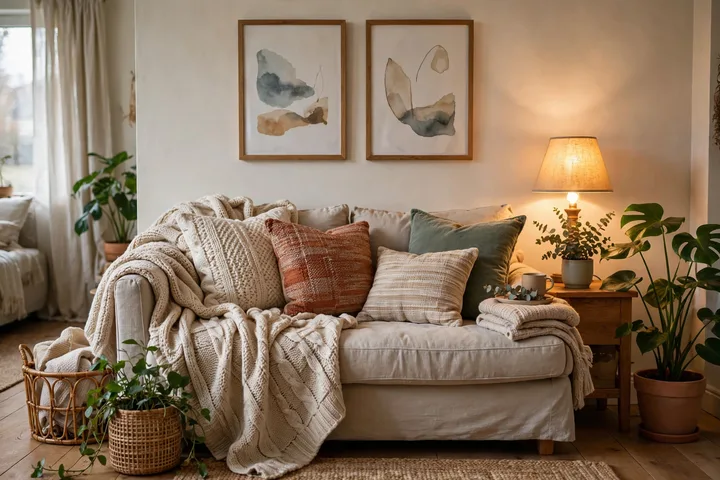
Rule 1: Decide the feeling before buying anything. Calm and airy? Warm and collected? Crisp and modern? Every purchase should serve the feeling you named. Without it, you will accumulate nice individual things that refuse to look good together.
Rule 2: Finish one room at a time. A fully decorated living room plus an untouched bedroom beats five half-decorated rooms. Completions build momentum — and give you one space that already feels like home while the rest catches up.
Rule 3: Live with it before finalizing. Paint swatches look different at 8am and 8pm. A rug needs a week of real life before you know if the color works. The best-decorated homes are edited over time, not furnished in a weekend. If you are starting with tight quarters, our small living room ideas guide pairs perfectly with the principles below.
“Decorating is editing. The eye needs somewhere to rest — and it cannot rest in a room where everything is shouting.”
Color: Ideas 1–4
The first four home decor ideas build a color foundation for the whole home.
1. Build a 3-color palette for the whole home
Choose one dominant neutral (warm white, greige, soft gray), one secondary color that appears in larger textiles and art, and one accent for pillows, throws, and small objects. Carry all three through every room in different proportions. This single decision does more for cohesion than any individual purchase — it is why designer homes look unified even with eclectic furniture. Of all home decor ideas, committing to a palette matters most.
2. Use the 60-30-10 rule in each room
Within the palette: about 60% of the room in the dominant color (walls, large furniture, rug), 30% in the secondary (curtains, accent chair, bedding), 10% in the accent (pillows, art, objects). It is a guideline, not a law — but when a room feels “off,” it is usually because the ratios drifted: too many competing accents, or no accent at all.
3. Test paint in the actual room, at actual times
Paint chips lie. Colors shift dramatically between morning and evening light, and between north-facing and south-facing rooms. Paint large test swatches (or use peel-and-stick samples) on at least two walls and live with them for 48 hours before committing. The right white for a sunny living room can look dingy in a dark hallway — test where it will live.
4. Repeat colors to connect rooms
Cohesion comes from repetition. The terracotta in the living room pillows reappears in the bedroom throw; the bedroom’s deep green shows up in the kitchen’s potted herbs. You do not need matching sets — you need echoes. Three to five repetitions of each palette color across the home is what makes it feel designed rather than assembled.
Textiles and Softness: Ideas 5–8
Home decor ideas 5 through 8 layer textiles for softness and warmth.
5. Layer rugs for warmth and zone-defining
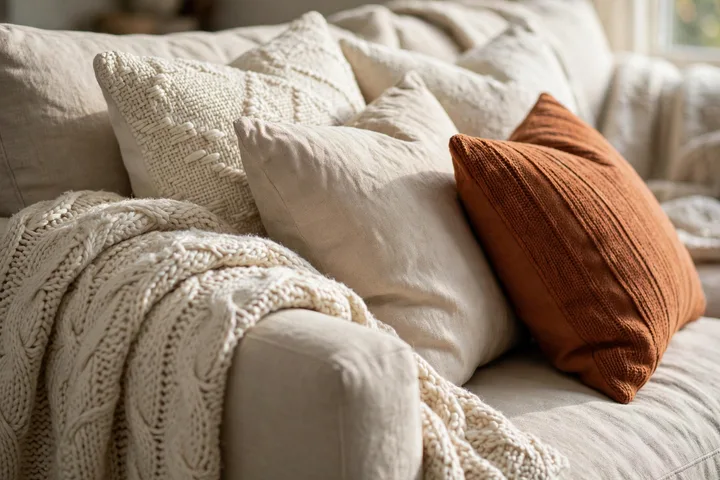
A rug does three jobs: warmth underfoot, noise softening, and visual zoning. In living areas, size up — front legs of all seating on the rug is the rule. Layering a smaller patterned rug over a large natural-fiber base (jute or sisal) adds pattern without the price of a big patterned rug, and the texture combination looks effortlessly collected.
6. Follow a pillow formula, then break it once
The reliable formula: two larger solid pillows in your secondary color, two medium pillows with pattern, one small lumbar in the accent. Odd numbers look natural; varying the sizes and textures (linen, velvet, knit) keeps it from looking like a set. Then break the formula once — one unexpected pillow — so it looks personal instead of staged.
7. Hang curtains that actually fit
Curtains hung at the trim line with panels that barely meet in the middle make windows look small and sad. Mount the rod near the ceiling, extend it well past the frame, and use panels wide enough to look full when closed (roughly twice the window width in fabric). Floor-length, just kissing the floor. This one change makes almost every room look taller and more finished.
8. Drape throws like you live there
A throw folded neatly over a sofa arm or casually across the foot of the bed adds the lived-in layer that makes rooms feel welcoming rather than showroom-stiff. Choose washable, touchable fabrics — chunky knits, washed linen, soft cotton — in your palette. One per seating area is enough; throws multiply on their own if you let them.
“Texture is the difference between a room that photographs well and a room you never want to leave.”
Walls: Ideas 9–12
The next set of home decor ideas transforms blank walls.
9. Go big with one piece of art
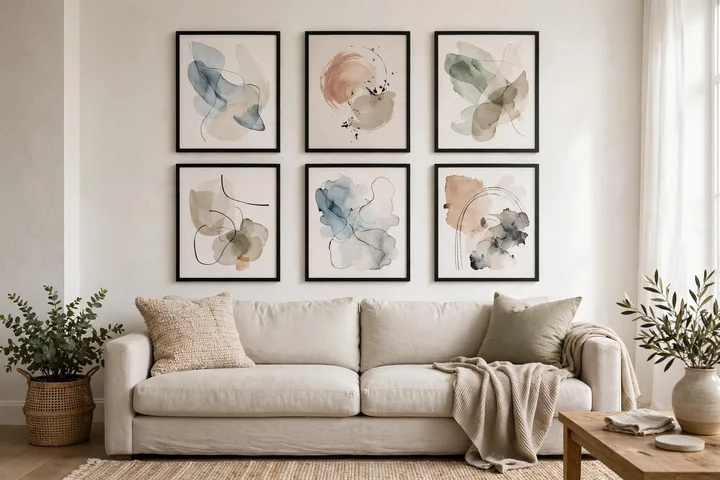
One oversized piece of art anchors a wall with confidence and gives the eye a single place to land. It can be an affordable large-scale print in a simple frame — scale matters more than price. Hang it so the center sits around 57–60 inches off the floor (gallery height), which feels right in almost every room.
10. Build a gallery wall with discipline
Gallery walls work when they are curated, not accumulated. Use consistent frames (or a deliberate mix of two), keep 2–3 inches between pieces, and lay the arrangement on the floor first. Include variety — art, a mirror, one sculptural object — but keep the palette tight. One gallery wall per home is usually enough; more than that and the walls start competing with each other.
11. Use mirrors as decor, not just tools
A beautiful mirror is wall art that also bounces light. Round mirrors soften rooms full of rectangles; an arched mirror adds architectural interest to flat walls; a leaning floor mirror makes bedrooms feel grander. Place them where they reflect something worth doubling — a window, a plant, a pretty corner — not the cluttered side of the room.
12. Style shelves with the two-thirds rule
Styled shelves look best about two-thirds full: books (some vertical, some stacked horizontally), a plant or vase, one meaningful object per shelf, and breathing room between groups. Corral small items on trays so they read as one composed object instead of scattered clutter. Step back and squint — if any shelf looks busy at a squint, remove one thing.
Life and Light: Ideas 13–16
Home decor ideas 13 through 16 bring life and light into every room.
13. Add plants — real ones if you can
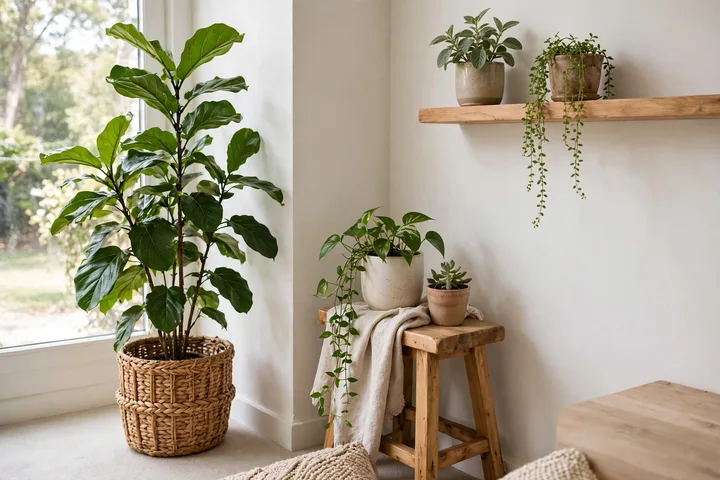
Nothing makes a room feel alive like greenery, and plants are nearly the only decor that improves air, mood, and aesthetics at once. Use the three-height trick: tall floor plant, medium table plant, small trailing plant. If your thumb is not green, start with the unkillable — pothos, snake plant, ZZ — in beautiful pots. The pot matters as much as the plant; coordinated planters in your palette tie them into the decor.
14. Layer the lighting in every room
Overhead light alone flatters no one and nothing. Every room wants three layers: ambient (ceiling or general), task (reading lamp, desk light, vanity light), and accent (picture light, shelf glow, candles). Warm bulbs around 2700K keep living spaces cozy. Put the main lights on dimmers — the ability to lower the lights is what turns a lit room into an atmosphere.
15. Finish with scent and candlelight
Decor is not only visual. A signature scent — a candle, a diffuser, fresh eucalyptus in the shower — makes a home feel cared for in a way guests notice immediately and remember. Keep it subtle and consistent rather than a different fragrance in every room. And never leave candles burning unattended; the ambiance is not worth the risk.
16. Keep fresh flowers (or branches) somewhere visible
A $5 grocery bunch in the entryway or on the dining table, refreshed weekly, is the highest-joy-per-dollar decor there is. In lean weeks, branches from the yard — eucalyptus, cherry blossom, even interesting bare branches — look sculptural and cost nothing. The habit matters more than the stems: living things, tended regularly, are what make a house feel like a home.
Finishing Touches: Ideas 17–18
The final home decor ideas are finishing touches with outsized impact.
17. Curate your collections — display less, rotate more
Collections (books, ceramics, travel finds, family photos) make a home personal, but everything-on-display reads as clutter. Choose the best pieces for now, store the rest, and rotate seasonally — the stored pieces feel new again when they return, and your shelves stay breathable. One shelf of beloved objects beats three shelves of everything you own.
18. Anchor it all — safety is part of good decor
Beautiful rooms should also be safe rooms. Bookcases, dressers, TV stands, and wall-mounted TVs should be anchored to the wall with anti-tip hardware — especially in homes with children or in earthquake-prone areas. The U.S. Consumer Product Safety Commission’s Anchor It! campaign walks through exactly how to secure furniture and TVs: use sturdy furniture, anchor TVs that are not wall-mounted, mount flat-screens, and install the anti-tip devices that come with new dressers. It is a twenty-minute job that prevents the unthinkable — and it is the finishing touch every decorated room deserves.
When decor projects grow into bigger changes, our home improvement ideas guide covers the structural side — and our kitchen remodel ideas guide takes the same thoughtful approach to the hardest-working room in the house.
Home Decor Mistakes to Avoid
Even the best home decor ideas won’t save a room that makes these mistakes:
- Buying everything at once. Rooms decorated in a single shopping trip look like showrooms. Buy the big pieces, then let the details accumulate.
- Ignoring scale. Tiny art on a big wall, a postage-stamp rug under a sectional — measure the wall and the furniture before buying.
- Too many small decor items. Ten tiny objects create visual noise; three substantial ones create style. When in doubt, go bigger and fewer.
- Matchy-matchy sets. The furniture set bought as a package looks flat. Mix pieces within your palette for a collected, personal feel.
- Forgetting the entryway. It is the first and last thing you see daily. A mirror, a hook, a small rug — ten minutes of attention pays off every single day.
- All overhead lighting. Covered above — layer it, dim it, warm it.
Frequently Asked Questions
How can I decorate my home on a tight budget?
Start free: declutter, rearrange furniture, and deep clean. Then paint (the highest-impact cheap change), update textiles (pillows, throws, curtains), thrift frames and vases, and add plants. Under a few hundred dollars, thoughtfully spent, transforms most rooms — proof that the best home decor ideas are often free.
How do I mix decorating styles without it looking messy?
Keep the color palette tight and repeat finishes. A mid-century chair, a rustic wood table, and modern art coexist happily when they share colors and the room is not overcrowded. The palette is the glue; style-mixing without it falls apart.
What is the 60-30-10 rule in decorating?
A classic proportion guide: roughly 60% of a room in the dominant color, 30% in a secondary color, 10% in an accent. It keeps rooms balanced — enough unity to feel calm, enough contrast to feel interesting.
How do I decorate a rental without losing my deposit?
Lean on the removable: peel-and-stick wallpaper on one wall, large art leaned rather than hung, rugs, textiles, plants, and freestanding shelves. Command strips and careful patching handle the rest. Color and texture do not require a drill.
How often should I refresh my home decor?
There is no schedule — refresh when a room stops feeling good. Seasonal textile swaps (heavier throws in winter, lighter linens in summer) and rotating art and objects keep things fresh without buying anything new.
Where should I start decorating if everything needs work?
The room you spend the most waking hours in — usually the living room or bedroom. Finish it completely before moving on. One done room sustains you through the rest of the project list.
Conclusion
Beautiful homes are not bought; they are edited. Pick your palette, layer textiles and light, bring in living things, display only what you love, and anchor it all safely. Work through these 18 home decor ideas at whatever pace your budget allows — even a handful will make your home feel more beautiful, more personal, and unmistakably yours.
Leave a Reply