
The best small living room ideas come down to three things: right-size furniture, layered lighting, and hidden storage. Below are 20 practical ideas — from layout tricks to budget decor — that make a tiny living room feel bigger, brighter, and more comfortable.
A small living room is not a design problem to solve. It is a constraint that forces better decisions. Every inch has to earn its place, which means small rooms often end up more intentional — and more inviting — than sprawling ones. Whether you are working with a compact apartment living room, a narrow family room, or a studio corner that has to do it all, these small living room ideas will help you get more comfort, more storage, and more style out of the square footage you have.
These 20 small living room ideas are organized by impact: start with layout and furniture, then color and light, storage, and finishing touches.
Key Facts
- Measure first: map your room and door swings before buying anything — most small-room regret comes from furniture that is one size too big.
- Light colors recede: pale walls, ceilings, and large textiles make boundaries feel farther away.
- Mirrors double light: one large mirror opposite or beside a window is the cheapest square-footage illusion there is.
- Legs create air: sofas and chairs with visible legs let the eye travel underneath, so the floor reads as continuous.
- Every piece should do two jobs: in a small room, single-purpose furniture is a luxury you cannot afford.
Start With the Layout: Measure First, Buy Second
This measure-first approach makes every small living room idea below work harder.
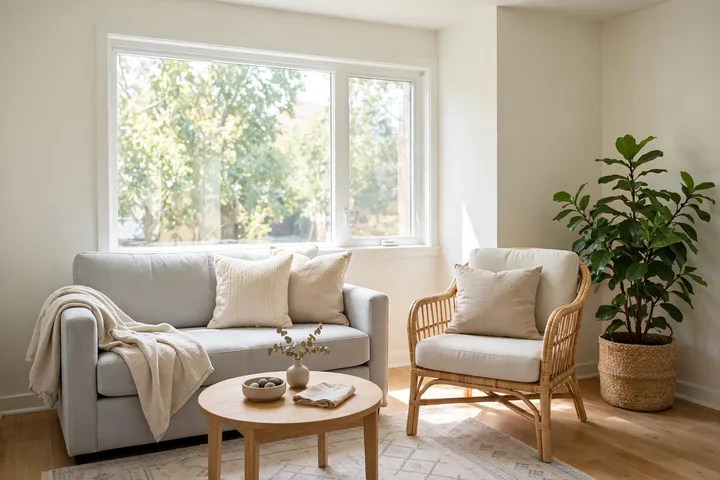
Before a single idea below matters, do the unglamorous work: measure. Measure the room’s length and width, the height of the windows, the swing of every door, and the exact footprint of the furniture you already own. Sketch it on paper or use a free room-planner app. This ten-minute job prevents the most common small-room mistake — falling in love with a sofa that technically fits through the door but swallows the room once it is inside.
Then pick a focal point. Every living room needs one spot the eye lands on: a window with a view, a fireplace, a media console, or a great piece of art. Arrange seating to face it, keep walkways at least 30 inches wide, and resist the urge to line every wall with furniture. A little breathing room around pieces paradoxically makes the room feel larger than cramming it edge to edge.
“In a small room, negative space is not wasted space — it is the thing that makes everything else look intentional.”
Layout and Furniture: Ideas 1–5
The first five small living room ideas tackle layout and furniture — the foundation everything else builds on.
1. Choose a sofa that fits the room, not the showroom
Showroom sofas are scaled to warehouses, not to your 12-by-14-foot room. For small living rooms, look for sofas in the 72- to 84-inch range with a shallower seat depth (around 36–38 inches instead of 40+). A loveseat paired with an accent chair often seats just as many people as an oversized sectional while leaving circulation space intact. Sit-test for comfort, but buy for the floor plan you actually have. Of all the small living room ideas here, right-sizing the sofa matters most.
2. Float furniture instead of pushing everything against the walls
It feels counterintuitive, but pulling the sofa even six inches off the wall creates a shadow line that adds depth. In very small rooms, one floated piece — a reading chair angled into a corner, or a loveseat defining the edge of a rug — breaks up the “waiting room” effect of perimeter furniture and makes the layout feel designed rather than defaulted. It’s one of the simplest small living room ideas to try this weekend.
3. Try an armless or low-arm sofa
Arms eat visual width. An armless loveseat or a sofa with low, slim arms can save 6–10 inches of perceived bulk on each side, which matters enormously in a tight room. Bonus: armless pieces are easier to move, rearrange, and squeeze through narrow apartment doorways.
4. Make every big piece do two jobs
In a small living room, single-purpose furniture is a luxury. A storage ottoman holds blankets and doubles as a coffee table or extra seat. A sleeper sofa or daybed handles overnight guests without a guest room. A drop-leaf console works as a desk by day and a serving table when friends come over. When you shop, ask of every candidate: what is its second job?
5. Define the zone with an area rug
A rug that is too small chops the room into fragments; a rug large enough to sit the front legs of all seating on unifies it. In open-plan studios, the rug is what tells the eye “this is the living room” versus the dining corner or workspace. Choose a low-pile, light-toned rug — easier to clean, and it keeps the floor plane calm and continuous.
Color, Light, and Walls: Ideas 6–10
The next group of small living room ideas uses color, light, and walls to change how large the room feels.
6. Go light and bright on the big surfaces
You do not have to paint everything white, but pale walls, a light ceiling, and light-toned large textiles push the boundaries of the room outward. Soft warm whites, pale greige, and muted pastels reflect more light than saturated colors. If you crave drama, put the deep color on one accent — a single navy armchair, an emerald throw — against the light backdrop. Contrast in small doses adds depth without closing the room in.
7. Hang one large mirror to double your light
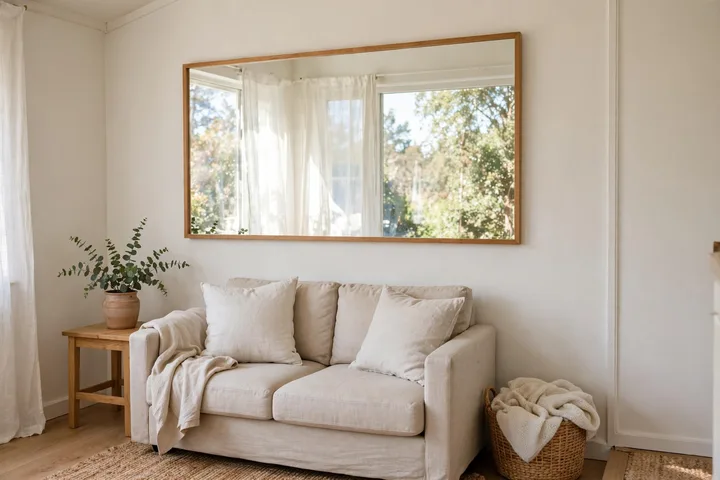
A large mirror opposite or adjacent to a window bounces daylight deep into the room and visually doubles the space. One big mirror outperforms a gallery of small ones — multiple small mirrors chop the reflection into fragments and can feel busy. Lean a full-length mirror against the wall if you rent and cannot drill, or hang one substantial piece where it catches the brightest window.
8. Layer three kinds of lighting
A single overhead light flattens a small room and casts harsh shadows. Aim for three layers: ambient (a ceiling fixture or floor lamp washing the room), task (a reading lamp by the chair, a lamp near the sofa end), and accent (a small picture light, LED strip behind a shelf, or a candle-style lamp in a dark corner). Warm bulbs around 2700K keep the room cozy; cooler light can feel clinical. And when you upgrade bulbs or fixtures, look for the ENERGY STAR label — ENERGY STAR certified lighting and appliances cut energy use while delivering the quality and brightness you expect, which matters when lamps run for hours every evening.
9. Build upward with tall, narrow storage
Floor space is fixed; wall space is not. A tall, narrow bookcase draws the eye up and makes ceilings feel higher while occupying barely two square feet of floor. Floating shelves above a desk or beside a window turn dead wall into display and storage. Keep the top shelves styled and the everyday items at arm’s reach — vertical storage only works if you can actually use it.
10. Hang curtains high and wide — and keep them simple
Mount the curtain rod close to the ceiling and extend it 6–12 inches beyond the window frame on each side. Floor-length panels in a fabric close to the wall color make windows look larger and ceilings taller. Heavy patterns and fussy valances visually chop the wall; simple, light-filtering panels keep the sightline clean. If privacy allows, sheers alone maximize daylight, which is a small room’s best friend.
“Light is the cheapest square footage you can buy. A well-lit 150-square-foot room feels bigger than a dim 250-square-foot one.”
Storage That Disappears: Ideas 11–15
Small living room ideas 11 through 15 focus on storage that disappears into the design.
11. Hide clutter in plain sight
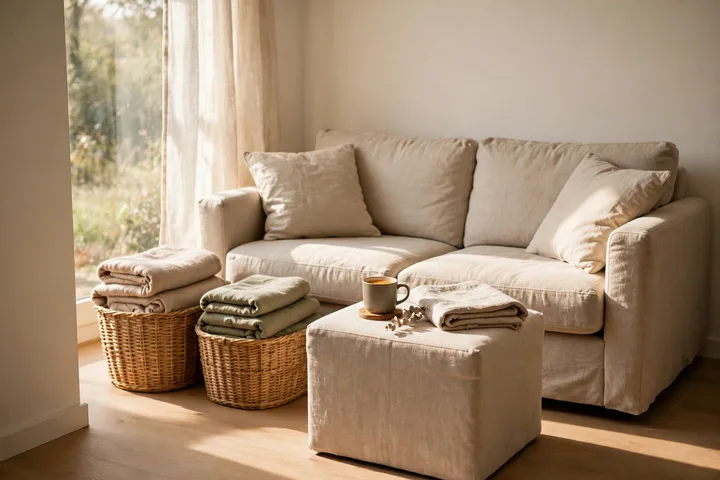
Visual clutter shrinks a room faster than any furniture choice. The fix is not minimalism as a lifestyle — it is closed storage. A storage ottoman swallows throws and remotes. A lidded basket beside the sofa corrals magazines and chargers. A media console with doors hides the tangle of devices. Aim for the “hotel lobby” test: surfaces mostly clear, everything else behind a door, drawer, or lid.
12. Mount the TV on the wall
A TV on a bulky console consumes a full piece of furniture’s worth of floor and visual space. Wall-mounting frees the surface below for a slim console, a bench with baskets, or nothing at all — glorious empty floor. If you rent, a floor-standing TV mount that leans against the wall achieves the same look with no drilling.
13. Corral the small stuff with baskets and boxes
Open shelving looks great in photos and chaotic in real life unless the small items are contained. Matching baskets, fabric bins, or lidded boxes turn a shelf of random objects into a calm, textured wall. Label them if it helps the household actually maintain the system — a basket labeled “chargers” gets used; an unlabeled one becomes a junk drawer.
14. Use the space behind and beside the sofa
The 8–10 inches behind a sofa is prime real estate in a small room. A slim console table there holds lamps, books, and a charging station without stealing floor space. Beside the sofa, a narrow side table or a C-shaped table that slides over the armrest gives you a landing spot for coffee without a bulky end table. These slivers of space are where small rooms win or lose. Small living room ideas like this one turn dead space into storage.
15. Edit ruthlessly — less stuff reads as more space
Every object in a small room is on stage. Do a hard edit: if it is not useful, beautiful, or genuinely loved, it is making your room feel smaller. This is not about stark minimalism — a collected, personal room can still breathe. It is about density. Fewer, better things with space around them will always look more expensive and more spacious than more things crowded together. For bigger whole-home refreshes on a budget, our home improvement ideas guide covers high-impact, low-cost projects room by room.
Decor and Finishing Touches: Ideas 16–20
The final set of small living room ideas covers decor and finishing touches.
16. Choose one large art piece over many small ones
A single oversized piece of art gives the eye one confident place to rest and makes the wall feel grander. A scatter of small frames, by contrast, can read as visual noise in tight quarters. If you love a gallery look, keep it to one wall, use consistent frames, and leave generous spacing — the wall showing between frames is part of the design.
17. Add plants at three heights
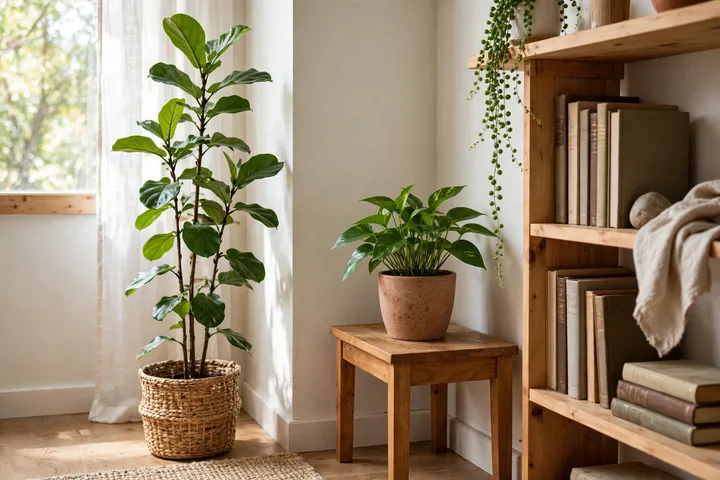
Greenery softens hard edges and adds life, and plants are one of the few decor items that improve a room without consuming visual weight. Use three heights: a tall floor plant in an empty corner, a medium plant on a shelf or side table, and a small trailing plant on top of a bookcase. Stick to low-maintenance varieties if you are not a plant person — a thriving pothos beats a dying fiddle-leaf fig every time.
18. Commit to a tight color palette
Pick three colors: a dominant neutral, a secondary tone, and one accent. Repeat them across the rug, pillows, art, and throws. A disciplined palette makes disparate pieces — the hand-me-down chair, the thrifted lamp, the new sofa — look like they were chosen together. In small rooms this cohesion matters double, because every item is visible at once. Our home decor ideas guide has more on building palettes that work across rooms.
19. Let furniture show its legs
Sofas, chairs, and consoles raised on legs reveal more floor, and visible floor equals perceived space. A low, blocky sectional sitting flush on the ground looks like a solid mass; the same footprint on six-inch legs looks airy. When shopping, flip the perspective: look at how much floor each piece reveals, not just how much it covers.
20. Finish with texture, not more stuff
Once the layout, light, and storage are right, resist adding more objects. Instead, add texture: a chunky knit throw, linen pillows, a jute rug layered over carpet, a woven basket. Texture adds richness and warmth without visual bulk — it is how small rooms feel finished and cozy rather than empty or crowded. One textured layer per seating area is plenty. It’s the gentlest of these small living room ideas — no tools required.
Small Living Room Mistakes to Avoid
Even the best small living room ideas won’t save a room that makes these common mistakes:
- Buying the sectional first. Sectionals can work in small rooms, but only the compact, low-profile kind — and only after measuring. Default to sofa-plus-chair until the tape measure says otherwise.
- One overhead light and nothing else. Flat, shadowy, and unflattering. Layer it.
- A tiny rug floating in the middle. If the rug does not reach the furniture, it shrinks the room. Size up.
- Pushing everything flat against the walls. A few inches of breathing room adds depth.
- Keeping every gift and gadget on display. Edit, contain, or relocate. Your room will thank you.
- Ignoring the ceiling. It is the fifth wall — a fresh coat of bright white paint there lifts the whole room.
If your ambitions extend beyond the living room — say, the kitchen is next on the list — our kitchen remodel ideas guide applies the same small-space thinking to the hardest-working room in the house.
Frequently Asked Questions
What is the best layout for a small living room?
Anchor seating around one focal point (window, fireplace, or media wall), keep walkways at least 30 inches wide, and float at least one piece slightly off the wall. Measure everything before buying — most small-room problems are really wrong-size-furniture problems.
What colors make a small living room look bigger?
Light, warm neutrals on walls and large textiles — soft whites, pale greige, light warm gray — reflect more light and push walls visually outward. Add depth with one or two darker accents rather than painting the whole room dark.
Should I use a sectional in a small living room?
Only a compact, low-profile sectional that you have measured against the room. In most small rooms, a right-size sofa plus an accent chair seats just as many people while preserving walkways and flexibility.
How do I add storage to a small living room without clutter?
Choose closed storage: ottomans with lids, consoles with doors, lidded baskets on shelves. Wall-mount the TV, build upward with tall narrow shelving, and use the inches behind the sofa for a slim console.
Do mirrors really make a room look bigger?
Yes — one large mirror near a window bounces light deep into the room and visually doubles the space it reflects. One big mirror works better than several small ones, which can look busy.
What is the cheapest way to improve a small living room?
Declutter, rearrange what you own, and improve the lighting — all free. Then paint (one gallon covers a small room’s accent needs), add a right-size rug, and hang curtains high and wide. Under a few hundred dollars total transforms most small rooms — proof that the best small living room ideas are often free.
Conclusion
A small living room rewards intention. Measure before you buy, let light do the heavy lifting, give everything a hidden home, and finish with texture rather than stuff. Work through these 20 small living room ideas one at a time — even three or four of them will make your room feel noticeably bigger, brighter, and more like yours.
Leave a Reply