

The Kwanzaa principles are seven values, known together as the Nguzo Saba, and there is one for each day of the holiday. Kwanzaa runs from Saturday 26 December 2026 to Friday 1 January 2027, and each evening families light a candle on the kinara and focus on that day’s principle: Umoja (unity), Kujichagulia (self-determination), Ujima (collective work and responsibility), Ujamaa (cooperative economics), Nia (purpose), Kuumba (creativity) and Imani (faith). Together, they turn the week between Christmas and New Year into a daily practice of reflection, family conversation and community commitment.
If you are new to the holiday, our guide to what Kwanzaa is and how it began covers the history first; this article goes deeper on the seven principles themselves — what each one means, which day it belongs to, and how families actually talk about it around the table.
Key Facts
- The Kwanzaa principles are called the Nguzo Saba, which is Swahili for “the seven principles”.
- Day 1, 26 December: Umoja (unity). Day 2: Kujichagulia (self-determination). Day 3: Ujima (collective work and responsibility).
- Day 4: Ujamaa (cooperative economics). Day 5: Nia (purpose). Day 6: Kuumba (creativity). Day 7, 1 January: Imani (faith).
- Each principle is paired with one candle on the kinara, lit in a set order across the week.
- The principles were created by Dr Maulana Karenga in 1966, drawn from African communal values.
- The principles are meant to be practised all year, not only during Kwanzaa week.
What Are the Nguzo Saba?
The Nguzo Saba are the value system at the heart of Kwanzaa. When Dr Maulana Karenga created the holiday in 1966, he wanted each day to carry a lesson families could discuss and live by. He drew the principles from African communal traditions, in which the wellbeing of the group and the individual are tied together, and gave each one a Swahili name so the holiday would connect its celebrants to African language and heritage.
The seven principles build on one another in a deliberate order. The week starts with unity inside the family and community, moves outward into work, economics and shared purpose, and ends with creativity and faith — a kind of ladder from “who we are together” to “what we believe we can become”. Each evening, after the candle is lit, families talk about the day’s principle in practical terms: what it means, where they fell short of it this year, and one concrete thing they will do differently in the year ahead.
The principles carry formal recognition in the United States: a tribute in the U.S. Congressional Record lists all seven principles and describes Kwanzaa as a celebration of family, community and culture.
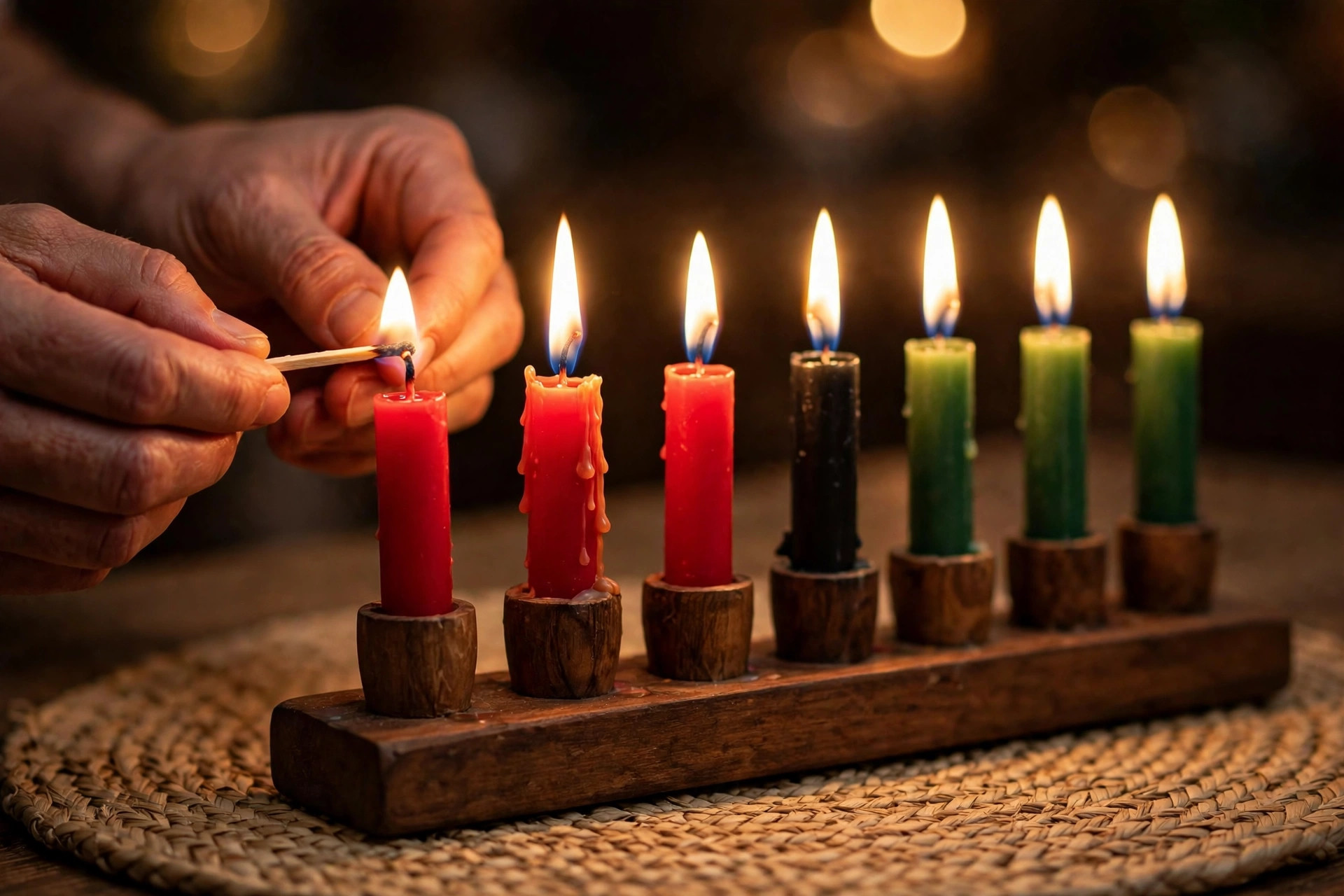
The Seven Kwanzaa Principles, Day by Day
Day 1 — Umoja (Unity)
Umoja means unity: striving to maintain togetherness in the family, the community, the nation and the wider world. It comes first because every other principle depends on it. On 26 December, families light the black centre candle of the kinara and talk about where their bonds are strong and where they need repair. A typical Umoja conversation might end with a small commitment — calling a relative more often, settling a disagreement, or showing up for a neighbour who needs help.
Day 2 — Kujichagulia (Self-Determination)
Kujichagulia, usually pronounced koo-jee-cha-goo-LEE-ah, means self-determination: defining ourselves, naming ourselves, creating for ourselves and speaking for ourselves. It is about cultural pride and personal agency. Families discuss the goals each person set for themselves this year, the stories they want told about their community, and the choices that are genuinely theirs to make. Children are often asked what they want to learn or become, and their answers are treated seriously.
Day 3 — Ujima (Collective Work and Responsibility)
Ujima means building and maintaining the community together, and treating a brother’s or sister’s problem as your own problem to solve together. This is the principle of shared effort: the food bank shift, the street clean-up, the homework help, the neighbour’s fence fixed by many hands. The first red candle is lit on this day, and many families choose one act of collective work to do during the week itself, not just talk about.
Day 4 — Ujamaa (Cooperative Economics)
Ujamaa means cooperative economics: building and maintaining our own shops, stores and businesses and profiting from them together. On this day families talk about money in a communal way — supporting Black-owned and local businesses, saving together, teaching children where money goes, and planning purchases so that spending strengthens the community rather than only leaving it. It is a practical, unglamorous principle, and deliberately so: values that never reach the wallet rarely change anything.
Day 5 — Nia (Purpose)
Nia means purpose: looking inside ourselves and setting goals that benefit the whole community, with the aim of building and developing that community and restoring it to its traditional greatness. Where Kujichagulia asks “who am I?”, Nia asks “what am I for?” Families use this evening to set collective goals for the coming year — a skill to learn, a project to finish, a young person to mentor — alongside personal resolutions.
Day 6 — Kuumba (Creativity)
Kuumba means creativity: doing as much as we can, in the way we can, to leave our community more beautiful and beneficial than we inherited it. It falls on 31 December, the night of the Karamu feast, and it is the most joyful of the principles. Families share music, poetry, dance, cooking and handmade gifts, and children are encouraged to perform or present something they made. Creativity here is not decoration; it is understood as a duty to improve what you pass on.
Day 7 — Imani (Faith)
Imani means faith: believing with all our hearts in our people, our parents, our teachers and our leaders, and in the righteousness of the struggle to build a better community. The final green candle is lit on 1 January, and the week closes with reflection, gratitude and the giving of zawadi (gifts), usually handmade or educational. Imani is not tied to any religion — Kwanzaa is a cultural holiday open to people of any faith or none — it is faith in the community and in the year ahead.
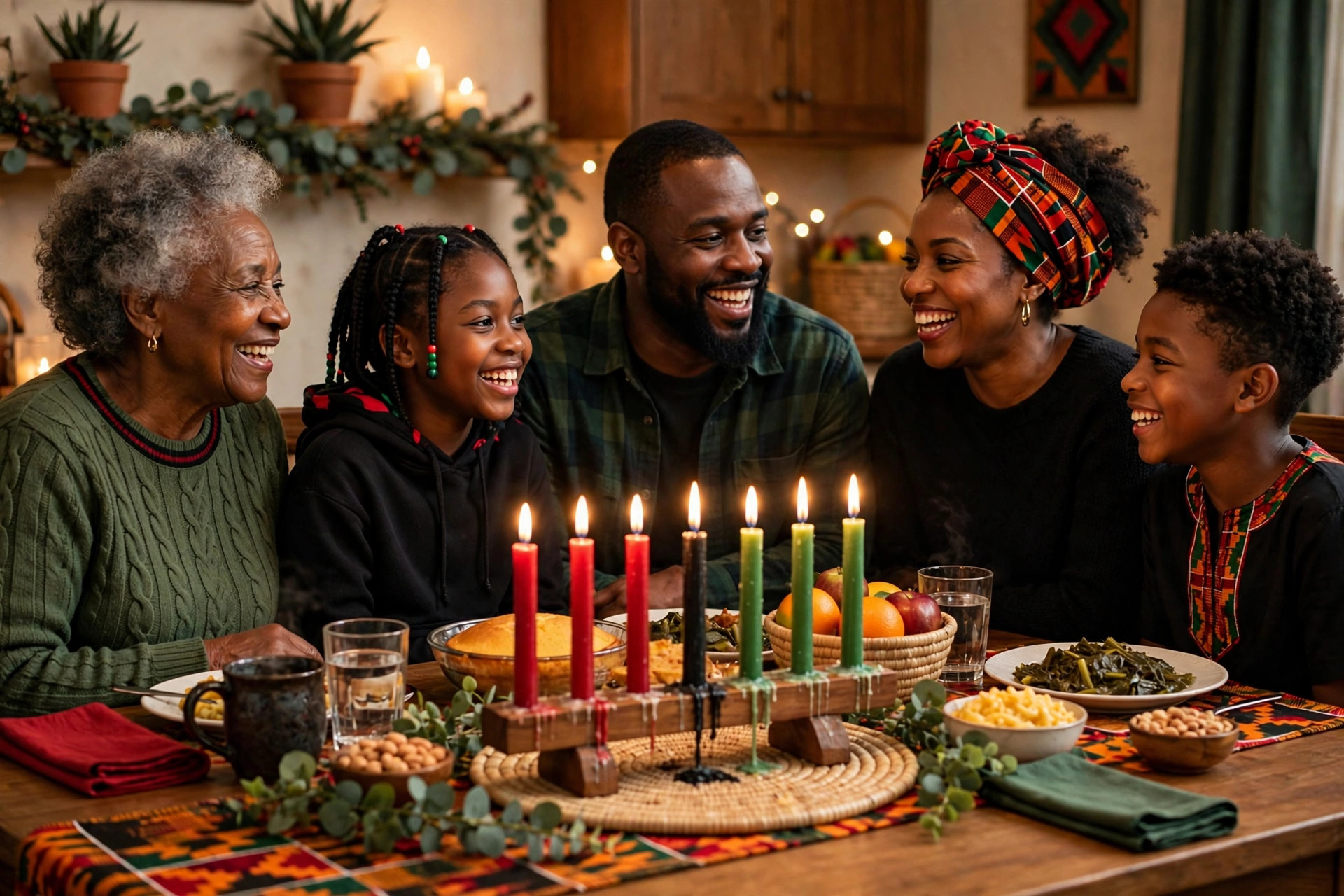
How Families Use the Principles All Year
The principles are designed to outlast the holiday. Many families keep the list on the kitchen wall, revisit one principle each month, or use them as prompts for family meetings and New Year goal-setting. Our overview of Kwanzaa traditions and celebrations shows how the principles weave through the feasts, greetings and gift-giving of the week. A simple way to start: each evening of Kwanzaa, ask one question per principle — Where did we show unity today? What did I define for myself? Whose problem did we help solve? — and let the answers, not lectures, do the teaching.
Frequently Asked Questions
What are the seven Kwanzaa principles in order?
Umoja (unity), Kujichagulia (self-determination), Ujima (collective work and responsibility), Ujamaa (cooperative economics), Nia (purpose), Kuumba (creativity) and Imani (faith), celebrated one per day from 26 December to 1 January.
What does Nguzo Saba mean?
Nguzo Saba is Swahili for “the seven principles”. Swahili was chosen because it is spoken across East Africa and does not belong to a single ethnic group, making it a unifying language for the holiday.
Which candle is lit for each principle?
The black centre candle is lit first, for Umoja. The three red candles to its left are then lit across the following days, followed by the three green candles on the right, ending with Imani on 1 January.
Who created the Kwanzaa principles?
Dr Maulana Karenga, an American academic and activist, created Kwanzaa and the Nguzo Saba in 1966, drawing on African harvest festivals and communal values.
Do you have to be religious to follow the Kwanzaa principles?
No. Kwanzaa is a cultural celebration, not a religious one. The final principle, Imani, means faith in family, community and shared purpose, and people of any faith — or none — can observe Kwanzaa alongside their own beliefs.
What is the traditional Kwanzaa greeting about the principles?
Each day, someone asks “Habari gani?”, Swahili for “What is the news?”, and the answer is that day’s principle — for example, “Umoja” on the first day. It is a simple way to teach children the order and names.
Leave a Reply