

Medium length hairstyles for thick hair work best when the cut removes bulk instead of fighting it: a layered lob, a textured shag, or a U-cut with long layers keeps the length you love while making thick hair lighter, faster to dry, and easier to style. Medium length — roughly collarbone to just past the shoulders — is the sweet spot for thick hair, because it is long enough to show off the volume and short enough that the weight does not pull the style flat. Below are the cuts that work, the techniques that thin without ruining the shape, and the styling habits that keep thick hair looking good between salon visits.

Key Facts
- Best length: collarbone to just past the shoulders — long enough for volume, short enough to stay manageable.
- The key technique: internal layers and point cutting remove weight from the inside, so the outside keeps its shape.
- Best cuts: layered lob, textured shag, U-cut with long layers, and curtain bangs paired with layers.
- Drying time: a good cut can cut blow-dry time by a third, because there is simply less hair to dry.
- Maintenance: a trim every 8–10 weeks keeps layers from growing heavy and shapeless.
Quotable: “Thick hair does not need to be tamed — it needs a cut that lets the weight out and the shape in.”
Why Medium Length Suits Thick Hair
Thick hair has a problem that thin hair never faces: there is too much of it. Long thick hair pulls itself flat at the roots, takes forever to dry, and turns into a triangle when it grows past the shoulders — wide at the bottom, flat on top. Short hair solves the weight problem but removes the styling options and the volume that makes thick hair beautiful in the first place.
Medium length solves both problems at once. At collarbone length, the hair is heavy enough to fall smoothly and light enough to hold a bend, a wave, or a bit of lift at the crown. The ends sit where a good cut can shape them, and the top still has enough length to layer without going short. Most stylists will tell you the same thing: if you have thick hair and you are not sure what to do with it, medium length with layers is the safest, most flattering starting point — and it is also the easiest length to grow out if you change your mind later.
The other advantage is practical. Medium length thick hair dries faster than long thick hair, uses less product, and holds a style longer because the hair is not pulling itself down. A round-brush blowout that collapses in an hour on long thick hair can last all day at medium length. That is not a small thing when you are the one doing the drying every morning.

The Best Medium Length Hairstyles for Thick Hair
1. The Layered Lob
The layered lob — a long bob that ends at or just below the collarbone — is the single most reliable of all medium length hairstyles for thick hair. The lob’s clean line gives the hair a shape, and the layers inside take the weight out so it does not puff into a bell. Ask for long layers that start at the cheekbones and get longer toward the ends, with point cutting through the bottom two inches so the ends move instead of sitting like a shelf.
The layered lob works straight, wavy, or curly, which is part of why it is so popular. Worn straight, it looks polished and expensive. Worn wavy, the layers show up as movement instead of bulk. It also grows out gracefully: because the layers are long, you can go two or three months between trims without the shape falling apart, and when you do go back, the stylist is just refreshing the ends rather than rebuilding the cut.
2. The Textured Shag
The shag is the boldest choice on this list, and it is also the one that removes the most bulk. A textured shag uses short layers through the crown and longer layers around the face, with a lot of texturizing through the mid-lengths. The result is a cut that looks deliberately undone — piecey, airy, full of movement — and that dries with almost no effort. If you like the lived-in look and you hate spending twenty minutes with a dryer, the shag is your cut.
The shag suits thick hair better than it suits fine hair, because thick hair has the density to support the choppy layers without looking thin. On fine hair, a shag can look stringy. On thick hair, it looks full and intentional. Pair it with curtain bangs and the whole cut frames the face while the layers do the heavy lifting underneath. One caution: a shag is a commitment to texture. If you prefer a sleek, straight finish, the shag will fight you — choose the lob instead.
3. The U-Cut with Long Layers
The U-cut is the quiet classic. Seen from behind, the hair forms a soft U shape — shorter at the sides, longest in the middle — instead of a straight line. For thick hair, that shape matters, because it removes the heavy corners that make a blunt cut look like a curtain. Add long layers through the last few inches and the ends taper naturally, so the hair moves when you do.
The U-cut is the best choice if you want to keep as much length as possible while still getting rid of bulk. It is also the easiest cut to maintain at home: the shape is forgiving, it works with air drying, and it looks good pulled back into a low ponytail or a clip, which is how most people with thick hair actually wear it on busy days. If your hair is very thick and very straight, ask the stylist to add a few internal layers as well, so the under-section does not push the top section out.
4. Curtain Bangs with Layers
Curtain bangs are a small change with a big payoff for thick hair. Because they are parted in the middle and blended into the layers at the sides, they break up the solid wall of hair around the face without committing you to a full fringe. They work best when they are cut long — cheekbone length or longer — so they blend into the layers instead of sitting apart from them.
Curtain bangs do two useful things for thick hair. First, they give the front of the hair a shape, which matters because the front is what you see in the mirror. Second, they take weight out of the heaviest part of the cut, around the face, where thick hair tends to puff. Pair them with any of the cuts above and the whole style looks lighter and more deliberate. If you have never had bangs, curtain bangs are the lowest-risk way to try them, because they grow out into face-framing layers rather than an awkward in-between stage.
5. The Butterfly Cut
The butterfly cut is the layered cut that has been everywhere lately, and thick hair is where it works best. It combines short, face-framing layers on top with long layers underneath, so the hair looks like it has wings when it moves — hence the name. The short top layers give lift and movement, while the long bottom layers keep the length. For thick hair, the butterfly cut is essentially a layered cut with more drama, and it is a good choice if you want your hair to look styled even when you have done almost nothing to it.
The butterfly cut needs a stylist who understands layering on thick hair, because the short layers on top can puff if they are cut too bluntly. Ask for the layers to be point-cut and texturized, not cut straight across, and make sure the shortest layer is no shorter than chin length unless you want a lot of volume on top. Our full guide to the butterfly haircut covers the cut in detail, including who it suits and how to style it.
How Layers and Thinning Remove Bulk
Understanding what the stylist is doing helps you ask for the right thing. There are three main techniques, and most good cuts for thick hair use at least two of them.
Long layers are the foundation. The stylist cuts the hair at different lengths so the weight is distributed instead of sitting in one heavy block. Long layers — where the shortest layer is still fairly long — keep the shape soft and are the safest choice. Short layers remove more weight but add more volume on top, which is the opposite of what most people with thick hair want.
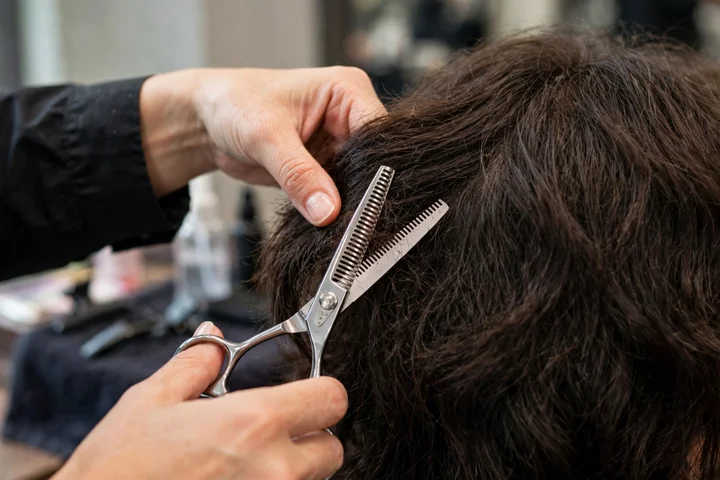
Point cutting is a finishing technique where the stylist snips into the ends of the hair with the tips of the scissors held vertically. This softens the ends so they do not sit in a hard line, and it removes a small amount of weight at exactly the place where thick hair tends to look heaviest. A cut that is point-cut at the ends looks natural and moves well; a cut that is blunt at the ends looks solid and heavy.
Thinning and texturizing use thinning shears or a razor to remove weight from the inside of the hair, underneath the top layer, so the outside keeps its length and shape. This is the technique that makes the biggest difference for very thick hair. The key is restraint: a good stylist removes weight in small amounts and checks the result as they go. Too much thinning makes the ends look wispy and the hair look frizzy, and it can take months to grow out. If a stylist reaches for the thinning shears in the first five minutes, that is a warning sign. The best thinning happens at the end, once the shape is already there.
One technique to be careful with is the razor. A razor can create beautiful texture on thick hair, but on the wrong hair type it causes frizz and split ends. If your hair is thick and coarse, a razor usually works well. If your hair is thick but fine-textured, or if it is prone to frizz, ask the stylist to stick to scissors.
Styling and Drying Tips for Thick Hair
A good cut does half the work. The other half is how you dry and style it, and thick hair rewards a few specific habits.
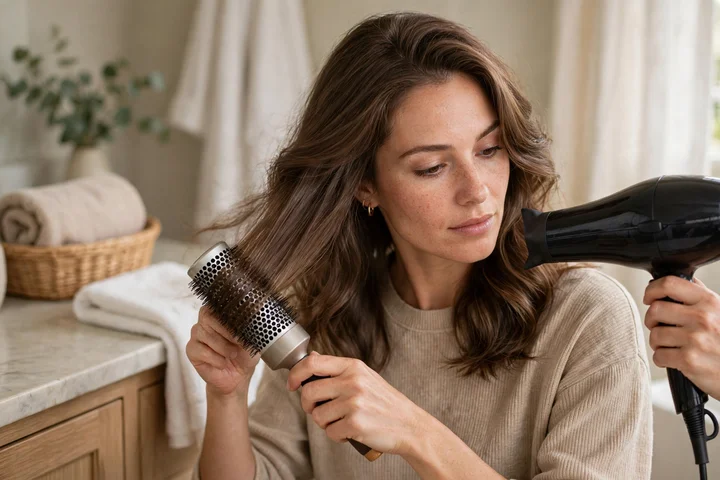
Dry in sections. This is the single most useful tip for thick hair. Clip the top layers up and dry the underneath first, working in sections about two inches wide. It takes the same total time as drying everything at once, but the result is smoother, because each section actually gets dry instead of the outside drying while the inside stays damp. Damp under-layers are the main reason thick hair goes frizzy an hour after styling.
Use a nozzle on the dryer. A concentrator nozzle focuses the airflow and smooths the cuticle as you dry. Without it, the air blows the hair in every direction and the finish looks rough. Keep the dryer pointing down the hair shaft, not up into it, and finish with a shot of cool air to set the style.
Less product, applied right. Thick hair does not need a lot of product — it needs the right product in the right place. A pea-sized amount of smoothing cream or leave-in conditioner through the mid-lengths and ends is enough. Putting product at the roots weighs the hair down and makes it look greasy by afternoon. For waves, a light mousse scrunched into damp hair gives hold without stiffness. Heavy oils and butters look good for about an hour and then turn thick hair lank, so use them sparingly and only on the very ends.
Air dry when you can. Medium length thick hair air-dries better than long thick hair, because there is less weight pulling the wave out. If your hair has any natural wave, scrunch in a little mousse, let it dry most of the way, and then finish the front pieces with a quick pass of a flat iron or a round brush. You will get most of the polished look with a fraction of the heat and time.
A round brush is your best tool. For a smooth blowout on medium length thick hair, a medium round brush — about two inches in diameter — gives enough tension to smooth the hair without creating too much curl. Work in sections, roll the brush through, and keep the dryer moving. The whole thing takes ten minutes once you have the rhythm, and the result lasts longer than a flat iron finish because the hair has been dried into its shape rather than pressed into it.

What to Ask Your Stylist
The consultation matters as much as the cut. Walk in knowing what to say, and you will walk out with the hair you actually wanted.
Start with the length: “collarbone length, no shorter.” Then the layers: “long layers starting at the cheekbones, with weight taken out underneath, not on top.” Then the finish: “point-cut ends so it moves, not a blunt line.” If you want bangs, say “curtain bangs, cheekbone length, blended into the layers.”
Bring a photo, but bring the right kind of photo: someone with your hair thickness and texture, not just a face you like. A layered lob on fine hair looks nothing like a layered lob on thick hair, and the stylist needs to see what the cut does on hair like yours. Two or three photos are better than one, because they show the range of what you would be happy with.
Tell the stylist how you actually style your hair. If you air dry every day, say so — the cut should be designed for air drying, not for a blowout you will never do. If you flat iron daily, say that too, because the stylist will cut the ends to sit well when straight. A cut designed for the wrong routine is the most common reason people hate a haircut they asked for.
Finally, ask how the cut will grow out. A good medium cut for thick hair should look decent for at least eight weeks. If the stylist says you will need a trim in four weeks to keep the shape, the layers are probably too short or too aggressive for your hair.
Maintenance: Keeping the Cut Looking Good
Medium length hairstyles for thick hair are not high maintenance, but they do have a rhythm. A trim every eight to ten weeks keeps the layers light and the ends healthy. Go longer than that and the layers grow into each other, the weight comes back, and the cut starts to look like one heavy block again. The trim itself is quick — mostly the ends and a light refresh of the layers — and it is what keeps the cut working between visits.
Between trims, the main job is keeping the ends healthy. Thick hair hides damage well, which means split ends can creep up the hair shaft unnoticed. A small amount of leave-in conditioner on the ends after every wash helps, and a weekly deep-conditioning mask keeps the hair supple. If you use heat tools, a heat protectant is not optional: thick hair takes more heat to style because there is more of it, and that heat adds up over time.
Wash frequency matters too. Thick hair usually does not need washing every day — every two or three days is typical — because the scalp’s natural oils take longer to travel down thick hair. Washing less often also means less heat styling, which means healthier ends. On non-wash days, a dry shampoo at the roots absorbs oil without disturbing the shape, and a quick refresh of the front pieces with a brush and dryer is usually all the style needs.
If your hair is color-treated as well as thick, the maintenance picture changes slightly. Color lifts the cuticle and can make thick hair feel rougher and look frizzier, so a color-safe shampoo and a regular mask matter more. Tell your stylist about the color when you discuss the cut, because the two services interact: heavily layered hair shows color dimension beautifully, but over-thinned hair can make color look patchy.

Mistakes to Avoid
Going too short in the layers. Short layers on thick hair create volume at the crown, which is the opposite of what most people want. If the shortest layer is above the cheekbones, the top of the hair will puff out. Keep layers long unless you specifically want volume on top.
Over-thinning. Thinning shears are a tool, not a solution. Too much thinning makes the ends see-through and the hair frizzy, and it grows out badly. If your hair feels wispy at the ends a week after a cut, it was over-thinned. The fix is time and trims, so prevention matters more than repair.
A blunt cut with no layers. A one-length cut on thick hair looks heavy and shapeless, and it is the fastest route to the triangle shape. Even a single long layer around the face makes a visible difference. If you love the blunt look, ask for invisible internal layers underneath so the shape stays clean while the weight comes out.
Cutting it wet and short. Hair shrinks as it dries, and thick hair shrinks more than most people expect. A cut that looks perfect wet can end up an inch shorter dry. Ask the stylist to check the length dry before finishing, especially around the face.
Ignoring your natural texture. A cut that fights your hair’s natural wave or curl will need daily heat to look right. Medium length hairstyles for thick hair work best when they are designed around the texture you actually have, not the texture you wish you had. If your hair is wavy, a cut that enhances the wave will look better with less effort than a cut designed for straight hair. Our guide to layered haircuts for women explains how layers work with different textures, and our bob haircuts for women guide covers the shorter end of the medium-length range if you are thinking of going shorter later.
Skipping the consultation. The five minutes before the scissors come out decide the result. If a stylist starts cutting without asking about your routine, your texture, and what you do not like about your current hair, stop them and have the conversation. It is your hair, and it grows slowly.

Frequently Asked Questions
What is the best medium length hairstyle for very thick hair?
A layered lob with long layers and point-cut ends is the safest choice. It removes bulk without losing length, works with straight, wavy, and curly texture, and grows out gracefully between trims.
How do I make thick hair less puffy at medium length?
Ask for internal layers and texturizing underneath the top layer, not on top. Dry the hair in sections with a nozzle, point the dryer downward, and use a small amount of smoothing cream on the mid-lengths and ends only.
Should thick hair be thinned?
Usually yes, but in moderation. Thinning shears remove weight from the inside so the outside keeps its shape. Too much thinning makes the ends wispy and frizzy, so a good stylist removes weight in small amounts and checks as they go.
How often should I trim medium length thick hair?
Every 8–10 weeks. Longer than that and the layers grow into each other, the weight comes back, and the cut loses its shape. The trim itself is quick — mostly the ends and a light layer refresh.
Does medium length hair take long to dry if it is thick?
Less time than long thick hair, but still longer than fine hair. Drying in sections with a concentrator nozzle is the fastest method, and a good layered cut can cut drying time by about a third because there is less hair to dry.
Can I get curtain bangs with thick hair?
Yes — they are one of the best additions for thick hair. Keep them long, at cheekbone length or longer, so they blend into the layers. They take weight out of the front of the cut and frame the face without the commitment of a full fringe.
What should I ask for at the salon if I have thick hair?
Say the length first (collarbone), then the layers (long, starting at the cheekbones, weight out underneath), then the finish (point-cut ends). Bring photos of people with your hair thickness, and tell the stylist how you actually style your hair day to day.
Is the butterfly cut good for thick hair?
Yes, it is one of the best choices for thick hair, because the short top layers give lift while the long bottom layers keep the length. Ask for the layers to be point-cut and texturized rather than cut straight across, so the top does not puff. The American Academy of Dermatology has general guidance on keeping hair healthy between cuts, which is worth reading if your hair is also color-treated or heat-styled often — see the American Academy of Dermatology for their hair care advice.
Leave a Reply