

New year traditions around the world range from jumping off chairs in Denmark to eating twelve grapes against the clock in Spain, hearing a temple bell ring 108 times in Japan, and dressing all in white on the beaches of Brazil. Every country rings in Friday 1 January 2027 differently, but the themes repeat everywhere: shake off the old year’s bad luck, welcome prosperity, and start fresh surrounded by the people you love. Some traditions are centuries old, some began as jokes that stuck, and all of them are worth knowing before the countdown begins on Thursday 31 December 2026.
If the festive customs of December fascinate you, our guide to Christmas traditions around the world makes the perfect companion read. Here are twelve New Year customs, country by country.
Key Facts
- Spain: eat 12 grapes, one with each midnight chime, for 12 lucky months.
- Denmark: stand on a chair and literally leap into the new year at midnight.
- Scotland: Hogmanay’s “first-footing” — the first visitor after midnight should be a dark-haired man carrying coal, bread and whisky.
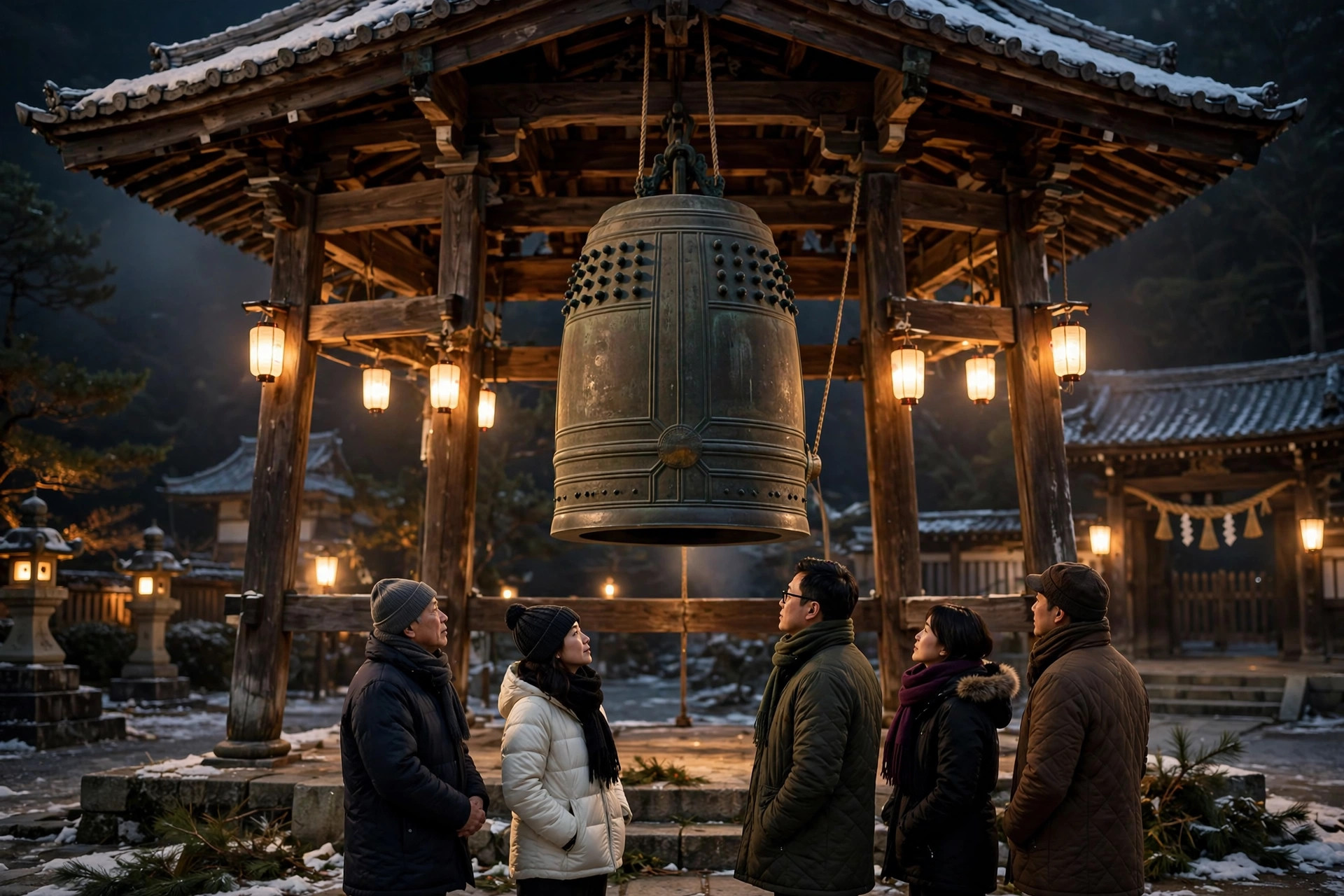
- Japan: temple bells ring 108 times (Joya no Kane) to cleanse the 108 earthly desires.
- Brazil: wear white and offer flowers to Yemanjá, goddess of the sea, at the beach.
- Philippines: display 12 round fruits at the midnight meal (media noche) for a year of abundance.
- Germany: Bleigießen — pour molten metal (today usually wax or tin) into water and read your fortune in the shape.
One thing every country shares is the wait for midnight — which arrives in waves across the world’s time zones; you can watch official U.S. time and UTC at time.gov, run by the National Institute of Standards and Technology and the U.S. Naval Observatory.
Spain: Twelve Grapes Against the Clock
Spain’s countdown is a race. When the clock at Madrid’s Puerta del Sol begins its twelve chimes, everyone eats one grape per chime — about one grape every three seconds. Finish all twelve in time and each month of 2027 is said to be lucky. The tradition, las doce uvas de la suerte, took hold in the early 1900s, and Spanish supermarkets now sell tins of exactly twelve small, seedless grapes for the occasion. It is impossible to do gracefully, which is precisely why families film each other attempting it every year.
Denmark: Leap Into the New Year
Danes welcome the year from a height: as midnight strikes, they climb onto chairs and sofas and jump into the new year together, a leap meant to carry them over bad luck and into good fortune. Earlier in the evening, some Danes smash old plates against the front doors of friends and family — the bigger the pile of broken crockery outside your door on 1 January, the more friends and luck you are said to have. Hosts planning their own countdown can borrow both ideas from our New Year’s Eve party ideas — although maybe skip the plates.
Scotland: Hogmanay and First-Footing
Scotland celebrates New Year — Hogmanay — bigger than Christmas, with street parties, fire festivals and singing of Auld Lang Syne, a Scots poem the whole world has adopted. The key custom is first-footing: the first person to cross your threshold after midnight sets the household’s luck for the year. Ideally the first-footer is a dark-haired man (a throwback to Viking times, when a blond stranger at the door meant trouble) carrying symbolic gifts: coal for warmth, bread or shortbread for food, salt, a coin for wealth, and whisky for good cheer. In exchange, the household offers food, drink and hospitality.
Japan: 108 Bells and Cleansing Noodles
In Japan, Buddhist temples ring their great bells 108 times in the ceremony called Joya no Kane, finishing just after midnight. In Buddhist belief, humans are held back by 108 earthly desires and passions; each ring of the bell drives one away, so the new year begins cleansed. Families watch the ringing at temples or on television, then eat toshikoshi soba — long buckwheat noodles that symbolise crossing over from the old year and cutting away its hardships. The first shrine visit of the year, hatsumode, follows over the next few days.
Brazil: White Clothes and Offerings to the Sea
Brazil’s Réveillon is one of the world’s great New Year parties, centred on beaches like Copacabana in Rio de Janeiro. The dress code is strict: white, for peace and renewal, sometimes with coloured underwear chosen for the year you want — yellow for money, red for love, green for health. At midnight, crowds wade into the sea and jump seven waves, making a wish on each, and offer white flowers and small gifts to Yemanjá, the Afro-Brazilian goddess of the ocean. If your offering floats out to sea, she has accepted it and the year will be blessed.

The Philippines: Twelve Round Fruits
Filipino families prepare the media noche, a midnight feast on New Year’s Eve, and its centrepiece is twelve round fruits — grapes, oranges, kiat-kiat mandarins, apples, plums and more — one for each month of the coming year. Roundness means coins, coins mean wealth, and a full circle of fruit promises a full year of it. Children jump at midnight in the hope of growing taller, windows and doors are thrown open to let luck in, and pockets and wallets are kept full of coins so the year starts with money in hand.
Germany: Reading Fortunes in Metal
Germany’s most distinctive custom is Bleigießen, “lead pouring”. A small piece of lead is melted over a candle and tipped into cold water, where it hardens instantly into a strange shape. Held up to a light, the shadow it casts is interpreted like a tea leaf reading: a ball means luck rolling your way, a star means happiness, a cross means hard times. Because lead is toxic, most kits today use tin or wax instead — the fortune-telling works exactly the same, and the shapes are just as debatable after a glass of Sekt. Dinner for One, a British comedy sketch from 1963, is also inexplicably shown on German television every single New Year’s Eve.
More Customs Worth Knowing
In Ecuador, families build scarecrow-like effigies of the old year — el Año Viejo — stuffed with paper and dressed in old clothes, and burn them at midnight to torch the year’s failures and make room for the new. In Colombia, hopeful travellers walk around the block carrying an empty suitcase at midnight to guarantee a year of travel. In Estonia, tradition once held that eating seven, nine or twelve meals on New Year’s Eve would give you the strength of that many men for the year. And in Greece, an onion is hung on the door as a symbol of rebirth, while parents wake children on New Year’s morning by gently tapping them on the head with it.
A World of Ways to Say Happy New Year
However you celebrate — leaping, eating, ringing, burning or simply toasting — the heart of every tradition is the same wish for the people beside you. If you want the words to go with the moment, our collection of New Year wishes for 2027 has messages for family, friends and colleagues in every tone from heartfelt to funny.
Frequently Asked Questions
What is the most unusual New Year tradition in the world?
Strong contenders include Denmark’s midnight leap off a chair, Germany’s fortune-telling with molten metal, and Ecuador’s burning of old-year effigies at midnight. Unusual is in the eye of the beholder — every country on this list finds the others’ customs stranger than its own.
Why do Spaniards eat 12 grapes at midnight?
Each grape matches one of the twelve chimes of the clock and represents one month of the coming year. Eating all twelve before the chimes end is said to guarantee twelve lucky months.
What is first-footing in Scotland?
First-footing is the Hogmanay custom that the first person to enter a home after midnight brings its luck for the year. The ideal first-footer is a dark-haired man carrying coal, bread, salt, a coin and whisky.
Why do Japanese temples ring bells 108 times?
The Joya no Kane ceremony rings the bell 108 times because Buddhist tradition counts 108 earthly desires that cloud the mind. Each strike symbolically removes one, so people enter the new year purified.
Why do Brazilians wear white on New Year’s Eve?
White symbolises peace, purity and a fresh start. Many Brazilians add coloured underwear chosen for their hopes — yellow for wealth, red for love — and offer white flowers to Yemanjá at the sea.
When is New Year’s Day 2027?
New Year’s Day is Friday 1 January 2027, and New Year’s Eve celebrations take place on Thursday 31 December 2026.
Leave a Reply