

Table of Contents
There is a moment on every Thanksgiving afternoon when the turkey is still in the oven, the guests have arrived, and everyone is standing in the kitchen with nothing to do. That is the moment a Thanksgiving charcuterie board earns its place. It is not a recipe, and it is not a course. It is a board of cheese, cured meat, crackers, and fall fruit that you set out an hour before dinner, and it keeps people happy, fed, and out of the cook’s way while the real meal finishes.
These Thanksgiving charcuterie board ideas are about building that board well: what to put on it, how much to buy, how to arrange it so it looks generous, and how to keep the crackers crisp until the moment guests arrive.
A charcuterie board is different from the appetizers you might serve alongside it. Appetizers are small dishes you cook; a board is food you arrange. There is no recipe to follow, no oven time, and no last-minute cooking. That is the whole point. If you want cooked starters as well, our Thanksgiving appetizers guide has fifteen of them, from baked brie to deviled eggs. But the board is the part of the spread that needs no cooking at all, and on a day when the oven is already working as hard as it can, that matters more than it sounds.
What Goes on a Thanksgiving Charcuterie Board: The 3-3-3 Formula
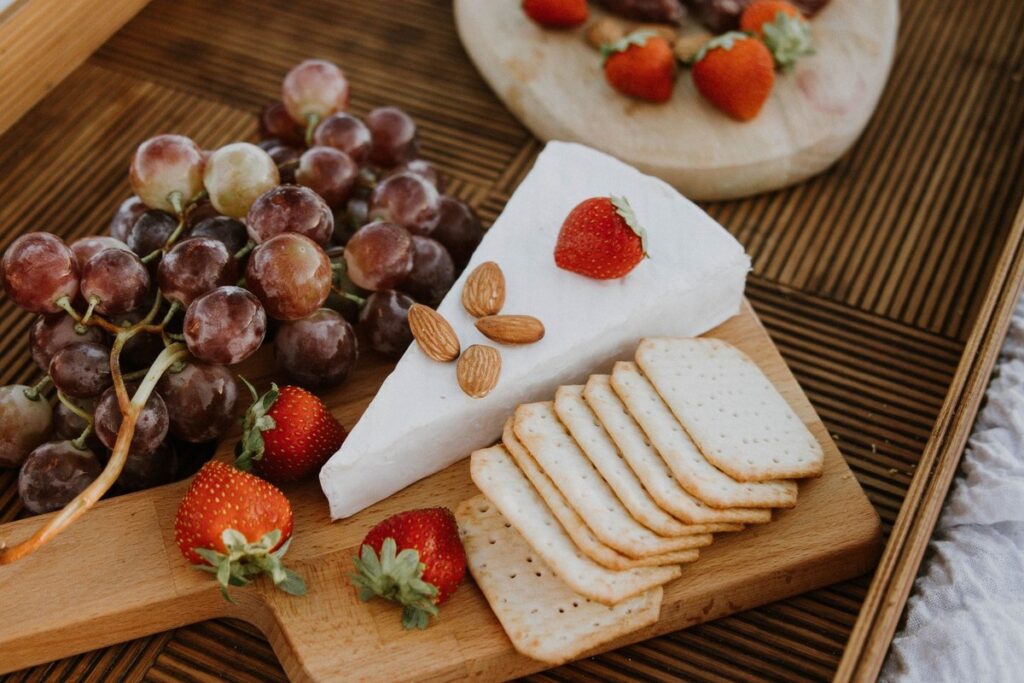
Every good board follows a simple formula: three cheeses, three meats, and then the things that fill the gaps. The cheeses should cover three textures. A soft cheese, such as brie or goat cheese, gives the board something spreadable. A semi-hard cheese, such as aged cheddar or gouda, gives it something sliceable. A hard cheese, such as parmesan or manchego, gives it something to nibble in chunks. Three cheeses is enough for a board of any size, and adding a fourth rarely makes it better. It just makes it more expensive.
The three meats follow the same logic. A folded salami, a draped prosciutto, and a sliced soppressata give you three flavors and three shapes, which is what makes a board look interesting rather than flat. If one of your guests does not eat pork, swap in a turkey salami or a beef jerky-style sliced meat. The point is variety in flavor and in shape, not a specific shopping list.
After the cheeses and meats, the board needs crackers, fall fruit, and something sweet and something briny. Crackers should be plain and sturdy: water crackers, thin wheat crackers, and sliced baguette cover most tastes. Fall fruit is where Thanksgiving shows up on the board: red grapes, sliced pears, apple slices with a squeeze of lemon to stop them browning, and dried cranberries scattered in the gaps. The sweet element can be honey, fig jam, or a small pot of apple butter. The briny element can be cornichons, olives, or pickled onions. Fill the remaining gaps with nuts, such as marcona almonds or candied pecans, and the board will look full even before anyone touches it.
One rule governs all of it: buy less than you think you need. A board is a pre-dinner nibble, not the meal. Guests will eat less from it than you expect, because they know turkey is coming. Overbuying is the most common mistake, and it is how you end up with a fridge full of half-eaten cheese on Friday. The portioning section below gives you exact numbers by guest count, so you can shop with confidence instead of guessing.
15 Thanksgiving Charcuterie Board Ideas
These fifteen boards are sorted by style and situation, not by recipe, because a board is a build, not a dish. Pick the one that matches your table, your guests, and your budget, and use the formula above to fill it. Each board below tells you what makes it different and how to put it together.
1. The Classic Harvest Board

This is the board most people picture: a large wooden board loaded with three cheeses, three meats, crackers, red grapes, sliced pears, dried cranberries, candied pecans, and a small pot of honey. Arrange the cheeses first, spaced apart in a triangle, then fold the meats into ribbons and rosettes between them. Fill the gaps with fruit and nuts last, and put the honey pot near the brie so people find the pairing naturally. It suits a table of eight to twelve and looks like autumn on a board.
2. The Big Crowd Board
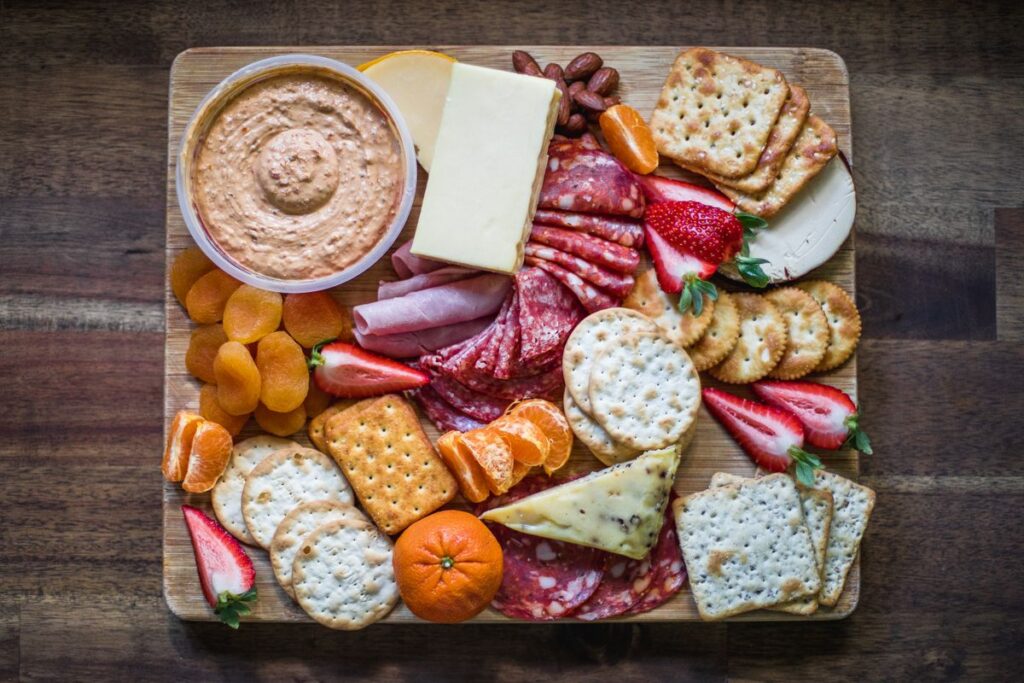
When you are feeding fourteen or more, one board is not enough. Use two boards, or cover a baking sheet with parchment and build directly on it. Double the cheese and meat, add a second cracker type, and put a bowl of spiced nuts at each end so guests are not all reaching for the same spot. The trick with a crowd board is repetition: put the popular items, brie and salami, in two places, not one, so the board does not develop a queue.
3. The Small-Space Board
A small table or a kitchen counter does not need a smaller board. It needs a smarter one. Use a single round board or a large dinner plate, choose two cheeses instead of three, one meat instead of three, and let the fruit do the work of filling space. Slice the cheese thin so it goes further, fan the crackers in a single arc, and pile the grapes high in the center. It feeds six comfortably and takes up no more room than a serving plate.
4. The Turkey-Shaped Board
Children remember this one. Build the board in the shape of a turkey: a round cheese ball or a wheel of brie forms the body, sliced meats fan out behind it like tail feathers, and rows of crackers, grapes, and cheese cubes make the feather layers. Use a small bowl of dip or a round of cheese for the head, with two olive slices for eyes and a sliver of red pepper for the wattle. It takes ten extra minutes to arrange, and it is the first thing children run to when they walk in.
5. The Kids’ Snack Board
Young children do not want brie and prosciutto. They want food they recognize, in pieces they can pick up. Build a small board just for them: mild cheddar cubes, turkey slices rolled into pinwheels, pretzels, goldfish crackers, apple slices, grapes cut in half, and a small bowl of ranch dip. Keep it on a low table or at their end of the room, away from the adult board, so they can graze without elbowing the grown-ups. It keeps them fed and busy while dinner finishes.
6. The Budget Board
A beautiful board does not need expensive cheese. Buy one good cheese, such as a sharp cheddar, and let the cheaper items do the filling: sliced deli turkey and ham instead of prosciutto, store-brand crackers, peanuts instead of marcona almonds, and apples and grapes for color. A jar of jam from the pantry and a handful of dried cranberries make it look generous. You can build a board for eight people for under twenty-five dollars, and nobody at the table will know the difference.
7. The Grocery-Store Shortcut Board
Some Thanksgivings leave no time to shop at three stores. This board comes from one supermarket trip: a pre-sliced cheese tray, a pack of salami, a box of crackers, a bag of grapes, and a baguette. Unwrap the tray, re-arrange the cheese on your own board, add the salami in folds, fan the crackers, and scatter the grapes. The rearrangement is the whole trick. It takes five minutes, and it turns a plastic tray into a board that looks like you built it from scratch.
8. The Vegan Board

A vegan board is not a board with the meat removed. It is a board built around foods that stand on their own: hummus and white bean dip in small bowls, roasted chickpeas, marinated olives, cornichons, sliced cucumber and bell pepper, apple and pear slices, dried apricots and figs, spiced nuts, and dairy-free cheese if you can find one you like. Add seeded crackers and a dark bread. It works as a full board for vegan guests and as a second board for a mixed table, where it quietly gets eaten by everyone.
9. The Gluten-Free Board
Gluten-free guests are often left staring at a board they cannot eat from, because the crackers are the problem, not the cheese. Build this board with gluten-free crackers kept in their own pile, rice crackers, corn tortilla chips, and plenty of naturally gluten-free fillers: fruit, nuts, olives, and sliced meats. Label the cracker pile with a small card, and keep a separate knife for the gluten-free cheese so crumbs from the regular crackers do not cross over. The rest of the board is the same as any other, which is exactly the point.
10. The Nut-Free Board
When a guest has a nut allergy, the nuts have to go entirely, not just to one corner. Replace them with seeds, which give the same crunch and the same job of filling gaps: roasted pumpkin seeds, sunflower seeds, and sesame crackers. Add extra fruit, such as dried cranberries and sliced figs, and a second cracker type to make up the volume. Wipe the board down before building, and check the cracker and cheese labels, because nuts hide in places you would not expect. Tell the allergic guest the board is safe for them. That sentence is worth more than any garnish.
11. The Sweet-and-Savory Board
Some guests head straight for the sweet things, and this board is built for them. Pair each savory item with a sweet one: salty prosciutto with fresh figs, sharp cheddar with apple butter, creamy brie with honey, salami with dried cherries. Add dark chocolate squares, candied ginger, and a small pot of cranberry sauce. It works well as a second board, set out beside the classic one, and it is the board that disappears first at most Thanksgivings.
12. The Cheese-Lovers’ Board
Skip the meat entirely and build a board around five cheeses instead of three: a soft brie, a creamy goat cheese, a sharp aged cheddar, a nutty gouda, and a blue cheese for the bold. Pair each with its own partner, a spoonful of honey beside the blue, fig jam beside the goat cheese, and apple slices beside the cheddar. Add plenty of crackers and bread, because cheese without something to put it on is a missed opportunity. This board suits a table with vegetarians, and it suits anyone who thinks the cheese was always the best part anyway.
13. The Thanksgiving Morning Board
Thanksgiving morning is long, and people get hungry while the turkey roasts. Set out a small morning board at ten o’clock: sliced baguette, cream cheese, smoked salmon, cucumber slices, grapes, and a few pastries. It is a lighter build than the afternoon board, and it uses the same board and the same bowls, so the washing up stays minimal. When the afternoon board goes out, the morning one comes in. Two boards, one set of dishes.
14. The Dessert Board

After dinner, clear the savory board and build a dessert one. It takes five minutes: chocolate squares, shortbread and ginger cookies, sliced apples and pears, candied pecans, dried cranberries, and a small bowl of whipped cream or caramel dip. Add a few squares of fudge if you have them. It is a lighter way to end the meal than a second slice of pie, and it gives people something to nibble while they sit and talk. If you baked cookies for the holiday, this is where they belong.
15. The Day-After Leftovers Board
On Friday, the board comes back, built from what is left. Leftover turkey sliced thin, leftover cheese, the cranberry sauce from dinner, rolls sliced into rounds, and the last of the grapes and nuts. It turns the fridge clean-out into a lunch that feels intentional instead of improvised, and it uses up the odds and ends that would otherwise sit in containers until they get thrown away. Put it on the table at lunchtime and let people build their own sandwiches and snacks from it.
Thanksgiving Charcuterie Board Ideas: How Much Food Per Person
Portioning is where most boards go wrong, and it is the easiest part to get right once you have the numbers. The portioning below works for all fifteen Thanksgiving charcuterie board ideas above, because the amounts scale with the guest count rather than with the style of the board. The board is a pre-dinner nibble, served for about an hour, so plan on small amounts per person and let the dinner do the heavy lifting. Here is the guide for a board served an hour before dinner.
- 4 guests: 8 ounces of cheese total, 6 ounces of cured meat, 1 cup of crackers, 1 cup of fruit, and a small handful of nuts. One small board.
- 6 guests: 12 ounces of cheese, 8 ounces of meat, 2 cups of crackers, 2 cups of fruit, and a half cup of nuts. One medium board.
- 8 guests: 1 pound of cheese, 12 ounces of meat, 3 cups of crackers, 2 to 3 cups of fruit, and 1 cup of nuts. One large board.
- 10 guests: 1 and a quarter pounds of cheese, 1 pound of meat, 4 cups of crackers, 3 cups of fruit, and 1 cup of nuts. One large board, or two medium boards.
- 12 guests: 1 and a half pounds of cheese, 1 and a quarter pounds of meat, 5 cups of crackers, 4 cups of fruit, and 1 and a half cups of nuts. Two boards, or one very large board.
- 16 guests: 2 pounds of cheese, 1 and a half pounds of meat, 6 cups of crackers, 5 cups of fruit, and 2 cups of nuts. Two large boards, with popular items repeated on both.
These numbers assume guests will eat dinner within an hour of the board going out. If the board is the only food for an evening, double the cheese and meat. If children are grazing, add more crackers and fruit and less meat, because children fill up on the crunchy and the sweet. And remember that a board that looks slightly sparse at the start will look generous once people begin eating from it, because a half-eaten board is a sign that it worked.
How to Build the Board, Step by Step
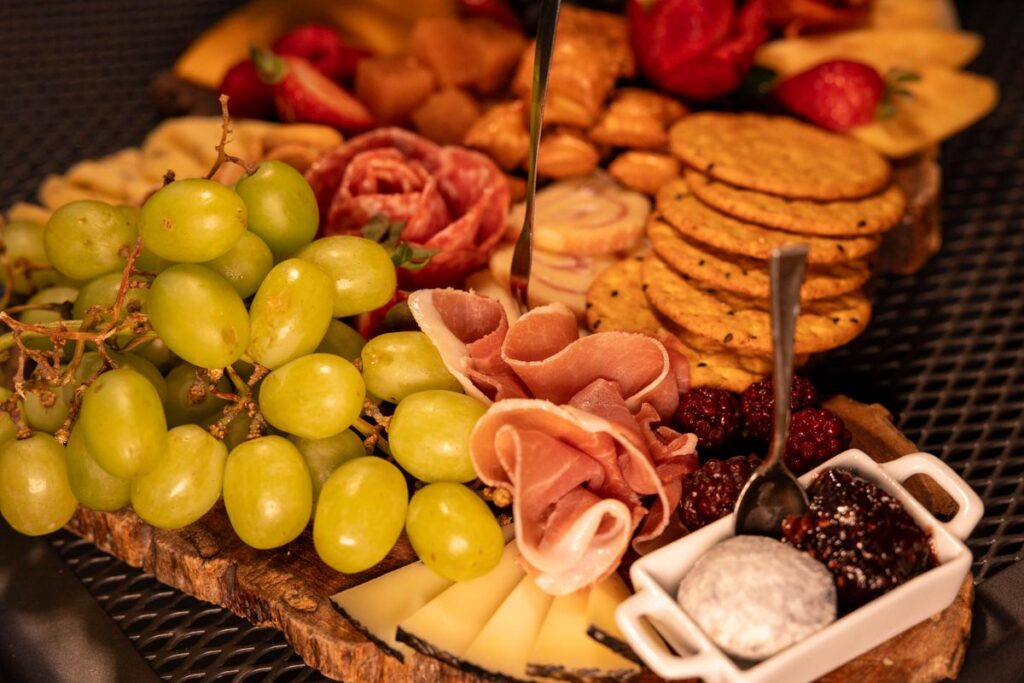
Building a board is a sequence, and the order matters. Start with the board itself. Wood is best, because it looks warm and it does not slide around. A large cutting board, a baking sheet lined with parchment, or even a clean piece of slate all work. Avoid glass, which shows every smear, and avoid anything with a rim, which makes it hard to reach the food at the back.
- Place the bowls first. Small bowls for honey, jam, olives, and dips anchor the board and give it structure. Put one near each corner, or in a triangle if the board is round. Everything else is arranged around them.
- Add the cheeses next. Space the three cheeses apart, one at each end and one in the middle, so guests are not all reaching for the same spot. Cut the hard cheese into cubes, slice the semi-hard cheese, and leave the soft cheese whole with a knife beside it.
- Fold the meats. Salami folds into quarters and stands in a row. Prosciutto drapes in loose ribbons. Soppressata fans in overlapping slices. Shape is what makes a board look expensive, and folding takes thirty seconds per meat.
- Fan the crackers. Put the crackers in two or three small groups rather than one big pile, so the board stays balanced as people eat. Stand them upright against a cheese wedge or a bowl edge, which looks better than laying them flat.
- Fill the gaps with fruit and nuts. Grapes in clusters, apple and pear slices fanned, dried cranberries and nuts scattered into every empty space. This is the step that makes the board look full, and it is the step most people skip. Do not skip it.
- Add the finishing touches. A few sprigs of rosemary or thyme, a drizzle of honey over the brie, and a small card naming the cheeses. Step back and look at it from across the room. If you can see bare board, fill it with fruit or nuts. If it looks crowded, take one thing off. Then cover it loosely with plastic wrap until guests arrive.
Make-Ahead and Anti-Soggy-Cracker Tips
Almost everything on a board can be prepared the day before Thanksgiving, which is why boards are such a good fit for a day when the oven is busy. Slice the cheeses and store them in separate containers in the fridge, so the flavors do not mix. Fold the meats and store them the same way. Wash the fruit, and slice the apples and pears the morning of, with a squeeze of lemon juice to stop them browning. Mix the spiced nuts a week ahead and keep them in a sealed jar. The only jobs left for Thanksgiving Day are arranging the board and putting out the crackers.
Crackers are the one item that cannot be prepared early, because they go soft. The rule is simple: crackers go on the board last, no more than thirty minutes before guests arrive, and they never touch anything wet. Keep them away from the fruit, the honey pot, and the olives. If a cracker sits against a slice of apple for an hour, it will be limp by the time anyone eats it. The same goes for bread: slice it and put it out at the same time as the crackers, not before.
Humidity is the other enemy. If your kitchen is steamy from the turkey and the potatoes, keep the board in a cooler room until serving time. A board built in a hot kitchen will have soft crackers and sweating cheese within half an hour. Build it in the dining room or the living room, cover it loosely, and bring it to the table when guests arrive. If the board will sit out for a while, put the crackers in a separate bowl beside it and let people add their own. It is less pretty, but the crackers stay crisp, and crisp crackers are worth more than a perfect photograph.
For the rest of the day, our Thanksgiving dinner timeline and hosting checklist maps out exactly when each job happens, so the board fits into the day rather than competing with it. Build the board while the turkey rests, put it out an hour before dinner, and clear it when everyone sits down. And if you are planning the whole day from scratch, our Thanksgiving dinner planning guide walks through guest counts, budgets, and menus in order.
How Long Can a Charcuterie Board Sit Out?
This is the question that matters most, and the answer is simpler than people expect. Perishable foods, which includes cheese and sliced cured meat, should not sit at room temperature for more than two hours. That is the USDA guidance, and it is the rule that FoodSafety.gov repeats across its serving advice: two hours at room temperature, or one hour if the room is above 90 degrees Fahrenheit. A Thanksgiving board sits indoors in November, so the two-hour window is the one that applies, and it starts the moment the food leaves the fridge, not the moment guests arrive.
The practical way to handle it is to treat the board as a one-hour event. Put it out an hour before dinner, clear it when everyone sits down, and pack the leftovers into the fridge within that two-hour window. Soft cheeses, such as brie and goat cheese, are the most vulnerable because of their high moisture, so they should be the first things packed away. Hard cheeses are more forgiving, but they follow the same rule. Sliced meats follow it too. Whole, unsliced salami lasts longer, but once it is sliced and on the board, the clock applies.
If your gathering runs long, the fix is to refresh rather than to stretch. Put out half the board first, keep the second half in the fridge, and swap it in after an hour. That way nobody eats food that has been sitting out too long, and the board looks fresh all evening. For a fuller explanation of how the two-hour rule applies to each item on a board, the guide at Amazing Charcuterie Boards on how long a charcuterie board can sit out breaks it down by cheese type and meat type, following the same USDA guidance.
Frequently Asked Questions
What should I put on a Thanksgiving charcuterie board?
Three cheeses, three cured meats, crackers, fall fruit such as grapes, pears, and apples, a sweet element like honey or fig jam, a briny element like olives or cornichons, and nuts to fill the gaps. That combination covers flavor, texture, and color, and it is enough for a board of any size.
How much charcuterie do I need per person?
For a board served an hour before dinner, plan on 2 to 3 ounces of cheese and 2 ounces of cured meat per person, plus a cup of crackers and a cup of fruit per two people. For eight guests, that means about a pound of cheese, twelve ounces of meat, and three cups of crackers. The full portioning table by guest count is in the section above.
How far ahead can I make a Thanksgiving charcuterie board?
You can slice the cheese and fold the meat the day before and store them in the fridge. Slice the fruit the morning of, and arrange the board up to an hour before guests arrive. Put the crackers on last, no more than thirty minutes before serving, so they stay crisp.
How do I keep crackers from getting soggy on a charcuterie board?
Keep crackers away from anything wet: fruit, honey, olives, and dips. Put them on the board last, build the board in a cool room rather than a steamy kitchen, and consider serving crackers in a separate bowl beside the board if it will sit out for a while.
Can I make a Thanksgiving charcuterie board the night before?
You can prep everything the night before, but do not assemble the full board until the day. Cheese dries out and fruit browns in the fridge overnight, and crackers go soft within hours. Prep the components on Wednesday, assemble and arrange on Thursday, and the board will look and taste its best.
What is the best cheese for a Thanksgiving charcuterie board?
Brie is the most popular choice because it is soft, spreadable, and pairs well with honey and cranberry. Aged cheddar gives the board a sharp, sliceable option, and manchego or parmesan adds a hard, nutty cheese for nibbling. Those three cover every texture a board needs.
How long can a Thanksgiving charcuterie board sit out?
Two hours at room temperature, following USDA guidance. Put the board out an hour before dinner, clear it when everyone sits down, and refrigerate leftovers within two hours of the food leaving the fridge. Soft cheeses should be packed away first.
Leave a Reply