
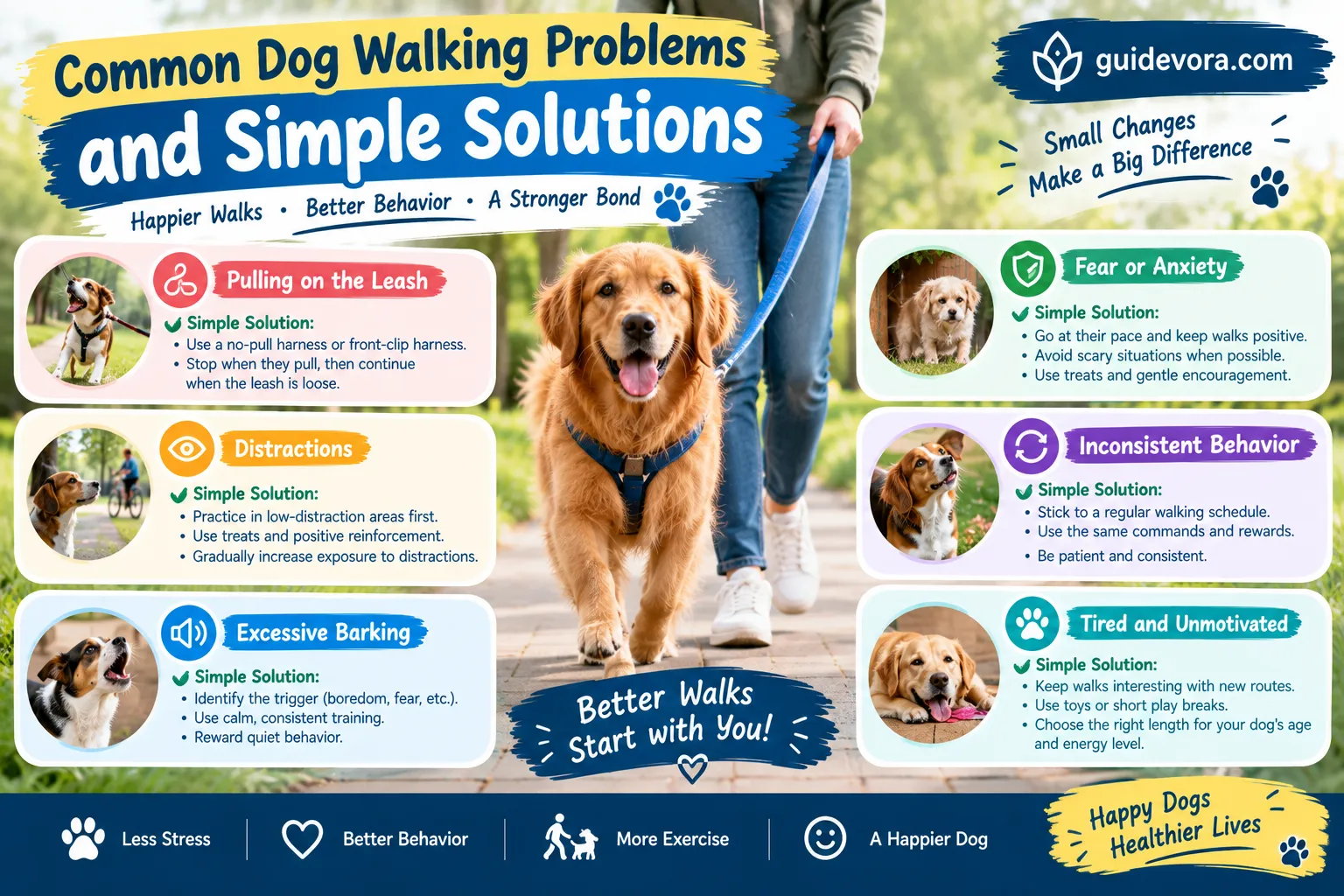
Most walking problems trace back to one of three causes: the dog is over-aroused, under-trained, or being walked with the wrong equipment. Almost none of them are stubbornness, and almost none improve with corrections.
Here are the seven problems dog owners run into most, what’s actually driving each one, and the fix that works.
Problem 1: Pulling on the Leash
Why it happens: Pulling works. Every time a dog pulls and the walk continues forward, the behavior gets reinforced. Dogs also simply walk faster than humans and are motivated by scent ahead of them.
The fix:
- Stop the moment the leash goes tight. Wait until your dog returns to your side or the leash slackens, then continue. The walk only moves when the leash is loose — this is the entire lesson, and it takes consistency more than technique.
- Switch to a front-clip harness. Clipping at the chest redirects forward momentum sideways instead of letting the dog lean into pressure, which is what a back-clip harness or flat collar encourages.
- Reward the position you want. Treat your dog whenever they’re walking beside you, not just when correcting them out of a pull.
- Skip retractable leashes. They create inconsistent tension and teach a dog that pulling extends their range — the exact opposite of the lesson.
Read More: Useful Products for Dogs That Spend a Lot of Time Alone
Problem 2: Lunging and Barking at Other Dogs
This is leash reactivity, and it’s one of the most common walking problems there is.
Why it happens: There are three distinct motivations, and the fix depends on which one you’re dealing with:
- Fear — the dog feels trapped by the leash with no escape option, so it uses barking and lunging as distance-increasing behavior to make the trigger go away.
- Frustration — the “frustrated greeter,” a dog who plays fine off-leash but can’t handle the leash as a barrier to saying hello.
- Overarousal — general excitement escalating past the point of thinking.
The fix — work below threshold:
- Find your dog’s threshold distance — the distance at which they notice a trigger but can still respond to you. This might be 50 feet or half a block.
- Work at that distance, not closer. Dogs can’t learn while highly aroused; training closer than threshold accomplishes nothing.
- Counter-condition: when a trigger appears at threshold distance, feed high-value treats continuously until it passes. You’re changing the emotional association, not commanding obedience.
- Close the distance gradually, over weeks, as your dog stays calm.
- If your dog reacts, you went too close. Add distance and repeat — don’t push through.
Read the escalation ladder so you can intervene early:
- Alert: body stiffens, ears forward, hard stare → redirect or add distance now
- Aroused: leaning forward, fast breathing, hackles up → increase distance immediately
- Over threshold: barking, lunging, spinning → the thinking brain is offline; leave the situation
Important: Don’t punish barking or lunging. Both the Animal Humane Society and Best Friends Animal Society are clear that corrections teach a dog that other dogs predict punishment, which deepens the fear driving the behavior. Some commercial trainers advocate prong collars for this; the major welfare organizations do not, and that disagreement is worth knowing about before choosing a method. If your dog has ever harmed a person or another dog, a basket muzzle for walks plus a qualified professional is the responsible path.
Problem 3: Your Own Tension Travels Down the Leash
Why it happens: You spot a trigger, your stomach drops, and you tighten the leash before your dog has even reacted. Dogs read that tension instantly, and it confirms that something is wrong — creating a feedback loop where your anxiety and your dog’s reactivity escalate each other.
The fix:
- Keep a “J” shape in the leash — visible slack whenever possible.
- Breathe out deliberately when you spot a trigger, before doing anything else.
- Move away calmly, without drama. A brisk, matter-of-fact turn works far better than a panicked yank.
Read More: How to Make Grooming Easier at Home
Problem 4: The Dog That Refuses to Walk
Why it happens: Usually fear (of traffic, surfaces, or a past bad experience), physical discomfort, or an ill-fitting harness — not stubbornness.
The fix:
- Rule out pain first. Sudden refusal in a dog who previously walked fine warrants a vet check, especially in senior dogs or breeds prone to joint issues.
- Check harness fit. A harness that pinches the armpit is a common, easily missed cause.
- Don’t drag. Pulling a frozen dog forward confirms the walk is something to fear.
- Shrink the goal. Walk to the end of the driveway and back, reward heavily, and build distance over days.
Problem 5: Eating or Grabbing Things Off the Ground
Why it happens: Scavenging is a natural, self-rewarding behavior — the dog gets an immediate payoff every time it succeeds.
The fix:
- Teach “leave it” at home first, where there’s no competition, before expecting it on a walk.
- Trade up, don’t chase. Chasing a dog with something in its mouth turns it into a game; offering a better treat in exchange doesn’t.
- Scan ahead. Steering around a discarded chicken bone is faster than any recall cue.
- Consider a basket muzzle for persistent scavengers — it allows panting and drinking while preventing ingestion, and it’s a welfare tool, not a punishment.
Read More: Useful Cat Accessories for Small Homes
Problem 6: Stopping at Every Single Smell
Why it happens: Sniffing isn’t a distraction — it’s how dogs process their environment, and it’s genuinely tiring for them in a good way.
The fix — split the walk:
- Designate “sniff time” and “moving time.” Use a specific cue (“go sniff”) to release your dog to explore, and a different one to resume walking.
- Build in one dedicated sniffing walk per week — slow, meandering, no distance goal. A 20-minute sniff walk tires most dogs more than a brisk 40-minute one.
- Fighting sniffing entirely tends to backfire; structuring it works.
Problem 7: Walking Two Dogs at Once
Why it happens: Dogs amplify each other’s arousal, and one leash-reactive dog will often trigger the other.
The fix:
- Train them separately first. A behavior that isn’t solid with one dog won’t hold with two.
- Use separate leashes, not a coupler — couplers remove your ability to manage each dog independently.
- Keep the more reactive dog on the side away from the street and from passing triggers.
Before You Walk: Three Things That Prevent Most Problems
- Run a 2-minute obedience drill (sit, down, stay) before clipping the leash. It engages the thinking part of the brain before you head out.
- Make leash-clipping a calm moment, not an excitement spike. If your dog is bouncing off the walls at the door, wait for four calm paws before opening it.
- Use the right equipment: a 4–6 foot standard leash and a front-clip harness or, for strong pullers, a properly fitted head halter. Equipment improves your control — it never replaces training.
Quick-Reference: Problem to Solution
| Problem | Core Fix |
|---|---|
| Pulling | Stop when leash tightens; front-clip harness; reward position |
| Lunging/barking at dogs | Work below threshold distance; counter-condition; never punish |
| Handler tension | Keep slack “J” in leash; breathe; calm exits |
| Refusing to walk | Rule out pain; check harness fit; shrink the distance goal |
| Scavenging | Train “leave it” at home; trade up; scan ahead |
| Constant sniffing | Cue-based sniff time; one dedicated sniff walk weekly |
| Two dogs at once | Train separately; separate leashes; manage positioning |
Frequently Asked Questions
Why does my dog pull on the leash? Because pulling works — every time the walk continues while the leash is tight, the behavior is reinforced. Dogs also naturally walk faster than people and are drawn forward by scent. Stopping the moment the leash tightens, paired with a front-clip harness, addresses both.
How do I stop my dog from lunging at other dogs on walks? Work at your dog’s threshold distance — far enough away that they notice the trigger but can still respond to you — and pair the trigger’s appearance with high-value treats. Close the distance gradually over weeks. Don’t punish the lunging, as corrections tend to worsen the underlying fear.
What’s the difference between leash reactivity and aggression? Reactivity is an over-the-top response to normal stimuli, often driven by fear or frustration rather than intent to harm — many reactive dogs play normally off-leash. Aggression involves genuine intent to cause harm. The distinction matters because it changes both the training approach and the safety precautions required.
What’s the best harness for a dog that pulls? A front-clip harness is the most commonly recommended option, since clipping at the chest redirects forward momentum instead of letting the dog lean into neck or chest pressure. For very strong pullers, a properly fitted head halter offers more control. Neither replaces training.
Why does my dog suddenly refuse to walk? Sudden refusal in a dog who previously walked normally most often indicates pain, fear, or an ill-fitting harness — not stubbornness. A vet check is the appropriate first step, particularly for senior dogs.
Should I let my dog sniff on walks? Yes. Sniffing is how dogs process their environment and is genuinely mentally tiring. Structure it with a release cue rather than suppressing it — a 20-minute sniff walk tires most dogs more effectively than a faster, longer one.
Final Thoughts
Nearly every walking problem gets better with the same three ingredients: more distance from triggers, less tension on the leash, and rewarding the behavior you want instead of correcting the one you don’t. Pick the single problem costing you the most on walks, work on it consistently for two to three weeks before judging results, and bring in a qualified professional for reactivity that involves growling, snapping, or any history of a bite — that’s a safety issue, not a training project to solve alone.
Leave a Reply