
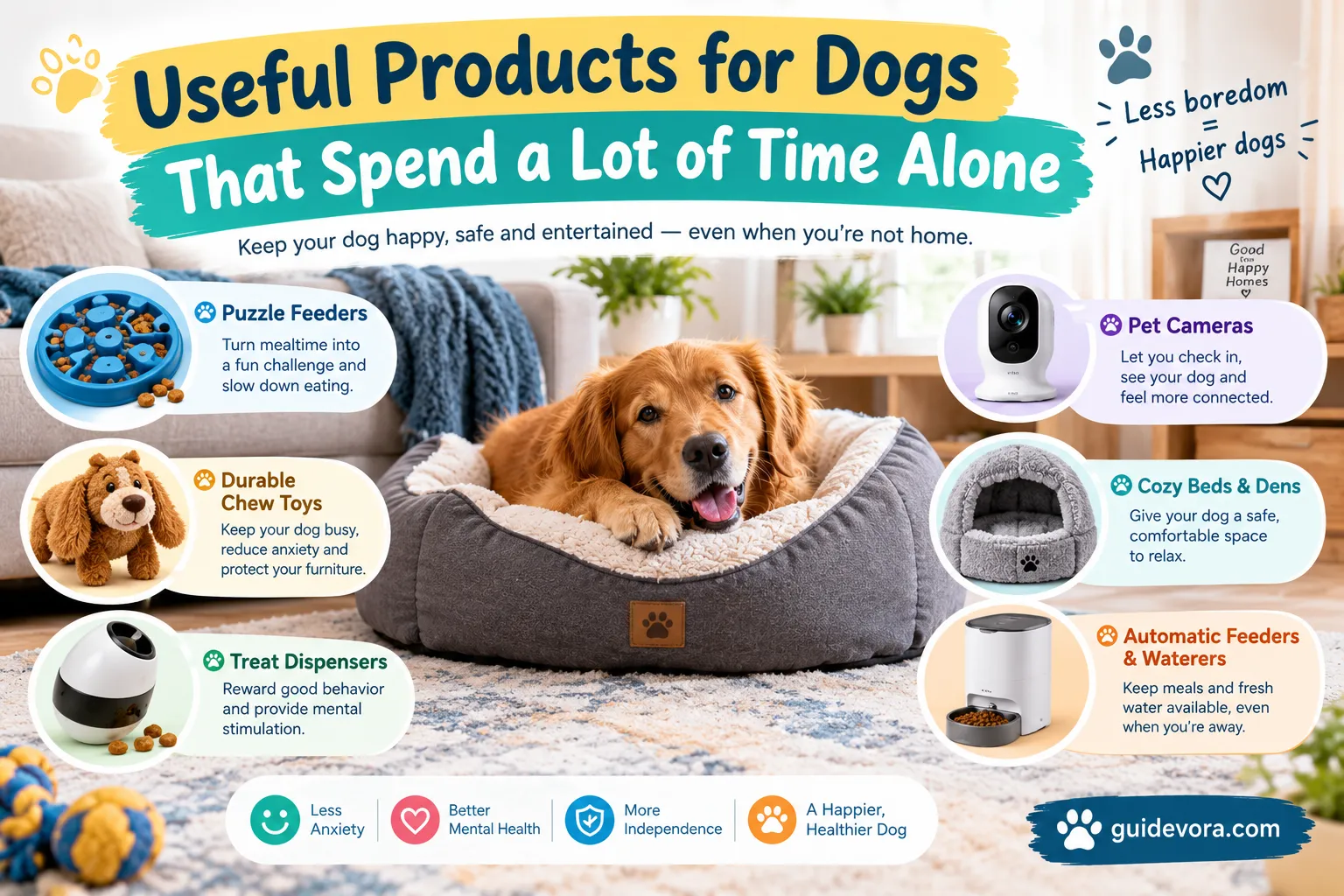
Every full-time working dog owner eventually asks the same question: is my dog actually okay while I’m gone? The honest answer depends on the dog. Veterinary behavior research puts the share of dogs showing some sign of separation-related distress anywhere from 13% to 29%, depending on how strictly “distress” is defined — a wide range that reflects a real, well-documented split between dogs who nap through an eight-hour workday and dogs who pace, bark, or chew the moment the door closes.
This guide isn’t a generic toy list. It starts by helping you figure out what kind of alone-time struggle your dog actually has, because the right product depends heavily on that — a bored Labrador and an anxious rescue need almost opposite solutions.
First: What’s Actually Happening While You’re Gone?
Before buying anything, it helps to know which category your dog falls into. Most alone-time struggles break down into three patterns:
- Boredom-driven behavior — chewing, digging, or knocking things over, usually starting an hour or more after you leave, often in dogs under 3 years old with high energy levels.
- True separation anxiety — distress that begins within minutes of your departure: pacing, drooling, howling, or attempts to escape confinement. This is a specific, diagnosable condition, not just “missing you.”
- Under-stimulation from routine, not time alone itself — a dog who’s fine alone for 4 hours but struggles at 8 often needs a midday break or enrichment adjustment, not a behavioral diagnosis.
Products help meaningfully with the first and third categories. For true separation anxiety — especially if it involves self-injury, destruction near doors and windows, or distress that doesn’t improve after a few weeks of consistent management — a veterinary behaviorist should be involved before you invest heavily in gadgets. No product replaces a diagnosis.
How Long Can a Dog Actually Be Left Alone?
There’s no single universal number, but general veterinary guidance breaks down roughly like this:
- Puppies under 6 months: 2–3 hours max, tied closely to bladder control, not just comfort
- Adult dogs (1–7 years): typically 6–8 hours with proper enrichment and a bathroom plan
- Senior dogs (7+ years): often need a shorter window again, closer to 4–6 hours, due to bladder control and joint stiffness from long stillness
- Dogs with diagnosed separation anxiety: duration should be built up gradually through structured training, not assumed from age alone
If you’re consistently gone longer than these windows, a midday dog walker, doggy daycare, or the crate/playpen setup covered below becomes less optional and more necessary.
Read More: Essential Items Every New Dog Owner Should Have
The Product Categories That Actually Help
1. Puzzle Feeders and Slow Feeders
Puzzle feeders turn a 2-minute meal into 15–30 minutes of problem-solving, which matters because mental effort tires a dog out more efficiently than physical activity alone in a confined space.
What to look for:
- Adjustable difficulty settings, so the toy scales as your dog masters it
- Dishwasher-safe materials, since these get used daily
- A non-slip base, especially on hard flooring
Common mistake: Buying one puzzle toy and expecting it to work indefinitely. Dogs habituate to a single puzzle within days. Rotating 2–3 toys weekly keeps the novelty — and the enrichment value — intact.
2. Snuffle Mats and Lick Mats
These tap into scent-foraging, one of the most naturally calming activities for a dog, because it mimics the extended, low-intensity searching behavior dogs evolved to do for food.
- Snuffle mats work best with dry kibble or small training treats tucked into fabric folds.
- Lick mats — spread with plain yogurt, canned pumpkin, or wet food, then frozen for 2–3 hours before you leave — extend engagement time and the repetitive licking motion has a measurable calming effect, similar to how chewing self-soothes.
3. Treat-Dispensing Pet Cameras
A camera with two-way audio and remote treat dispensing (Furbo-style devices are the best-known example) does something puzzle toys can’t: it gives you actual data. Watching footage from a stressful day tells you whether your dog is truly anxious or just waiting by the door out of habit — a distinction that changes which solution you need.
What to prioritize:
- Two-way audio — many dogs respond more to a familiar voice than a treat toss
- Bark and motion alerts, useful for spotting patterns you’d otherwise miss entirely
- Night vision, if your dog’s alone-time includes early morning or evening hours
4. Automatic Feeders
Useful less for entertainment and more for consistency — dogs on tight feeding schedules do better behaviorally when meals arrive at a predictable time, even if you’re running late.
- Look for portion accuracy within a few grams, especially for dogs on a vet-prescribed diet.
- App-connected models let you delay or adjust a feeding remotely without needing to be home.
5. Calming Beds and a Consistent Safe Space
A bed with a raised, cushioned rim mimics the physical security of curling against another body — a small but real comfort cue.
- Placement matters more than the product itself: keep it in one consistent, low-traffic spot. Moving a dog’s resting area around undermines the “stable home base” effect that makes it work.
- Adding a worn (unwashed) piece of your clothing nearby reinforces the same effect through scent.
6. White Noise Machines and Sound Management
Sudden outside noise — delivery trucks, other dogs barking, a slammed car door — is one of the most common triggers for reactive barking in a dog left alone.
- A steady, low-volume white noise machine masks noise spikes more reliably than leaving a TV or radio on, which itself introduces unpredictable sound.
- Treat calming audio or video content as a low-cost experiment — response varies significantly by individual dog, and there’s limited independent evidence it works uniformly.
7. Pheromone Diffusers
Synthetic dog-appeasing pheromone diffusers are among the more researched non-medication options for mild stress behaviors, though evidence on how consistently they work is mixed across studies.
- Plug into the room your dog spends the most time in while alone — not an entryway.
- Effects build over 1–2 weeks; judging results after a single day undersells how these products actually work.
8. Calming Chews and Supplements
Some calming chews use L-theanine, chamomile, or melatonin for mild anxiety support.
- Always consult a veterinarian before starting any calming supplement, especially for dogs already on medication — this isn’t a formality, since some ingredients interact with prescription drugs.
- Supplements are a support tool for mild cases, not a substitute for training or enrichment, and they won’t meaningfully help true separation anxiety on their own.
9. Indoor Potty Solutions
For absences that stretch past your dog’s comfortable bladder window — particularly relevant for puppies, seniors, or unpredictable work schedules — a real-grass or turf indoor potty pad adds a safety net.
- Position it away from food, water, and the designated safe space; dogs generally avoid eliminating near where they eat or rest.
- Real-grass subscription pads outperform synthetic pads on absorbency and odor control for daily use.
10. Dog Doors or Secure Playpens
For dogs with safe yard access, a secure dog door reduces restlessness by giving them agency to move between indoor comfort and outdoor space on their own schedule.
- Without yard access, a playpen with enough room to stand, turn, and stretch fully offers more freedom than an all-day crate.
- Combine with a puzzle feeder or snuffle mat inside the pen — confinement plus enrichment beats confinement alone.
Matching Products to the Actual Problem
| If your dog… | Prioritize |
|---|---|
| Chews or destroys things starting an hour+ after you leave | Puzzle feeders, rotating toys, longer pre-departure exercise |
| Barks or reacts to outside noise | White noise machine, camera with two-way audio |
| Paces, drools, or panics within minutes of your leaving | Consult a vet/behaviorist first; pheromone diffuser and calming bed as support, not a fix |
| Struggles specifically past hour 6–8 | Automatic feeder, indoor potty backup, or a midday dog walker |
| Seems fine but you want peace of mind | Treat-dispensing camera for visibility |
Frequently Asked Questions
What are the most useful products for dogs that spend a lot of time alone? Puzzle feeders, a snuffle or lick mat, a treat-dispensing camera, and a consistent calming bed cover the core needs — mental stimulation, monitoring, and physical comfort — without requiring medication or a diagnosis.
How long can a dog safely stay home alone? Roughly 6–8 hours for healthy adult dogs with proper enrichment and a bathroom plan; shorter for puppies (2–3 hours), seniors (4–6 hours), and dogs with diagnosed separation anxiety, who need a gradual, trained-up tolerance rather than a fixed number.
What are the signs of separation anxiety in dogs, versus normal boredom? Separation anxiety typically starts within minutes of departure — pacing, drooling, howling, or attempts to escape — while boredom-driven behavior (chewing, digging) tends to build gradually over the first hour or more alone. True separation anxiety warrants a veterinary behaviorist, not just products.
Do calming chews actually work for dogs left alone? They can help with mild anxiety, particularly ingredients like L-theanine or chamomile, but should be introduced with veterinary guidance and paired with training — they’re a support tool, not a fix for true separation anxiety.
What’s the best camera for monitoring a dog home alone? Prioritize two-way audio, a treat-dispensing feature, and bark or motion alerts — together they cover interaction, comfort, and behavior tracking, which matters more than resolution or design extras.
Final Thoughts
The dogs who struggle most while home alone usually aren’t missing a product — they’re missing the right diagnosis of why they’re struggling. Figure out whether it’s boredom, true anxiety, or simply too many hours for their current routine, then match the category above to that specific problem. Start with one or two changes, watch how your dog responds over 1–2 weeks — a treat-dispensing camera makes this observation far easier — and build from there rather than buying the full list at once.
Leave a Reply