

Table of Contents
A wreath is the one Christmas decoration that does a whole job by itself. It greets people before they reach the door, it fills a blank wall, and it tells the street that someone inside is looking forward to Christmas. The trouble is that most wreaths look either bare or overdone, and the difference is rarely money. It is knowing what size fits the door, which base to build on, and when to stop adding things. These christmas wreath ideas cover all three, with twenty complete wreaths you can make at home, grouped by material so you can pick the one that matches what you already own and how much time you actually have.
Every wreath below is a full idea, not a colour suggestion. Each of these christmas wreath ideas lists its materials and the one detail that makes it work, so you can build it in an afternoon with a wire form, a glue gun, and a pair of secateurs. There are evergreen wreaths for the front door, pinecone and dried-flower wreaths that last for years, fabric and ribbon wreaths for a softer look, and hoop wreaths for anyone who prefers restraint. There are also sections on sizing, hanging without damaging the door, and keeping a fresh wreath alive until Christmas Day.
Before You Start: Size, Base, and Where It Will Hang
Size first, because it is the mistake people make most often. For a standard 36-inch front door, a wreath 22 to 24 inches across looks right, and that sizing rule holds for nearly all christmas wreath ideas, whatever the material. The rule of thumb is about two-thirds the width of the door. On double doors, hang one wreath on each door, a few inches narrower than each door itself. A wreath that is too small disappears against the door, and one that is too large crowds the frame and catches every time the door opens. For a window, 12 to 16 inches is usually enough.
For a mantel, a wreath needs to be big enough to hold the space above the fireplace, so 24 to 30 inches works better, or hang two smaller ones side by side.
Next, pick a base. A wire wreath form is the cheapest and most forgiving starting point: it holds its shape, it takes wire and hot glue well, and it works for almost every material. A grapevine base gives a rustic, textured look and holds greenery without much wire, because the stems tuck into the vines. A foam base suits fabric and ribbon wreaths, since pins and glue hold easily, but it is not strong enough for a heavy evergreen wreath. A straw base is the traditional choice for fresh greenery, because it holds moisture and keeps the stems alive longer, though it sheds. Buy the base to match the wreath you are making, not the other way round.
Finally, decide where the wreath will live. An outdoor wreath needs materials that can handle rain, wind, and frost: fresh evergreen, pinecones, dried oranges, and wired ribbon. Fabric, paper, and dried flowers belong indoors or in a sheltered porch, because one wet week will ruin them. If the door gets direct afternoon sun, a fresh wreath will dry out fast, so hang it in the shade of the porch or choose a faux base instead. A wreath on a south-facing door in December lasts half as long as the same wreath on a north-facing one.
How to Build a Wreath in 7 Steps

Almost every one of these christmas wreath ideas follows the same seven steps. Learn the sequence once and you can build any of the twenty ideas below without a second tutorial. The order matters: greenery first, structure second, decoration last.
- Prepare the base. If you are using a wire form, wrap it in a strip of burlap or floral tape so the wire does not show through the greenery. If you are using grapevine, soak it briefly so it bends without snapping. If you are using foam, wrap it in ribbon or fabric first so the foam never shows.
- Cut the greenery into bundles. Cut evergreen branches into pieces about six inches long. Gather three or four pieces into a small bundle and bind the cut ends with floral wire. Working in bundles, rather than one stem at a time, is what makes a wreath look full instead of sparse.
- Attach the bundles in one direction. Lay the first bundle on the base and wire it firmly in place. Lay the next bundle overlapping the first by about half, so the cut ends are hidden under the tips of the bundle before it. Work all the way round in the same direction. Never alternate directions, or the wreath will look like it is arguing with itself.
- Fill the gaps. Step back and look for thin spots, usually where the bundles meet. Tuck in short pieces of greenery, pinecones, or dried foliage to fill them. A wreath that looks full from the front and thin from the side is not finished yet.
- Add the focal point. Every good wreath has one place the eye lands first: a large bow, a cluster of pinecones, a bunch of dried oranges, or a single statement ornament. Place it at the bottom centre or slightly off to one side, and wire it in firmly. Everything else is decoration around it.
- Add the smaller decorations. Berries, small baubles, cinnamon sticks, dried orange slices, and sprigs of eucalyptus go on now, tucked into the greenery rather than glued on top of it. Work in odd numbers and repeat the same element three times around the wreath so it looks deliberate.
- Attach the hanger and check the back. Wire a loop of ribbon or floral wire to the top of the base, turn the wreath over, and trim any loose wire ends that could scratch the door. Hang it, step back to the pavement, and look at it from the distance your neighbours will see it from. That is the view that matters.
If you want a second opinion on the build, HGTV’s step-by-step guide to making a Christmas village wreath follows the same sequence of fluffing a base, layering, and finishing, and its tips on hot glue and placement transfer to almost any wreath. See HGTV: How to Make a Christmas Village Wreath.
20 Christmas Wreath Ideas
Each of these christmas wreath ideas is a complete wreath with its materials and the detail that makes it work. Pick by material first, then by where it will hang. The evergreen wreaths suit the front door. The dried-flower and fabric wreaths suit the inside. The hoop wreaths suit anyone who wants Christmas without clutter.
1. Classic Fraser Fir with Red Berries

The wreath most people picture when they hear the word. Fraser fir branches, wired onto a wire form in overlapping bundles, with clusters of red berries tucked in threes around the ring and a deep red velvet bow at the bottom. The trick is the fir itself: Fraser fir holds its needles far longer than spruce, and its branches are soft enough to wire without snapping. Keep the berries in clusters rather than scattered, because clusters read as deliberate and scattered berries read as an accident. Hang it on the front door and it will last three to four weeks in cold weather.
2. Mixed Greens with Magnolia Leaves
For a wreath that looks like it came from a florist, mix three greens: cedar for softness, pine for structure, and magnolia leaves for the broad, glossy shapes that break up the needles. The magnolia leaves go on last, tucked in at intervals with the brown underside showing on half of them, which gives the wreath a two-tone depth that a single green cannot match. Add a cream linen bow and nothing else. This is one of the most elegant christmas wreath ideas in this list, and it suits a dark green or black front door better than any other.
3. Cedar and Eucalyptus
Cedar and eucalyptus are the two greens that smell like Christmas before you add anything else. Build the base from cedar bundles, then weave in sprigs of silver-dollar eucalyptus so the round leaves catch the light. No berries, no bow, no ornaments. The scent does the decorating, and the pale green of the eucalyptus against the dark cedar is enough colour on its own. This wreath dries well too: when the cedar fades, the eucalyptus keeps its shape and colour for months.
4. Frosted Evergreen with White Berries
A flocked or frosted evergreen wreath for anyone who wants snow without the weather. Start with a faux evergreen base, or spray a fresh one lightly with flocking powder, then add white berries, silver pinecones, and a white ribbon bow. The danger with flocked wreaths is overdoing the white, so keep the base green visible in places and let the frost sit on the tips rather than coating everything. This wreath suits a white or pale grey door, where a dark green wreath would look heavy.
5. Boxwood Wreath
Boxwood is the neatest of all wreath greens: small, dense, glossy leaves that hold their shape for weeks without shedding. Wire short boxwood sprigs tightly onto a foam or wire form, overlapping generously, until the base disappears completely. The result is a smooth, almost sculpted ring. Add a single burgundy bloom or a narrow ribbon bow at the bottom, or leave it completely plain. Boxwood wreaths are the right choice for a formal front door, and they are the easiest fresh wreath to keep alive, because boxwood dries slowly and evenly.
6. Pinecone and Cinnamon

The wreath for people who like Christmas to smell like a kitchen. Start with a grapevine base and wire on pinecones of different sizes, working from large at the bottom to small at the top. Tuck in bundles of cinnamon sticks tied with twine, a few dried orange slices, and a handful of star anise. No greenery at all. The pinecones give it structure, the cinnamon gives it scent, and the whole thing lasts for years if you store it in a box between Decembers. This is one of the most durable christmas wreath ideas here, and it costs almost nothing if you collect the pinecones yourself.
7. Foraged Evergreen and Dried Orange
Foraged sounds grand, but it means a walk with a pair of secateurs. Cut branches from your own garden or a neighbour’s hedge, add pinecones from the park, and slice an orange thin, dry the slices in a low oven for two hours, and wire them into the wreath in threes. The orange slices go translucent in the light and smell faintly of Christmas for the first week. This wreath costs nothing but time, and it is the most personal one in this guide, because no two foraged wreaths ever look the same.
8. Pinecone Cluster with Gold Accents
A variation on the pinecone wreath for a more formal door. Use only pinecones, packed tightly onto a wire form until no base shows, then add gold-painted pinecones at intervals, a gold ribbon bow, and a few gold baubles tucked deep into the ring. The trick is restraint with the gold: one gold pinecone in every five, not every other one, or the wreath turns brassy. This wreath is heavy, so use a proper over-door hanger rated for the weight rather than a suction hook.
9. Woodland Wreath with Feathers and Twigs
For a wreath that looks gathered rather than bought, combine evergreen with bare twigs, a few pheasant feathers, dried seed heads, and a small handful of acorns. The twigs stick out at angles on purpose, which gives the wreath a wild, woodland shape that suits a cottage door or a porch. Keep the colours in browns, greens, and creams, and skip the red entirely. Feathers are the detail that makes it: two or three, placed at the bottom, not scattered everywhere.
10. Velvet Ribbon Wreath
A wreath made entirely of ribbon, for a soft, indoor look, and one of the simplest christmas wreath ideas to build, because there is no greenery to wire. Cut wide velvet ribbon into strips, loop each strip into a bow shape, and pin or glue the loops tightly onto a foam base until it is covered. Use one colour, usually deep red, forest green, or dusty blue, with a second ribbon in a lighter shade for the bow at the bottom. No greenery, no pinecones. The texture of the velvet does all the work. This wreath is light, it never sheds, and it stores flat in a bag.
11. Buffalo Plaid and Burlap
Red and black buffalo plaid ribbon, burlap loops, and a few cream baubles, built on a wire form. The plaid is the pattern, so keep everything else plain: no berries, no pinecones, no second colour. A burlap bow at the bottom finishes it. This is the most forgiving of the fabric christmas wreath ideas, because plaid hides uneven spacing, and it suits a farmhouse front door or a kitchen wall better than any other wreath in this list.
12. Fabric Scrap Wreath
The wreath for anyone with a fabric box. Cut old shirts, tea towels, and fat quarters into strips about an inch wide and six inches long, then tie each strip onto a wire form in a knot, pushing the strips tight together as you go. Use a limited palette, three colours at most, or the wreath turns noisy. A fabric scrap wreath is shaggy, soft, and completely unique, and it is the best use for fabric that is too worn for anything else. Children can help with this one, because there is no glue gun involved.
13. Deco Mesh Wreath
Deco mesh is the big, fluffy material that makes a wreath look enormous for very little money. Attach the ends of red, green, and white mesh to a wire form with pipe cleaners, pull loops of each colour through the wires in turn, and keep going until the form is covered. The loops should be generous, because flat mesh looks thin. Add a bow and a few baubles at the end. Deco mesh wreaths are the fullest christmas wreath ideas in this guide, which makes them the right choice for a wide double door or a large blank wall.
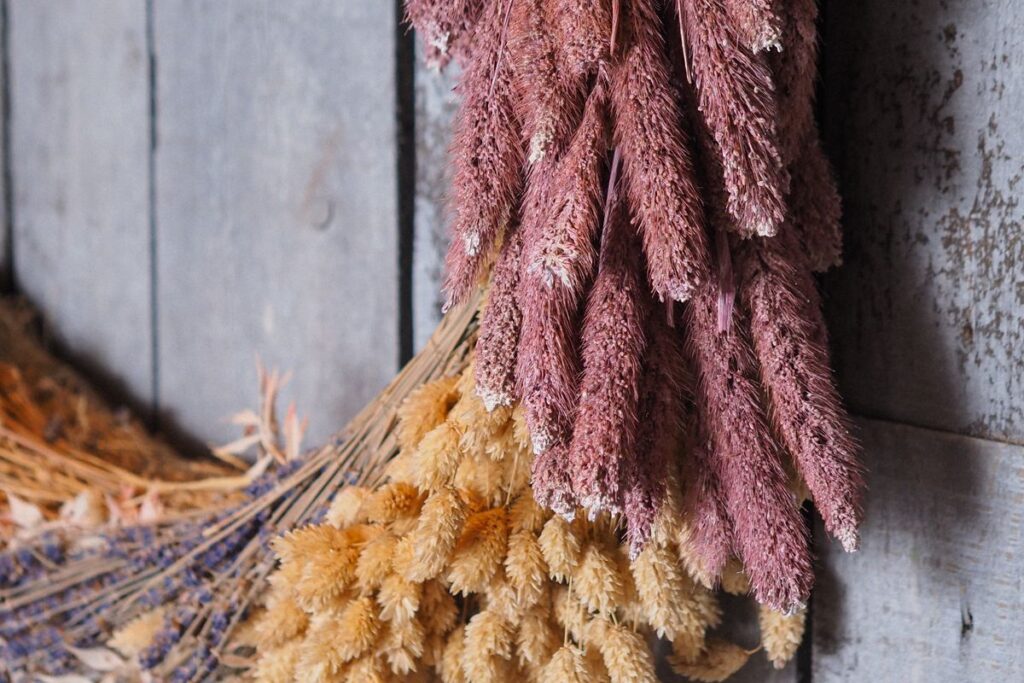
14. Dried Flower Wreath
Dried flowers give a wreath that no fresh greenery can match: soft, muted colour that lasts for years. Build on a straw or grapevine base, then wire in bunches of dried lavender, strawflowers, statice, and honesty seed pods, working in small clusters and keeping the palette to two or three colours. Lavender gives scent, strawflowers give colour, and the seed pods give shape. Hang this one indoors, because rain will ruin dried flowers in a day. It suits a bedroom door or a hallway wall better than the front door.
15. Dried Orange and Cinnamon Ring

Simpler than the pinecone version and brighter. Wire dried orange slices in a neat ring around a grapevine base, overlapping them slightly like scales, then add cinnamon sticks in bundles of three at intervals and a thin twine bow. No greenery, no pinecones. The orange slices are the whole wreath, and they catch the light beautifully on a white wall. Make the slices in November so they are fully dry before you build, because a damp slice will curl and darken.
16. Eucalyptus and White Flower Wreath
A modern, pale wreath for a bright interior. Silver-dollar eucalyptus as the base, with small white dried flowers, white berries, and a cream ribbon woven through. The colours are all pale green, silver, and white, which makes it the calmest wreath in this list. It suits a white or pale grey wall, a mirror, or the back of a dining chair. Keep it away from the front door, because eucalyptus fades in direct sun and the white flowers show every mark.
17. Ornament Ball Wreath
The fastest wreath in this guide, and the most cheerful. Thread baubles of different sizes onto a wire coat hanger bent into a circle, or glue them onto a foam base, packing them tightly until no base shows. Use one colour family, reds and golds, or blues and silvers, with a few glitter baubles for sparkle. A big bow at the top hides the join. This wreath takes about thirty minutes, it uses the baubles you already own, and it is the best choice for anyone who wants a wreath today rather than a project for the weekend.
18. Minimalist Gold Hoop with Dried Orange
A thin gold metal hoop, a small bunch of greenery wired to one side, two dried orange slices, and a length of velvet ribbon tied at the top. That is the whole wreath. The empty space is the point: the hoop frames the wall behind it, and the small cluster of decoration draws the eye without filling the circle. This is the most restrained of all these christmas wreath ideas, and it suits a modern interior, a small door, or a window where a full wreath would block the light.
19. Hoop Wreath with Asymmetric Greenery

A wooden or rattan hoop with greenery wired along the bottom third only, rising higher on one side than the other, with a few pinecones and a single bow where the greenery ends. The asymmetry is what makes it look designed rather than unfinished: the bare top of the hoop is part of the look, not a gap. Hang it on a mirror or a plain wall, where the bare hoop can breathe. This wreath takes less than half the greenery of a full wreath, which makes it the cheapest evergreen option in this guide.
20. Advent Wreath for the Table
A wreath that lies flat instead of hanging. Build a low evergreen ring on a straw base, set it on a tray or a plate, and place four candles in holders around it: three purple and one pink, by tradition, with a white candle in the centre for Christmas Day. Light one candle each Sunday of Advent. This is a different kind of wreath from the other nineteen, because it is a ritual object rather than a decoration, and it belongs on the dining table or the mantel, not the door. Never leave the candles burning unattended, and keep the greenery away from the flames.
Where to Hang a Wreath
The front door is the obvious place, and it is the right one for most of these christmas wreath ideas, because it is where the wreath does the most work. Hang it at eye level, centred on the door, so its centre sits a little above the door knocker. On a door with a window, hang the wreath on the solid part below the glass, not over it.
Inside, a wreath earns its place in more spots than people use. Above the mantel is the classic indoor position, especially a large wreath that echoes the tree. In a window, a small wreath hung from a ribbon looks like a picture frame, and it reads from both inside and outside. On a wall, a wreath fills a blank space that a picture would leave cold. On the back of a dining chair, a small wreath turns an ordinary chair into a Christmas chair, which children love. And flat on the table, a wreath becomes a centrepiece: set a pillar candle or a bowl of baubles in the middle and the table is dressed.
One wreath can serve two positions if you plan for it. A medium evergreen wreath works on the door in December and on the wall in January, and a hoop wreath works on the door, the mirror, and the window in turn. Buy or make the wreath for the place it will spend the most time, and let the other spots be a bonus.
How to Hang It Without Damaging the Door
A wreath that falls off the door at midnight is a Christmas memory nobody wants. The right hanger depends on the weight. A light wreath, under two pounds, hangs happily from a suction hook on a glass door or a removable adhesive hook on a painted door, as long as the surface is clean and dry when you stick it on. A medium wreath needs an over-door hanger, the metal hook that slides over the top of the door and holds the wreath on a hook at the front. A heavy wreath, a pinecone wreath or a fully loaded evergreen one, needs a hanger rated for its weight, or a nail into the door itself if you own the house.
Ribbon is the gentlest hanger of all. Loop a length of wired ribbon over the top of the door and let the wreath hang from it, with the ribbon held in place by the door closing on it. The ribbon shows from the inside, which is part of the charm, and it leaves no mark at all. Whichever method you use, hang the wreath and then open and close the door a few times before you walk away. A wreath that swings into the frame every time the door moves will shed its decorations within a week.
Keeping a Fresh Wreath Alive
A fresh evergreen wreath is a cut plant, and it behaves like one. Outdoors in cold weather, a well-made fir or cedar wreath from these christmas wreath ideas lasts three to four weeks. Indoors, in a heated room, it lasts about two. The two things that kill it fastest are sun and dry air. Hang it in the shade, mist it with water every few days, and keep it away from radiators and open fires.
Timing matters as much as care. Make or buy a fresh wreath in the last week of November or the first week of December, and it will still look good on Christmas Day. Make it in early November and it will be brown by the middle of the month. If you want a wreath up for the whole season, buy a faux base and add fresh sprigs to it, replacing the sprigs once halfway through December. The faux base never fades, and the fresh sprigs keep the scent.
When the season ends, a fresh wreath goes in the compost or the garden waste, and a faux wreath goes into a box with tissue paper between the decorations. Store a wreath flat, not hanging, because a wreath stored on a hook will sag into an oval by next year. Our guide on how to store Christmas decorations covers the full pack-away, including wreaths, garlands, and artificial trees, so the wreath you love this year survives to next December.
For the rest of the season, the wreath is only the start. Our DIY Christmas decorations guide has thirty handmade ideas for the rest of the house, from garlands to table decorations, and our merry Christmas wishes for 2026 has ready-to-use messages for the cards you will write once the decorating is done.
What a Wreath Costs: Three Budget Levels
At the under-25-dollar level, you are making one of these christmas wreath ideas from what you can find: a wire form, greenery cut from the garden, pinecones collected on a walk, and a spool of ribbon. That is enough for a beautiful wreath, because the materials are free and the only cost is the form and the wire. The foraged evergreen and dried orange wreath in this guide costs almost nothing, and it is the one guests ask about most.
At the 25-to-75-dollar level, you can buy a proper base, fresh greenery from a florist or a garden centre, dried flowers, and a good wired ribbon. This is the level where most homemade wreaths land, and it is the level where buying after Christmas pays off, because wreath forms and ribbon sell for half price in January. At the splurge level, above 75 dollars, you are buying a large pre-made faux wreath or a full set of glass ornaments for an ornament ball wreath, and the money goes furthest on the base, because a good base lasts a decade and a cheap one sags after one season.
Mistakes That Make a Wreath Look Off
Most christmas wreath ideas fail for the same short list of reasons. The first is a wreath that is too small for the door, which looks like an afterthought. Measure the door before you buy or build. The second is greenery going in two directions, which makes the wreath look untidy from every angle. Work in one direction, always. The third is too many colours. A wreath with five colours and no dominant one looks busy. Pick two main colours and one accent, and let everything else support them.
The fourth is decorations glued on top of the greenery instead of tucked into it, which makes them look stuck on rather than part of the wreath. Push each decoration into the ring so it sits among the branches. The fifth is a bow that is too small, which disappears, or too large, which swallows the wreath. A bow about a quarter of the wreath’s width is right for most wreaths. And the last is hanging the wreath too high, so it crowds the top of the door. Eye level is the rule: the centre of the wreath should sit where a door knocker would go.
Frequently Asked Questions
What size wreath should I hang on my front door?
For a standard 36-inch door, a wreath 22 to 24 inches across looks right, which is about two-thirds the width of the door, and that rule holds for nearly every one of these christmas wreath ideas. On double doors, hang one wreath on each door, a few inches narrower than each door. For a window, 12 to 16 inches is usually enough, and for a mantel, 24 to 30 inches works better.
When should I hang a Christmas wreath?
Late November or the first week of December is the right time for a fresh wreath, so it still looks good on Christmas Day. A fresh evergreen wreath lasts three to four weeks outdoors in cold weather. A faux or dried wreath can go up whenever you like, including early November, because it will not fade.
How long does a fresh Christmas wreath last?
Outdoors in cold weather, a well-made fir or cedar wreath lasts three to four weeks. Indoors, in a heated room, it lasts about two weeks. Keep it out of direct sun, mist it with water every few days, and keep it away from radiators and open fires to make it last as long as possible.
How do I hang a wreath without damaging my door?
Use an over-door hanger for most wreaths: a metal hook that slides over the top of the door and holds the wreath on the front. For light wreaths, a suction hook or a removable adhesive hook works. A loop of wired ribbon over the top of the door is the gentlest method of all and leaves no mark.
Can I make a Christmas wreath without a glue gun?
Yes. Floral wire does most of the work in a traditional wreath, and it holds better than glue on fresh greenery. Use wire to attach bundles to the form, and save the glue gun for small decorations like berries and dried orange slices. A fabric scrap wreath needs no glue at all, because the strips are tied on.
What is the difference between a wreath and a garland?
A wreath is a closed ring, hung on a door, a wall, or a window, or laid flat as a centrepiece. A garland is a long, open length of greenery, draped along a mantel, a staircase, or a doorway. They use the same materials and the same techniques, but a wreath frames a space and a garland follows a line.
Leave a Reply