
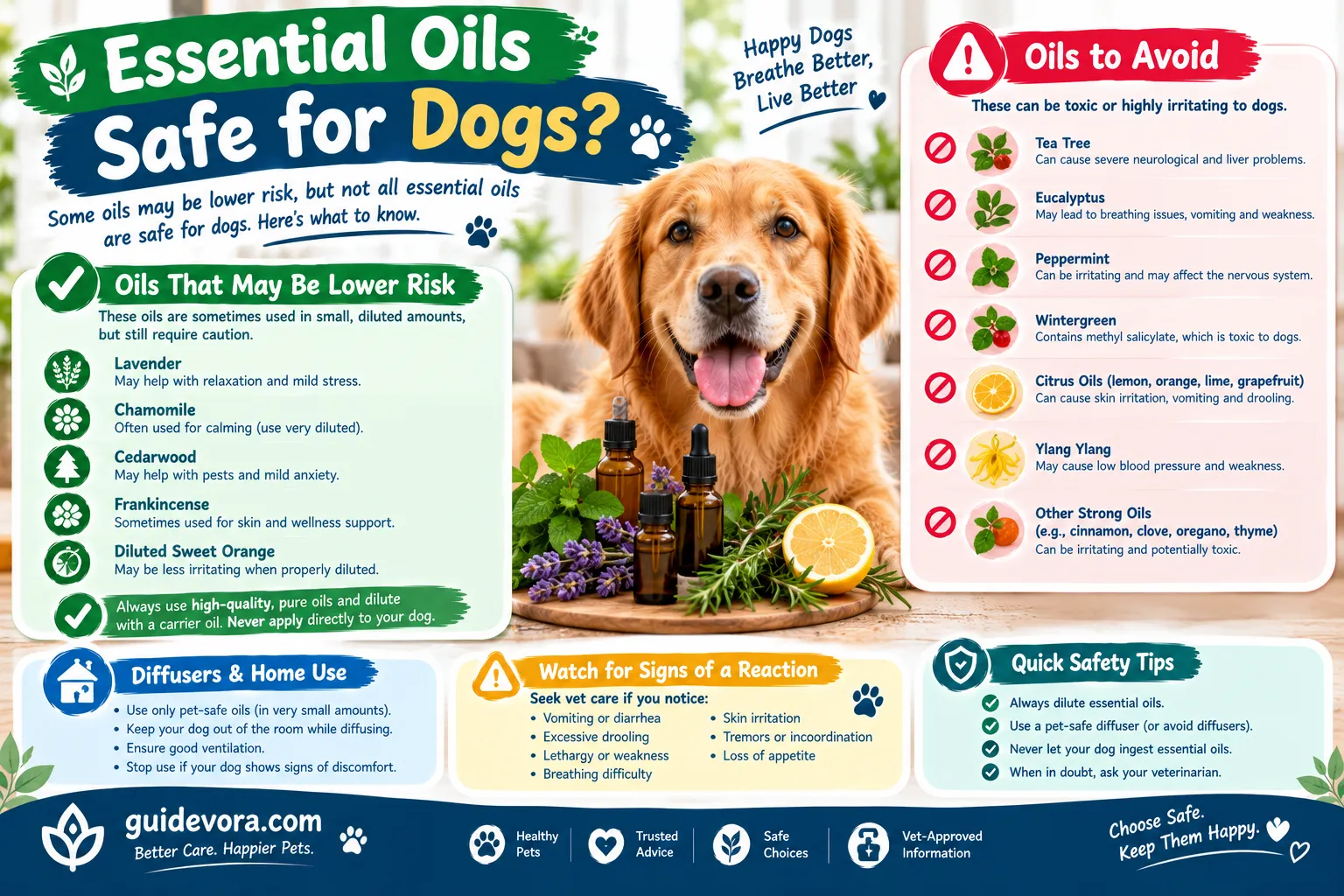
The honest, short answer: a small number of essential oils are considered lower-risk for dogs when heavily diluted and used briefly, but a genuinely important number of popular oils are documented toxicity risks — and if there’s a cat anywhere in the house, the calculation changes completely. Veterinary sources don’t fully agree on where exactly the safe line sits, and this guide reflects that honestly rather than pretending there’s a single settled list.
Essential Oils to Avoid With Dogs — No Real Debate Here
These appear on essentially every veterinary toxic-oil list and have documented poisoning cases behind them:
- Tea tree (melaleuca) — one of the most frequently reported essential oil toxicants in pets; the ASPCA notes as few as 7–8 drops of concentrated (100%) oil can cause serious toxicity in a dog
- Eucalyptus — listed by the Merck Veterinary Manual among oils that can cause seizures in animals
- Peppermint — can cause vomiting, lethargy, and liver damage in concentrated form; even diffused, it can irritate the airways of brachycephalic breeds (Bulldogs, Pugs, and similar flat-faced dogs)
- Wintergreen — chemically related to aspirin; toxic in concentrated form
- Pine
- Cinnamon
- Citrus oils (d-limonene) — different from citrus fruit itself, and specifically the concentrated oil form that’s the concern
- Pennyroyal — among the more dangerous oils on any list; linked to liver failure even in relatively small exposures
- Ylang ylang
Never apply any essential oil directly to a dog’s skin or coat, regardless of which oil it is — direct dermal application is a separate, higher-risk exposure route than ambient diffusion.
Essential Oils Sometimes Described as Lower-Risk
This is where sources genuinely diverge, so read this section as “cautiously permissive,” not “green light”:
The Merck Veterinary Manual and ASPCA guidance generally treats these as lower-risk only at diffusion levels, heavily diluted, for brief sessions, with the dog able to leave the room. The American Kennel Club takes a more conservative position, stating that even commonly-cited “safer” oils like lavender and eucalyptus should generally be avoided entirely rather than used with caveats. Neither position is wrong — they reflect different risk tolerances applied to the same underlying, genuinely limited evidence. The most defensible reading: these oils carry meaningfully lower documented risk than the avoid-list above, but “lower risk” is not the same claim as “safe,” and a specific veterinary go-ahead is the more responsible bar for any individual dog, especially puppies, small breeds, and dogs with existing liver, kidney, or respiratory conditions.
What Essential Oils Are Safe for Cats and Dogs Together?
This is where the answer changes most, and it’s worth being direct about it: if there’s a cat in the household, the safest guidance is to avoid essential oil diffusing altogether, regardless of which oil it is.
Here’s why cats aren’t just “more sensitive dogs” — it’s a different biological mechanism. Cats lack a specific liver enzyme (involved in a process called glucuronidation) that both humans and dogs use to break down and clear certain compounds, including many essential oil constituents. Without it, these compounds can build up to toxic levels in a cat’s system even from exposure levels a dog would tolerate. Cats are also specifically sensitive to phenols and phenolic compounds, found in oils like eucalyptus, tea tree, peppermint, cinnamon, and wintergreen — the same oils already on the dog avoid-list, but at a lower threshold of concern for cats.
Practical takeaway for multi-pet households: don’t look for a cat-and-dog-safe oil list, because the more defensible answer for any home with a cat is to skip essential oil diffusing entirely, or confirm with your veterinarian first given your specific pets, oils, and setup.
Diffusers: What Actually Matters
Diffusing is generally considered a lower-exposure method than direct application, but “lower” isn’t “zero,” and a few specific factors determine real-world risk:
- Session length — Merck Veterinary Manual guidance suggests limiting diffuser sessions to under 30 minutes, with ventilation afterward
- Room access — your dog (or cat) should always have a way to leave the room; never diffuse in a closed space they can’t exit
- Diffuser type — passive diffusers (scent evaporation) are generally lower-risk than active/ultrasonic diffusers that emit fine oil microdroplets directly into the air, which can settle on fur and be ingested during grooming
- A dog’s sense of smell is far more sensitive than a human’s, so “it’s a big house, they’re in another room” isn’t as protective as it sounds — strong scent particles travel further, and further affect a dog, than most owners assume
Signs of Essential Oil Toxicity
Watch for these after any known or suspected exposure:
- Drooling or pawing at the mouth
- Vomiting or diarrhea
- Lethargy or unusual weakness
- Difficulty breathing, coughing, or wheezing
- Wobbliness or muscle tremors
- Redness or irritation on skin that contacted oil directly
What to Do If Your Dog Is Exposed
- Move your dog to fresh air immediately if the exposure is inhalation-related — this is the single most reversible step and the first priority.
- Wipe off any oil that contacted skin or coat with a mild, pet-safe soap and water — don’t use additional chemical solvents.
- Do not induce vomiting without direct veterinary instruction. This is a specific and important distinction from many other toxin exposures: essential oils are oily substances, and vomiting them back up carries a real risk of aspiration pneumonia if any enters the lungs — a separate, serious injury on top of the original exposure.
- Call your vet or the ASPCA Animal Poison Control Center (888-426-4435) immediately for any known ingestion or a concentrated-oil skin exposure, even if your dog seems fine so far.
- Mild symptoms (slight drooling, minor discomfort) may be reasonable to monitor while arranging a same-day vet appointment; severe symptoms (difficulty breathing, seizures, collapse) require immediate emergency care.
Frequently Asked Questions
Are essential oils safe for dogs? Some oils, heavily diluted and used briefly via diffusion, are considered lower-risk by sources like the ASPCA and Merck Veterinary Manual — but several commonly available oils (tea tree, eucalyptus, peppermint, pennyroyal, and others) are documented toxicity risks even at moderate exposure. The AKC’s more conservative position is to avoid essential oils around dogs generally. No oil should ever be applied directly to a dog’s skin or coat.
What essential oils are safe for dogs? Lavender, chamomile, frankincense, and cedarwood (atlas) are the oils most commonly cited as lower-risk at diffusion levels — but this comes with real caveats around dilution, session length, and individual dog sensitivity, and isn’t a universal “safe” list across all veterinary sources.
What essential oils are safe for cats and dogs? There isn’t a confident, agreed-upon list for households with both. Cats lack a liver enzyme dogs and humans use to process many essential oil compounds, making them significantly more sensitive. The safer default in a mixed household is to avoid diffusing essential oils altogether, or check with your vet first.
What essential oils are toxic to dogs? Tea tree, eucalyptus, peppermint, wintergreen, pine, cinnamon, citrus oils, pennyroyal, and ylang ylang are consistently listed as toxic risks across veterinary sources, with tea tree and pennyroyal among the most frequently documented in actual poisoning cases.
Can I use an essential oil diffuser around my dog? Only with real precautions: sessions under 30 minutes, a passive (not active/ultrasonic) diffuser where possible, your dog able to leave the room freely, and avoidance of any oil on the toxic list — and never in a household that also includes a cat, given cats’ significantly higher sensitivity.
What should I do if my dog was exposed to a toxic essential oil? Move them to fresh air, gently wipe any oil off their skin or coat, and call your vet or the ASPCA Animal Poison Control Center (888-426-4435) — do not induce vomiting without direct veterinary instruction, since essential oils carry an aspiration risk that other toxins don’t.
Read More: Can Dogs Eat Cheese? Safe Types, Amounts, and What to Avoid
Final Thoughts
The most accurate answer here isn’t a clean list — it’s a short set of oils with real documented risk to avoid outright, a shorter set sometimes described as lower-risk under specific conditions, and a firm rule that everything changes if a cat shares the home. If you’re set on using essential oils around pets, the safest real-world approach is confirming your specific oil and setup with your veterinarian rather than relying on any single online list — including this one.
This article is for informational purposes and doesn’t replace veterinary guidance for a specific exposure or household situation.
Artifacts
Useful products for dogs that spend a lot of time alone
Document·MD
Dog food for kidney disease
Document·MD
Essential items new dog owner seo v2
Document·MD
Useful cat accessories for small homes
Document·MD
Cat not peeing causes and emergency care
Document·MD
Common dog walking problems and simple solutions
Document·MD
Useful products for dogs home alone v2
Document·MD
How to make your home more comfortable for your dog
Document·MD
Dog is wobbly and off balance
Document·MD
Essential items every new dog owner should have
Document·MD
Cat stung by a bee
Document·MD
Dog ate silica gel packet
Document·MD
How to keep your pets feeding area clean
Document·MD
Dog ate chocolate what to do
Document·MD
Dog ate a bee
Document·MD
Best ways to keep your dog entertained indoors
Document·MD
How to make grooming easier at home
Document·MD
Can dogs eat chocolate
Document·MD
Leave a Reply