
Thanksgiving STEM activities for kids turn the holiday into a hands-on science lab — 15 experiments built around cranberries, pumpkins, turkeys, and balloons, using supplies already in your kitchen. Each activity below takes 10–30 minutes, works for ages 4–12 with simple tweaks, and teaches a real concept: buoyancy, chemical reactions, forces, measurement, or engineering design. No special kit needed — just a pumpkin, a bag of cranberries, some balloons, and curiosity.
Key Facts
- Best ages: 4–12 (every activity includes a younger-kid and older-kid tweak).
- Time per activity: 10–30 minutes; most use only kitchen supplies.
- What kids learn: buoyancy, density, chemical reactions, forces and motion, measurement, and the engineering design process.
- Thanksgiving 2026: Thursday, November 26 — these work for the classroom, the kids’ table, or the long weekend.
- Safety: All activities are adult-supervised; the only hot step is melting candy corn, which an adult handles.
Quotable: “The best Thanksgiving STEM activities for kids don’t look like school — they look like playing with dinner before you eat it.”
Why Thanksgiving Is Perfect for STEM
Thanksgiving hands you a science lab disguised as a holiday. Cranberries float — or do they? Pumpkins are full of seeds to count, weigh, and measure. Cream turns into butter if you shake it long enough. A turkey-shaped balloon races along a string when you let the air out. Every one of these Thanksgiving STEM activities is a genuine experiment, and the holiday theme means kids actually want to do it — unlike a worksheet, which is why these pair so well with our Thanksgiving worksheets for kids rather than replacing them.
The secret is framing. Don’t announce “science time.” Say “let’s find out which Thanksgiving foods float” and let the question do the work. Kids form a hypothesis, test it, and argue about the result — that is the scientific method, and they won’t notice they’re doing it. For classroom use, these also slot neatly into the Thanksgiving classroom activities you may already be running.
1. Cranberry Sink or Float
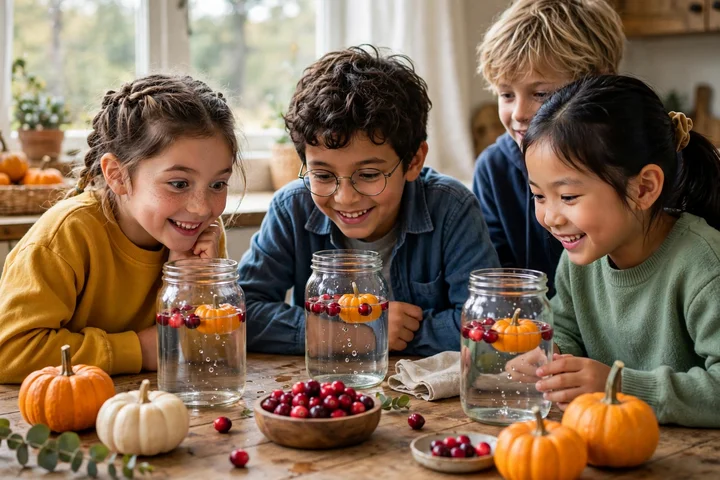
Fill a clear tub with water and gather Thanksgiving foods: fresh cranberries, a grape, a small pumpkin, a walnut, a piece of bread, a carrot stick, a marshmallow. Before each item goes in, every child guesses — sink or float? — and you keep score on a chart.
The surprise: fresh cranberries float. They have four tiny air pockets inside, which is also why good cranberries bounce — the “bounce test” is how growers once sorted them. Kids ages 4–6 love the guessing game; ages 9–12 can measure how much weight a floating cranberry raft (a small foil boat) can hold before it sinks, turning it into a buoyancy engineering challenge. Dry everything off and the cranberries can still go into the sauce afterward.
2. Turkey Balloon Race
Thread a straw onto a long piece of string, tape the string across a room, then tape an inflated balloon (decorated as a turkey with a paper beak and feathers) to the straw. Let go — the escaping air pushes the balloon forward along the string. That’s Newton’s third law, and it is also the loudest, silliest race on this list.
Race two balloons at once for a competition, then change one variable at a time: a bigger balloon, a less-inflated balloon, a heavier paper turkey. Older kids can measure the distance with a tape measure and time it with a phone stopwatch,
then calculate speed. Younger kids just want to race again. Either way, the physics lands.

3. Pumpkin Seed Counting and Measurement
Cut open a pumpkin and scoop out the seeds — then, instead of throwing them away, count them. A medium pumpkin holds roughly 500 seeds, which makes it a perfect estimation lesson: guess first, count in groups of ten, then compare. Weigh the seeds, measure the pumpkin’s circumference with string, and estimate its volume by counting how many cups of water it displaces in a bucket (an adult handles the heavy lifting).
Roast the seeds afterward with a little salt and you’ve turned a math lesson into a snack. Ages 4–6 can sort seeds by size; ages 10–12 can graph seed counts from two or three different pumpkins and look for a pattern — bigger pumpkins don’t always have more seeds, which is a genuinely surprising result.

4. Shake Your Own Butter
Pour heavy cream into a jar with a tight lid, add a pinch of salt, and shake. And shake. After about 10 minutes of shaking, the cream turns to whipped cream, then suddenly separates into butter and buttermilk. Kids can watch the change happen through the glass — a physical change they can feel in their arms.
This is the one activity that doubles as a history lesson: it’s how butter was made before grocery stores, and it connects directly to the first Thanksgiving table. Spread the finished butter on rolls at dinner and let the child who shook it take the credit. For a classroom, pass the jar around so every child gets a turn — teamwork is part of the point.

5. Cranberry Construction Challenge
Give each child 20 cranberries and 20 toothpicks and ask them to build the tallest free-standing tower they can in 10 minutes. Cranberries are round and soft, so the structure wobbles — which forces kids to discover triangles, wide bases, and cross-bracing on their own. That’s engineering design: build, test, improve, rebuild.
Score it two ways: tallest tower, and strongest tower (how many books can it hold?). Photograph each attempt so kids can compare designs. Ages 4–6 will build flat shapes and that’s fine — the challenge scales itself. Use dried cranberries if fresh ones are too soft for the toothpicks.

6. Dissolving Candy Corn
Drop candy corn into three jars — one with water, one with vinegar, one with vegetable oil — and watch. In water it dissolves in minutes, leaving a colorful swirl; in vinegar it fizzes slightly and dissolves faster; in oil it barely changes at all. Ask kids to predict the order before you start, then time each jar.
This is a clean introduction to solvents and polarity for older kids, and pure magic for younger ones. The same experiment works with other Halloween and Thanksgiving candy, so you can run a whole “candy lab” with leftovers. Keep the jars on a tray — vinegar and oil spills are part of the experience.

7. Turkey Parachute Drop
Make a paper turkey, attach it to a coffee filter or a square of tissue paper with strings, and drop it from a staircase or a chair. Then change the parachute: bigger, smaller, two filters, a plastic bag. Which one falls slowest, and why?
Air resistance is the concept, and the competition is irresistible — everyone wants the slowest turkey. Older kids can time the drops and record them in a table; younger kids can decorate their turkeys and judge by eye. It’s the perfect after-dinner activity when the kids need to move and the adults need ten quiet minutes.

8. Pumpkin Volcano
Hollow out a small pumpkin, put a few spoonfuls of baking soda inside, add a squirt of dish soap and a little food coloring, then pour in vinegar. The eruption foams out of the pumpkin’s top like a very festive volcano. The chemistry is the classic acid-base reaction, but the pumpkin makes it Thanksgiving.
Let kids measure the baking soda and vinegar themselves and change the amounts to see what happens — more vinegar, bigger eruption; more baking soda, longer fizz. Do it outside or on a baking tray. Ages 4–6 will shriek with delight; ages 10–12 can be challenged to make the eruption last the longest.
9. Gratitude Engineering: The Tallest Thankful Tower
This one mixes engineering with the holiday’s theme. Using only newspaper and tape, teams build the tallest tower that can hold a small pumpkin on top. The catch: each piece of newspaper must have something the builder is thankful for written on it before it goes into the structure.
It takes about 20 minutes, works brilliantly as a family competition, and produces a tower covered in gratitude notes — a decoration and a lesson in one. The engineering insight kids discover is always the same: a wide base and rolled-paper columns beat a tall, skinny stack every time.
10. Apple Oxidation Race
Cut an apple into slices and leave one plain, one brushed with lemon juice, one in salt water, and one in plain water. Check every 10 minutes: which slice stays white, and which turns brown? The browning is oxidation — the same reaction that rusts iron — and the lemon juice slows it because of its acidity.
Kids can record the color change on a simple chart, and the activity leads naturally into a conversation about why we squeeze lemon on fruit salad. Eat the results at the end (except the salt-water slice — that one is for science only).
11. Feather Float and Fall
Drop a feather and a small rock at the same time and ask which lands first — then drop a feather and a flat sheet of paper. The feather and the paper fall slowly because air pushes against their wide, light surfaces. Then scrunch the paper into a ball and drop it again: same paper, much faster fall. The variable is surface area, and kids can see it change in real time.
Tape feathers to paper turkeys and race them down a ramp for a sillier version. This is a five-minute activity, perfect for the youngest kids or as a warm-up before the bigger experiments.
12. Corn Kernel Dancing
Put a handful of dried corn kernels in a glass of clear soda water (or water with baking soda and vinegar). The bubbles stick to the kernels, lift them to the surface, pop, and the kernels sink again — dancing up and down for several minutes. It’s mesmerizing, it’s buoyancy in action, and it uses the same corn that sits at the center of the Thanksgiving story.
Ask older kids why the kernels rise and fall in a cycle rather than floating once and staying up. The answer — bubbles attach, lift, pop, and the kernel sinks until new bubbles form — is a neat little physics loop.
13. Pumpkin Pie in a Bag
Put graham cracker crumbs, pumpkin puree, and a little whipped topping in a sealed zip-top bag and let kids squish it into a no-bake mini pie. The science is in the states of matter: solid crumbs plus soft puree plus airy topping, mixed by hand into something new — and the math is in the measuring.
It’s messy, edible, and takes ten minutes. For a classroom, pre-measure ingredients into cups so each child gets an identical bag. The result is a snack kids made themselves, which they will insist tastes better than the real pie.
14. Turkey Feather Catapult
Build a simple catapult from a plastic spoon, a rubber band, and a small block, then launch pom-poms or small feathers at a paper turkey target. Change the angle, change the launch force, and see what changes the distance. That’s projectile motion, and it’s the activity the kids will still be playing with an hour later.
Set up a points system on the target and let siblings compete. Older kids can measure launch distances and graph them; younger kids can just enjoy knocking over the turkey. Keep the launch zone pointed away from the good china.
15. The Mayflower Boat Challenge
Give each child a square of aluminum foil and challenge them to build a boat that holds the most “passengers” (pennies or marbles) before sinking. The Mayflower carried 102 passengers across the Atlantic in 1620 — how many can your foil boat carry? The winning design is almost always a wide, flat boat with folded-up edges, which kids discover by trial and error.
This is the best closing activity for the day because it ties the science back to the Thanksgiving story. Test the boats in a tub of water, count the passengers, and crown a winner. For a full history connection, pair it with our Thanksgiving activities for kids for crafts and games that round out the day.
How to Run a Thanksgiving STEM Day
Pick three Thanksgiving STEM activities, not fifteen. A morning of sink-or-float, a butter shake, and a boat challenge is a full day for most kids — trying to do everything is how a fun day becomes a chore. Set up stations if you have a crowd: one table per experiment, kids rotate every 20 minutes, and an adult at each station.
Keep a simple chart on the wall: what we predicted, what happened, what we learned. Kids love seeing their predictions proven right — and proving a prediction wrong is the best science lesson of all. For more structured, classroom-ready material, NASA’s STEM resources at nasa.gov/stem offer free, tested activities that pair well with everything here.
Frequently Asked Questions
What are the best Thanksgiving STEM activities for kids? The best Thanksgiving STEM activities for kids are cranberry sink-or-float, the turkey balloon race, pumpkin seed counting, shaking butter, and the Mayflower foil-boat challenge — all use kitchen supplies, take under 30 minutes, and teach a real concept.
What age are Thanksgiving STEM activities for?
Ages 4–12. Younger kids (4–6) enjoy the guessing, shaking, and splashing; older kids (9–12) can measure, time, graph, and change variables to run real experiments.
Do I need to buy a STEM kit?
No. Every activity here uses things you already have: cranberries, a pumpkin, balloons, cream, foil, toothpicks, and candy corn. A kit is optional, never required.
Are these safe for preschoolers?
Yes, with adult supervision. Avoid small parts like toothpicks and marbles for under-4s, and let an adult handle vinegar, hot water, and anything sharp.
Can I use these in a classroom?
Absolutely — sink-or-float, the butter shake, and the boat challenge all scale to a full class with stations. They complement the Thanksgiving classroom activities most teachers already run in November.
How long does each activity take?
Most take 10–30 minutes. The butter shake is the longest at about 10 minutes of shaking; the feather drop takes five minutes. Plan three activities per session, not fifteen.
Leave a Reply