
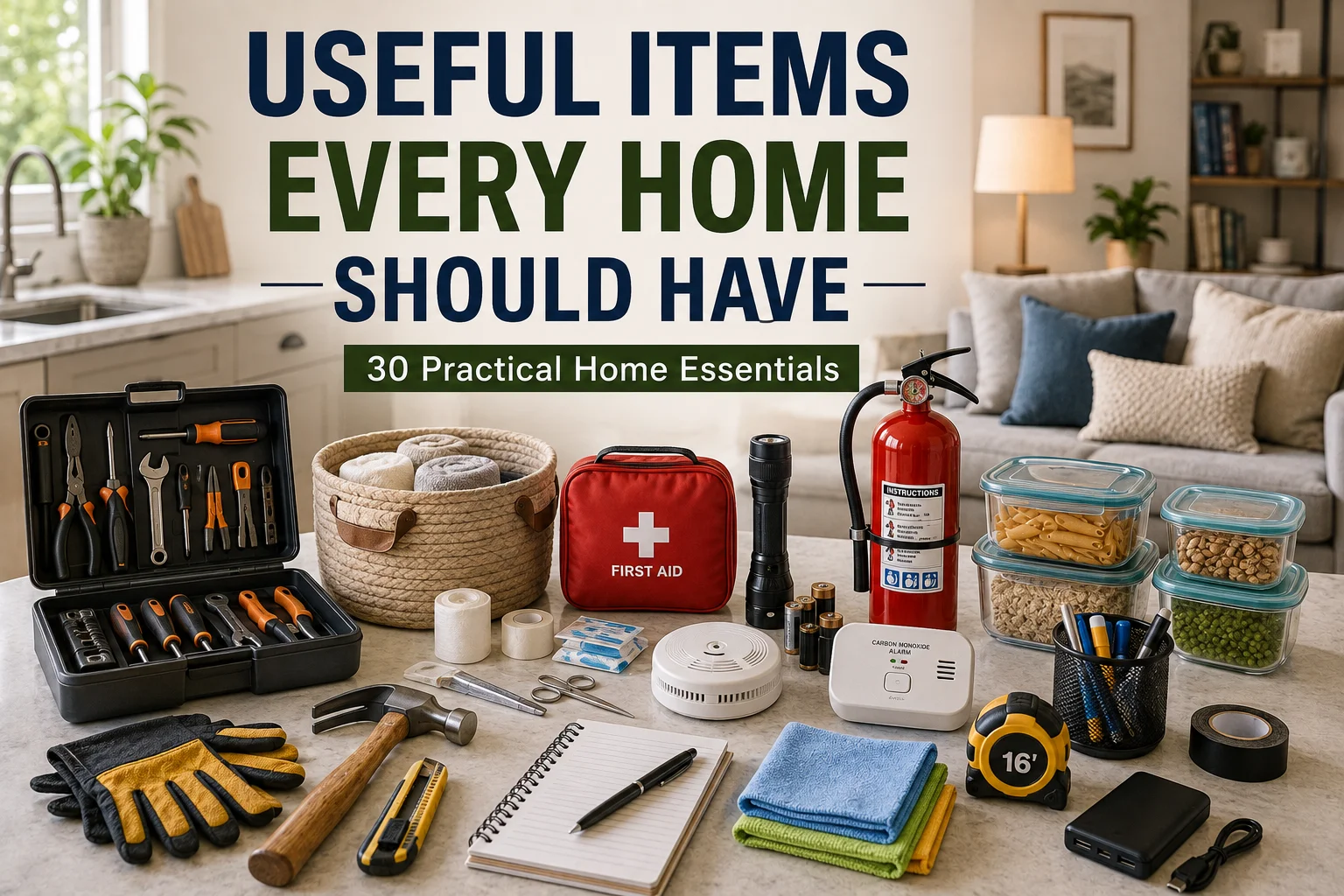
A well-equipped home does not need to be filled with expensive gadgets or products you rarely use. The most useful household items are usually simple things that help with cooking, cleaning, organization, repairs, safety, and everyday emergencies.
The right essentials can save time, prevent small problems from becoming bigger ones, and make your home easier to manage. Instead of buying everything on a typical “must-have” list, focus on items that solve problems you are likely to encounter.
Here are the useful items every home should have, along with what each one is actually good for.
What Should Every Home Have?
Every home has different needs, but a practical basic setup should include items from these categories:
- Basic hand tools
- First-aid supplies
- Smoke and carbon monoxide alarms
- Fire extinguisher
- Flashlights and spare batteries
- Cleaning supplies
- Kitchen essentials
- Food-storage containers
- Basic household repair supplies
- Emergency supplies
- Organization tools
- Basic lighting
- Measuring and maintenance tools
You do not need the most expensive version of every item. Reliability, durability, and ease of use are usually more important than having the latest features.
1. Basic Tool Kit
A basic tool kit is one of the first things worth keeping at home.
You do not need a professional workshop for ordinary household jobs. A small collection of useful tools can handle many basic tasks.
A practical starter kit can include:
- Phillips and flat-head screwdrivers
- Adjustable wrench
- Pliers
- Tape measure
- Utility knife
- Hammer
- Hex keys
- Level
- Screwdriver bits
- Work gloves
These tools can help with assembling furniture, tightening loose hardware, hanging pictures, measuring spaces, and making minor repairs.
A cordless drill can be useful if you regularly work on furniture or home projects, but it is not necessary for every household.
Why a Tool Kit Is Worth Having
Small household problems rarely happen when it is convenient to borrow a tool.
Having basic tools available means you can deal with simple problems immediately instead of turning a loose screw or missing picture hook into a weekend project.
For larger electrical, plumbing, structural, or gas-related work, use a qualified professional rather than attempting repairs beyond your experience.
2. First-Aid Kit
Every home should have a basic first-aid kit.
Useful supplies include:
- Adhesive bandages
- Sterile gauze
- Medical tape
- Antiseptic supplies
- Disposable gloves
- Tweezers
- Scissors
- Instant cold pack
- Digital thermometer
- Basic first-aid instructions
Keep the kit somewhere easy to find.
A first-aid kit is not useful if nobody knows where it is when someone needs it.
Check the contents occasionally and replace supplies that have been used or expired.
3. Smoke Alarms
Smoke alarms are not optional household accessories. They are an important part of home fire safety.
Install smoke alarms according to local requirements and the manufacturer’s instructions, and test them regularly.
The U.S. Fire Administration recommends smoke alarms on every level of a home, inside bedrooms, and outside sleeping areas. It also recommends testing alarms regularly and replacing batteries or the entire unit according to the manufacturer’s guidance. (usfa.fema.gov)
For larger homes, make sure alarms can provide adequate warning throughout the property.
4. Carbon Monoxide Alarm
Carbon monoxide is especially dangerous because it cannot be seen or smelled.
A carbon monoxide alarm can provide an early warning if dangerous levels of the gas are detected.
The U.S. Fire Administration recommends carbon monoxide alarms in central locations outside sleeping areas and on every level of the home. (usfa.fema.gov)
Follow the manufacturer’s installation instructions and replace alarms according to their recommended service life.
If a carbon monoxide alarm sounds, do not simply silence it and continue normal activities. Follow the alarm manufacturer’s emergency guidance and contact emergency services when appropriate.
5. Fire Extinguisher
A properly selected fire extinguisher can be useful for certain small, developing fires.
For a typical home, a multipurpose extinguisher rated for common household fire classes may be appropriate, but homeowners should understand how to use it safely.
The U.S. Fire Administration advises that portable extinguishers are most appropriate for small, contained fires and that people should have a clear escape route before attempting to use one. (usfa.fema.gov)
A fire extinguisher should never become a reason to remain in a dangerous fire.
If the fire is growing, producing heavy smoke, or blocking your escape route, leave immediately and call emergency services.
6. Flashlights
A flashlight is one of the simplest useful items every home should have.
It becomes particularly valuable during:
- Power outages
- Severe weather
- Electrical problems
- Nighttime emergencies
- Basement or attic inspections
Keep at least one flashlight somewhere that is easy to reach in the dark.
A rechargeable flashlight can reduce disposable battery use, while battery-powered models provide another option during extended outages.
7. Spare Batteries
Even if many household devices are rechargeable, batteries are still useful for:
- Flashlights
- Smoke alarms
- Carbon monoxide alarms
- Clocks
- Radios
- Other emergency equipment
Store batteries according to the manufacturer’s recommendations and keep them away from extreme temperatures and moisture.
Check emergency devices regularly so you do not discover dead batteries during an outage.
8. Power Bank
A portable power bank can keep a phone or other small device operating when normal power is unavailable.
It can be useful during:
- Power outages
- Travel
- Severe weather
- Long days away from electrical outlets
Keep it charged and check its condition periodically.
For emergency preparedness, a power bank is most useful when combined with other supplies rather than treated as a complete backup-power solution.
9. Emergency Water and Food Supplies
Every household should consider basic emergency supplies appropriate for its location and household needs.
Ready.gov recommends keeping enough supplies to support household members during an emergency and lists water, food, flashlights, batteries, a first-aid kit, and other basic items among emergency-kit supplies. (ready.gov)
The amount you need depends on:
- Household size
- Climate
- Local hazards
- Medical needs
- Whether you have pets
- How long you may need to remain at home
Store emergency supplies somewhere accessible and check them periodically.
10. Cleaning Supplies
You do not need dozens of specialized cleaning products.
A basic cleaning collection can cover many ordinary household jobs.
Consider keeping:
- Microfiber cloths
- Sponges
- Scrub brushes
- Broom and dustpan
- Mop
- Vacuum
- Bucket
- General-purpose cleaner
- Dish soap
- Bathroom cleaner
- Rubber gloves
- Trash bags
A small collection of versatile cleaning supplies can be easier to store and manage than a cabinet full of products.
Never mix household cleaning chemicals unless the product instructions specifically allow it.
11. Microfiber Cloths
Microfiber cloths are inexpensive and useful throughout the home.
They can be used for:
- Dusting
- Cleaning glass
- Wiping counters
- Cleaning appliances
- Polishing suitable surfaces
Keep separate cloths for different cleaning jobs when appropriate, particularly for kitchens and bathrooms.
Wash reusable cloths according to their care instructions rather than continually replacing them.
12. Food Storage Containers
Reusable food containers make leftovers and prepared ingredients easier to store.
Choose containers in several practical sizes rather than buying an enormous collection.
Look for:
- Secure lids
- Easy-to-clean surfaces
- Stackable designs
- Appropriate food-contact materials
- Sizes that fit your refrigerator
Do not buy containers simply because they look organized.
They should fit the way you actually store food.
13. Digital Food Thermometer
A digital food thermometer is a small kitchen tool that provides useful information rather than relying on guesswork.
It can help you determine whether food has reached the appropriate internal temperature.
The USDA Food Safety and Inspection Service recommends using a food thermometer to check whether food has reached a safe internal temperature. (fsis.usda.gov)
This is particularly useful when cooking meat and poultry.
14. Kitchen Measuring Tools
A basic set of measuring cups and spoons is useful for cooking and baking.
A digital kitchen scale can also be valuable, particularly for recipes that use weight measurements.
Useful measuring tools include:
- Measuring cups
- Measuring spoons
- Liquid measuring cup
- Kitchen scale
- Measuring jug
You do not need every specialized measuring tool sold in kitchen stores.
Start with the tools you are likely to use regularly.
15. Sharp Kitchen Knife
A good chef’s knife is generally more useful than a large collection of specialized knives.
A basic kitchen knife setup might include:
- Chef’s knife
- Paring knife
- Serrated bread knife
Keep knives clean, dry, and properly stored.
A knife that is comfortable to use and maintained correctly can handle a wide range of everyday food-preparation tasks.
16. Cutting Board
A sturdy cutting board protects countertops and gives you a stable surface for food preparation.
Consider keeping separate boards or following appropriate cleaning practices when handling raw meat and foods that will be eaten without further cooking.
Choose a size that provides enough working space without becoming difficult to clean or store.
17. Basic Food Storage and Refrigerator Thermometer
A refrigerator thermometer is inexpensive but useful because the temperature shown by a refrigerator control may not tell you the actual internal temperature.
The FDA recommends keeping a refrigerator at 40°F or below and a freezer at 0°F. It also recommends using an appliance thermometer to monitor temperatures. (fda.gov)
This small item can help you identify a temperature problem before food safety becomes a concern.
18. Extension Cord and Power Strip
A quality power strip can be useful for electronics, but it should not be treated as a universal solution for high-power appliances.
Use electrical products according to their ratings and manufacturer’s instructions.
Avoid overloading outlets or power strips.
For appliances that draw significant power, use the appropriate outlet and electrical setup rather than relying on an inexpensive extension cord.
If you are unsure whether a device can safely be connected to a particular circuit, consult a qualified electrician.
19. Storage Bins and Baskets
Storage bins are useful for keeping similar items together.
They can organize:
- Seasonal clothing
- Toys
- Cleaning supplies
- Office materials
- Tools
- Small household items
Measure the available storage area before buying containers.
The right storage bin is one that fits the space and makes items easier to find.
20. Basic Lighting
Every home needs reliable lighting beyond the main ceiling fixtures.
Useful options include:
- Table lamps
- Floor lamps
- Under-cabinet lighting
- Closet lights
- Night lights
- Rechargeable emergency lights
Layered lighting can make rooms easier to use because you can adjust the light according to the activity.
A reading area, for example, needs different lighting from a hallway.
21. Tape Measure
A tape measure is one of the most useful low-cost household tools.
You can use it when:
- Buying furniture
- Hanging pictures
- Planning storage
- Measuring windows
- Checking appliance spaces
- Rearranging rooms
Measure before buying furniture.
Many small home problems begin with assuming something will fit.
22. Level
A small spirit level helps you install shelves, pictures, mirrors, and other items more accurately.
It is particularly useful when several objects need to line up.
A level is inexpensive and takes very little storage space, making it a practical addition to a basic tool kit.
23. Utility Knife
A utility knife can handle many everyday jobs, including:
- Opening packages
- Cutting cardboard
- Trimming materials
- Small household projects
Store it safely and keep replacement blades away from children.
Use the correct blade and technique for the material you are cutting.
24. Plunger
A plunger is one of those household items you may not think about until you need one.
Keep an appropriate plunger available for toilet and drain problems.
Using the correct type for the fixture can make a difference.
Do not repeatedly force a blockage when the underlying plumbing problem may require professional attention.
25. Basic Hardware
A small collection of common hardware can save unnecessary trips to the store.
Consider keeping:
- Assorted screws
- Wall anchors
- Picture hooks
- Nails
- Washers
- Nuts and bolts
- Zip ties
- Adhesive hooks where appropriate
Store them in a divided container so you can identify what you have.
26. Duct Tape and Electrical Tape
Tape can be useful for temporary household fixes and organization.
Duct tape can help with certain temporary repairs and securing materials.
Electrical tape has specific uses around electrical components, but it should never be treated as a substitute for proper electrical repair.
For electrical faults, damaged wiring, or unsafe outlets, contact a qualified electrician.
27. Step Stool
A stable step stool can make it easier to reach high cabinets, shelves, and storage areas.
Choose one appropriate for the height and tasks you need.
Do not stand on chairs or unstable furniture as a substitute for a proper step stool.
28. Laundry Basket
A laundry basket is simple, but it earns its place in most homes.
Choose a size that fits your laundry routine and storage space.
If several household members share laundry responsibilities, separate baskets can make sorting and transportation easier.
29. Reusable Shopping Bags
Reusable shopping bags are useful for groceries and other everyday purchases.
Keep them in a location where you will actually remember them.
A bag hidden in a distant closet is less useful than one stored near the door or another place that fits your routine.
30. Basic Emergency Information
One of the most useful things to have at home is not a physical product.
Keep important information accessible, including:
- Emergency contacts
- Medical information where appropriate
- Insurance information
- Utility contact information
- Important household instructions
- Copies of essential documents
Digital copies can be useful, but important information should not depend entirely on one device or account.
What Should You Buy First?
If you are setting up a home from scratch, do not buy everything at once.
Start with the essentials that solve the most likely problems.
First priority
- Smoke alarms
- Carbon monoxide alarms
- First-aid kit
- Basic tool kit
- Flashlight
- Fire extinguisher
- Basic cleaning supplies
- Kitchen essentials
Second priority
- Food-storage containers
- Refrigerator thermometer
- Step stool
- Storage bins
- Power bank
- Additional lighting
- Basic hardware
Buy as needed
- Specialized kitchen tools
- Specialty cleaning equipment
- Advanced smart-home products
- Large quantities of storage containers
- Specialized repair tools
This approach saves money and prevents your home from becoming a collection of products you rarely use.
What Should Every Home Have for Emergencies?
A basic emergency kit should be adapted to your location and household.
Ready.gov recommends considering supplies such as water, food, a flashlight, batteries, a first-aid kit, a whistle, local maps, and other items based on individual needs. (ready.gov)
Depending on where you live, you may also need supplies for:
- Power outages
- Hurricanes
- Tornadoes
- Winter storms
- Flooding
- Wildfires
- Extreme heat
Do not build an emergency kit based on a generic checklist alone.
Consider the risks that are realistic for your area.
How to Avoid Buying Unnecessary Household Items
A common mistake is buying products because they are marketed as “must-haves.”
Before buying something, ask:
What problem does this solve?
How often will I use it?
Do I already own something that does the same job?
Where will I store it?
Will it require maintenance?
A home with fewer useful items can function better than a home packed with products that rarely get used.
Frequently Asked Questions
What are the most useful items every home should have?
The most useful household essentials include a basic tool kit, first-aid kit, smoke alarms, carbon monoxide alarms, fire extinguisher, flashlights, cleaning supplies, kitchen basics, food-storage containers, and emergency supplies.
What should I buy for my first home?
Start with safety equipment, basic tools, cleaning supplies, kitchen essentials, bathroom necessities, and emergency supplies. Add specialized products only when you discover a specific need.
What tools should every homeowner have?
A practical starter tool kit should include screwdrivers, pliers, an adjustable wrench, hammer, tape measure, utility knife, level, hex keys, and basic hardware.
What emergency supplies should I keep at home?
Consider water, shelf-stable food, flashlights, batteries, a first-aid kit, power banks, essential medications, important documents, and supplies appropriate for local hazards. Ready.gov provides a broader emergency-kit checklist.
Does every home need a carbon monoxide alarm?
Homes that can be exposed to carbon monoxide should have appropriate carbon monoxide detection. The U.S. Fire Administration recommends CO alarms in central locations outside sleeping areas and on every level of the home.
What kitchen items are most important?
Start with a good chef’s knife, cutting board, cookware, basic utensils, measuring tools, food-storage containers, and a digital food thermometer. Add specialty tools based on what you actually cook.
How many cleaning products does a home need?
Most homes do not need a large collection of specialized cleaners. A small selection of appropriate multipurpose and task-specific products, along with microfiber cloths, brushes, a vacuum, broom, and mop, can cover many everyday cleaning jobs.
What should I keep in a basic home tool kit?
A basic tool kit should include screwdrivers, pliers, an adjustable wrench, hammer, tape measure, utility knife, level, hex keys, and assorted screws and wall anchors.
Final Thoughts
Useful household items do not have to be complicated.
A good home has the basics needed to stay safe, clean, organized, and functional. Start with safety equipment, basic tools, cleaning supplies, kitchen essentials, and emergency supplies. Then add other products according to your actual lifestyle.
The most important rule is simple:
Buy for real household needs, not because something is marketed as a must-have.
A small collection of reliable items that you use regularly is more valuable than a crowded home full of products that seemed useful when you bought them.
For safety-related items, follow manufacturer instructions and current local requirements. For emergencies, tailor your supplies to your household and local risks rather than relying on a generic list.
Leave a Reply