
Here’s how to play dreidel in one minute: everyone puts a token in the pot, players take turns spinning the four-sided top, and each of the four Hebrew letters tells you to take all, take half, take nothing, or add a token. That is genuinely the whole game — and once you know how to play dreidel, you can teach it to anyone in less time than it takes the candles to burn down. Below are the full rules, what each letter means, how to set up, the story behind the game, and variations for kids.

Key Facts
- Players: 2 or more — the more, the merrier; no upper limit.
- You need: one dreidel and equal piles of tokens per player (chocolate gelt, nuts, raisins, or pennies).
- The four letters: nun (nothing happens), gimel (take all), hey (take half), shin (put one in).
- A round: everyone antes one token; players spin in turn until one player holds everything (or set a time limit).
- The deeper meaning: the letters stand for Nes Gadol Haya Sham — “a great miracle happened there.”

The 4 Hebrew Letters & What They Mean
A dreidel has four sides, each stamped with a Hebrew letter. Outside Israel the letters are nun (נ), gimel (ג), hey (ה), shin (ש). (In Israel, the fourth side is peh instead of shin — more on that below.) Each letter is both a game instruction and an initial:
| Letter | Name | When you spin it | Meaning |
|---|---|---|---|
| נ | Nun | Nothing — pass the dreidel | Nisht — “nothing” (Yiddish) |
| ג | Gimel | Take everything in the pot | Gantz — “all” |
| ה | Hey | Take half the pot (round up if odd) | Halb — “half” |
| ש | Shin | Put one of your tokens into the pot | Shtel — “put in” |
Together, the four initials spell out Nes Gadol Haya Sham — “a great miracle happened there” (in the Land of Israel). Israeli dreidels replace shin with peh (פ) so the phrase reads Nes Gadol Haya Po — “a great miracle happened here.” Either way, every spin of the top is a tiny retelling of the Hanukkah story. For more background on the holiday’s traditions, MyJewishLearning’s dreidel guide is a clear, reliable reference.

What You Need to Set Up
- A dreidel (or one per player, though sharing works fine). Wood, plastic, or metal — size doesn’t matter.
- Tokens, 10–15 per player, all starting equal. Traditional choices: chocolate gelt (gold-foil coins), nuts, raisins, dried beans, or pennies. Chocolate gelt is the classic because it’s also the prize and the snack.
- A flat spinning surface — a table or tray. Dreidels that fall off the table are re-spun, by universal house rule.
The ante: each player puts one token into the center pot. When the pot runs low (one token or empty), everyone antes again.
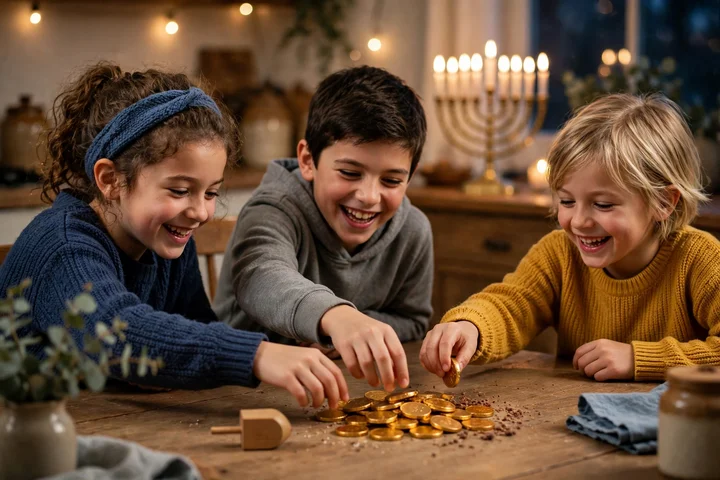
How to Play: Step by Step
- Gather and ante. 2+ players sit in a circle; everyone places one token in the pot.
- Youngest spins first (tradition!), then play passes clockwise.
- Spin the dreidel with a flick of the fingers and wait for it to land.
- Follow the letter:
- Nun: nothing happens. Pass the dreidel. (The Yiddish mnemonic kids learn: “nun means nisht.”)
- Gimel: jackpot — take the entire pot. Everyone then antes one token to rebuild it.
- Hey: take half the pot. If the pot has an odd number, round up in your favor.
- Shin: put one of your tokens into the pot. (Some families play “put in two” for a faster, swingier game.)
- Pass and repeat. The game continues until one player has won all the tokens — or, for a calmer evening, until a set time runs out, at which point the player with the most tokens wins.
House rules worth agreeing on first: what happens on shin (one or two tokens in?), whether fallen dreidels re-spin, and whether the game ends at total victory or a time limit. Five seconds of agreement prevents twenty minutes of debate.

Quotable: “Nun means nothing, gimel means everything — and somehow a two-thousand-year-old top still decides it all.”
The Story Behind the Game
Legend traces the dreidel to the darkest days of the Hanukkah story. When the Seleucid king Antiochus IV outlawed Jewish practice in the 2nd century BCE — including the study of Torah — Jews are said to have gathered in secret to study. They kept a small spinning top at hand: if soldiers approached, the scrolls vanished and the “gamblers” were just passing time. Whether or not every detail is historically precise, the story captures something real: a game born from the determination to keep learning under persecution.
The letters’ message — a great miracle happened there — ties every spin back to the Temple oil that burned for eight days. To read the full history of the Maccabees and the miracle, see what is Hanukkah.
Playing With Young Kids
Dreidel is one of the rare games genuinely good for ages 4 and up:
- Simplify: for very young children, play “gimel wins a candy” rounds or just practice spinning — the flick itself is half the fun.
- No tears version: play for small, equal prizes rather than winner-takes-all, or set a timer and declare everyone with tokens a winner.
- Chocolate math: hey’s “take half, round up” is sneaky arithmetic practice. Teachers have used dreidel in December classrooms for exactly this reason.
- Let them ante the gelt: kids love the ceremony of placing their own chocolate coin in the pot — and eating the evidence afterward.

Dreidel Variations Worth Trying
- The Israeli dreidel: with peh instead of shin, the acronym becomes “a great miracle happened here.” If you buy a dreidel in Jerusalem, this is what you’ll get — the rules are identical.
- Speed rounds: everyone spins simultaneously; fastest game in the house wins the pot.
- Story dreidel: each spin, the player adds one sentence to a collaborative Hanukkah story — gimel means your character finds treasure, shin means trouble arrives.
- Tournament night: with a big family, run a bracket across the eight nights — one champion per night, grand final on night eight.
The Dreidel Beyond the Game Table
The little top has escaped the game table entirely. Oversized dreidels spin in town squares each December as public art. Collectors prize antique silver and brass dreidels, some centuries old, that were once a family’s most precious Hanukkah object. Jewelry designers cast tiny dreidels as pendants; pastry chefs pipe them onto cupcakes. The shape itself — four flat faces around a stem — has become visual shorthand for the holiday, as recognizable as the menorah’s branches.
There’s a reason it endures as a symbol, not just a pastime. The dreidel is Judaism’s smallest history lesson: persecution survived, learning preserved, and a miracle encoded in four letters. Long after the chocolate gelt is gone and the candles have burned down, the top sits on the shelf — a reminder that some games are really about remembering.
Make It a Full Hanukkah Evening
Dreidel shines brightest as part of the classic sequence: light the candles, then play while they burn. The flames need about 30 minutes, which is exactly one good dreidel session — and the traditional table is already set with the game’s natural refreshments. Our Hanukkah dinner menu covers the latkes, sufganiyot, and brisket that turn a game night into a feast, and if you’re scheduling the evening, check when Hanukkah falls in 2026 for the night-by-night dates.

Quotable: “The dreidel is history you can hold: four letters, one miracle, and a game that outlasted an empire.”
Frequently Asked Questions
How to play dreidel — what are the basic rules?
Each player antes one token into the pot and takes turns spinning. Nun = do nothing, gimel = take all, hey = take half, shin = put one in. Play until one player has all the tokens or time runs out.
What do the 4 letters on a dreidel mean?
Nun (נ) = nothing, gimel (ג) = take everything, hey (ה) = take half, shin (ש) = add a token. Their initials spell Nes Gadol Haya Sham — “a great miracle happened there.”
Why does the Israeli dreidel have a different letter?
In Israel the fourth side is peh (פ) instead of shin, making the phrase Nes Gadol Haya Po — “a great miracle happened HERE.” The rules are the same.
What do you use for dreidel tokens?
Chocolate gelt (gold-foil coins) is traditional; nuts, raisins, dried beans, or pennies all work. Give each player 10–15 tokens to start.
How does a dreidel game end?
Traditionally when one player wins all the tokens. For a shorter game, set a time limit (20–30 minutes) and the player with the most tokens wins.
What is the story behind the dreidel?
Legend says Jews under Antiochus IV’s persecution studied Torah in secret, spinning a top to look like gamblers if soldiers approached. The letters encode the Hanukkah miracle: “a great miracle happened there.”
Leave a Reply