
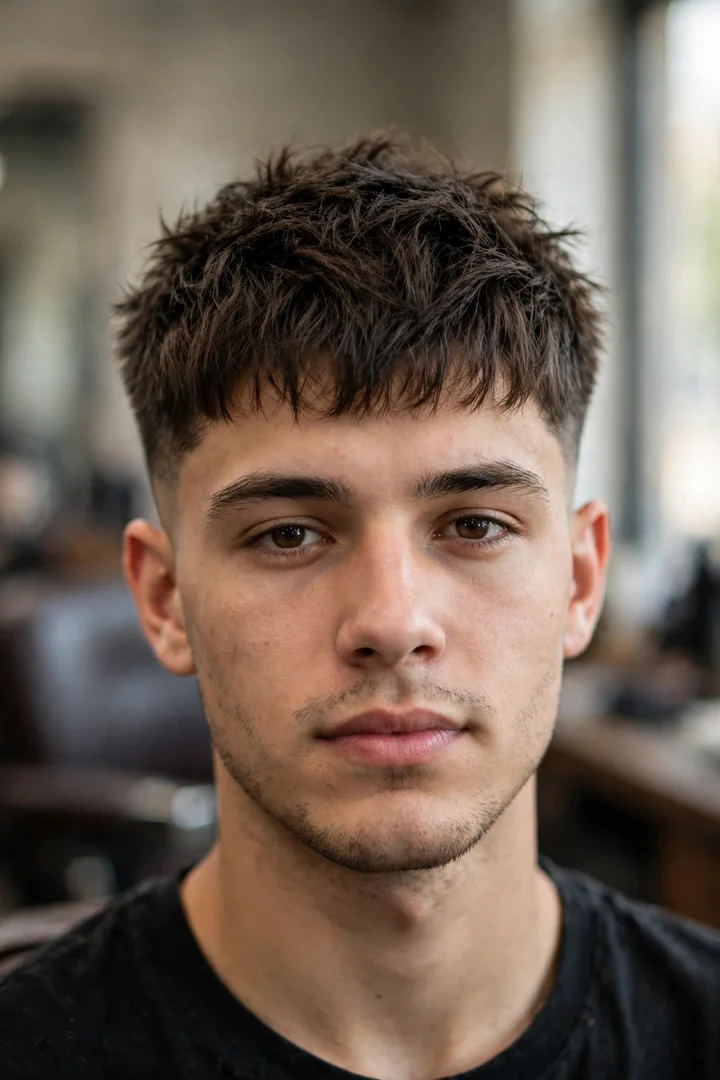
The textured crop for men is a short, choppy haircut with faded sides and a matte, piece-y top that suits almost every face shape — and it takes under five minutes to style. If you want one cut in 2026 that looks deliberate with minimal effort, this is it: no fussy blow-drying, no high-shine product, just texture that works with your hair instead of against it.

Key Facts
- What it is: short length on top (roughly 1–3 inches) cut with point-cutting or thinning shears for a choppy, piece-y finish, paired with faded or tapered sides.
- Best for: straight, wavy, and thick hair; works on round, square, oval, oblong, and heart face shapes with small adjustments.
- Styling time: under 5 minutes with a pea-sized amount of matte clay or paste — no blow-dryer required.
- Maintenance: a trim every 3–4 weeks keeps the shape; the grow-out is forgiving compared to most short cuts.
- The 2026 update: softer, less severe than the old military crop — more movement on top, lower-contrast fades, natural matte finish.
What Exactly Is a Textured Crop?
Strip away the barbershop jargon and the textured crop for men is beautifully simple: hair left long enough on top to show movement, cut in a way that creates separation and piece-iness, with the sides taken down in a fade or taper so the whole thing looks clean from every angle. The “texture” comes from how the top is cut — point-cutting (snipping into the ends vertically), slide-cutting, or thinning shears — rather than from product alone. That’s an important distinction. A blunt-cut top styled with product can fake texture for a day; a properly texturized top has texture built into the haircut itself, which is why it still looks good on day two or three.
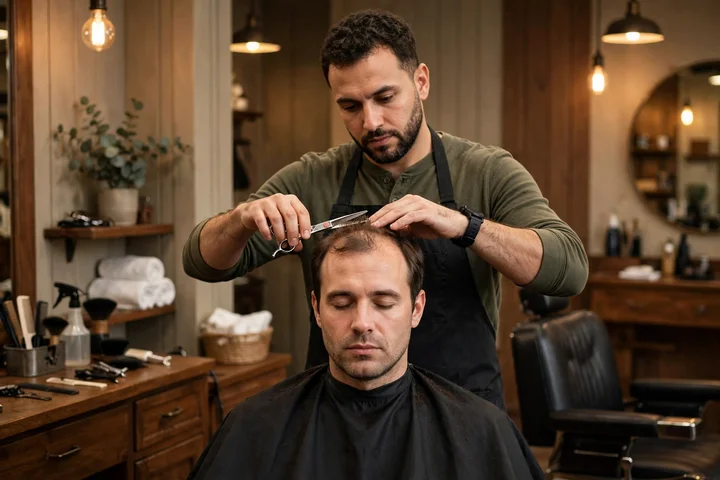
The classic version keeps the top around 1.5 to 2.5 inches with a mid or low fade on the sides. The fringe — the hair along the forehead — is usually left slightly forward and choppy rather than swept up. That forward fringe is doing quiet work: it shortens the appearance of a long forehead, adds edge to the silhouette, and gives the cut its modern character. Push it too far forward and it reads dated; keep it soft and broken up and it reads 2026.
Quotable: “A textured crop is the haircut equivalent of a well-worn leather jacket — it looks better the less you fuss over it.”
What separates the 2026 version from the crops of five years ago is softness. The old crop was severe: harsh lines, aggressive skin fades, helmet-like tops. Today’s version keeps the architecture but relaxes it — the fade blends lower, the top has more length and movement, and the finish is matte and touchable instead of shellacked. It photographs well, it survives a windy commute, and it doesn’t collapse by 3 p.m.
Why It Flatters Almost Every Face Shape
Few cuts are genuinely versatile, but the textured crop earns the claim because the barber can tune three variables — top length, fringe direction, and fade height — to balance whatever face shape walks into the chair.
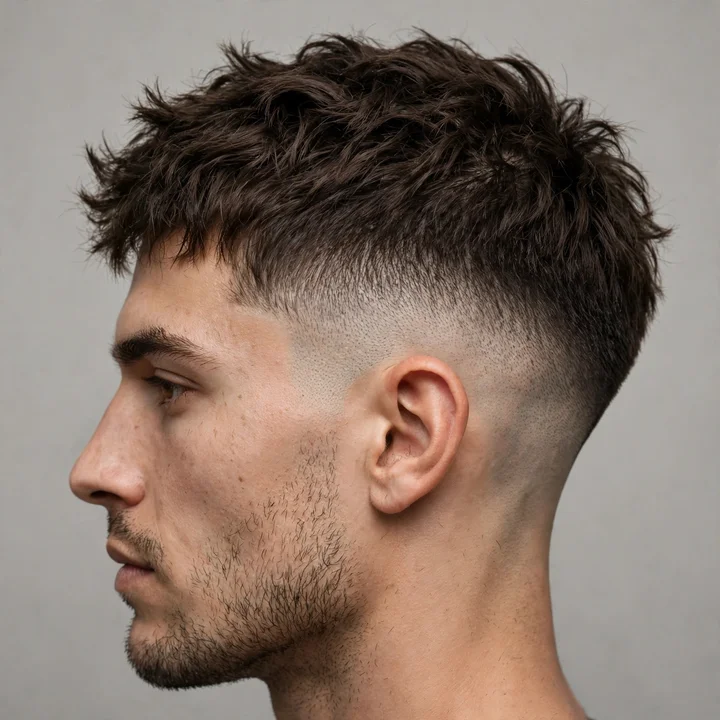
Round faces
The goal is height and angles. Ask for extra length on top (closer to 3 inches) worn slightly forward and textured, with a mid-to-high fade on the sides. The added height on top visually lengthens the face, while the tight sides keep width in check. Avoid a low fade with a flat top — that combination widens rather than lengthens.
Square faces
You already have the jawline everyone else is trying to fake, so the crop’s job is to complement, not compete. A mid fade with a textured top worn forward softens the forehead without hiding the jaw. Keep the fringe broken and piece-y rather than a heavy straight line, which can make a strong jaw look boxy.
Oval faces
The lucky ones — nearly any version works. The only real rule is proportion: don’t take the sides too tight with too much length on top, or the oval stretches into oblong territory. A classic mid fade with 2 inches of texture on top is the sweet spot.
Oblong and rectangular faces
Here the crop needs to avoid adding height. Keep the top shorter (1–1.5 inches), wear the fringe forward to visually shorten the forehead, and choose a low fade rather than a high one — tight high sides on a long face emphasize length. The forward fringe is your best friend.
Heart-shaped faces
Width at the forehead, narrow at the chin. The fix is volume through the top and softness at the temples — a textured top with some width, a low-to-mid fade, and a fringe that isn’t too heavy. Avoid skin-tight sides that exaggerate the forehead-to-chin taper.
What to Ask Your Barber: The Exact Script
Walking in and saying “textured crop” gets you something in the family, but the difference between a decent crop and a great one is specificity. Use this script, adjusted to your face shape notes above:
“I want a textured crop — about two inches on top, point-cut for texture, fringe worn forward and choppy. Mid fade on the sides, blended, not too high. Taper the neckline naturally, no hard line at the back.”
Then add the personalizers: show two or three reference photos (same hair type as yours — this matters more than anything), mention how you style it day to day (“I just use clay, no blow-dryer”), and be honest about your hairline. A good barber will adjust the fringe to work with a maturing hairline rather than against it — which brings us to an important point.
If your hairline is receding, the crop is actually one of the smarter choices: the forward, textured fringe camouflages early recession far better than a slicked-back style that exposes it. But camouflage has limits. If the hairline is actively moving, the American Academy of Dermatology recommends seeing a dermatologist early — treatments for hair loss work best when started at the first signs, not years later. A haircut can buy you time and confidence; a dermatologist can buy you options.
Bring photos. Seriously. “Textured” means ten different things to ten different barbers, and a 30-second photo exchange prevents a 3-week regret.
How to Style It in Under 5 Minutes
The whole point of the textured crop for men is that the cut does the heavy lifting. Your morning routine should be almost boring:
Step 1 — Start with dry or nearly dry hair. The crop styles best on hair that’s 90% dry. If you shower in the morning, towel-dry thoroughly and give it five minutes. Styling soaking-wet hair with matte product gives you a sticky, flat result.
Step 2 — A pea-sized amount of matte clay or paste. Warm it between your palms until it disappears — no white streaks. Less is more; you can always add a touch more, but too much product kills the piece-y separation and makes the top look greasy by noon.
Step 3 — Work it through, roots to ends. Push your fingers through the top from front to back, lifting at the roots. Then pinch small sections and twist slightly — that’s what creates the separated, piece-y texture. Don’t comb it; combs undo texture.
Step 4 — Set the fringe forward. Pull the front pieces slightly forward and let them fall naturally. If a piece misbehaves, leave it — the crop is supposed to look a little undone. Perfection is the enemy of this haircut.
Step 5 — Walk away. Seriously. The more you touch it during the day, the flatter it gets. Matte clay has a reworkable hold, so if it collapses after lunch, just ruffle it with dry hands and it springs back.
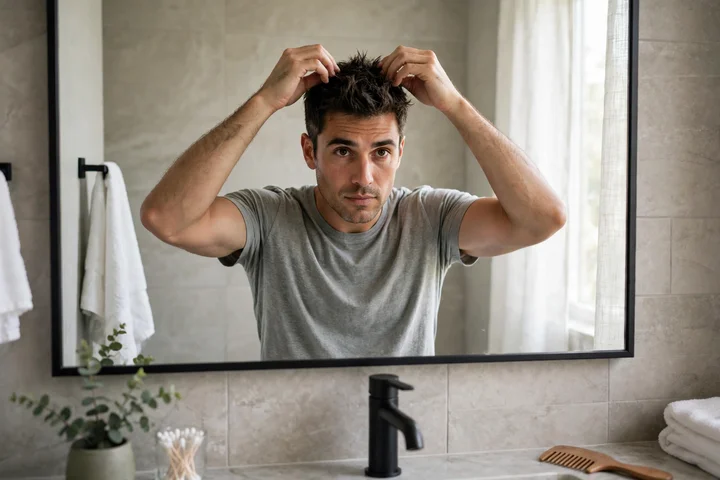
No blow-dryer, no round brush, no three-product cocktail. If your current routine takes longer than making coffee, you’re overdoing it.
Quotable: “The best styling product for a textured crop is restraint — a little clay, a little chaos, and the discipline to stop touching it.”
Growing It Out (Without the Awkward Phase)
Every short cut eventually faces the grow-out, and the crop handles it better than most because texture disguises uneven lengths. The plan: stretch trims to every 5–6 weeks, and ask the barber to clean up only the sides and neckline while letting the top grow. This keeps you looking intentional while the top gains the length it needs for its next life.

Where’s it headed? Around the 3–4 inch mark on top, you have options. Let it keep growing toward a curtain haircut for men with a middle part, or keep the sides tight and ride it out as a longer textured style. The in-between months — when the top is long enough to flop but too short to style back — are managed with a touch more product and a willingness to let it be a little shaggy. Shaggy with clean sides reads intentional; shaggy all over reads neglected. Keep the neckline and sideburns tidy and nobody questions the plan.
5 Mistakes That Ruin a Textured Crop
1. Too much product. The number-one crop killer. Heavy product glues the texture together into a solid helmet. Start with half what you think you need.
2. The wrong fade height for your face. A high skin fade on a long face, a low taper on a round face — the fade is half the haircut, and it has to match the face shape notes above.
3. A blunt, heavy fringe. If the barber cuts the fringe straight across with no texturizing, you get a Lego-man hairline. Ask for it point-cut and broken up.
4. Waiting too long between trims. The crop’s shape lives in the contrast between the textured top and clean sides. Past week five, the sides blur into the top and the whole thing goes shapeless. Book the next appointment before you leave the shop.
5. Fighting your hair type. Very curly hair can absolutely wear a crop, but it needs more length on top (3+ inches) and a barber who cuts curls dry or stretched. Forcing tight curls into a 1-inch crop is a recipe for a shape you didn’t ask for.

If the crop ever feels too short or too severe, its shorter cousin — the modern buzz cut for men — is worth a look for the truly low-maintenance, while the wolf cut for men sits at the opposite end for anyone tempted by longer, wilder texture.

Frequently Asked Questions
How long does a textured crop for men take to style each morning?
Under five minutes. Towel-dry, a pea-sized amount of matte clay worked through with fingers, fringe pushed forward — done. No blow-dryer needed.
Is the textured crop good for thin or thinning hair?
Yes, with caveats. The choppy texture creates the illusion of density, and a forward fringe camouflages early recession. But very advanced thinning needs a different strategy — shorter all over, or a dermatologist’s input.
What should I ask my barber for a textured crop?
“About two inches on top, point-cut for texture, choppy fringe worn forward, mid fade on the sides, tapered neckline.” Bring reference photos showing your hair type.
How often does a textured crop need trimming?
Every 3–4 weeks to keep the shape crisp. You can stretch to 5–6 weeks during a grow-out if the barber tidies just the sides and neckline.
Does the textured crop work on curly hair?
Yes — keep more length on top (3+ inches) so the curls have room to form their pattern, and find a barber experienced with cutting curly hair. The texture technique adapts well to curls.
What’s the difference between a textured crop and a French crop?
They’re close cousins. The French crop traditionally has a blunt, straight fringe; the textured crop’s fringe is choppy and piece-y. In 2026, most barbers use the terms interchangeably, so reference photos matter more than the name.
Leave a Reply