

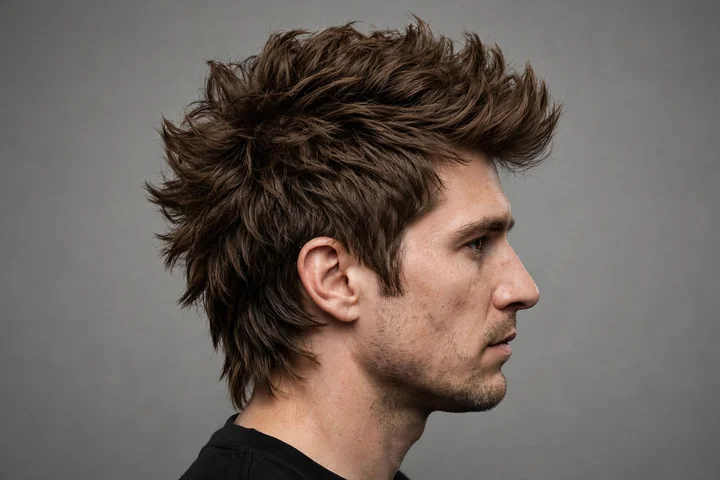
The wolf cut for men is a shaggy, heavily layered haircut with volume on top that tapers into longer length at the back — the lovechild of a shag and a mullet, minus the extreme. In 2026 it’s been tamed just enough for real life: all the texture and movement, without looking like a costume.

Key Facts
- What it is: short, choppy layers through the crown and top blended into longer layers at the back and sides — volume up top, length at the nape.
- Best for: wavy and curly hair (the cut’s natural allies); straight hair works with texturizing and styling effort; needs medium density or better.
- Styling time: 5–10 minutes with salt spray or curl cream, often air-dried — the messier, the better.
- Maintenance: a shape-up trim every 6–8 weeks; the grow-out is graceful because shag grows into shag.
- The 2026 update: softer than the viral 2021 version — less dramatic mullet contrast, more wearable blending, cleaner perimeters.
Shag + Mullet, Explained Without the Fear
The name does the cut no favors — “wolf” sounds feral, and “mullet” carries decades of baggage. So let’s demystify it. A shag is a haircut built on layers of many lengths, designed to create volume and movement. A mullet is short on top and sides, long in the back. The wolf cut takes the shag’s layering philosophy and the mullet’s silhouette and meets them in the middle: the top is full and piece-y like a shag, the back has length like a mullet, but the transition is blended instead of abrupt.
The result is a cut with a lot of personality that still passes in most rooms in 2026. The extreme versions — rat-tail backs, bleached spikes — were a moment; what’s survived is the wearable core: texture, volume, movement. Think less rock star, more “guy who looks interesting in a coffee shop.”
Quotable: “The wolf cut is controlled chaos — every layer looks accidental, and none of them are.”
Who’s it for? Guys who want their hair to be a feature, not a background. It suits creative fields, casual dress codes, and anyone tired of the fade-and-crop uniformity. It demands some confidence — this is not a blend-in haircut — but it rewards that confidence with one of the most distinctive silhouettes in men’s hair right now.

The Three Versions: Straight, Wavy, Curly
The wolf cut behaves so differently across hair types that they’re practically three haircuts sharing a name.
Straight hair wolf cut
The highest-maintenance version, honestly. Straight hair doesn’t volunteer volume, so the cut leans on texturizing — heavy point-cutting, sometimes razor work — plus styling. You’ll need salt spray on damp hair, rough-dried upside down for lift, and a light paste to separate pieces. Without styling, a straight wolf cut can fall flat and read stringy. If you’re not willing to spend ten minutes, choose something else — the textured crop for men gives texture with a fraction of the effort.
Wavy hair wolf cut
The sweet spot — the version the cut was secretly designed for. Natural wave provides the volume and separation the style needs, often with nothing more than salt spray scrunched into damp hair and air-dried. The layers enhance the wave pattern instead of fighting it. If you have 2A–2C waves and medium density, this is the easiest great-looking version of the cut.
Curly hair wolf cut
Spectacular when done right, disastrous when done wrong. Curls plus shag layers equal incredible volume and shape — but the barber must cut curls with their spring in mind (dry-cutting or curl-by-curl), because wet-cut layers spring up unpredictably. Keep more length than you think you need, embrace the volume, and style with curl cream rather than salt spray. The result is the fullest, most dramatic wolf cut of the three.

What to Ask Your Barber
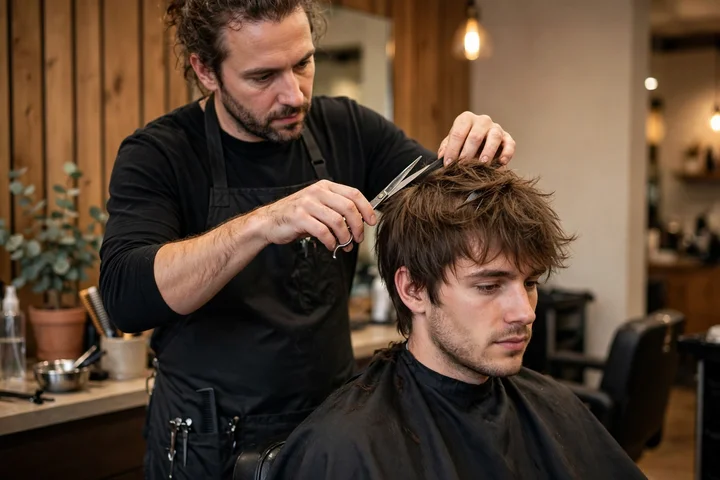
Few cuts depend more on the barber’s skill — a bad wolf cut is just a bad haircut with ambition. Vet your barber: ask if they’ve done wolf cuts before, and specifically on your hair type. Then:
“I want a wolf cut — heavy shaggy layers through the top and crown, blended into longer length at the back, textured ends throughout. Keep the perimeter soft, no harsh mullet line. I want volume, not just length.”
Bring photos of wolf cuts on your exact hair type and at your realistic length. And discuss the back length honestly: the difference between “cool shag” and “unintentional mullet” is about two inches at the nape and how blended the transition is. When in doubt, start conservative — length is easier to keep than to regain.
Styling: Salt Spray, Curl Cream, and Air
The wolf cut’s styling philosophy is enhancement, not construction. You’re bringing out what the layers want to do, not forcing them into submission.
For wavy and straight hair — the salt spray routine: On damp (not wet) hair, spray salt spray generously through the mid-lengths and ends, scrunch upward with your hands, and either air-dry or rough-dry on medium heat while scrunching. Once dry, warm a tiny amount of matte paste between palms and pinch random pieces to define separation. The whole thing should take under ten minutes and look like you spent two.
For curly hair — the curl cream routine: On soaking-wet hair, work curl cream through in sections, scrunch to encourage the curl pattern, and either diffuse or air-dry without touching. Touching drying curls creates frizz — the one enemy this cut can’t outrun. A light oil on dry ends finishes it.
The universal rules: don’t brush it (ever — brushing destroys the piece-y separation and, on curls, creates a triangle of frizz); don’t over-wash it (2–3 times a week max — the American Academy of Dermatology notes that overwashing strips the natural oils textured styles depend on); and sleep on it messy — a silk or satin pillowcase preserves the shape overnight better than cotton.
Quotable: “A wolf cut styled to perfection looks like a mistake — which is why the only real styling rule is to stop before it looks finished.”

The Grow-Out: Shag Grows Into Shag
Here’s the wolf cut’s secret superpower: it grows out better than almost any men’s cut, because the grow-out of a shag is just a longer shag. The plan is gloriously low-effort — trims every 8–10 weeks to reshape the top layers and keep the back from going full mullet, and otherwise let it ride.
Around month four or five, you’ll hit a decision point: the back is getting long enough that the cut reads more mullet than wolf. At that fork, either commit (let it grow into a genuine modern mullet, if that’s your road) or have the barber rebalance — take the back up slightly and re-layer the top to restore the wolf proportions. Most guys rebalance once or twice, then either settle into long shag territory or transition to something cleaner like the bro flow for men.

4 Mistakes That Turn Edge Into Accident
1. The wrong barber. A wolf cut from someone who’s never layered a shag is a gamble with bad odds. This is the one cut where barber selection matters more than the consultation script.
2. Too much contrast. When the top is cropped short and the back is very long with no blend, you’ve left wolf territory and entered costume mullet. The 2026 version lives in the blend.
3. Product overload. Heavy waxes and gels glue the layers together and kill the airy separation that makes the cut work. Light products, small amounts — the layers do the talking.
4. Brushing it. Said above, saying again: a brush turns a wolf cut into a shapeless puff. Fingers or a wide-tooth comb on wet hair only.
If the wolf ever feels like too much statement, the exits are graceful: grow the top and blend the back for flow, or take it all down to a modern buzz cut for men and start the whole journey over with a clean slate.
Frequently Asked Questions
What is a wolf cut for men?
A shaggy, heavily layered cut with volume on top tapering to longer length at the back — a blended mix of shag and mullet, wearable in its 2026 refined form.
Does the wolf cut work on straight hair?
Yes, but it’s the highest-maintenance version — straight hair needs texturizing in the cut plus salt spray and rough-drying to create the volume waves and curls get naturally.
How long does hair need to be for a wolf cut?
Medium length minimum: roughly 3–4 inches on top with enough back length to layer. Shorter than that and the silhouette can’t form.
How do you style a wolf cut?
Salt spray scrunched into damp hair for wavy/straight types (air-dry or rough-dry); curl cream scrunched into wet hair for curly types. Never brush it dry.
Is the wolf cut still in style in 2026?
Yes — the extreme viral version faded, but the refined wolf cut (softer blend, wearable proportions) is established as a mainstream textured option.
How often should I trim a wolf cut?
Every 6–8 weeks to reshape the top layers and keep the back balanced. The grow-out is forgiving — shag grows into longer shag gracefully.
Leave a Reply